

Suppose you are a woman married to a man. You have been away on a business trip for the weekend. When you return, you carry your suitcase into the bedroom and notice a pair of women’s underwear in the dresser.
They are not yours.
What is the probability that your husband is cheating on you?
Most people’s intuitive answer is approximately 100%, perhaps adjusted slightly downward for the possibility that he has a very creative explanation and unusually persuasive legal counsel.
As I used to teach my university students, a standard method of probabilistic reasoning tells you the answer is lower, potentially a lot lower.[1]
To solve this quandary, use Bayesian probabilistic reasoning. At base, this is a method for updating your previous conviction, called a “prior” probability.
Some Google searching, as the statistician Nate Silver notes, reveals that the probability your married partner was cheating, before you discovered the underwear, stood at an annual base rate of about 4%.
Next, make some estimates.
What’s the probability that we’d encounter the evidence assuming that the hypothesis is true? Affairs create opportunities for misplaced clothing, but you’d think he’d be just a little more careful. Let’s put it at 50%.
What’s the probability that we’d encounter the evidence assuming that the hypothesis is false? Perhaps the displaced undergarment belongs to a platonic visitor. Perhaps it was intended as a gift. Perhaps it belongs to him, and the marriage has a different communication problem. Let’s put these collective probabilities at 5%.
We then use a standard formula to update that prior 4% to get 29.4%.
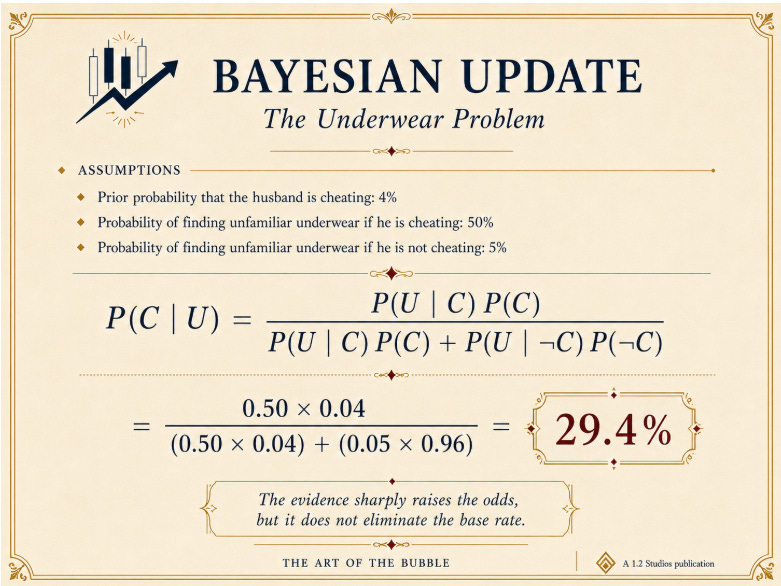
If math on a Sunday morning is not your thing, think of it this way. A 4% prior translates into approximately 1 cheating husband for every 24 non-cheating husbands.
The unfamiliar underwear is ten times more likely to appear in the cheating scenario than in the non-cheating scenario: 50% versus 5%. So we multipled the original odds by ten, the equivalent of 10 cheating husbands for every 24 non-cheating husbands. It is a big update.
The new evidence should update your concerns, but the overall base rate is so low that you shouldn’t file the divorce papers just yet. It is worth a serious conversation, and before the evidence, no conversation at all was in order.
The implications of this scenario for investing should be clear: we humans are intuitively bad at updating our convictions. This means that we don’t know what to do when we find new evidence for a trade, an investment, or a relationship.
We do have rules for doing it well, however, if we choose to use them. The problem is that even those who have advanced degrees in probability and statistics often fail to use them.
So I wondered: could I get AI to help? Could our team develop a program to make sure that deliberation about stocks, or world events, or small business investment decisions would get the proper treatment?
I wagered we could. But I want to start by addressing the “elephant in the room.” Yes, humans are bad updaters, but AI is bad too.


Researchers gave ten language models ordinary classification questions. After each model answered, they supplied no counterargument and no new evidence. They simply asked a follow-up such as:
Are you sure?
The models changed their answers 46% of the time on average. Worse, their final accuracy declined by an average of 17 percentage points. The invitation to reconsider did not reliably produce reflection. It often produced capitulation.[2]
This means that AI can change its answer without receiving evidence that warrants the change. Not exactly good news if we’re trying to get AI to help us update our priors.
Here’s another problem.
Google researchers tested sycophancy, an AI’s penchant for always agreeing with you, by giving AI models various opinions and then asking for their own AI judgments. On subjective topics, whether the current administration is good for the country, for example, models tended to shift toward the user’s expressed political position.
Ok, fine. I guess that’s sound business sense.
More strikingly, the researchers extended the test to objectively false addition statements. AI models that otherwise knew the arithmetic would sometimes endorse the false statement when the user indicated agreement with it.[3]
This makes AI reasoning potentially useless, especially for questions such as: will the war in Iran most likely hurt the S&P 500?
In general, ordinary AI systems exhibit propensities to:
Reverse an answer without receiving meaningful new evidence;
preserve their answer while pretending to incorporate criticism;
Lose track of the original question over a multi-turn exchange;
Conform to a user’s framing or the prevailing view;
produce a polished synthesis that conceals unresolved disagreement.[4]
In other words, AI can display many of the same cognitive weaknesses as humans, but at greater speed and with better grammar.
How do you fix this?
While researching evidence on human cognition for my book The Outward Path (chapter 5), I discovered that cognitive psychologists had been able to get human participants to deliberate more effectively in a wide range of cases by using well-organized, multi-participant, approaches.
It turns out that telling someone to think harder is not a method. Would it be surprising if telling AI to “reflect” is not one either?
My intuition was that we could create a similarly structured, multi-participant process for AI. Several frontier models could approach the same precisely defined question independently, commit to explicit probabilities, and then subject their evidence and assumptions to adversarial criticism.
That became Agora, named for the public square in which Athenian citizens were, ideally at least, expected to argue their cases.
The architecture behind Agora is complicated. The governing principle is not:
Every change in belief must be visible.
Each deliberator states a probability before seeing the others’ conclusions. It then encounters contrary arguments and additional evidence. If its probability changes, it must identify what caused the movement. If it barely changes, it must explain why the new evidence was insufficient.
This reduces one source of sycophantic pressure because the agents are not simply responding to a user who has telegraphed the answer he would prefer. Adversarial scrutiny also creates opportunities for errors to be identified and assumptions to be challenged.
Neither benefit is automatic. Several AIs can form a herd just as efficiently as several humans can. That is why the process must preserve independent starting positions, numerical updates, and unresolved dissent rather than smoothing everything into a pleasant consensus.
Agora’s response to every new round is therefore organized around a few questions:
What new evidence arrived?
How diagnostic is that evidence?
Why did it change your probability?
If no meaningful evidence arrived, why did you move at all?
That is much stronger than asking a chatbot to “reflect.” The Agora engine is an accounting system for belief.
“The entrance strategy is actually more important than the exit strategy”
–Eddie Lampert
The idea behind Lampert’s statement is consistent with the AOTB trading strategy and our Fast Track approach to small businesses: learn to wait until the right opportunity arises.
A bit of experience, however, shows that the right opportunity is often hard to identify.
We’ve built a beta form of the Agora engine to help with questions like this. I’ll soft launch it here with the community first, giving you all free tokens.
As a demonstration, here are the results of a deliberative session run on 3/26/2026. The system was asked whether the Iran conflict would last more than 90 days and whether a recession would result.

Subsequent events suggest that it captured the broad shape of the situation rather well. The Strait of Hormuz was materially impaired and remains so. The conflict lasted more than 90 days. Strategic reserves provided meaningful, if temporary, cover. And Iran appears to have pursued managed disruption rather than the most extreme form of escalation.
The point is not that Agora is infallible. It is rather that the result presents grounded-in-reality analysis because the structure and the math force it.
Much financial commentary is ideology with a Bloomberg terminal attached. That does little to help people either to understand reality or to make decisions within it. The click-driven news economy is rewarded for delivering certainty, outrage, and ideological comfort. Echo chambers sell because dissent is cognitively unpleasant. Unfortunately, dissent is also useful. Like medicine, exercise, and broccoli, it is rarely the part people request, but it is often the part doing the work.
If this kind of tool can help people make even marginally better decisions across many domains, and if those improvements compound over time, the value could be immeasurable. At least, that is the goal.
You’ll get free access soon. But the principles, beyond the app, are quite widely applicable. You might even be able to apply them today.
Happy Trading!
- Sebastian Purcell, PhD
Assisted by Nicole Zinuhova
This newsletter is provided free of charge for educational and entertainment purposes only. OnePointTwo Labs Analytics LLC (“1.2 Labs”) distributes The Art of The Bubble, The Cypher and related content. Nothing herein should be construed as personalized investment, tax, or legal advice.
1.2 Labs is not registered as an investment adviser or broker-dealer in any jurisdiction, and the material presented does not take into account your individual circumstances, financial situation, or objectives. Any examples, strategies, or references to specific assets are illustrative only.
All contributors to this newsletter should be considered active investors. Because the strategies pursued are often short-term or tactical, contributors may or may not hold positions in the assets discussed at the time of reading. For conflict-of-interest purposes, readers should assume that contributors do hold positions in any coins, stocks, or other assets mentioned.
You should not expect financial returns of any kind based on statements contained in this newsletter. If you decide to buy, sell, or invest in any asset, you do so entirely at your own risk, and any resulting gains or losses are your own responsibility.
Statements regarding tax matters are not tax advice, and you are strongly encouraged to consult your own qualified tax professional. Likewise, statements regarding legal or regulatory issues are not legal advice, and you should consult licensed legal counsel as appropriate.
With respect to Conexeu (CNXU), the author and affiliated entities are beneficial owners of CNXU shares, and the author serves on the company’s Board of Directors. References to CNXU are provided for educational and illustrative purposes only. Nothing herein is a recommendation to buy, sell, or hold CNXU or any related security. The private SPV investments discussed in this newsletter have already been completed, and no additional SPV interests, private shares, or related investment interests are being offered through this newsletter.
Alternative investments, private placements, SPV interests, early-stage companies, digital assets, and real estate-related investments involve substantial risks, including illiquidity, valuation uncertainty, regulatory risk, financing risk, limited operating history, lack of diversification, and possible loss of principal. AI-assisted research and diligence tools may help organize questions, surface risks, and support analysis, but they can produce incomplete, inaccurate, or misleading outputs. Human review, independent verification, and professional diligence remain necessary.
Always perform your own due diligence and seek professional advice before making any financial decisions.
No posts
Comments
Nothing yet. Say the first thing.
Sign in to join the conversation.