
Welcome back to The Cypher!
It was quite a week. Treasury Secretary Scott Bessent signaled that Treasury is willing to lean against disorderly moves in long-term yields, and digital assets responded as though someone had finally located the adult supervision.
It is a large enough development that this week’s Art of The Bubble will focus on it separately.
For The Cypher, we wanted to look underneath the bond drama and ask a broader question: are the economic conditions surrounding risk assets actually improving?
To answer that, the team looked at three seemingly contradictory developments: the increasingly visible K-shaped economy, a crypto bear market that is statistically much milder than the last one but somehow feels worse, and a housing market where almost nobody is buying anything despite prices remaining near record highs.
As it turns out, none of these is quite as contradictory as it looks. Markets are merely doing that irritating thing where the details matter.
TL;DR: While the K-shaped economy is real, it is psychology that appears to be weighing on digital assets, while real estate is, in fact, acting just as your Econ 101 text book taught you.

COVID was good for your pocketbook if you were in the top 20%. Not so much otherwise. That cohort scooped up 3.7x its “fair share” of net-worth growth since 2019.
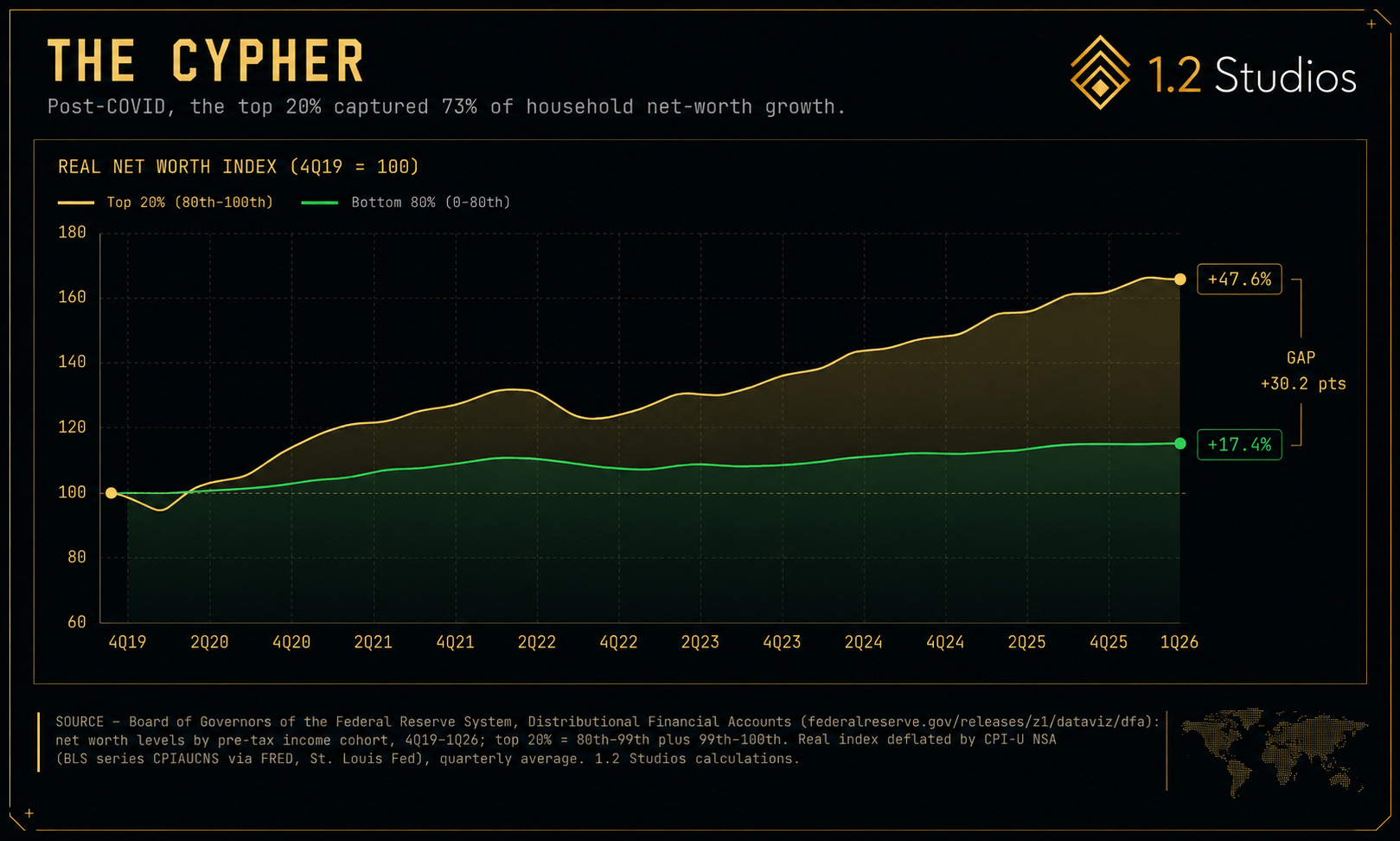
That sounds dramatic because it is. But there’s an important wrinkle: the top 20% already owned roughly 71% of the wealth.
Takeaway: What you’re seeing is what happens when wealth compounds through adverse economic environments: the people who already own the assets tend to capture most of the recovery. Read differently, the data shows that 20% of the population does have capital to re-direct towards other assets.
Relevant Tickers Impacted: SPY, RSP, QQQ, MAGS, IGV, XRT, GLD, IEI, TLT (Note that inclusion is descriptive, not prescriptive, as long duration instruments, such as IEF and TLT bear the most acute risks).

Psychologists have found that it can be easier to adapt to something dramatic than to a persistent minor irritation. Breaking your leg, for example, may be psychologically easier than tweaking your knee. Your “psychological immune system” mobilizes for the big thing. The annoyance just keeps annoying.
If we’re near a bottom, numerically, this bear market is much better. GDLC, roughly a composite of the top five cryptos, is down ~30% this year and ~53% from its peak. Last cycle: ~88%.
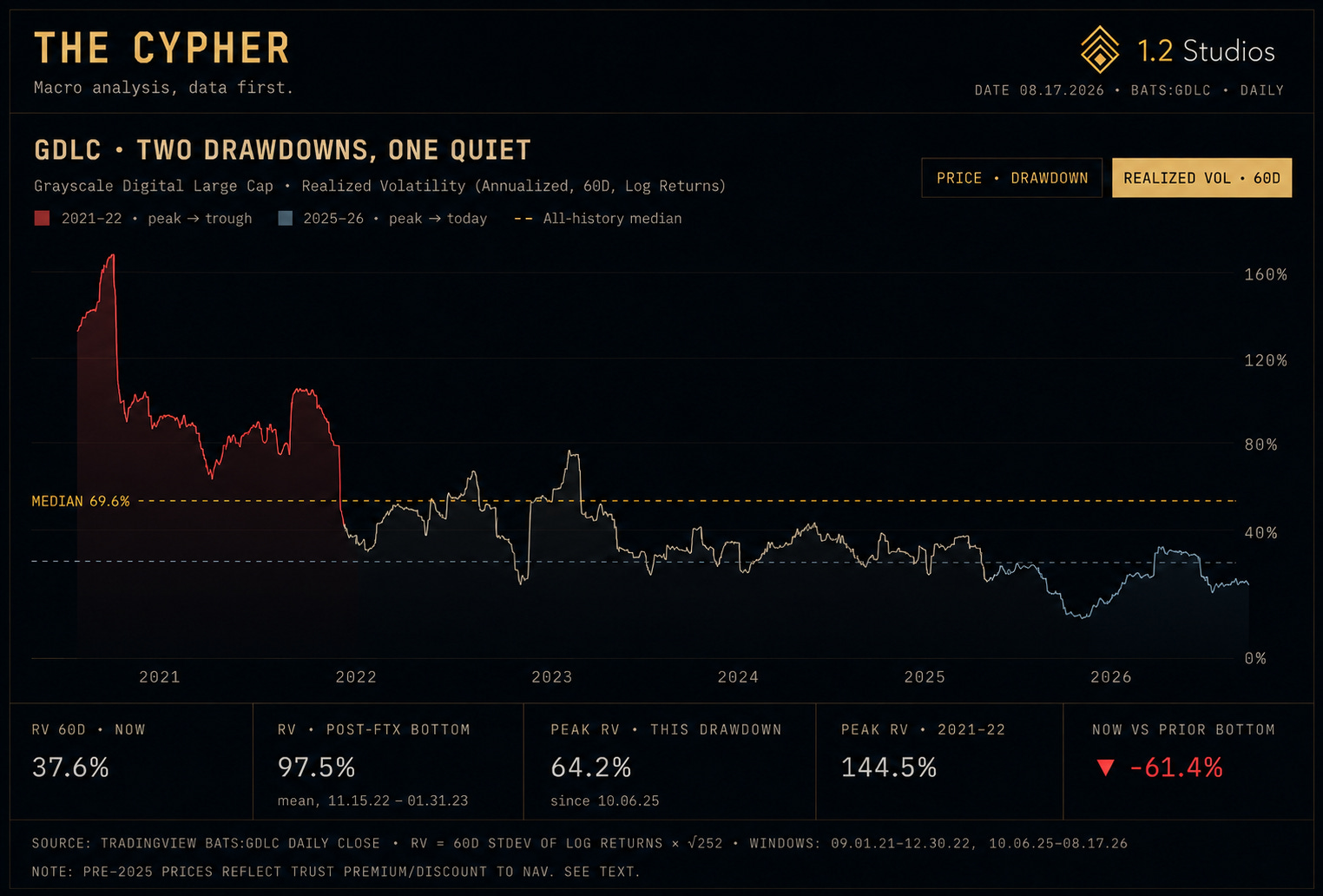
But GDLC is now an ETP and trades more efficiently, so the cleaner comparison is realized volatility (60-day): ~38% today versus ~86% last cycle.
Takeaway: If this is the bottom, it’s decidedly milder. And yet people seem to hate this bear market more. Psychologically, we may have traded the broken leg for the tweaked knee.
Relevant Tickers Impacted: BTC, IBIT, MSTR, STRC, COIN, GLXY (Inclusion is descriptive, not prescriptive; note that not all tickers are strongly correlated with BTC’s price movements.)

No one is buying, but it still costs a lot.
We’ve now completed roughly four years of exceptionally low sales volumes, last seen on a comparable basis around 2011. But prices sit at record highs.
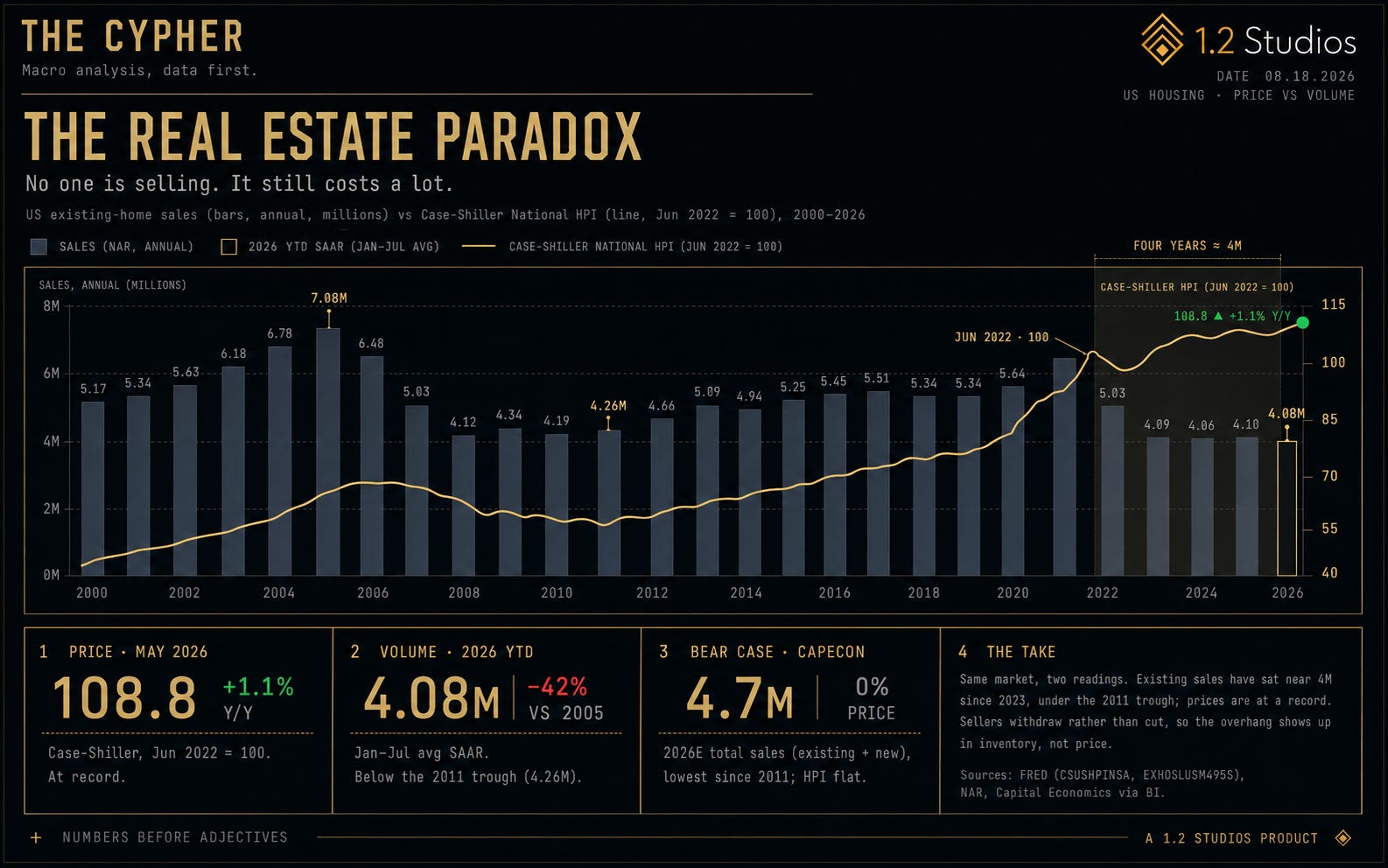
Econ 101 can remain accredited. Crush both demand and supply, and price doesn’t necessarily fall. In this case, it rose, though, as last week’s data showed, not as fast as inflation.
Takeaway: So housing has achieved the unusual combination of being both expensive and difficult to sell. As always, the national picture hides plenty of exceptions. Specific metro areas are doing just fine, and some are flourishing.
Relevant Tickers: Z, RDFN, VNO, SPG, HD, LOW, ITB, VNQ, XLRE (Inclusion is descriptive, not prescriptive; some commercial names may decouple from sector trends.)

“Do I contradict myself? Very well then I contradict myself,
(I am large, I contain multitudes.)”
— Walt Whitman
Markets, apparently, contain multitudes too.
The three stories this week look contradictory only if we insist on describing each market with a single number.
The economy can feel weak while the top 20% continues accumulating investable capital. Crypto can experience a dramatically milder bear market while investors find it more psychologically exhausting. Housing can sit near record prices while transaction volumes collapse because sellers would rather stay put than surrender cheap mortgages.
None of this requires us to throw out the models. Quite the opposite.
Capital compounds. Psychology matters. Supply and demand still work even when both disappear at the same time.
The strange thing about this market may be that, underneath all the apparent contradictions, it is behaving rather normally.
Econ 101 survives another week.
We believe knowledge is power. If you learned something, share The Cypher. Help others before a CNBC anchor starts yelling at them in all caps.
Happy Trading!
The Team:
Sebastian Purcell, PhD
Julian von Loesch, PhD
David LaRoca, PhD
Elyse Purcell, PhD
Todd Mei, PhD
This newsletter is provided free of charge for educational and entertainment purposes only. OnePointTwo Labs Analytics LLC (“1.2 Labs”) distributes The Art of The Bubble, The Cypher and related content. Nothing herein should be construed as personalized investment, tax, or legal advice.
1.2 Labs is not registered as an investment adviser or broker-dealer in any jurisdiction, and the material presented does not take into account your individual circumstances, financial situation, or objectives. Any examples, strategies, or references to specific assets are illustrative only.
All contributors to this newsletter should be considered active investors. Because the strategies pursued are often short-term or tactical, contributors may or may not hold positions in the assets discussed at the time of reading. For conflict-of-interest purposes, readers should assume that contributors do hold positions in any coins, stocks, or other assets mentioned.
You should not expect financial returns of any kind based on statements contained in this newsletter. If you decide to buy, sell, or invest in any asset, you do so entirely at your own risk, and any resulting gains or losses are your own responsibility.
Statements regarding tax matters are not tax advice, and you are strongly encouraged to consult your own qualified tax professional. Likewise, statements regarding legal or regulatory issues are not legal advice, and you should consult licensed legal counsel as appropriate.
With respect to Conexeu (CNXU), the author and affiliated entities are beneficial owners of CNXU shares, and the author serves on the company’s Board of Directors. References to CNXU are provided for educational and illustrative purposes only. Nothing herein is a recommendation to buy, sell, or hold CNXU or any related security. The private SPV investments discussed in this newsletter have already been completed, and no additional SPV interests, private shares, or related investment interests are being offered through this newsletter.
Alternative investments, private placements, SPV interests, early-stage companies, digital assets, and real estate-related investments involve substantial risks, including illiquidity, valuation uncertainty, regulatory risk, financing risk, limited operating history, lack of diversification, and possible loss of principal. AI-assisted research and diligence tools may help organize questions, surface risks, and support analysis, but they can produce incomplete, inaccurate, or misleading outputs. Human review, independent verification, and professional diligence remain necessary.
Always perform your own due diligence and seek professional advice before making any financial decisions.
This newsletter is provided free of charge for educational and entertainment purposes only. OnePointTwo Labs Analytics LLC (“1.2 Labs”) distributes The Art of The Bubble, The Cypher and related content. Nothing herein should be construed as personalized investment, tax, or legal advice.
1.2 Labs is not registered as an investment adviser or broker-dealer in any jurisdiction, and the material presented does not take into account your individual circumstances, financial situation, or objectives. Any examples, strategies, or references to specific assets are illustrative only.
All contributors to this newsletter should be considered active investors. Because the strategies pursued are often short-term or tactical, contributors may or may not hold positions in the assets discussed at the time of reading. For conflict-of-interest purposes, readers should assume that contributors do hold positions in any coins, stocks, or other assets mentioned.
You should not expect financial returns of any kind based on statements contained in this newsletter. If you decide to buy, sell, or invest in any asset, you do so entirely at your own risk, and any resulting gains or losses are your own responsibility.
Statements regarding tax matters are not tax advice, and you are strongly encouraged to consult your own qualified tax professional. Likewise, statements regarding legal or regulatory issues are not legal advice, and you should consult licensed legal counsel as appropriate.
With respect to Conexeu (CNXU), the author and affiliated entities are beneficial owners of CNXU shares, and the author serves on the company’s Board of Directors. References to CNXU are provided for educational and illustrative purposes only. Nothing herein is a recommendation to buy, sell, or hold CNXU or any related security. The private SPV investments discussed in this newsletter have already been completed, and no additional SPV interests, private shares, or related investment interests are being offered through this newsletter.
Alternative investments, private placements, SPV interests, early-stage companies, digital assets, and real estate-related investments involve substantial risks, including illiquidity, valuation uncertainty, regulatory risk, financing risk, limited operating history, lack of diversification, and possible loss of principal. AI-assisted research and diligence tools may help organize questions, surface risks, and support analysis, but they can produce incomplete, inaccurate, or misleading outputs. Human review, independent verification, and professional diligence remain necessary.
Always perform your own due diligence and seek professional advice before making any financial decisions.
No posts
Comments
Nothing yet. Say the first thing.
Sign in to join the conversation.