

The conventional model of investing is straightforward: buy an asset and hope the price goes up.
Ideally, the hope rests on good reasons. Ideally, the world then has the courtesy to cooperate with those reasons. It frequently declines. The world, regrettably, has never signed your investment memo.
Private markets occasionally offer something more interesting.
Imagine that you are investing in a venture round. Your allocation is secured and you are making a final decision about how much to invest, but you also learn that the current financing is oversubscribed. The next round is already taking shape, and prospective investors are discussing a valuation 50% higher.
Nothing is guaranteed. But your expected return is no longer based entirely on hoping that the business becomes more valuable someday. A potential 50% repricing is already beginning to emerge from the sequence of the financing itself.
In this scenario, your anticipated gain is not totally dependent on “number go up” hope. It is one of five recurring ways I see investors structure their profits.
Rather than merely selecting an investment and hoping for a favorable outcome, you arrange the financing, tax treatment, contractual rights, business relationships, or surrounding assets so that the range of losing outcomes becomes dramatically smaller.
Put differently, you move part of the return from forecast into architecture.
Not zero. There are very few genuine guarantees in investing, and most of the people offering them eventually appear in documentaries.
But smaller.
This is Item Six in our Fast Track Roadmap: Structure.
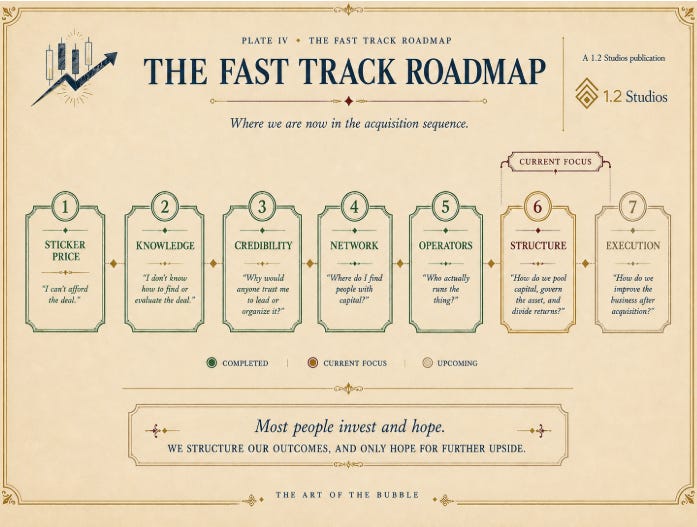
If there is one reason I have become particularly fond of private and alternative markets, it is this. Opportunities to structure returns are considerably more common than most investors realize. You simply have to know what they look like, and then search diligently for them.
Over this newsletter and the next, I want to introduce five of the most useful structures:
The Round Bridge
The Portfolio Shield
The Multiple Step-Up
The Risk Conversion
The Enterprise Stack
Each works differently. But all five follow the same principle:
Don’t merely ask whether an investment can win. Ask whether you can structure the transaction so that it becomes difficult to lose.
The venture example above is the first of these: The Round Bridge. You enter one financing while the next, at a higher valuation, is already beginning to form on the other side.
The bridge does not guarantee that you reach the other side. Bridges occasionally feature in documentaries too. But the potential repricing is no longer purely hypothetical.
Now let’s look at a different way to change the payoff: The Portfolio Shield.

Suppose you already expect to realize substantial taxable gains elsewhere in your portfolio this year. At the same time, you are offered the opportunity to invest $100,000 in a film production.
On its own, the film is a fairly conventional speculative investment. It might do well. It might not. Audiences have been known to display independence of judgment.
But assume the production has two additional characteristics:
the investment qualifies for unusually rapid tax amortization or deduction, and
the production also qualifies for a substantial local film incentive.
For simplicity, imagine that the $100,000 investment produces a first-year deduction worth roughly $40,000 to you given your tax position. Assume further that the production incentive ultimately returns another $30,000 of the original capital.
The economics now look very different.
You invested $100,000, but roughly $70,000 of economic value may be recovered through benefits that do not depend on anyone buying a movie ticket.
Your effective exposure to the commercial performance of the film has fallen from something resembling $100,000 to something closer to $30,000.
Suppose the film is a disappointment and ultimately distributes only $40,000 back to investors. When viewed solely as a film investment, the result is dreadful:
$100,000 invested → $40,000 returned.
That’s a 60% loss and nobody adds that one to the producer’s highlight reel.
But viewed as part of the investor’s entire portfolio, the economics might look more like this:
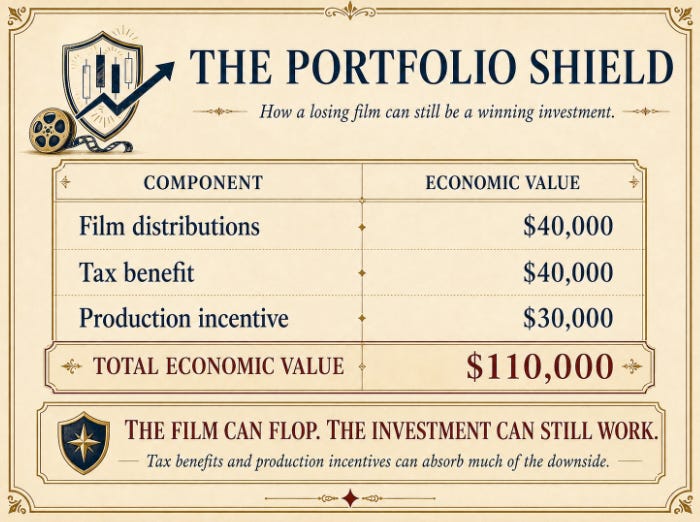
The film flopped but the investment didn’t. That is the Portfolio Shield.
The key insight is that you should not evaluate every asset as though it exists inside its own little glass box. Sometimes Asset A becomes substantially more attractive because of what Asset B has already done.
This does not mean tax benefits magically turn bad investments into good ones. The actual treatment depends on jurisdiction, eligibility, timing, deduction limitations, the structure of the incentive, and the investor’s individual tax situation. The tax code remains stubbornly resistant to newsletter-sized simplification.
The point is the architecture. Ordinary analysis asks:
“Will the film make money?”
The Portfolio Shield asks:
“What happens to my entire portfolio if the film doesn’t?”
If the surrounding structure absorbs enough of the downside, you can arrive at the strange but very useful outcome where an individual asset loses money while you still make money from owning it.
That is exactly the sort of thing I mean by structuring your profits. Let’s look at the next one.
Earlier in this series, we looked at the economics of acquiring a utility contractor. Much of that discussion focused on finding the right operator and figuring out how to compensate them. For a business like this, you might ultimately need to give the right person roughly 10% of the equity.
But the company was interesting for another reason.
Its Pennsylvania operations were benefiting from the data-center buildout, where AI-related capital spending is running into a rather old-fashioned constraint: someone still has to build everything.
There are simply too few qualified contractors to handle the amount of infrastructure being planned. The operator’s strategy, therefore, is to expand aggressively into that market. Better yet, the demand is expected to persist for years rather than until everyone gets bored with the latest app.
Some crypto moon-boy math follows.
Recall that businesses like this are commonly valued as a multiple of EBITDA: Earnings Before Interest, Taxes, Depreciation, and Amortization. A company producing $1.4 million of EBITDA might, for example, trade around 4× EBITDA.
But the multiple itself is not fixed.
Larger, faster-growing companies tend to command higher multiples. More importantly, once a business crosses a certain size, perhaps around $5 million of annual EBITDA in this example, it enters the acquisition universe of larger private-equity firms. More potential buyers means more competition for the asset, and the business begins to be valued according to a different set of expectations.
So, deliberately simplifying the economics, imagine the following:
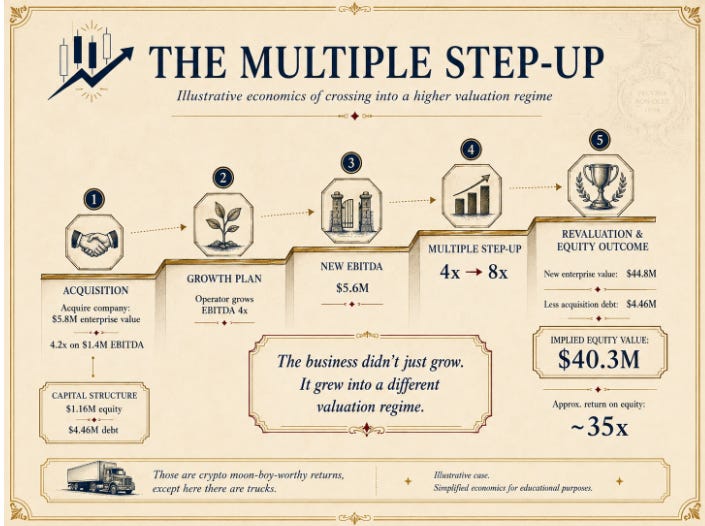
Acquire the company for roughly $5.8 million, or about 4.2× $1.4 million of EBITDA
Finance the acquisition with approximately $1.16 million of equity and $4.46 million of debt
Bring in an operator capable of growing EBITDA roughly 4×
New EBITDA: approximately $5.6 million
New valuation multiple: approximately 8×
New enterprise value: approximately $44.8 million
Less acquisition debt: approximately $4.46 million
Implied equity value: approximately $40.3 million
Against an original equity investment of only $1.16 million, that implies something approaching a 35× return on invested equity.
Those are crypto moon-boy-worthy returns, except here there are trucks.
Now, this is obviously a hypothetical case deliberately stripped of the things that make actual acquisitions less attractive on napkins: transaction costs, working capital, taxes, debt amortization, dilution, operator compensation, unforeseen disasters, and reality generally.
The point is not the precision of the 35×. The point is where the return comes from.
If the company remained valued at roughly 4× EBITDA, then $5.6 million of EBITDA would produce an enterprise value of approximately $22.4 million.
Instead, crossing the $5 million EBITDA threshold potentially changes the buyer universe. The company is now large enough to attract institutional acquirers, and its valuation might move toward 8× EBITDA.
Suddenly $5.6 million × 4 = $22.4 million becomes $5.6 million × 8 = $44.8 million. The company has not merely grown. It has grown into a different valuation regime.
That is the Multiple Step-Up.
But there is an important qualification. Simply predicting that a company will quadruple EBITDA does not constitute “structuring” your profits. That is called making a forecast. Investment bankers have produced several of them.
For this to become something closer to a structured outcome, you need a concrete mechanism capable of producing the growth required to cross the threshold.
In our hypothetical utility contractor, “AI data centers are booming” is only the background thesis. Plenty of people can identify a boom after Bloomberg has put it on the homepage.
The structure becomes interesting when the operator, Tony, brings something much more specific to the transaction: access to viable contracts for actual data-center construction.
His equity is not merely compensation for showing up and making LinkedIn profile. He needs to provide the bridge between the existing $1.4 million EBITDA business and the contracts capable of pushing it beyond $5 million. If those contracts are sufficiently concrete, you have changed the character of the investment.
You are no longer merely buying a small company and hoping it becomes a larger one. Rather, you have identified a valuation discontinuity, figured out what operating result is required to cross it, and then structured the deal around a credible mechanism for producing that result.

“The wise ones bet heavily when the world offers them that opportunity.
They bet big when they have the odds.
And the rest of the time, they don’t. It’s just that simple.”
– Charlie Munger
In the sub-$50 million market, our team has found some extraordinary opportunities. What made the best of them attractive was not merely that they were good businesses available at good prices. It was that the surrounding deal could be structured so that the range of losing outcomes became unusually small.
Munger’s advice applies especially well here.
Our own operating discipline has so far limited us to roughly one to three such opportunities a year. That is not because the private markets are empty. Most of them are simply not good enough. And that introduces the psychological difficulty.
With trading, much of the challenge is controlling your own behavior well enough to follow the strategy. With investments like these, the challenge is often more annoying: You have to become comfortable doing nothing.
Waiting is the core operation. If you prefer the Taoist formulation, it is active non-action.
Structured opportunities appear more frequently than once in a decade. But they do not appear on command. You have to know what you are looking for, reject almost everything else, and wait.
Then, when the odds finally become asymmetric enough, Munger’s second instruction matters: Bet big.
This is also the idea behind The Private Shelf, which we will be launching for members interested in accessing opportunities like these. My one concern is almost backwards: some people may find three to five opportunities in a year frustratingly sparse.
I would consider that a success.
A service dedicated to finding unusually attractive private investments probably should not discover one every Tuesday.
For today, you have learned three of the five structures: The Round Bridge. The Portfolio Shield. The Multiple Step-Up.
Next time, we will finish the set with The Risk Conversion and The Enterprise Stack.
Until then, the assignment is unusually demanding: Do nothing until something is worth doing.
Happy Trading!
- Sebastian Purcell, PhD
Assisted by Nicole Zinuhova
This newsletter is provided free of charge for educational and entertainment purposes only. OnePointTwo Labs Analytics LLC (“1.2 Labs”) distributes The Art of The Bubble, The Cypher and related content. Nothing herein should be construed as personalized investment, tax, or legal advice.
1.2 Labs is not registered as an investment adviser or broker-dealer in any jurisdiction, and the material presented does not take into account your individual circumstances, financial situation, or objectives. Any examples, strategies, or references to specific assets are illustrative only.
All contributors to this newsletter should be considered active investors. Because the strategies pursued are often short-term or tactical, contributors may or may not hold positions in the assets discussed at the time of reading. For conflict-of-interest purposes, readers should assume that contributors do hold positions in any coins, stocks, or other assets mentioned.
You should not expect financial returns of any kind based on statements contained in this newsletter. If you decide to buy, sell, or invest in any asset, you do so entirely at your own risk, and any resulting gains or losses are your own responsibility.
Statements regarding tax matters are not tax advice, and you are strongly encouraged to consult your own qualified tax professional. Likewise, statements regarding legal or regulatory issues are not legal advice, and you should consult licensed legal counsel as appropriate.
With respect to Conexeu (CNXU), the author and affiliated entities are beneficial owners of CNXU shares, and the author serves on the company’s Board of Directors. References to CNXU are provided for educational and illustrative purposes only. Nothing herein is a recommendation to buy, sell, or hold CNXU or any related security. The private SPV investments discussed in this newsletter have already been completed, and no additional SPV interests, private shares, or related investment interests are being offered through this newsletter.
Alternative investments, private placements, SPV interests, early-stage companies, digital assets, and real estate-related investments involve substantial risks, including illiquidity, valuation uncertainty, regulatory risk, financing risk, limited operating history, lack of diversification, and possible loss of principal. AI-assisted research and diligence tools may help organize questions, surface risks, and support analysis, but they can produce incomplete, inaccurate, or misleading outputs. Human review, independent verification, and professional diligence remain necessary.
Always perform your own due diligence and seek professional advice before making any financial decisions.
No posts
Comments
Nothing yet. Say the first thing.
Sign in to join the conversation.