

It’s best to begin this one with a visual demonstration.
Look at the following two images. They contain the same data, but they are branded very differently. With our current AI graphics workflow, I can turn the bottom image into the top one in about 90 seconds.
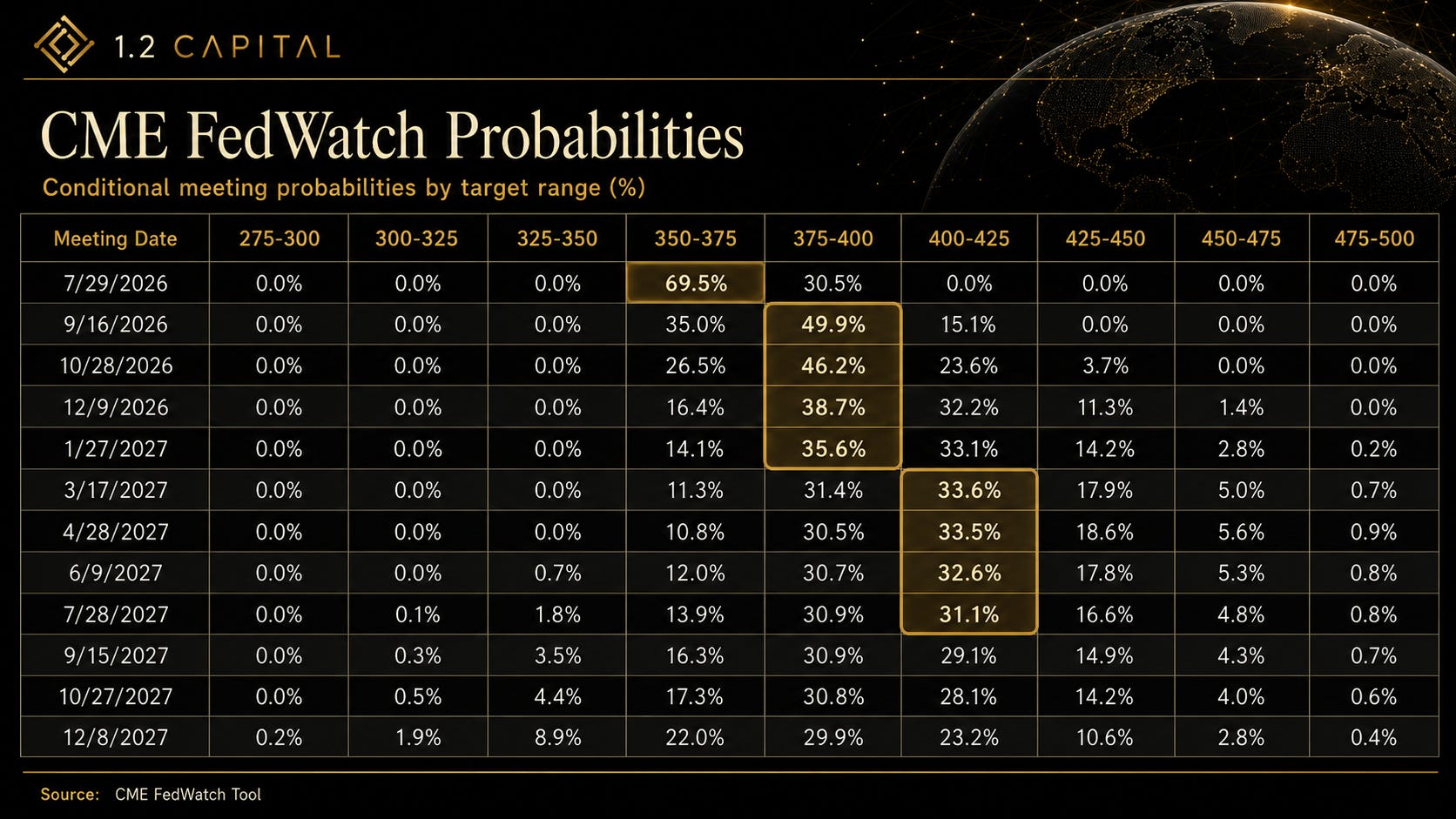
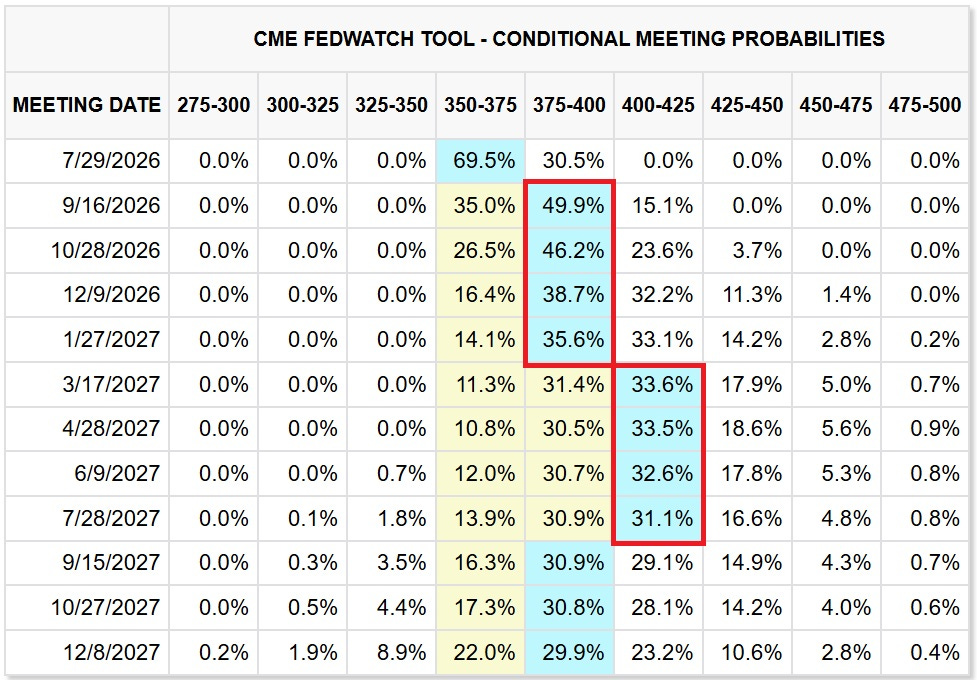
Before generative AI, that transformation would have required several rounds of coordination. At the volume of images we use, it eventually would have made sense to hire someone at roughly $65,000 a year to handle the work.
So, for years, we followed the financially sophisticated alternative: we published the ugly chart.
Does this mean that a $20-per-month subscription has replaced a $65,000-per-year job? Is this evidence of the long-promised job-pocalypse?
Hardly.
AI replaced a counterfactual job. The labor market has lost a position that nobody actually held.
There is an enormous sea of these jobs waiting to be discovered as AI pushes into what we’ve been calling the granularity frontier of enterprise activity: tasks that are valuable, frequent, and specific, but never quite valuable enough to justify assigning a person to them.
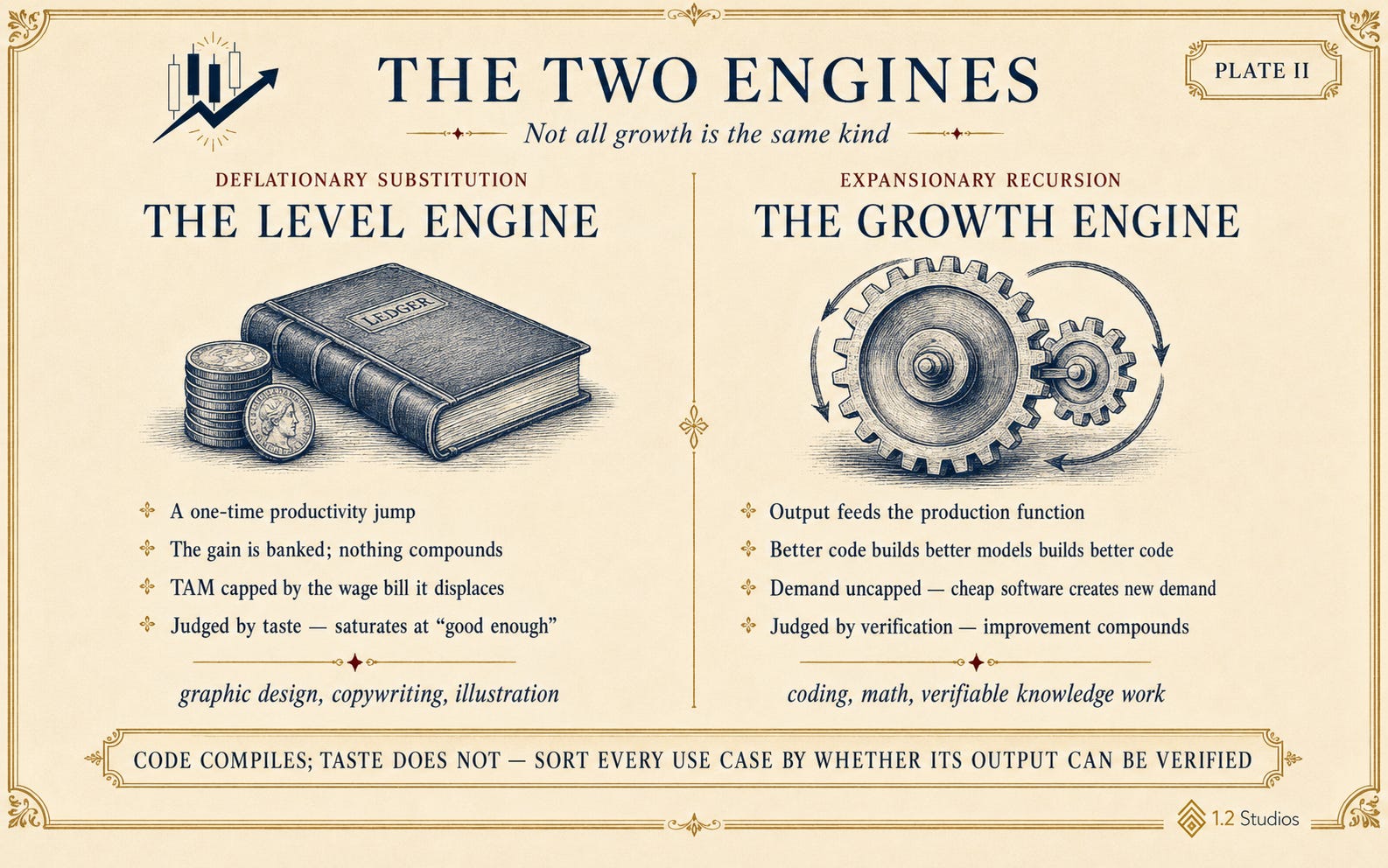
Economists would classify gains like these as level effects. They provide a one-time jump in productivity. The task becomes cheaper, the output improves, one imaginary employee vanishes, and then the gain is banked.
Nothing about producing a better logo today makes next year’s logo generator more capable. It merely reduces the probability that next year’s readers will wonder why the font changed again.
Coding is different. It is a candidate for a growth effect, meaning it can change the rate at which new capability arrives. AI can write the tooling, evaluations, agent scaffolding, and infrastructure code used to train and serve the next generation of models. The output feeds back into the production function:
Better code builds better models, which build better code.
Design output does not directly improve the image model. Code can improve the system producing the next model.
That distinction matters when investing in anything related to AI.
AI is becoming less a discrete market sector than a feature embedded throughout the enterprise. It’s thus worth disaggregating the category so that we know what our bets actually mean, whether we are investing through stocks, corporate bonds, private companies, or digital assets.
The way to do that is to combine two frameworks:
The AI Speculative Hierarchy, which identifies how a business can fail.
The distinction between level effects and growth effects, which identifies whether the business has an engine capable of closing the gap between valuation and fundamentals.
Yes, almost everything in AI is bubbly in one way or another. Valuations have run substantially ahead of current financial results. But these are different bubbles, with different failure mechanisms and very different chances of growing into their prices.
Let’s begin with the hierarchy.

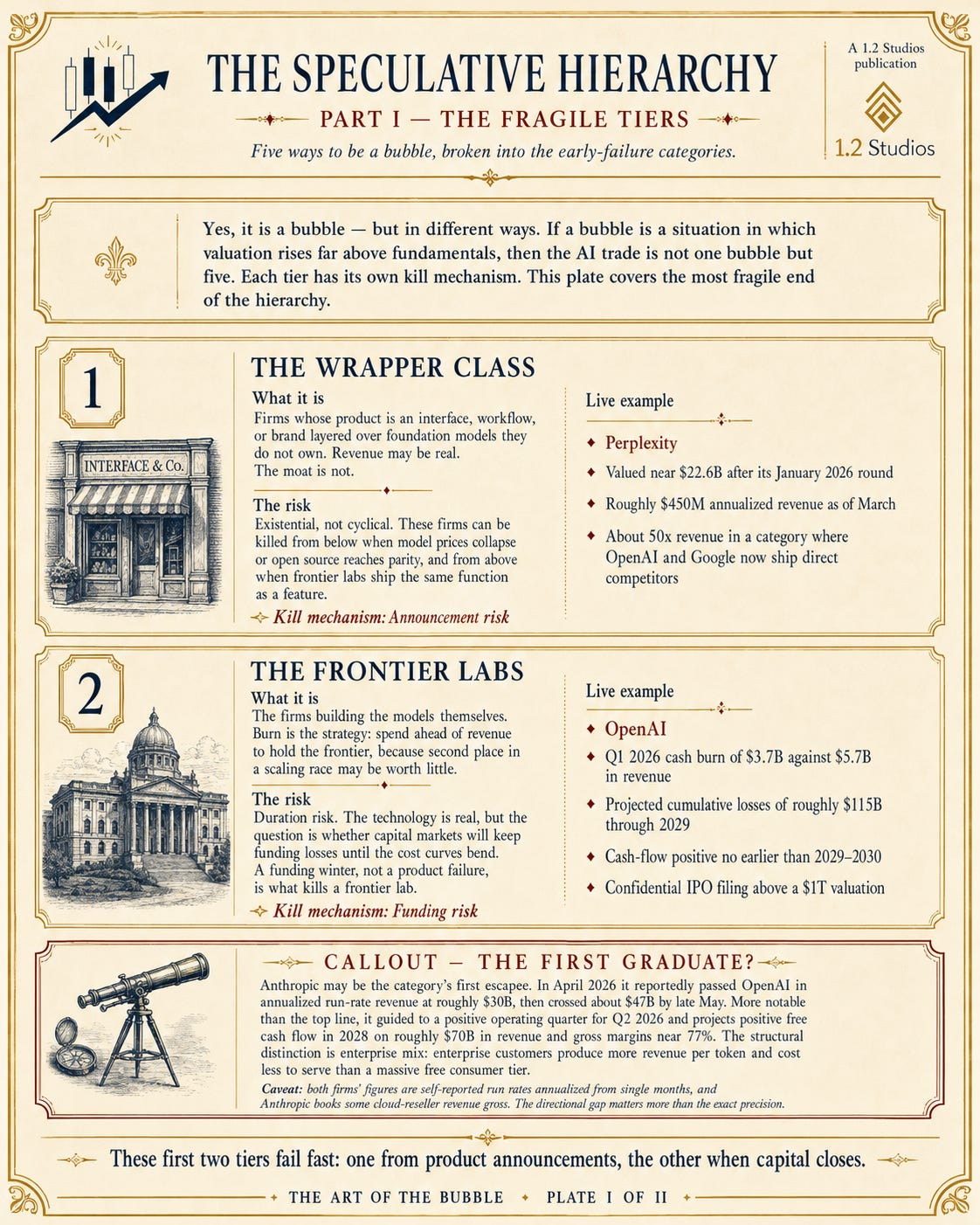
Calling something a “bubble” can be a lazy way of declining to think any further about it. With AI, the more useful question is not simply whether something is a bubble, but which way it is a bubble.
I think of the lower-numbered tiers as the most fragile and the higher-numbered tiers as the most deceptively safe. Every tier can pop, but they are not equally likely to go to zero, and they will not be killed by the same headline.
1. The Wrapper Class
What it is: Firms whose product is an interface, workflow, or brand layered over foundation models they do not own. The revenue may be real. The moat is considerably more philosophical.
The risk: Existential, not cyclical.
These firms can be killed from below when model prices collapse or open-source alternatives reach parity. They can also be killed from above when a frontier lab ships their core product as a feature.
The bubble here is not merely overvaluing the fundamentals. It is placing a high valuation on fundamentals that could be deleted by somebody else’s product announcement.
Live example: Perplexity appears to fit. Its reported valuation is around $22.6 billion, while estimated annual recurring revenue exceeded $450 million in March. That is roughly 50 times revenue for a company operating with outside foundation models while competing against increasingly capable search and agent products from the model providers and incumbent platforms themselves.
Kill mechanism: Announcement risk.
2. The Frontier Labs
What it is: The firms building the models themselves.
Burn is the strategy. They spend ahead of revenue to hold the frontier because second place in a scaling race may ultimately be worth very little.
The risk: Duration.
These are venture bets at sovereign scale, which is the point at which the zeros stop feeling like numbers and begin functioning as decorative elements.
The question is not whether the technology is real. It is. The question is whether capital markets will continue writing checks until the cost curves bend and durable unit economics emerge.
Live example: OpenAI burned approximately $3.7 billion during the first quarter of 2026 against $5.7 billion in revenue. Internal projections reportedly anticipate roughly $115 billion in cumulative cash burn through 2029. The company has confidentially filed for an IPO and has considered a valuation of up to $1 trillion.
Kill mechanism: Funding risk.
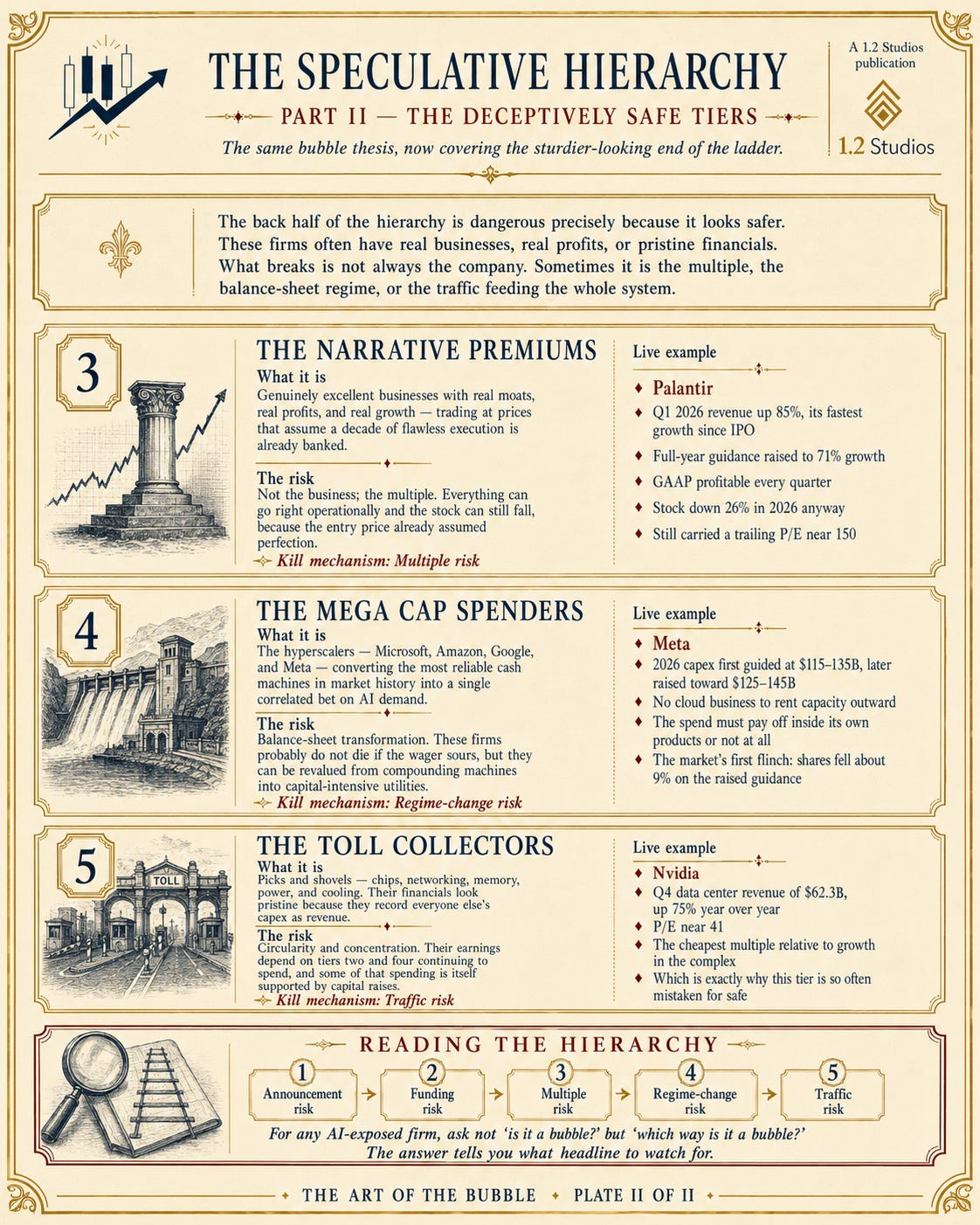
3. The Narrative Premiums
What it is: Genuinely excellent businesses with real moats, real profits, and real growth, trading at prices that assume a decade of flawless execution has already been completed, audited, and deposited.
The risk: Not the business, but the multiple.
Everything can go right operationally and the stock can still fall because “right” was already embedded in the entry price.
Live example: Palantir probably belongs here. First-quarter revenue rose 85%, its fastest growth since becoming public, and management raised full-year guidance to approximately 71% growth. Yet the stock was still down roughly 25% for the year by early summer and carried a trailing P/E around 150.
Kill mechanism: Multiple risk.
4. The Mega Cap Spenders
What it is: The hyperscalers, including Microsoft, Amazon, Google, and Meta, converting some of the most reliable cash machines in market history into one enormous, correlated wager on AI demand.
The risk: Balance-sheet transformation.
Their combined 2026 capital spending is expected to exceed $700 billion, with capex growth across the major hyperscalers running at roughly 76%. Amazon alone expects to invest approximately $200 billion and has warned of short-term free-cash-flow pressure.
These companies will not disappear if the wager disappoints. Instead, they could be revalued from “compounding machines” into “capital-intensive utilities.”
Live example: Meta raised its 2026 capex guidance from $115–135 billion to $125–145 billion. Its traditional business lacks a mature external cloud channel comparable to AWS, Azure, or Google Cloud, although the company is now exploring ways to lease capacity to outside customers. Shares fell roughly 8% to 10% after the increased spending outlook.
Kill mechanism: Regime-change risk.
5. The Toll Collectors
What it is: The picks and shovels of AI: chips, networking, memory, power, cooling, and related infrastructure.
Their financial statements often look pristine because they collect everyone else’s capital spending as revenue.
The risk: Circularity and concentration.
Their earnings sit downstream of tiers two and four continuing to spend. Some of that spending is financed through capital raised within the same AI ecosystem.
The earnings are real in roughly the same sense that canal-builder earnings were real in 1720: entirely real until the traffic stops.
Live example: Nvidia, obviously. Fourth-quarter data-center revenue reached $62.3 billion, up 75% year over year.
It is the tier most commonly mistaken for safe because the present financial results are extraordinary. Yet those results ultimately depend on sustained infrastructure demand from the firms spending hundreds of billions upstream.
Picks and shovels remain an excellent business, provided the prospectors continue arriving with financing.
Kill mechanism: Traffic risk.
Note: See Part II at the End For Visualization
The hierarchy tells you which way a firm is a bubble.
This section tells you whether the firm has an engine capable of closing the valuation gap, because gaps can close through falling prices or rising fundamentals, and investors generally prefer the second arrangement.
In the opening, we identified coding as a candidate for producing a growth effect. As generative AI improves, coding with AI improves. Better coding tools can then contribute to the infrastructure, evaluations, and systems used to produce more capable AI.
It is worth being clear about why that recursive effect is more plausible in coding than in areas such as graphic design. In one line:
code compiles; taste doesn’t.
Objective verification gives an optimization system a comparatively clear ground truth. Code runs or it does not. A theorem can be proved or rejected. An accounting ledger balances or, after a sufficiently creative meeting, becomes an adjusted metric.
Taste-based work is different. Aesthetic judgment often saturates at “good enough,” after which competition shifts increasingly toward speed and price.
This gives us a useful sorting rule:
AI use cases with objective verification are stronger candidates for growth effects. Use cases governed primarily by subjective judgment are more likely to produce level effects and deflationary substitution.
That distinction also changes the potential market size.
A level-effect product is often bounded by the wage bill or service expense it displaces. It may replace $65,000 of hypothetical labor with a very small portion of a $20 monthly subscription. This is wonderful for the customer and somewhat less thrilling for the vendor’s revenue-capture model.
A growth-effect product can create new demand. Cheap software does not merely replace existing programmers. It can make previously uneconomic software worth building.
That is the revenue-quality overlay. Two AI firms can report the same dollar of revenue while deserving different multiples because one dollar reflects substitution and the other participates in a recursive production process.
The Anthropic and OpenAI comparison is instructive.
Anthropic’s product and revenue mix is more heavily oriented toward enterprise customers and coding. Its revenue run rate passed $30 billion in April and reportedly exceeded $47 billion by late May, driven in significant part by business adoption and Claude Code. OpenAI, despite much larger consumer reach, burned $3.7 billion in the first quarter against $5.7 billion in revenue.
One firm appears to be spending toward an enterprise software business. The other has assembled a gigantic user base and must continue discovering how much of it would like to become a customer.
Same tier. Similar technology. Different engines.
“…the function of the margin of safety is, in essence,
that of rendering unnecessary an accurate estimate of the future.”
–Benjamin Graham
The upshot of this analysis is simple. You shouldn’t ask: is it a bubble?
Instead ask: what kind of bubble (in the hierarchy) and does it have a growth engine?
Benjamin Graham suggested introducing a “margin of safety” for your investments so that you wouldn’t need to predict the future exactly. For him, this meant buying at a steep discount.
That doesn’t work in the AI world, since everything is bubbly, but we do have something parallel-ish. It’s a two-dimensional framework. Identify where on the hierarchy your firm is located, then identify if it’s delivering growth oriented effects or level effects.
This does not make an expensive company safe. It gives the company a route to becoming less absurd.
The framework can also produce conclusions that differ from the market’s intuitive ranking. A toll collector may look safer because its current earnings are visible and enormous. Yet those earnings depend upon sustained spending elsewhere in the hierarchy. A coding-heavy frontier lab may look more dangerous because its burn is equally visible, but it may possess a recursive growth engine with a better chance of closing the valuation gap.
One has current cash flow. The other may have better growth physics.
Neither receives a halo.
The opportunity is what we might call a discount to narrative: finding cases where the market overprices visible safety, underprices the mechanism that can create future growth, or fails to distinguish a one-time productivity gain from a compounding one.
That is the practical purpose of the framework.
You may not know precisely what an AI investment will be worth five years from now. Nobody does, although several investment banks will shortly produce decimal-point estimates.
But you can know what must remain true for the investment to work, what headline can break it, and whether the business has an engine capable of growing into the story investors have already paid for.
In markets, that is about as close as we usually get to adult supervision.
Happy Trading!
- Sebastian Purcell, PhD
Assisted by Nicole Zinuhova
This newsletter is provided free of charge for educational and entertainment purposes only. OnePointTwo Labs Analytics LLC (“1.2 Labs”) distributes The Art of The Bubble, The Cypher and related content. Nothing herein should be construed as personalized investment, tax, or legal advice.
1.2 Labs is not registered as an investment adviser or broker-dealer in any jurisdiction, and the material presented does not take into account your individual circumstances, financial situation, or objectives. Any examples, strategies, or references to specific assets are illustrative only.
All contributors to this newsletter should be considered active investors. Because the strategies pursued are often short-term or tactical, contributors may or may not hold positions in the assets discussed at the time of reading. For conflict-of-interest purposes, readers should assume that contributors do hold positions in any coins, stocks, or other assets mentioned.
You should not expect financial returns of any kind based on statements contained in this newsletter. If you decide to buy, sell, or invest in any asset, you do so entirely at your own risk, and any resulting gains or losses are your own responsibility.
Statements regarding tax matters are not tax advice, and you are strongly encouraged to consult your own qualified tax professional. Likewise, statements regarding legal or regulatory issues are not legal advice, and you should consult licensed legal counsel as appropriate.
With respect to Conexeu (CNXU), the author and affiliated entities are beneficial owners of CNXU shares, and the author serves on the company’s Board of Directors. References to CNXU are provided for educational and illustrative purposes only. Nothing herein is a recommendation to buy, sell, or hold CNXU or any related security. The private SPV investments discussed in this newsletter have already been completed, and no additional SPV interests, private shares, or related investment interests are being offered through this newsletter.
Alternative investments, private placements, SPV interests, early-stage companies, digital assets, and real estate-related investments involve substantial risks, including illiquidity, valuation uncertainty, regulatory risk, financing risk, limited operating history, lack of diversification, and possible loss of principal. AI-assisted research and diligence tools may help organize questions, surface risks, and support analysis, but they can produce incomplete, inaccurate, or misleading outputs. Human review, independent verification, and professional diligence remain necessary.
Always perform your own due diligence and seek professional advice before making any financial decisions.
No posts
Comments
Nothing yet. Say the first thing.
Sign in to join the conversation.