
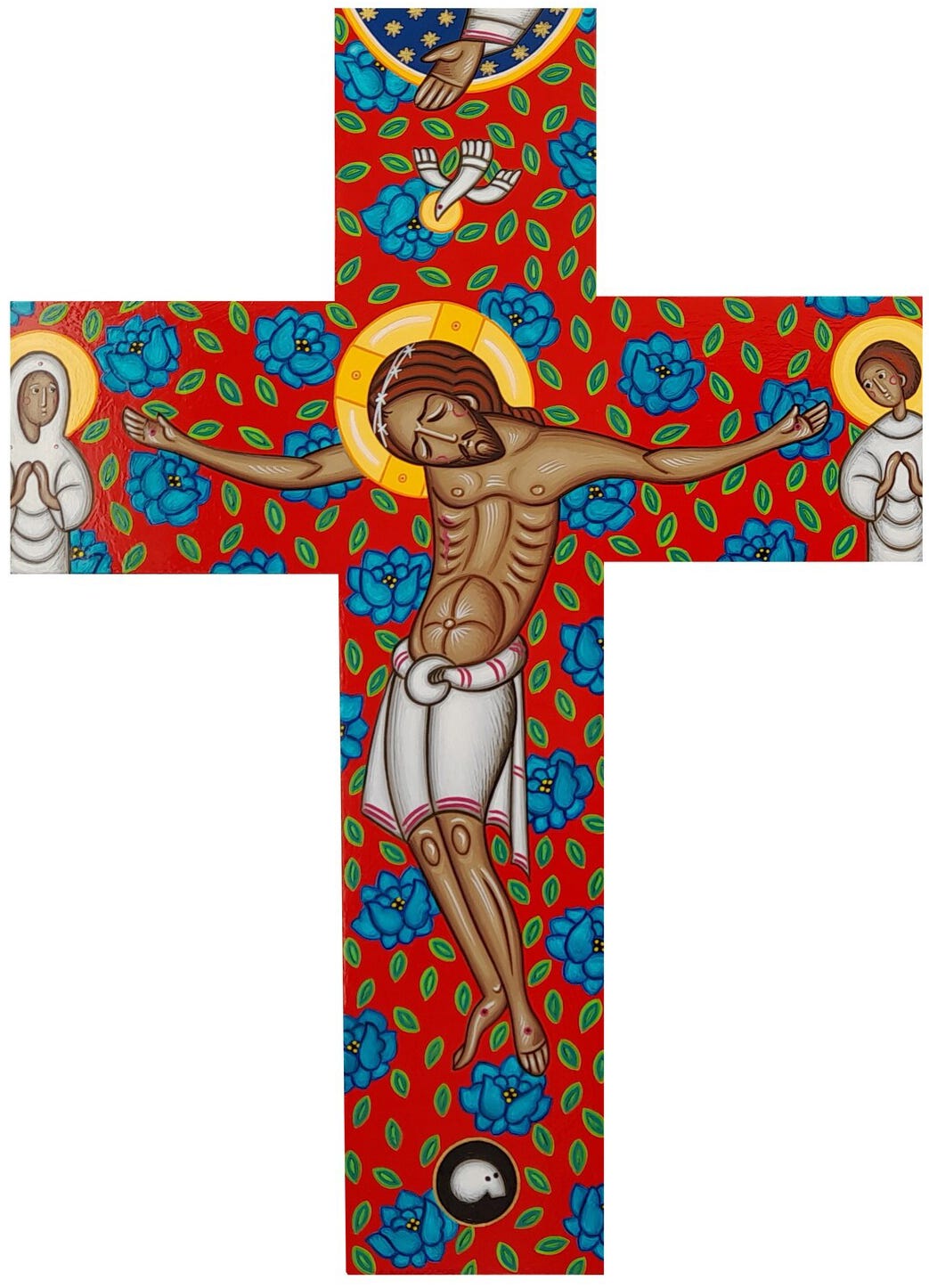
Icon: “Cross with Flowers” by Anna Makać
Find this week’s readings here. The readings here are from Track 2. If you are preaching Track 1, you can find our notes from three years ago here.
One of the great temptations in times of disorientation is to avoid the disorientation, avoid the pain altogether. We numb our pain with substances or activities that make us feel better temporarily but don’t actually do anything to help us. We often refuse to feel our feelings, or we blame ourselves or others, and we get stuck.
One of the leading scholars in the field of grief is David Kessler. He says that the person stuck in grief has to begin by feeling their feelings. One illustration of this is found in the nature of buffalos. When a storm comes, buffalos don’t run away. They run into the storm. Why? They instinctively know that the quickest way through the storm is through it. When you try to avoid, run from, or stuff pain, it is not acknowledged or healed. But as you allow yourself to feel those feelings, the intensity and frequency will change. Things begin to shift. 1
The prophet Jeremiah (Track 2, Jeremiah 15:15-21), expresses himself in painful prayer to God, not running away from the emotional weight he carries. Jeremiah expresses his loneliness, his fear, his anger, his disappointment, and even his doubt that God will remain faithful. He addresses these to God because he knows that God can handle them. It seems that Jeremiah is at the brink of giving up when the LORD reminds him of his calling, and that he is not alone. He reminds him of the words he spoke to him when he was young, and promises to fortify him. At the end of the reading, God simply reminds Jeremiah that he is not alone. The LORD is with him. He will save, deliver, and redeem him.
NEW: Many of you have shared with me that you are benefitting from the free weekly resource, and it is enough that you do not need a paid subscription. Would you consider supporting this work for the cost of a cup of coffee? It helps me continue doing this every week. Thanks!
Our epistle reading (Romans 12:9-21) focuses on the call to love in very specific situations: when we’ve been legitimately harmed, oppressed, or harassed. We all struggle with division and discord in our families, our workplaces, our churches, our neighborhoods, and our broader world. We are living in anger, struggling to live at peace with those we disagree with or those who have hurt us. Many of the people we encounter each day are like little tinderboxes, ready to explode at the smallest spark. We can be joyful in hope, patient in affliction, not meaning that we ignore these real realities. But, clear-eyed, we can respond Christianly in the midst of them.
It is amazing how God works in the midst of pain, in our weakness. It is often said that “Helping is healing.” God often allows our care for the needs others to be a part of our healing process. It gives us perspective, urging us to see the world differently. This is true in how God called Jeremiah, and in what Paul says to the church in Rome.
It is important to remember who we are. We are not beholden to a political tribe, corporate agenda, or consumer-driven dream. We are the people of God! “if your enemies are hungry, feed them; if they are thirsty, give them something to drink; Do not be overcome by evil, but overcome evil with good.”
In our gospel reading (Matthew 16:21-28), Jesus tells his disciples that he will undergo suffering and will be killed. Peter reacts strongly, refusing to allow even for the possibility. We all, like Peter, want Jesus to live up to our expectations. We want the victory and believe that suffering should not be a reality for ourselves or for the ones we love. We would much rather shortcut suffering and sacrifice if at all possible. And yet, Christ’s suffering is at the heart of gospel. Because of his suffering, we do not need to be afraid of suffering, of weakness, of loss. Because saving and finding are in the losing. It is only in losing our lives (our expectations, our plans, our other identities) that we truly find them. Poet and farmer Wendell Berry writes,
The grower of trees, the gardener, the man born to farming,
whose hands reach into the ground and sprout,
to him the soil is a divine drug. He enters into death
yearly, and comes back rejoicing. He has seen the light lie down
in the dung heap, and rise again in the corn.
His thought passes along the row ends like a mole.
What miraculous seed has he swallowed
that the unending sentence of his love flows out of his mouth
like a vine clinging in the sunlight, and like water
descending in the dark? 2
David Kessler, Finding Meaning: The Sixth Stage of Grief, (New York: Scribner, 2019).
No posts
Comments
Nothing yet. Say the first thing.
Sign in to join the conversation.