
Two figures contain most of the business case for AI in the gallery sector. In 2025, global dealer sales rose by 2 per cent. Dealers’ operating costs rose by an estimated 5 per cent.
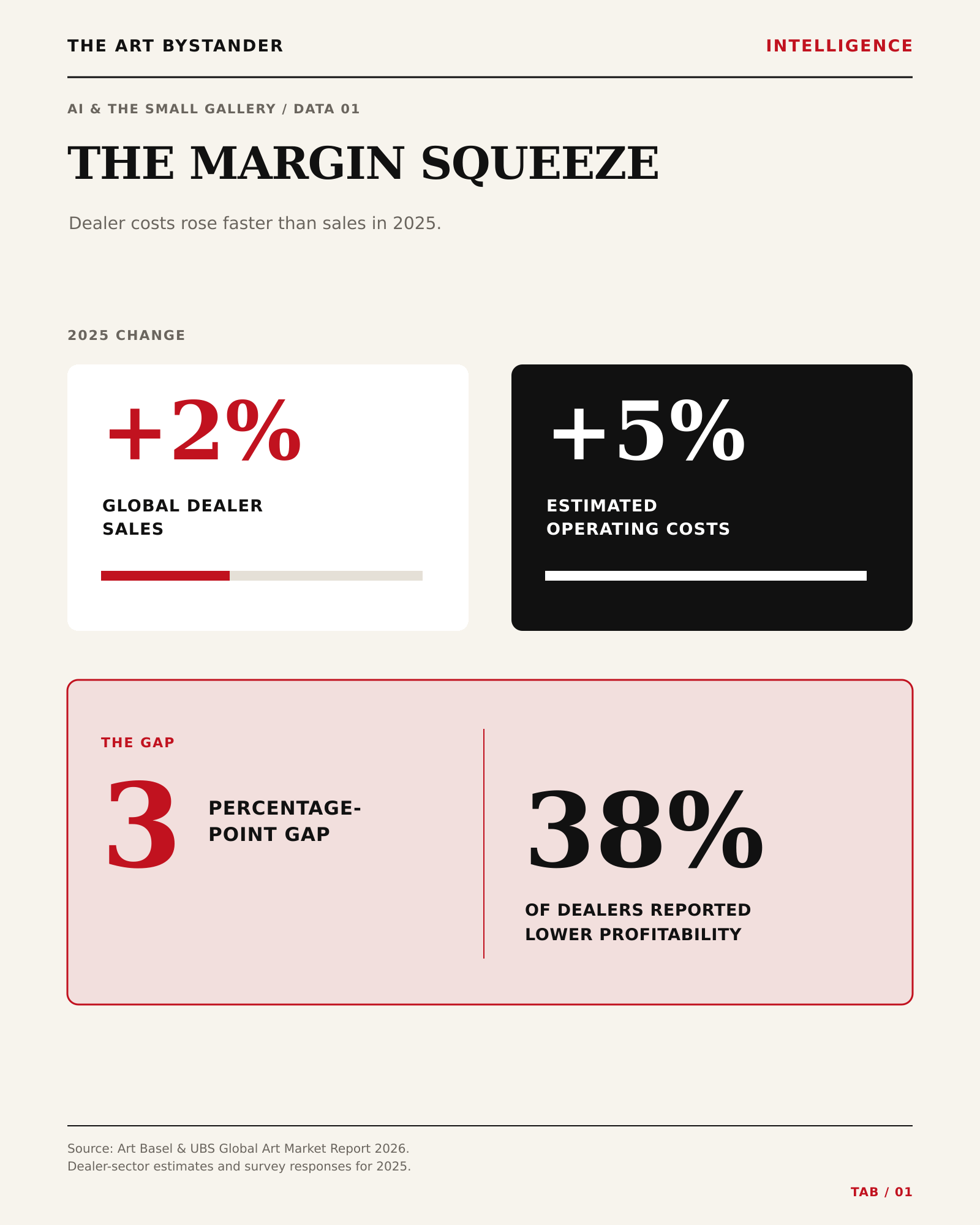
The pressure inside that three-point gap is considerable. Thirty-eight per cent of dealers reported lower profitability. Sales fell by 1 per cent among galleries turning over between USD 1 million and USD 10 million, while packing, shipping and logistics costs rose by 10 per cent and art-fair costs by 9 per cent. The Art Basel and UBS Global Art Market Report 2026 found that 59 per cent of dealer businesses employed five people or fewer. Much of the global art trade is conducted by companies with the staffing of a neighbourhood restaurant and the international complexity of a logistics group.
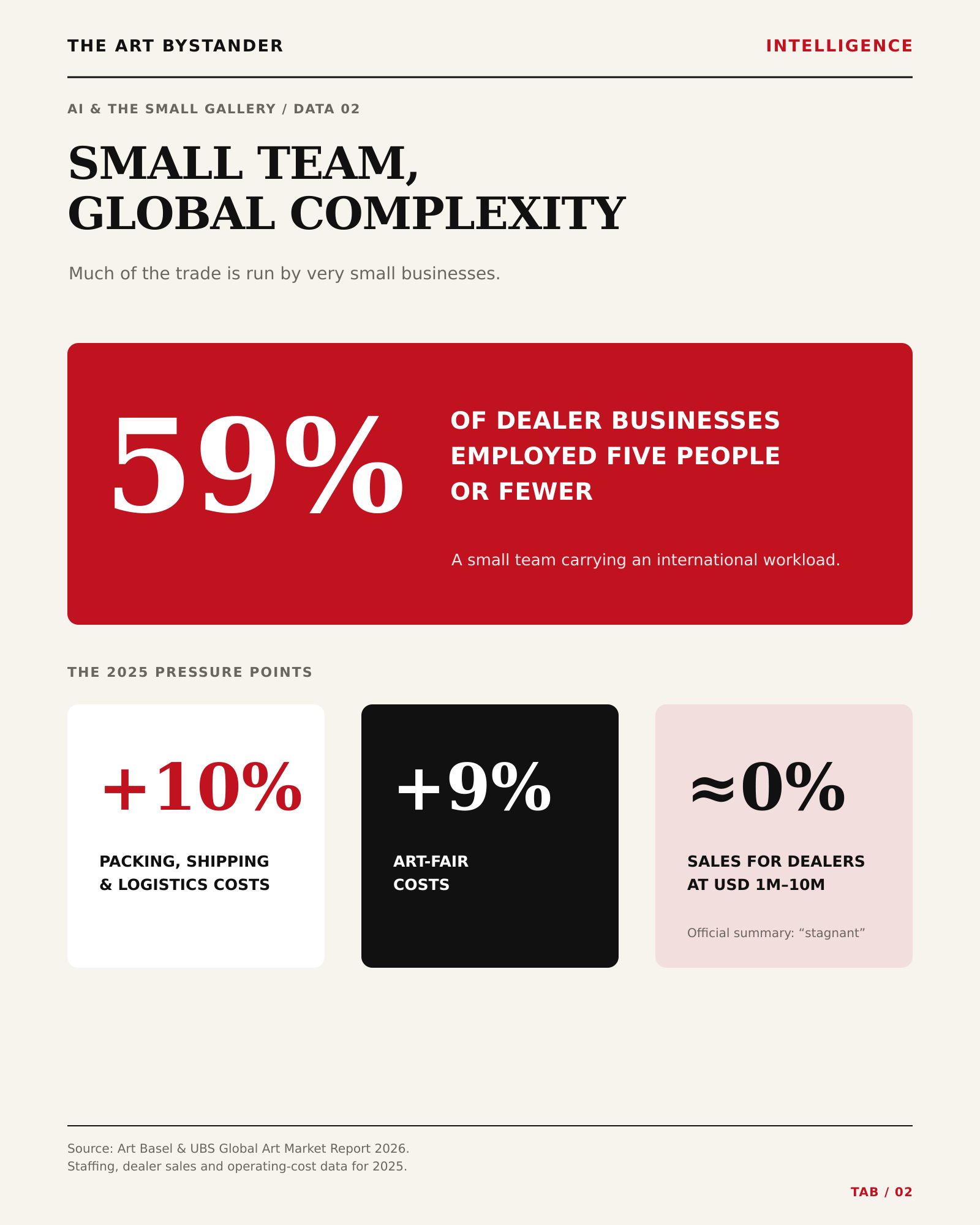
That squeeze explains why AI has suddenly become a dealer question rather than a tech-sector one. A small team needs more commercial capacity, but another permanent salary may consume the margin it is supposed to create.
Sean Green, founder and chief executive of ARTERNAL, has made the most forceful version of the technology argument. In his June 2026 whitepaper, Work as a Service: The AI-Native Gallery, he argues that gallery economics have broken, that conventional software imposed too much upkeep and that an “agentic workforce” can expand commercial capacity without adding fixed headcount.
Green’s case is more careful than its most provocative framing suggests. The whitepaper says the agents should not touch taste, judgement or relationships, and that a person should approve anything that ships, sends, files or posts. In a later public post, he also accepted that the art world’s fear of slop and of losing the human eye is justified. On those limits, he is right.
The disagreement begins when operational efficiency is treated as a theory of survival. Galleries spend an extraordinary amount of human time feeding systems that were meant to help them. Recovering that time matters. It does not follow that the firms automating first will become the culturally fittest.
The gallery economy is not a clean contest in which the most efficient firms inherit the market. Founders retire. Rents rise. Artists leave. Partnerships fracture. Collectors change direction. Some galleries knowingly subsidise difficult work that no efficiency model would select, creating cultural value while remaining commercially fragile. Financial strength matters, but it is not a reliable measure of cultural fitness.
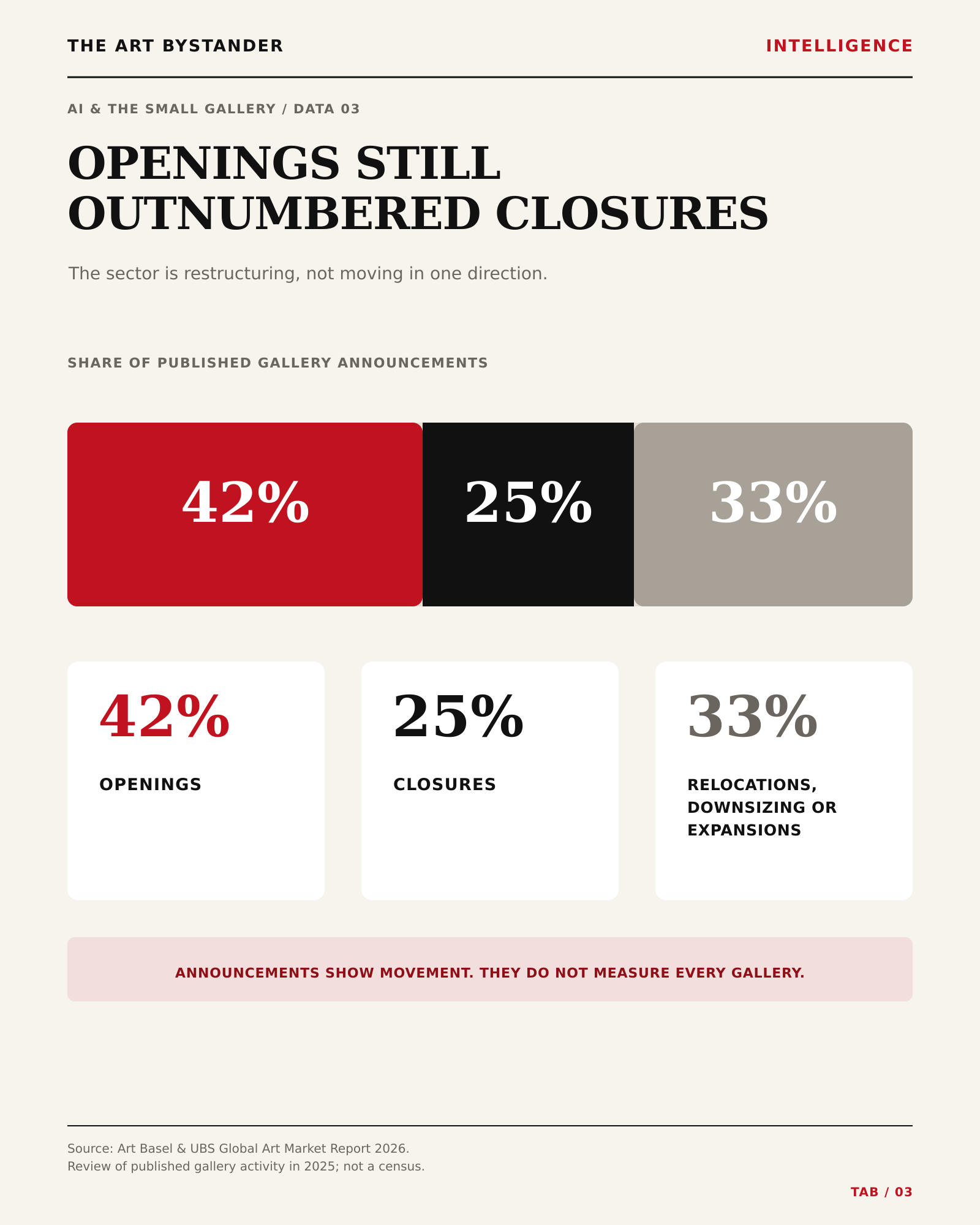
The report itself complicates the extinction story. Among published gallery announcements in 2025, openings accounted for 42 per cent, closures for 25 per cent, and relocations or other structural changes for the remaining 33 per cent. This was a review of announcements rather than a census, but it describes adaptation more convincingly than collapse.
AI will not repair a weak programme, restore a damaged reputation or create conviction around an artist. It can reduce the administrative drag around the work that does.
The evidence for AI-assisted productivity is no longer trivial. In a field experiment involving 5,172 customer-support agents, a generative AI assistant increased productivity by about 15 per cent. In another experiment, management consultants completed tasks within AI’s capabilities 25 per cent faster and at higher quality. On a task beyond that capability frontier, AI users were 19 percentage points less likely to reach the right answer. The same tool can be impressive and unreliable before lunch.
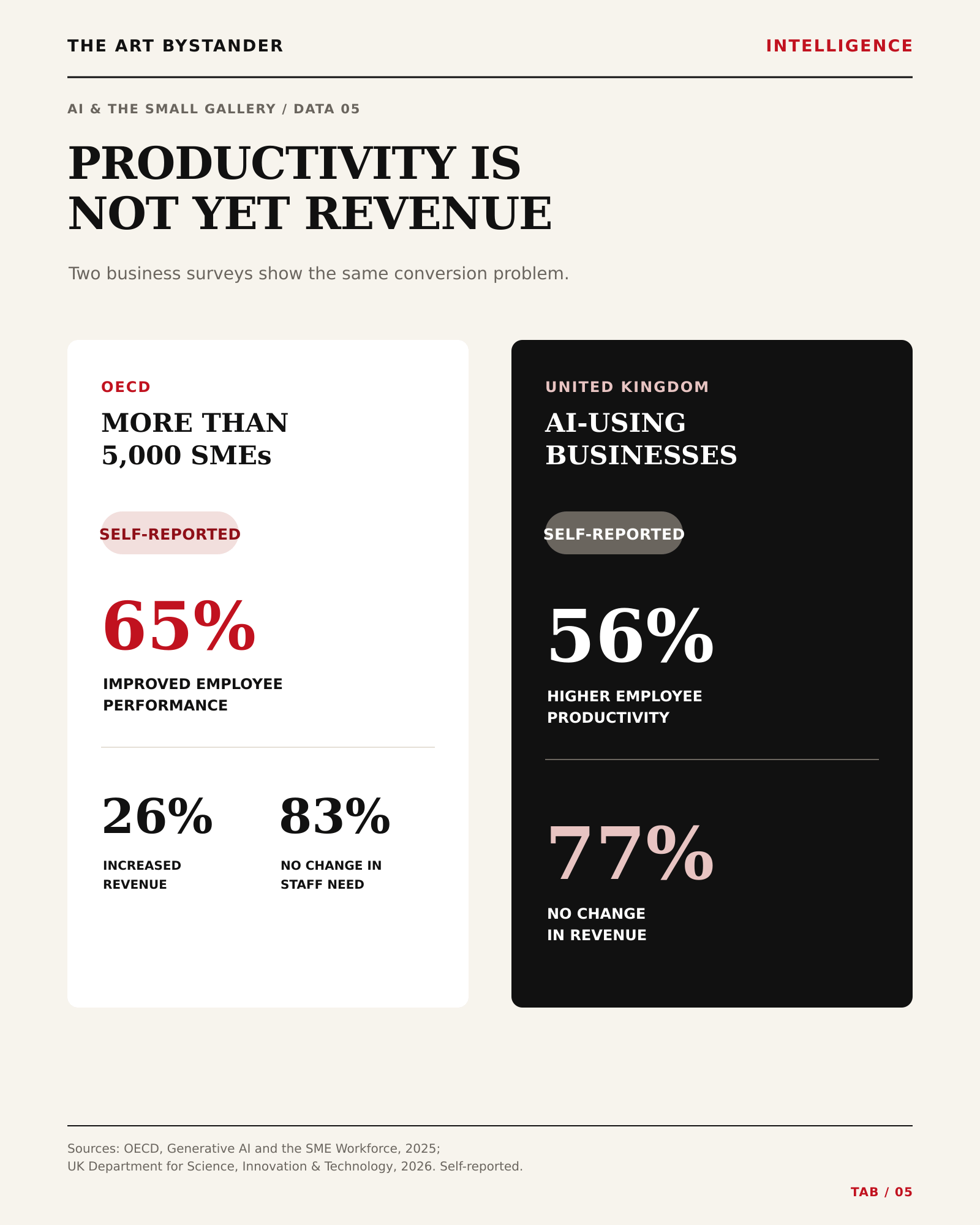
The small-business data is more sobering. An OECD survey of more than 5,000 SMEs found that 65 per cent of adopters reported improved employee performance, but only 26 per cent saw higher revenue. Eighty-three per cent said their staffing needs had not changed. In the United Kingdom, government research published in 2026 produced a similar split: 56 per cent of AI-using businesses reported a productivity gain, while 77 per cent reported no change in revenue. Most applied human checking, often extensively.
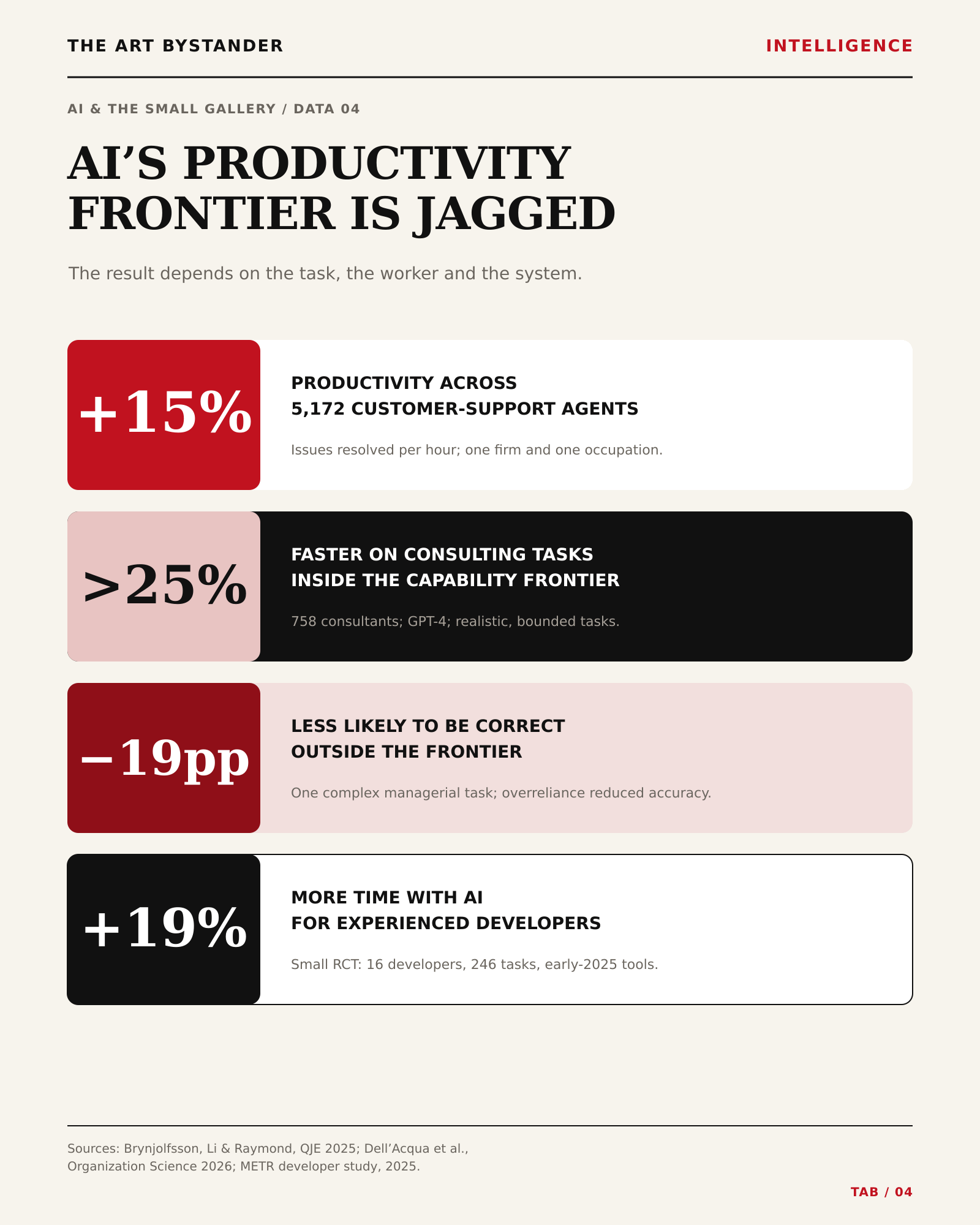
Even the feeling of speed can deceive. In a small randomised study of experienced open-source developers, participants using AI took 19 per cent longer on real tasks, despite believing the tool had accelerated them. Any gallery pilot must count prompting, checking and correction, not merely the time needed to produce a first draft.
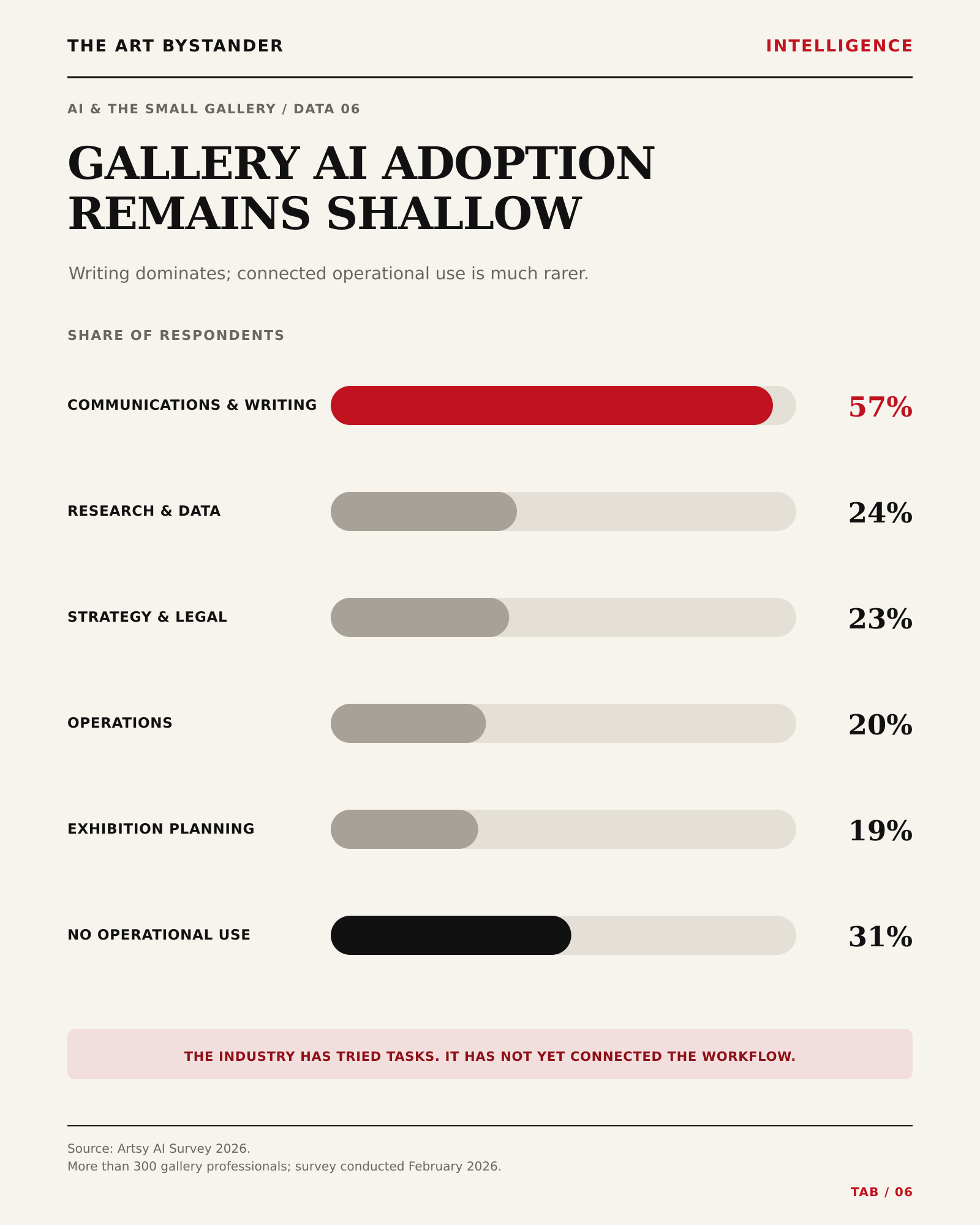
Gallery adoption remains tentative. In an Artsy survey of more than 300 gallery professionals, 57 per cent used AI to draft or edit communications. Far fewer used it for research, archiving, scheduling or travel, and nearly one third did not use it operationally at all. The industry has experimented with individual tasks. It has barely begun the harder work of connecting records, permissions and decisions.
At Pace, one of the few galleries to have described a more coordinated approach in public, senior director of IT Jennifer Candelario told the Financial Times that the real shift comes when AI moves beyond isolated tasks and supports work across several systems. Pace has a global AI policy and formal guardrails. That is a useful operational signal, although the resources of a mega-gallery say little about implementation inside a five-person business.
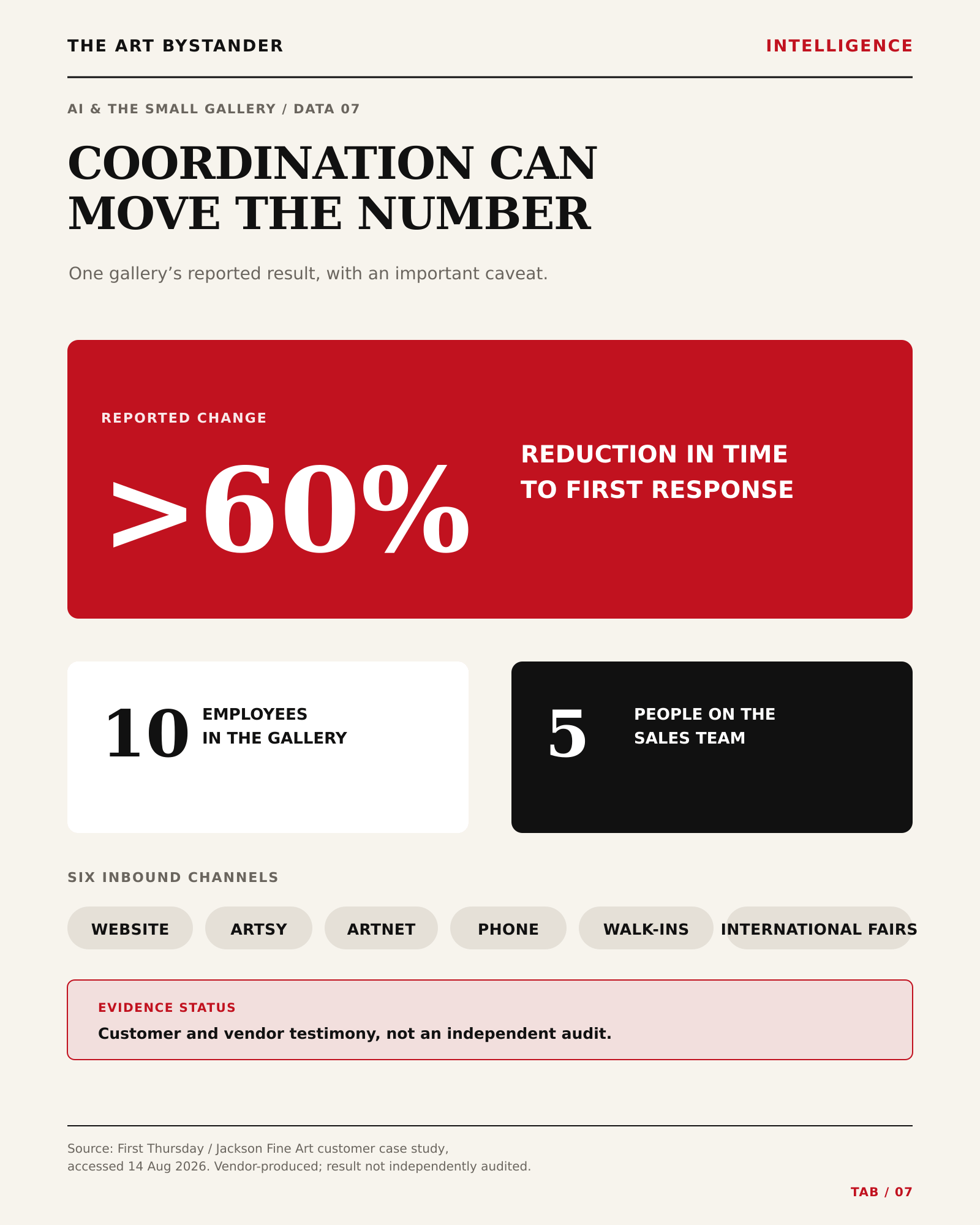
The closest published example at a smaller scale comes from Jackson Fine Art in Atlanta. The ten-person gallery had a five-person sales team, but enquiries arrived through its website, Artsy, Artnet, telephone calls, walk-ins and fair cards. Follow-up lived across inboxes, documents and spreadsheets.

“We were working across email, spreadsheets, paper cards and more,” executive sales director Malia Schramm told a First Thursday customer case study. The gallery says that bringing those channels into one shared system reduced its time to first response by more than 60 per cent.
The Jackson account is vendor-produced evidence rather than independent reporting. Its performance claim should not be treated as an audited result. What it does document is a recognisable operational problem: the sales team could not consistently see who owned a lead, whether somebody had replied or how an enquiry was moving towards a sale.
Saving ten hours a week has no commercial value if the time dissolves into more generic email, more social content or another fair that should never have been booked. The gain appears when a gallery decides what the recovered capacity is for: collector relationships, artist development, studio visits, institutional introductions, writing, hospitality and judgement.
The commercial unit is not the hour saved. It is the hour successfully reassigned.
Below the paywall: a practical map of six gallery workflows where AI can earn its place, the human gates that should remain non-negotiable, and a planning budget for a five-person team. The second half also examines apprenticeship, collector-data risk, watermarking and Content Credentials, and closes with a 90-day test for deciding whether a tool creates value or merely more supervision.
Comments
Nothing yet. Say the first thing.
Sign in to join the conversation.