
This post is public so feel free to share it!
At the end of August, I will travel to Marseille for Art-o-rama, a fair I have followed for some time but never experienced in person, and in the weeks leading up to the trip I have found myself thinking as much about the city as the fair itself.
Marseille has never fitted comfortably into the familiar image of the French cultural capital. It is too unruly for that, too marked by the port, by movement, migration and trade, by its proximity to North Africa and the wider Mediterranean, and by the social and political tensions that have accumulated over centuries. It does not offer the seamless beauty of the Riviera, nor the polished self-confidence of Paris. The city has always seemed to exist on another frequency, both unmistakably French and in constant conversation with somewhere else.
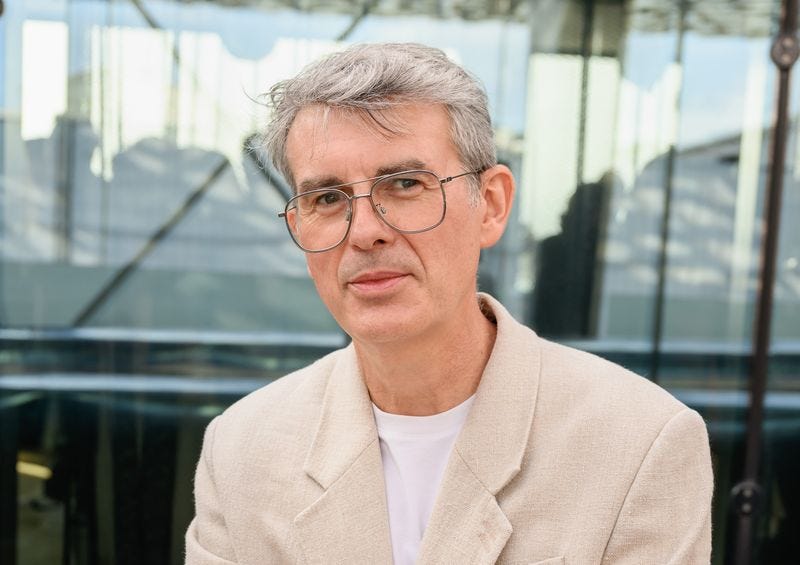
In the latest episode of The Art Bystander Podcast, I speak with Jérôme Pantalacci, founder and director of Art-o-rama, about what it means to build an international contemporary art fair in a city that was, for a long time, regarded as peripheral to both the French art world and the international market.
“Marseille is not a fancy place,” Jérôme tells me. “It’s not the Côte d’Azur, it’s not the French Riviera. It’s not a rich place. It was seen as a city you cross, you pass by, but you don’t stop. But now, step by step, as the city changes its image, people like to come also to see the city and to see what happened here.”
That shift in perception matters, but Marseille’s appeal would be diminished if it were understood simply as another story of urban regeneration, where cheap space attracts artists, cultural institutions arrive, restaurants follow and the city is gradually reformatted for outside consumption. What makes Marseille interesting is that it still resists this process. Its contradictions remain visible. Beauty and neglect sit close together. Wealth has not fully sanitised the streets, and culture has not yet been reduced to a lifestyle proposition.
The city is becoming more attractive to artists, Jérôme says, not only to those at the beginning of their careers but to established figures from elsewhere in Europe and the United States who are choosing to live and work there.
“I think the city is more attractive, and it’s great because we have many young artists, but also established artists coming from Europe and even the US, and are now living in Marseille. We are very confident because it’s great to have all those people coming.”
The arrival of artists is often described as proof that a city is becoming culturally important, but the more revealing question is what kind of city they are entering. Marseille does not offer a blank surface onto which a new art scene can be projected. It has its own histories, communities and institutions, its own difficult relationship with Paris, and its own position within the Mediterranean. Artists arrive not at the beginning of something, but in the middle of a story that has been unfolding for centuries.
Art-o-rama grew from that context. Founded by Jérôme in 2007, the fair began at a moment when Marseille had little standing as an international art-market destination. Rather than hiding that fact, or attempting to imitate the commercial machinery of fairs in Basel, London or Paris, Art-o-rama built its identity around what the city could offer precisely because it was not one of those centres.
“Since the beginning, we decided to focus on the curatorial project, because we are not in a big center for the market, we are in the periphery,” Jérôme explains. “So we decided to focus on the curatorial project, and to keep it as low as possible for galleries. We wanted to create something very specific, very small at first, but with a strong identity.”
The word periphery is important here. In the art world, it is usually used to describe distance from money, institutions and influence, as though cultural value radiates outwards from a handful of recognised capitals. Yet working from the edge can also create a form of freedom. Without the same density of collectors, blue-chip galleries and market expectations, Art-o-rama could not rely on scale or prestige. It needed another reason to exist. That reason became the quality and specificity of the presentations.
Art-o-rama is known for asking galleries to think beyond the conventional fair booth, where a selection of works is often assembled to cover as many tastes, artists and price points as possible. Here, the emphasis has always been on a more concentrated proposal, often centred on one artist or a closely developed curatorial idea. The booth becomes less a temporary shop window and more a compact exhibition, with a logic of its own.
This does not make the fair less commercial. Galleries participate because they need to sell, and artists cannot build sustainable practices on exposure alone. But Art-o-rama offers a different idea of how commerce might function, one in which the work is given enough space and context to be understood before it is reduced to inventory.
Its scale is part of this. Smaller fairs allow for a different rhythm, not only for galleries but for visitors. There is time to look, to return, to speak with someone for longer than five minutes and to understand why a presentation has been made in a particular way. In the largest fairs, abundance can become a form of erasure. Hundreds of booths, thousands of works and a relentless succession of names produce the impression of access while making sustained attention almost impossible.
Art-o-rama has retained the possibility of discovery because it has remained selective, but maintaining that quality over time requires more than repeating a successful formula.
“Each year you have to reinvent also the event, what you are doing,” Jérôme says. “It’s always the same thing, but it’s always new.”
It is a deceptively simple description of the challenge facing any cultural event that survives beyond its first years. An audience wants continuity, but it also wants surprise. Galleries return because they recognise the fair’s identity, yet that identity cannot become an alibi for predictability. The structure must remain visible while the content, energy and point of view continue to move.
In much of the art world, change is measured through expansion. More exhibitors, more visitors, more square metres, more sponsors and more cities are treated as evidence of success. Yet growth can easily flatten the qualities that made a project compelling in the first place. A fair built around intimacy and risk can become conventional simply by becoming too large to preserve either.
Art-o-rama suggests that reinvention does not always require enlargement. It can happen through the galleries invited, the artists presented, the conversations created around the fair and the ways in which it responds to the city around it. Remaining small is not a refusal of ambition. It can be a way of protecting it.
Our conversation also turns to the wider ecology in which artists and galleries operate, and to the limitations of looking at the art world solely through the market.
“It’s also important to be involved in these different levels of the activities for different artists, because an artist, of course, needs to sell to live, but there are also different activities that you can have,” Jérôme says. “So we try to support not only the market, but also the wider ecosystem around it.”
The language of the ecosystem has become almost unavoidable in cultural policy, but in this context it describes something practical. An artist’s career is rarely sustained by sales alone. It is built through exhibitions, studio visits, residencies, commissions, texts, institutional relationships and the slower accumulation of trust. A gallery may support an artist for years before the market begins to respond, while critics, curators and institutions often help establish the conditions under which that response becomes possible.
A fair sits at the meeting point of these forces. It is a place of transaction, but it can also be a place where an artist is first encountered by a curator, where a young gallery enters an international network, or where a presentation is understood as something more substantial than a set of works offered for sale.
This is particularly important now, when younger galleries face escalating costs and increasingly unforgiving expectations. They are required to be international almost from the beginning, travelling between fairs, maintaining visible programmes, producing content and cultivating collectors across several markets, often with very small teams and limited financial reserves. The pressure to appear established can arrive long before the business itself has become stable.
A fair that keeps participation costs relatively low and places serious attention on the curatorial proposal is therefore doing more than offering an alternative atmosphere. It is making a structural choice about who can take part and what kind of work can be shown. That does not remove the market from the equation. It gives the market a different frame.
Marseille is central to this because the fair could not be separated from the conditions in which it was formed. Held at La Friche la Belle de Mai, a former tobacco factory transformed into a major cultural complex, Art-o-rama belongs to a city where industrial histories, artistic production and social life remain visibly entangled.
It would be easy to describe Marseille as the next European art capital, but that kind of language usually reveals more about the hunger for novelty than the city itself. Cultural media has a habit of moving from place to place, announcing each new destination as the next Berlin, the next Lisbon or the next Athens, until the very qualities that made it interesting have been absorbed into a familiar narrative of discovery. Marseille deserves something more precise.
It is not interesting because it is about to replace Paris, London or Berlin. It is interesting because it exposes the limits of thinking about art solely through capitals in the first place. Its cultural life is shaped by another geography, looking towards the Mediterranean as much as towards northern Europe, and informed by histories and communities that do not sit neatly inside the usual map of the Western art world.
As I prepare to visit Art-o-rama later this month, my conversation with Jérôme became an introduction not only to the fair but to the city that made it possible. A city once treated as somewhere to pass through has become somewhere artists are choosing to stay, not because it has become polished or easy, but perhaps because it has not.
Marseille was never waiting to be discovered. The more interesting task is to arrive with enough attention to understand what was already there.
By Roland-Philippe Kretzschmar
Founder, The Art Bystander
No posts
Comments
Nothing yet. Say the first thing.
Sign in to join the conversation.