
The first time I was in Egypt was in a military cargo plane. It was a typical supply run between two allies, and I flew low enough over the terrain to see the pyramids up close. I couldn’t believe it. As a child, I was dazzled by the far away places I saw in National Geographic magazines. Ancient ruins, vibrant cultures, mysterious histories…and suddenly there I was, seeing the pyramids from above.
Years later, I visited Egypt as a tourist, and went looking for another ancient wonder: The Library of Alexandria. Or at least a historical marker or statue of it. Unfortunately, the Library of Alexandria doesn’t exist anymore. The Romans, the Greeks, the Arabs, and travelers and warfighters from multiple realms passed through on their way to worship, learn, trade, reform, plunder, or conquer. The city and library declined slowly over decades in the third century BC due to brain drain, war damage, natural destruction, and fires. Julius Caesar, setting Egyptian warships on fire in the harbor, caused additional burning of the port and part of the city.
Today, Alexandria is a beautiful coastal city, but just offshore is where the real action is happening. A curved beachfront, dissected by a highway, blends inland to a cityscape with grey structures ranging from citadels and remnants of ancient barricades to apartment buildings and modern city architecture. It’s an ancient town known as the center of Macedonian conqueror Alexander the Great’s empire, Cleopatra VII’s reign as the last Queen of Egypt, and rival to the Roman Empire.
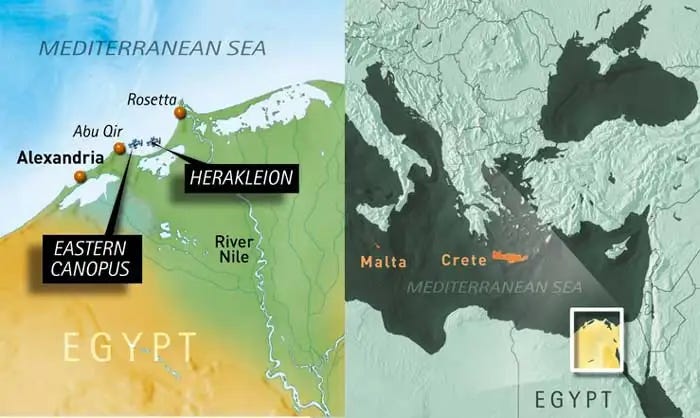
The nearby town of Canopus was culturally and religiously significant, and it’s where Cleopatra spent time in the temples of Osiris and Serapis. It is located on the Nile Delta and the Mediterranean Sea on the northern shore of Egypt. After ages of environmental damage, earthquakes, wars, and erosion, Canopus now lies under water, a mystery of the ancient cultural world. Underwater archeologists say forget Atlantis, we have Canopus.
Canopus was a major port for the Greek sea trade over 2000 years ago. Between the Roman Empire and the Egyptian Ptolemaic Dynasty, the Greeks were a major trade and political power. Their influence in philosophy and cultural supremacy was highly evident all over this region. Canopus was a town of spiritual temples to the god Serapis, a Greco-Egyptian deity, and Osiris, the Egyptian god of fertility. The multicultural community was rich from trade, enjoyed a multilingual culture, and honored spiritual practices. It was, however, a geographical area prone to earthquakes, rising tides, liquefaction, and natural disasters. Slowly, the city literally dissolved. Pilgrims and prophets came and went. Warriors, rulers, tradesmen, and technology changed the landscape. Ancient history gave way to modern life.
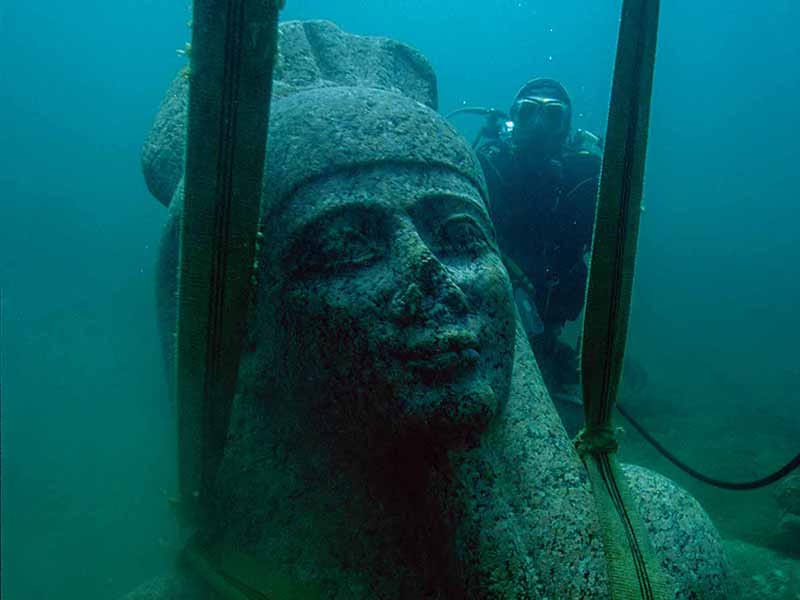
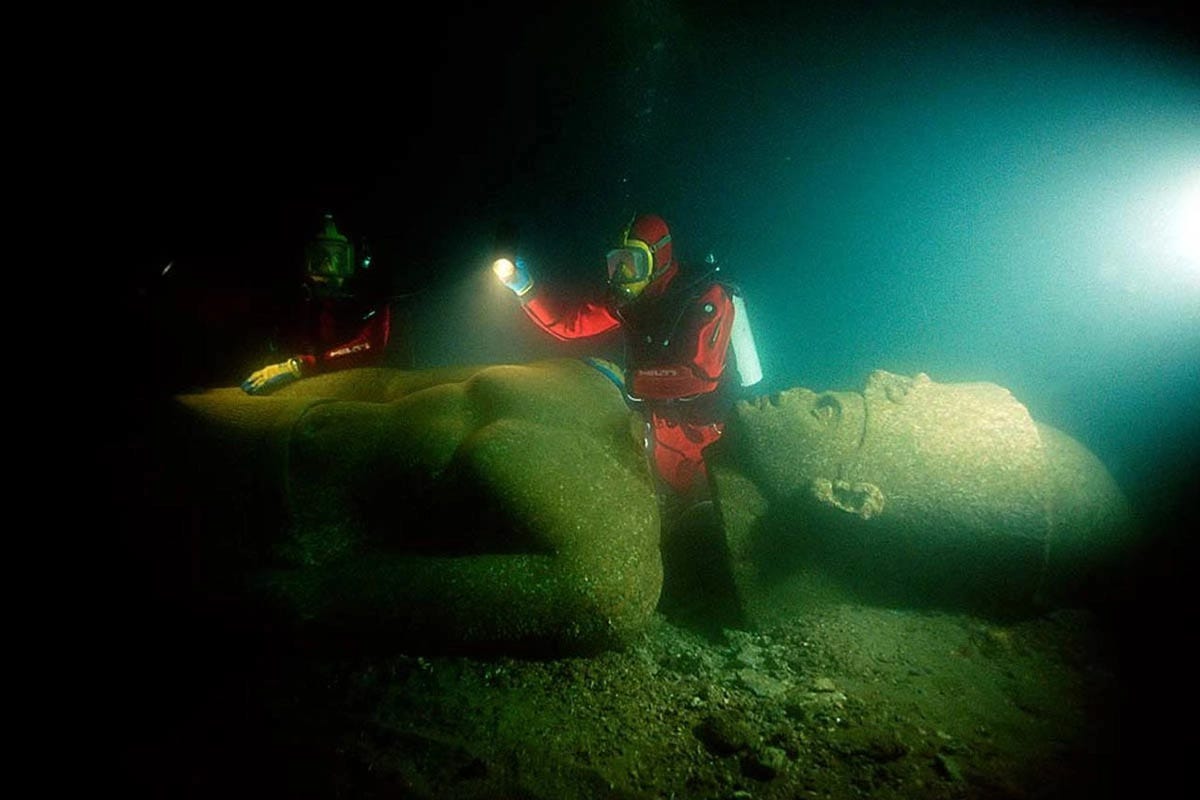
But some did not forget the architecture and artifacts of the lost city of Canopus. The British, the French, and a slew of international organizations have been searching for antiquities. Canopus has been found. The sunken city is emerging one crane hoist at a time. Statues from the reign of Ramses II laid on the ocean floor outside Alexandria alongside Greek and Roman artifacts, Egyptian sphinxes, and entire building and infrastructure pieces.
Sadly, Canopus had few records because it submerged due to erosion, earthquakes, and flooding, and any papyrus writings would not survive in the wet delta region. The city was nearly forgotten. But stories never die, and rumors of a sunken city persisted. A limestone tablet called the Decree of Canopus was discovered recently near Cairo, and this near-complete tablet discusses Ptolemaic Rule in Egypt in Egyptian hieroglyphics, Demotic, and ancient Greek, much like the Rosetta Stone. Not only does this give us a record from 238 BCE about the rule of law in Canopus, it helps solidify language translation and tells us about the society of a long-lost land.
Fishermen caught glimpses of artifacts and shared sea stories and myths because there were few written records of the once prominent city. Then came physical searches by fishermen and divers. Over the years technology improved. Then sonar. Giant columns were found and explorers began to map the underwater city, which prompted a wave of interest and research. This drew archaeologists from all over the world. Then Remotely Operated Vehicles were used, then drones, with the benefit of additional technology to photograph and map and retrieve artifacts without human invasion. Fortunately, the area is in stable waters and deep enough to help preserve the artifacts.
Statues of kings and gods continue to be discovered. Personal items like jewelry, pottery, and everyday objects are providing insight into daily life. The architecture reveals building techniques and technological capabilities. Coins and marketplace remnants show the wealth and global importance of the city, including the importance of religion, scholarly pursuits, and political issues. Writings in Egyptian hieroglyphics and ancient Greek continue to surface.
Frank Goddio, a French underwater archaeologist, is leading the joint excavation of the sunken city of Canopus. Recovered artifacts include immense monuments such as a quartz sphinx containing the cartouche of Pharaoh Ramesses II and a marble statue of a Roman nobleman. The footprint of a Roman-style city is being mapped out. Ancient Egyptian, Ptolemaic, Roman, Byzantine, and Islamic coins prove travel and trade were robust during the era. The stories of Canopus’ cosmopolitan past mingle with relics of religious significance.
These ancient remains can tell us more about daily life of the Canopus people, but the societal implications are much bigger than that. As with any archaeological discovery of this magnitude, there are stories to be told. The question is: who gets to tell and interpret those stories? Historians are like journalists, and personal experiences will mix with academic knowledge and motivation. Our cultural understanding is deeply shaped by the owners of the story. Since we have Greek, Roman, Egyptian (not to mention pre-Roman, Christian, Turkish and other regional seafaring cultures) represented here, which stories will we tell?
The area is equitably within Egyptian waters and the heritage belongs to them. Though the Ptolemaic dynasty ruled for about 300 years and the Romans ruled for 600, the underwater artifacts are not contested by the Greeks, Italians, or French. These are part of the heritage of ancient Egypt.
Egypt’s ministry of tourism works with historians and diplomats to showcase the amazing finds that have been accelerating over the past decades as recovery is accelerating. Cultural preservationists try to keep the sites protected as the excavation goes on. We have to not only tell these stories but protect the artifacts as well. International institutions are key in researching and interpreting, not to mention funding, the ongoing excavations.
As technology progresses, more discoveries are being made. Museums all over the world are capitalizing on the publicity. The Saint Louis Art Museum (USA) has an audio guide called Sunken Cities: Egypt’s Lost Worlds available on its website. YouTube hosts multiple educational videos about Canopus. Journal papers continue to reveal new information from scholars. Podcasts discuss exciting finds.
The rediscovery of Canopus reminds us that history isn’t static—it’s constantly being rewritten as new evidence emerges from beneath the waves. These aren’t just relics in museums; they’re windows into how multicultural societies functioned, how global trade shaped ancient economies, and how natural disasters can erase entire civilizations. The same questions facing Canopus—who owns the past, how do we preserve it, whose interpretation matters—face us today with contested cultural artifacts worldwide.
Recovery, documentation, and preservation are important because they help us interpret our history. These cultural artifacts explain our shared past and understand how our ancestors prayed, ruled, lived, and fought. I hope some kids are reading about these discoveries, watching the mysteries of the past unfold, and wonder. I hope it gives them the same yearning for discovery that set me on a path to becoming a pilot, serving my country, and now working to preserve culture.
Comments
Nothing yet. Say the first thing.
Sign in to join the conversation.