
To a hammer, everything is a nail.
Now that I’m studying art law, I see legal issues all throughout the arts. It’s a curse, but it’s also great writing fodder. It has redirected the way I look at the art world and the ecosystem in which artists work.
This weekend my husband and I stopped in at Fridman Gallery. The current exhibition is Double Bind: Belonging and Its Discontents, curated by Catharine Clark.
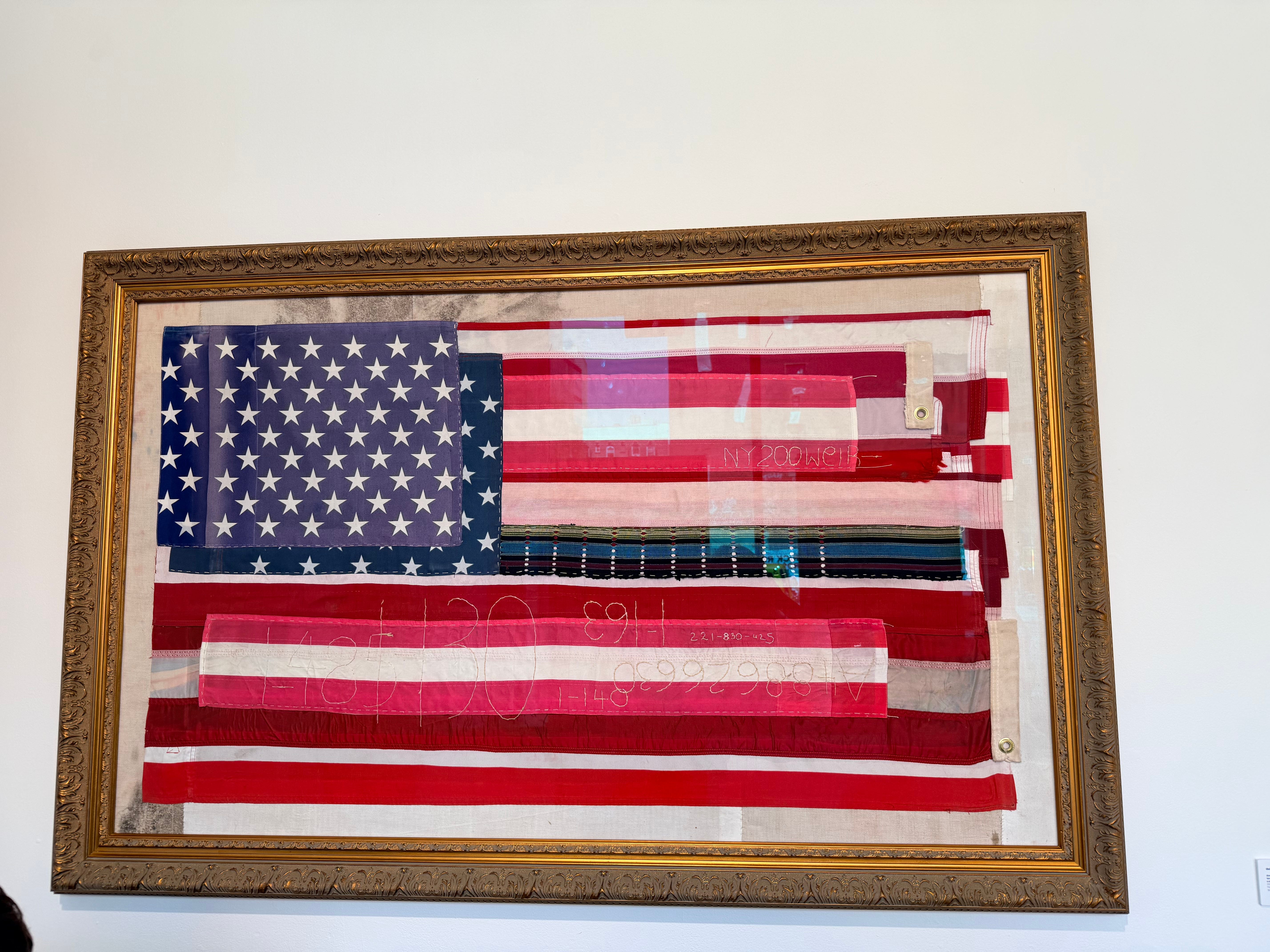
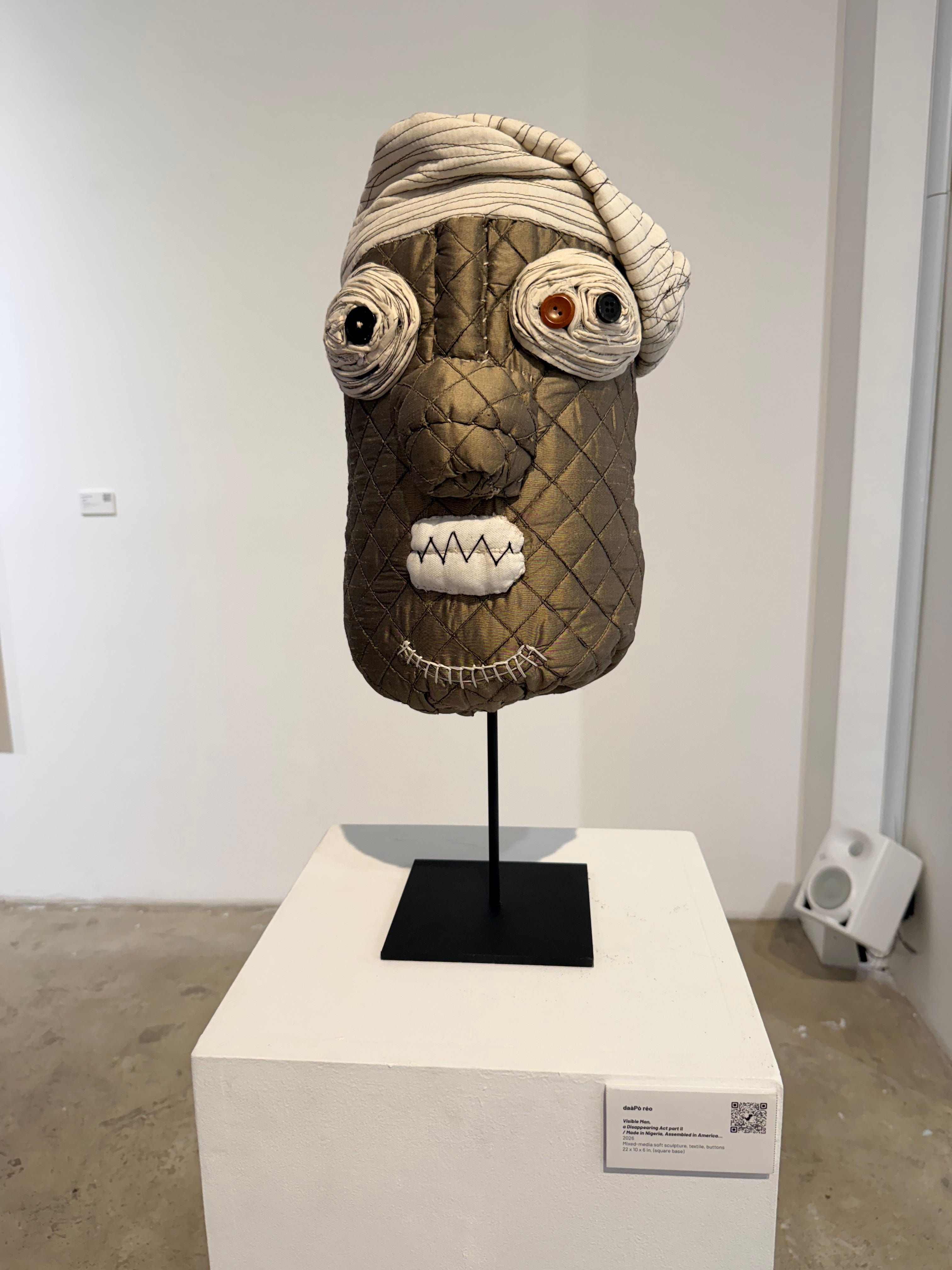
The first artwork to confront you when you walk in the door is daàPo réo’s mixed media, American flags and sculptural headpieces. There are a trio of headpieces throughout the gallery, sewn from flags and fabric and embellished with numbers that are meaningful to the artist. It is said that Réo is deconstructing the American flag, an act of rebellion to many, but here, more a commentary on status.
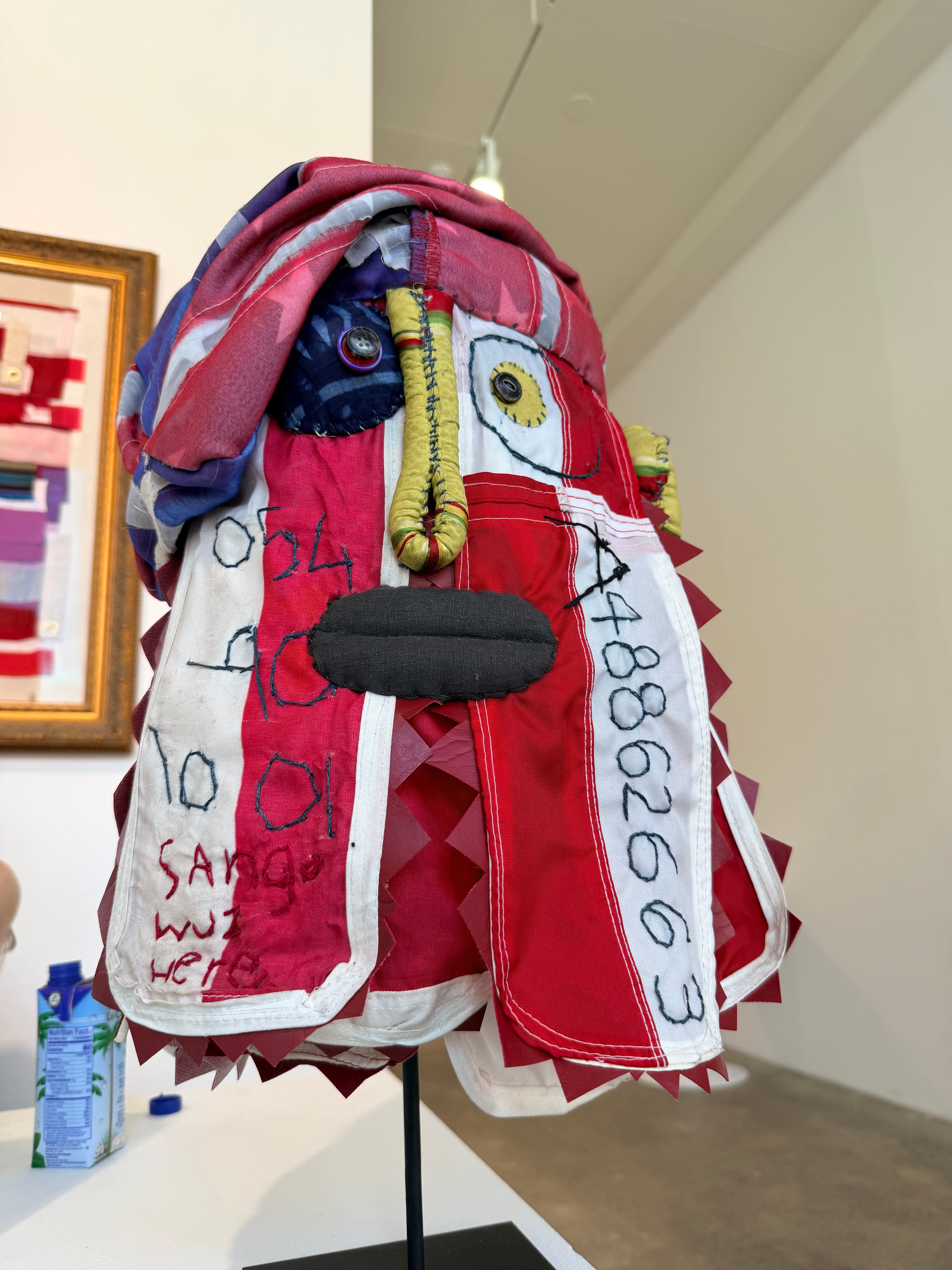
Standing in front of the work, it’s hard not to think about the First Amendment, looking at the strips of flag sewn onto the head of a figure or overlapping onto a patchwork collage. But legally, can an artist really do this?
In 1791, Congress ratified the Bill of Rights. This statement consists of ten amendments to the US Constitution that were written to help protect individual liberties and limit the power of the federal government. The first of those Amendments states:
Congress shall make no law respecting an establishment of religion, or prohibiting the free exercise thereof; or abridging the freedom of speech, or of the press; or the right of the people peaceably to assemble, and to petition the Government for a redress of grievances.
The long and formal explanation is here.
I know everyone has a different opinion of what it means to belong in America or be American, and these days it seems like whenever you approach that question, people are extremely critical, angry, or unsure of what to say. As someone who has spent two decades serving my country in the military, I don’t necessarily struggle with the question as much. I know there are a lot of things wrong with our country, but I’ve also traveled extensively, worked and studied abroad, and executed diplomatic missions, so I know there’s no place that’s perfect. The best of countries have messy politics, and no country serves everyone’s needs. But in art, in free countries, we can express our opinions in a lot of different ways. Including, in the United States, through the First Amendment’s freedom of speech clause.
The American flag has its own politics to understand. It is supposed to be a symbol of unity, growing and changing as our country has grown and changed, but today the flag can be a divisive symbol as well. The flag upside down is meant to signal distress, not discomfort, mind you, not anger either, but exceptional emergencies like pirate attacks or extreme danger. For a while, it was illegal to desecrate the American flag. But in Texas v. Johnson in 1989, the Supreme Court ruled that burning the flag is merely expressive conduct, just another form of symbolic political speech, and the government can’t ban the expression of an idea just because it is deeply offensive.
18 U.S. Code § 700 was the federal statute addressing desecration of the American flag. It stated that “Whoever knowingly mutilates, defaces, physically defiles, burns, maintains on the floor or ground, or tramples upon any flag of the United States shall be fined under this title or imprisoned for not more than one year, or both.” I grew up with that law.
Then, in 1984, activist Gregory Lee Johnson set fire to the flag during the Republican national convention in Dallas. He was arrested, sentenced to one year in prison, and fined $2,000. On appeal, his conviction was overturned and the case went to the Supreme Court. Justice Brennan delivered the 5-4 decision, which held that burning the flag is symbolic speech and therefore protected under the First Amendment. It’s much more complicated than that, of course, but effectively 18 U.S. Code § 700 is dead.
So now, back to réo and his interesting artwork. I can now appreciate the artist’s autobiographical material as he talks about sociocultural issues he has faced as a Nigerian-born American. A lot of his work involves flags and the reconstruction of symbolic materials to discuss dual perspectives of freedom and constraint, conflicting experiences, and cultural realities. Whether you agree or disagree shouldn’t be decided until you see the work, hear the stories, and understand individual backgrounds. Actually, that sentiment is true for all of the displays in this exhibition.
There Will Come a Soft Rain, 2025, is an ink on paper piece by Athena LaTocha. The deep blue and earth colors show a physical interaction with an environment marked by industrial intervention and discarded debris.
Sandow Birk’s Proposal for a Monument to the Declaration of Independence (and a Pavilion to Frederick Douglass), from the series Imaginary Monuments, 2018, is a copper plate etching on paper showing civic monuments with formative American dissertations. These imaginary monuments are a productive conversation between the text we wrote and the words critiquing various versions of American freedom. It shows how we take for granted the monuments we’ve erected and the speeches that have been given, and how we’re forced now to put them in their historical context, even though they don’t sit well together, and there we are, the casual onlooker, having our lunch under a tree.
Wura-Natasha Ogunji muses about language and contradictions in Atlantic, 2017. What land do we go back to? The thread and ink on paper are a real standout. The figure is listening in one ear, but the record player is on top of her head. And even though the face is nearly blank (of color, of words), it is the most powerful space on the artwork. It is the place that you look. The simplest form on the work is the piece that holds all the power.
There were other works in the show that deserved their own 15 minutes of fame, but let me highlight just one more. Because it felt museum-worthy. Because it was genuinely beautiful. Because it didn’t work too hard to make its statement. It just hung there beautifully, lighting up the room with its intelligence and craft. The artist is Nate Lewis. The work was Syncopated Current 27, 2025. It is a work on paper, although it looks quilted. Two figures dance, and then you look closer. The embrace is emotional, charged with conflict, deep in conversation. The curves in the background swirl around them, and we are in motion, swaying through time and space. What world is this? Lewis is a nurse-turned-musician-turned-artist, and this work is polished with humanity and song and structure. These figures are sublime. It’s quite simply a ravishing work.
I have to say that the older I get, the more I appreciate politically-motivated artwork, particularly if it shows me a perspective that is different from my experiences. I don’t have to agree in the end, and oftentimes I’m left with more questions than answers. After all, any artwork, story, or experience is only part of the greater picture. But at Double Bind, each artwork made its statement freely: some gently referencing experiences, some breathing through loudspeakers with 6-foot-tall video screens, and some with pieces of the American flag. Provocative and peaceful. The freedom of expression.
Comments
Nothing yet. Say the first thing.
Sign in to join the conversation.