
There is an arbitration court specifically designed to address art disputes–the really messy kinds: forgery, authentication, provenance, ownership. Here’s what’s wild. They have never heard a case.
Earlier this year, I got to attend a seminar about arbitration panels. Arbitration is one of many possible settlement methods in law, within the category of Alternative Dispute Resolution (ADR). When two parties have issues, they can resolve them through arbitration, mediation, or negotiation rather than suing and possibly going to court.
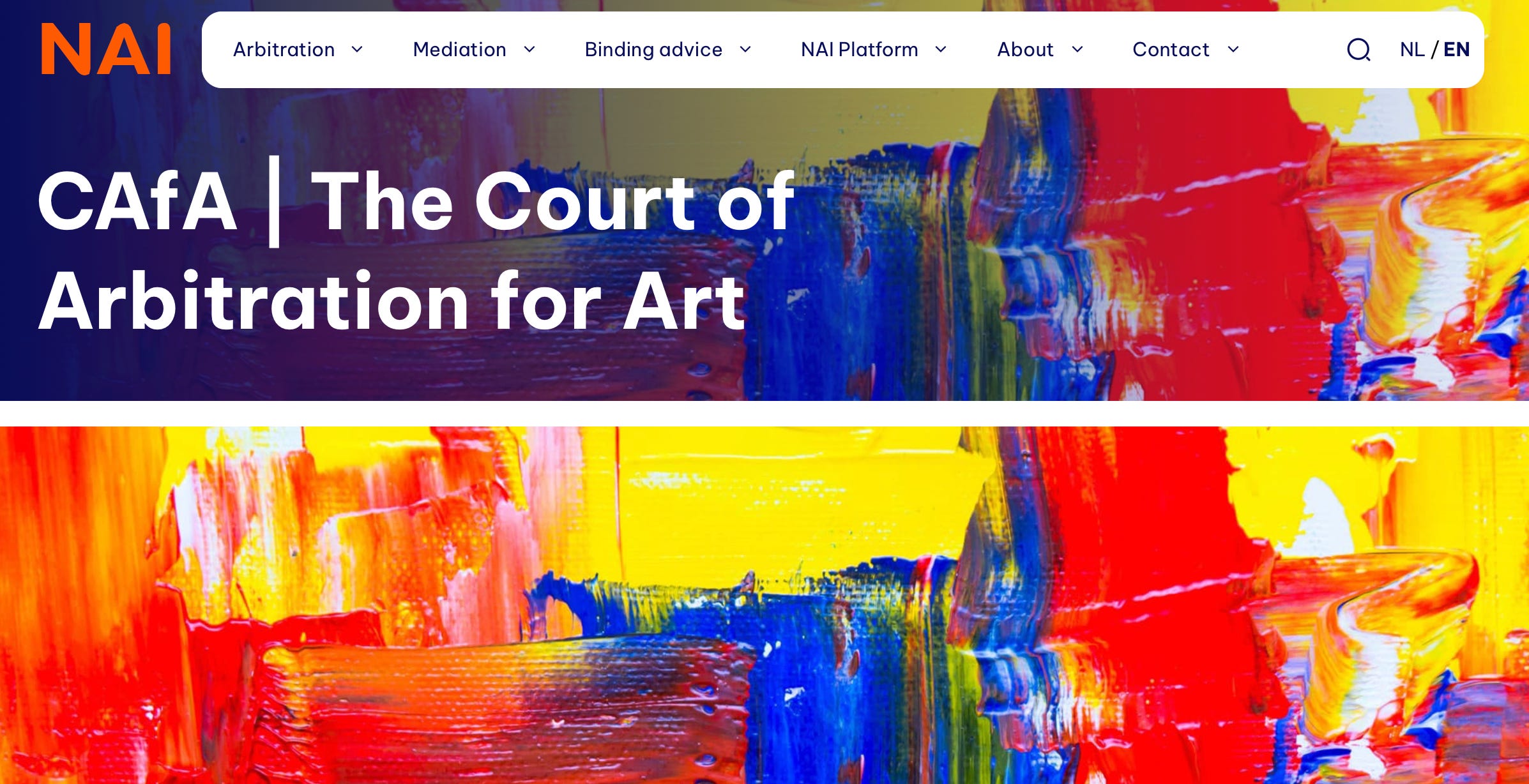
In 2018, the Netherlands Arbitration Institute (NAI) and Authentication in Art (AiA) in The Hague launched an arbitration court specifically designed to hear these types of art cases. The new entity is called the Court of Arbitration for Art (CAfA).
It was formed in response to the Groninger Plough forgeries case. That crime ring in Groningen, the Netherlands, spawned a legal battle that has been running since 1991, culminating in a series of events that led to the creation of CAfA. The Plough’s reputation is tarnished: nearly 400 works from the collection at the center of the case are suspected forgeries or stolen goods. This is unsettling because the Plough was a respected art collective founded in 1918. The forgers targeted an actual group and exploited the movement. One forger has been identified, but others remain at large.
Arbitration is one of several paths within the legal umbrella of Alternative Dispute Resolution, or ADR. As I mentioned before, when two parties have a conflict, they can resolve it through arbitration, mediation, or negotiation, rather than suing each other and heading to court.
Arbitration specifically is a private legal hearing. Instead of a judge, the case is decided by a qualified arbitration professional, or a panel of them. In specialized courts, such as an art-specific arbitration tribunal, arbitrators bring both legal training and art expertise to the table. That combination is the whole pitch: someone who actually understands the subject matter is the one deciding the case.
And in the case of CAfA, all arbitrators are legal professionals and trained arbitrators. They are judges, lawyers, and art professors. They know the law as well as the art world. Each has specialized training in fields of art, including provenance and forensic science.
Art disputes are technical in ways most legal disputes aren’t. Authentication and attribution questions involve forensic science and provenance research that can stump even seasoned experts, let alone a general civil court.
That’s the gap the Court of Arbitration for Art, or CAfA, was built to fill. It’s the first arbitration tribunal in the world devoted exclusively to art. Other specialized panels exist for other industries, but none had been built for art until CAfA.
CAfA is trying to close the gap between adjudicated issues and authentication issues. When a judge issues a ruling in court regarding the provenance or authenticity of a work of art, that art is effectively spoiled. The law stands. No professional can vouch for its authenticity afterward, whether they are correct or not. So few owners want a work to go to trial because of this danger. This is also why artist foundations will no longer authenticate works they don’t own.
Arbitration panels give relief here. They are fielded by art world professionals, not just legal adjudicators.
CAfA is co-founded by the Netherlands Arbitration Institute (NAI) and Authentication in Art (AiA). It’s seated in The Hague.
Arbitrators at CAfA are private judges, lawyers, and law professors drawn from a vetted international pool. They’re selected specifically for expertise in provenance and forensic science, the two issues that come up again and again in art disputes. When a case is heard, both parties present their arguments, and the panel issues a binding decision. There’s no appeal.
The number of arbitrators depends on the value of the work in dispute. There is one arbitrator for art valued under €1.5 million, three for anything above that, though parties can agree to deviate from the default.
CAfA’s real goal isn’t just efficient dispute resolution. They aim to reduce the flow of forgeries through the art market by providing the field with a credible, expert-driven venue to resolve authentication disputes.
Is it working? It’s hard to say. As of today, CAfA has not heard a single case since its founding.
On paper, the case for arbitration over litigation is strong:
It’s typically cheaper and faster than going to court.
Cases are decided by subject-matter experts, not a judge who might be hearing a contract dispute one day and an art case the next.
Arbitration awards are enforceable across borders, under the 1958 Convention on the Recognition and Enforcement of Foreign Arbitral Awards (the New York Convention).
Proceedings are confidential, and procedures can be tailored to the parties’ actual needs.
Remedies are more flexible than what a court can offer. Parties can design solutions such as long-term loans or co-ownership arrangements, rather than being limited to damages or injunctions.
But the crickets are chirping. Where are all the customers?
Despite the advantages, very few art law disputes actually go to arbitration.
Part of the problem is structural. Arbitration generally must be included in a contract in advance for both parties to be bound by it. It’s not something you can default into after a dispute has already started. And once you’re in arbitration, the arbitrators have broad discretion: there are no formal rules of evidence, the way there are in court.
Part of the problem is the art world itself. It’s a small field, and art law is an even smaller subset of it. There are potential conflicts of interest within a small pool of arbitrators.
And part of the problem is institutional inertia. Auction houses, the entities most likely to drive adoption of a new dispute mechanism, largely still rely on general commercial arbitration bodies.
CAfA has the structure, the expert pool, and the rules ready to go. What it doesn’t have is a track record.
Will we ever trust CAfA? Which disputing parties will be the first to trust the professionals ready to handle this type of work?
Comments
Nothing yet. Say the first thing.
Sign in to join the conversation.