

In C. S. Lewis’s The Silver Chair, Jill Pole finds herself desperately thirsty. She has wandered through an unfamiliar place long enough for thirst to become the one thing she can think about. Then she hears it: the sound of running water. A stream is nearby.
The sight and sound of it only make the thirst worse. The water is close enough to reach, clear enough to invite her forward, and exactly what she needs. Yet Jill does not move.
There is a Lion beside the stream.
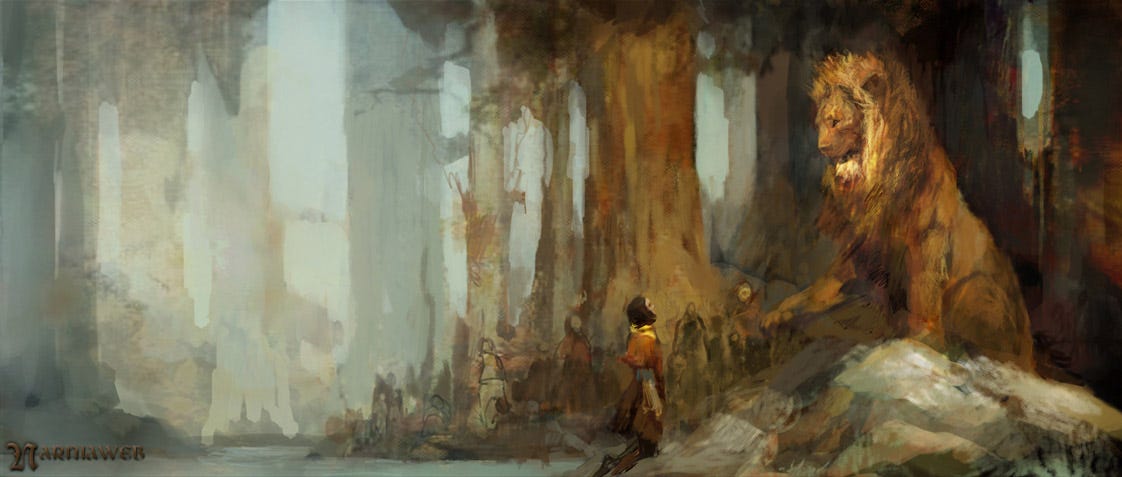
Aslan lies between her and the water, and Jill is terrified. She wants to drink, but she does not want to come any closer to him. For a while she simply stands there, caught between thirst and fear, listening to the stream while her need grows more painful.
Then Aslan speaks, “If you are thirsty, come and drink.”
Jill admits that she is dying of thirst, but she still hesitates. She asks whether he might move away while she drinks. He refuses. She asks whether he will promise not to harm her if she comes near. He makes no promise. The stream continues running beside him, close enough to hear, while Jill searches for some way to have the water without having to approach the Lion.
Finally, she suggests that perhaps she should leave and find another stream.
Aslan answers with a sentence that gives the whole scene its weight,
“There is no other stream.”
The water is there. Aslan has already invited her to drink. Yet Jill keeps searching for some way to reach the stream without having to come near the Lion. There is none. If she is going to drink, she must come to Aslan.
John 4 introduces us to another woman standing beside another source of water. She arrives at Jacob’s well carrying a jar, expecting to meet an ordinary need on an ordinary day. Instead, she finds Jesus sitting beside the well.
Before their conversation is finished, Jesus will speak of living water, bring the truth of her life into the open, answer her questions about worship, and finally reveal Himself as the Messiah. The water He offers cannot be separated from the One offering it.
The deepest thirst of the soul will never be satisfied by finding another well.
There is no other stream.

John 3 ends with John the Baptist directing all attention toward Christ: “He must increase, but I must decrease.” John 4 shows us why. Beside an ordinary well, Jesus meets a Samaritan woman who has come looking for water and begins speaking to her about a life only He can give.
The image of thirst runs through the encounter. We know the pattern well. We return to relationships, success, pleasure, approval, comfort, religion, and countless other places hoping to find something that lasts. Some satisfy for a season, but none can give eternal life. Eventually, we find ourselves thirsty again.
Jesus offers the only thing that can truly satisfy: living water.
“Now when Jesus learned that the Pharisees had heard that Jesus was making and baptizing more disciples than John (although Jesus himself did not baptize, but only his disciples), he left Judea and departed again for Galilee. And he had to pass through Samaria. So he came to a town of Samaria called Sychar, near the field that Jacob had given to his son Joseph. Jacob’s well was there; so Jesus, wearied as he was from his journey, was sitting beside the well. It was about the sixth hour.”
John 4 opens with Jesus leaving Judea for Galilee after the Pharisees hear that His ministry is drawing more disciples than John’s. John clarifies that Jesus Himself was not performing the baptisms, but His disciples were. With attention around His ministry increasing, Jesus departs Judea and begins traveling north.
John tells us that He “had to pass through Samaria.” Samaria lay between Judea and Galilee, making it a direct route north. John’s wording also prepares us for what is about to happen there. This journey through a region many Jews regarded with suspicion will become the setting for an encounter that reveals the reach of Christ’s mercy.
The hostility between Jews and Samaritans reached back centuries. Their histories, worship, and understanding of Scripture had diverged significantly. The Samaritans worshiped at Mount Gerizim and received the Pentateuch as Scripture, while the Jews worshiped at the temple in Jerusalem. By the first century, these differences had hardened into deep religious and ethnic suspicion.
The woman herself will bring that tension to the surface a few verses later when she asks, “How is it that You, a Jew, ask for a drink from me, a woman of Samaria?” She knows how unusual this conversation is. Jesus knows it too.
His journey brings Him to Sychar, near the field Jacob had given to Joseph. There, beside a well tied to Israel’s history, John gives us a remarkably ordinary picture of Jesus: “Jesus, wearied as He was from His journey, was sitting beside the well.”
There is something striking about seeing the eternal Word exhausted beside a well. The One through whom all things were made has walked beneath the heat of the day until He needs to sit and rest, and soon the One who made the waters of the earth will ask someone else for a drink. John allows the genuine humanity of Christ to stand in full view. Jesus knows weariness, thirst, and the strain of a long journey.
Yet this weary, thirsty traveler is about to speak of water that Jacob’s well could never provide.
Around noon, a Samaritan woman approaches to draw water. John has not yet told us much about her. We do not know the circumstances behind her past or the questions she carries with her. For the moment, she is simply a woman coming to a well with a jar in her hand.
Before she knows who Jesus is or understands what He can give her, He speaks first. Their conversation crosses several boundaries at once. He is a Jew speaking with a Samaritan and a man speaking publicly with a woman. Soon He will show that He knows the complicated history of her life as well.
“A woman from Samaria came to draw water. Jesus said to her, “Give me a drink.” (For his disciples had gone away into the city to buy food.) The Samaritan woman said to him, “How is it that you, a Jew, ask for a drink from me, a woman of Samaria?” (For Jews have no dealings with Samaritans.) Jesus answered her, “If you knew the gift of God, and who it is that is saying to you, ‘Give me a drink,’ you would have asked him, and he would have given you living water.” The woman said to him, “Sir, you have nothing to draw water with, and the well is deep. Where do you get that living water? Are you greater than our father Jacob? He gave us the well and drank from it himself, as did his sons and his livestock.” Jesus said to her, “Everyone who drinks of this water will be thirsty again, but whoever drinks of the water that I will give him will never be thirsty again. The water that I will give him will become in him a spring of water welling up to eternal life.” The woman said to him, “Sir, give me this water, so that I will not be thirsty or have to come here to draw water.”
Jesus opens with a simple request: “Give Me a drink.” His disciples have gone into the city for food, and His words immediately catch the woman off guard. “How is it that You, a Jew, ask for a drink from me, a woman of Samaria?” John explains her surprise plainly: Jews had no dealings with Samaritans.
The distance between them was real, but Jesus quickly moves the conversation beyond the social boundary she has noticed. “If you knew the gift of God, and who it is that is saying to you, ‘Give Me a drink,’ you would have asked Him, and He would have given you living water.”
Jesus begins with the words, “If you knew.” The woman does not yet understand the gift because she does not know the identity of the One offering it. As the conversation unfolds, those two questions will remain inseparable: What is this living water, and who is the Man who can give it?
She takes His words in their most immediate sense. The well is deep, Jesus has no bucket, and she cannot see where this water would come from. Her response resembles Nicodemus in the previous chapter. When Jesus spoke of being born again, Nicodemus pictured another physical birth. When Jesus speaks of living water, the woman thinks in terms of the well standing before them. In both conversations, Jesus begins with something familiar and gradually leads His listener toward a spiritual reality they have not yet understood.
The woman then asks whether Jesus is greater than Jacob, who gave them the well. She does not yet know how large that question is. Jacob’s well had supplied water for generations. Jesus is offering something no patriarch, however great, could give.
“Everyone who drinks of this water will be thirsty again,” Jesus tells her, “but whoever drinks of the water that I will give him will never be thirsty again.” Jacob’s well can meet a real need, but only for a time. Anyone who drinks from it will eventually return. The water Jesus gives becomes “a spring of water welling up to eternal life.”
Jesus is speaking about life that comes from God and endures forever. Later in John’s Gospel, He will again invite the thirsty to come to Him and drink, and John will connect that promise with the Holy Spirit. Living water therefore reaches far beyond a vague sense of fulfillment. Jesus is speaking of eternal life, given by God through the Son.
The imagery also reaches into the ordinary longings of the human heart. We return again and again to things we hope will make us feel secure, satisfied, or whole. Relationships, achievement, recognition, comfort, possessions, and experiences can all be good gifts, but they make poor saviors. None can bear the weight of our deepest need. Their pleasures fade, circumstances change, and the thirst returns.
The woman wants what Jesus is describing, even though she still misunderstands it. “Sir, give me this water, so that I will not be thirsty or have to come here to draw water.” Her mind is still on the well and the inconvenience of returning to it each day.
Jesus now brings the conversation into her own life. His next words sound abrupt, “Go, call your husband, and come here.” The subject has not changed as much as it first appears. Jesus is about to bring her need for living water into contact with the truth about her own life.
“Jesus said to her, “Go, call your husband, and come here.” The woman answered him, “I have no husband.” Jesus said to her, “You are right in saying, ‘I have no husband’; for you have had five husbands, and the one you now have is not your husband. What you have said is true.”
The woman answers Jesus simply: “I have no husband.”
Jesus replies, “You are right in saying, ‘I have no husband’; for you have had five husbands, and the one you now have is not your husband.” In a few sentences, the conversation moves from water to one of the most personal parts of her life.
Jesus has been speaking about a need that ordinary water cannot satisfy. Now He turns toward the condition of the woman asking Him for that water. The gift He offers will only make sense as she begins to see the need from which she must be saved.
We should be careful here not to write a story John does not give us. The fact that she has had five husbands tells us nothing about how each marriage ended. Death, abandonment, divorce, personal sin, or some combination of circumstances may have played a part. The text does not invite us to reduce this woman to a caricature of sexual immorality. Jesus does make one thing clear: the man she is presently with is not her husband. As John MacArthur points out in his commentary on this verse, he says, “By such an explicit statement, our Lord rejected the notion that when two people live together it constitutes as marriage. Biblically, marriage is always restricted to a public, formal, official, and recognized covenant.”
The Apostle John’s larger emphasis falls on Jesus’ knowledge of her. She gives Him only a short answer, yet He knows the history behind it. He knows what is true about her life before she has any real understanding of who He is.
The way Jesus handles that knowledge is equally important. He does not humiliate her or turn her past into a spectacle. He also refuses to speak around the truth. He names her situation plainly and continues the conversation.
Jesus has already offered this woman living water, knowing exactly who she is. Nothing in her history surprises Him, and nothing about her present life has escaped His notice. He knows the truth she has not told Him and continues speaking with her anyway.
Her story also gives the imagery of thirst a sharper edge, though we should avoid claiming more than the text tells us. John never says that each of her relationships was a deliberate attempt to fill a spiritual emptiness. The broader pattern, however, is familiar to every sinner. We regularly ask created things to carry expectations they were never designed to bear. We look to relationships, pleasure, security, approval, or success and quietly hope that one of them will finally be enough. Sin feeds on promises like that. It holds out some pleasure, relief, or fulfillment and convinces us that satisfaction lies just beyond our reach. Then the moment passes, the appetite returns, and we begin looking again.
Jesus knows where those wells lead. His offer of eternal life comes with the light of truth shining into the places we would rather keep hidden. The woman cannot keep Jesus at a comfortable distance while receiving the life He gives. He knows her too well for that.
Still, Jesus remains beside the well and continues speaking with her. He sees the disorder in her life and continues drawing her toward Himself. In fact, His knowledge of what she has not told Him becomes part of the way she begins to recognize who He is.
“The woman said to him, “Sir, I perceive that you are a prophet. Our fathers worshiped on this mountain, but you say that in Jerusalem is the place where people ought to worship.” Jesus said to her, “Woman, believe me, the hour is coming when neither on this mountain nor in Jerusalem will you worship the Father. You worship what you do not know; we worship what we know, for salvation is from the Jews. But the hour is coming, and is now here, when the true worshipers will worship the Father in spirit and truth, for the Father is seeking such people to worship him. God is spirit, and those who worship him must worship in spirit and truth.”
The woman now sees Jesus differently. “Sir, I perceive that You are a prophet.” She still does not understand exactly who He is, but His knowledge of her life has convinced her that she is speaking with someone who possesses unusual spiritual authority.
She raises the long-standing dispute between Jews and Samaritans: “Our fathers worshiped on this mountain, but you say that in Jerusalem is the place where people ought to worship.” Some interpreters see this as an attempt to steer the conversation away from her personal life. That is possible, but John never tells us her motive. She may simply realize that if she is sitting across from a prophet, she has an opportunity to ask about a question that had divided her people from the Jews for generations.
The mountain she refers to is Mount Gerizim, the center of Samaritan worship. The Jews worshiped at the temple in Jerusalem. Their disagreement reached into Scripture, history, identity, and the proper way to approach God. Jesus takes her question seriously. “Woman, believe Me, the hour is coming when neither on this mountain nor in Jerusalem will you worship the Father.” The coming of Christ is bringing the long dispute over sacred geography toward its fulfillment. The worship of God will no longer be centered upon access to Gerizim or Jerusalem.
Jesus does not treat the Samaritan and Jewish positions as equally correct. “You worship what you do not know; we worship what we know, for salvation is from the Jews.” God had entrusted His revelation and covenant promises to Israel, and the Messiah Himself would come from the Jewish people. Samaritan worship had departed from that revelation in serious ways. Jerusalem, however, was also pointing beyond itself. Earlier in John, Jesus had spoken of His own body as the true temple. Now He tells the woman that “the hour is coming, and is now here,” when true worshipers will worship the Father “in spirit and truth.” With the arrival of Christ, worship is being drawn away from a debate over competing sacred locations and toward the reality to which the temple itself pointed.
Worship “in spirit and truth” reaches beyond location and outward ceremony. It arises from within and accords with the truth God has revealed. As John’s Gospel unfolds, both ideas are drawn increasingly toward Christ, who reveals the Father, and toward the Spirit of truth whom He will give to His people.
Jesus grounds this in God’s own nature: “God is spirit, and those who worship Him must worship in spirit and truth.” God is not confined to Gerizim, Jerusalem, or any other earthly location. He must be approached as He truly is and according to the revelation He has given.
The same warning reaches us. A person can inherit Christian vocabulary, attend church faithfully, sing familiar songs, and participate in every outward practice while the heart remains distant from God. Religious habits have value, but they cannot substitute for knowing the One we worship.
The woman began by asking which mountain was right. Jesus has led her toward the God who seeks true worshipers and toward the Messiah through whom He makes Himself known.
She knows enough to understand that the Messiah will finally bring clarity.
“The woman said to him, “I know that Messiah is coming (he who is called Christ). When he comes, he will tell us all things.” Jesus said to her, “I who speak to you am he.”
The woman responds by looking toward the Messiah: “I know that Messiah is coming (He who is called Christ). When He comes, He will tell us all things.”
She is waiting for someone who can settle these questions. The Messiah will come, the confusion will clear, and the truth will finally be made known. What she cannot yet see is that the One she is waiting for is already sitting beside her.
Jesus gives a direct answer: “I who speak to you am He.”
The conversation has been leading here from the beginning. She first knew Him only as a Jewish traveler, then wondered whether He might be greater than Jacob, and finally recognized Him as a prophet. Now Jesus tells her plainly who He is. His identity makes sense of everything He has said. The One offering living water is the Messiah Himself. He knows her life, speaks with authority about the Father, and offers eternal life because of who He is.
She came thinking about ordinary water. Jesus has led the conversation through eternal life, her own condition, the nature of true worship, and finally the coming of the Messiah. The answer to her spiritual thirst has been sitting in front of her all along.
Eternal life is found in Christ Himself. No well, religious tradition, or sacred mountain can give the woman what the Messiah standing before her offers.
Jesus reveals His identity personally to a Samaritan woman beside a well, fully aware of her history and the life she is presently living. One of the clearest declarations of His messianic identity in John’s Gospel is given in the middle of this quiet, unlikely conversation.
She came carrying a water jar and found herself speaking with the One who gives living water. The Messiah she expected someday to come was already sitting beside her.
She had said, “When He comes, He will tell us all things.”
He had already come.
Reflection Question(s): What “well” are you most tempted to return to for satisfaction, security, or identity, and what does your repeated return to it reveal about what you are asking it to provide? Are you willing to come to Christ as He is, allowing Him to expose your sin, correct your worship, and satisfy your deepest need, or are you still looking for another stream?

Jill Pole could hear the stream. The water she desperately needed was only a short distance away, yet reaching it meant approaching Aslan. She searched for another option until the Lion finally told her the truth she could no longer avoid: “There is no other stream.”
The Samaritan woman came to Jacob’s well without knowing how deeply those words would fit her own story. She wanted the water Jesus described long before she understood the Man offering it. Patiently, Jesus led her from the well to her own life, from her life to worship, and from worship to the question of the Messiah. Then He revealed that the One she was waiting for had been speaking with her all along.
The living water was standing in front of her.
The same thirst runs through our lives. We return to relationships, success, comfort, approval, pleasure, and even religion, asking them to give us something lasting. Some are good gifts and others become sinful substitutes, but all of them reach their limit. None can give eternal life.
Christ knows every place we have looked for satisfaction and every part of ourselves we would rather keep hidden. Still, His invitation remains. He tells us the truth about our sin and offers the life only He can give.
At the stream, Jill finally has to reckon with Aslan’s words: “There is no other stream.”
John 4 brings us to the same truth. No other well can satisfy the soul, and no other Savior can give eternal life.
If we are thirsty, we must come to Christ.
There is no other stream.
Comments
Nothing yet. Say the first thing.
Sign in to join the conversation.