
Six posts in, and it’s time to show my work — the last of this long-running series on measurement.
How do we turn everyday community engagement into a force for social renewal? Engagement processes are often focused on simply soliciting input or recruiting people into pre-existing causes. Yes, important work. But that next step of connecting, bridging, and cultivating shared identities — let’s call it “community building” — is often missed.
For those following this Substack, you’ll know I’ve been recently exploring the potential of measurement tools to hasten the integration of community building into engagement practices. Perhaps if we can show some quantifiable “evidence” of stronger, more connected communities, it will motivate funders and decision-makers to invest in this work.
The sustainable design movement offers an instructive roadmap. The introduction of measurement standards like LEED (Leadership in Energy and Environmental Design) created shared benchmarks and a shared language that allowed sustainability to be institutionalized and incentivized. LEED took a nascent but powerful collection of ideas (sustainability) and catalyzed them into a paradigm shift for the built environment professions.
We now face a similar crisis analogous to the one that galvanized the environmental movement -- but this time with social fragmentation. Can we take an equally fuzzy concept that rarely appears on anyone’s balance sheets — “community” — and again incentivize the folks with power and capital to take notice?
In this spirit, over the last six posts, we’ve explored:
How sustainable measurement standards like LEED accelerated the widespread adoption of sustainable design practices, and how this might be a similar path for community engagement and community building.
Whether existing measurement standards (LEED, SITES, LBC, SEED) already include relevant metrics for engagement processes or community building. (They don’t).
The need to ensure that we are measuring inclusive social identities that incorporate people of all identity groups, not homogeneous groups that exclude others.
The need to be clear about our psychological and geographic units of measure, in particular, focusing on “place-based communities” at the scale of the neighborhood.
Exactly what questions to ask in our measurement, using a framework of social relationships, identity, and power.
An ambitious proposal to create a new unit of measurement - neighborhood boundaries — to replace the largely worthless units of census blocks and zip codes.
So let’s circle back to the original impetus for this series: what would a certification standard look like?
As a reminder, this question is largely directed at top-down project-based approaches, like when a government hires a consultant to “engage” a community in some sort of design, planning, or policy decision. Yes, it could also appliey to bottom-up engagement projects, like those done by community organizers. However, in both cases, we must be mindful not to let measurement take away the joy and creativity that centers such community building efforts.
Below, finally, is a draft outline of a measurement standard.
There’s considerably more detail behind each section that I can’t fit into a single post. Think of what follows as the index, not the full text.
The ideas in this draft are built upon my years-long exploration of social and environmental psychology. It’s also built upon my 20 years of practice working directly with communities and teaching community engagement methodologies.
There’s a book’s worth (wink) of thinking underpinning this, but two concepts are at its core:
Bridging: Bridging identity groups — whether race/ethnicity, politics, income, or whatever — by leveraging insights from social psychology’s intergroup contact theory.
Place-Belonging: Creating connections and shared-identities at the neighborhood scale — the unit of change for which we are evolutionarily predisposed for enduring meaningful relationships, and the seedbed of pluralistic Democracy.
Within this framework, there’s still plenty to debate about what engagement practices best contribute to bridging and belonging. This is my take.
If you’re interested in contributing to the discussion, I’m assembling a working group of folks to shepherd this toward reality. Please reach out if you would like to join.
Here’s what this standard could look like, with a little commentary in parentheses and links to previous posts that explain these ideas further.
Define your place-based community boundary
Provide demographic information for the community within that boundary
Define overall project outcomes.
Define the community question(s). What it is that you want to hear from community? How will their feedback be reflected in the final project outcome?
Define decision making structure, ie. “Who decides?”
(The Project Information section establishes important prerequisites, ensuring projects are clear about their engagement process and are working within a defined place-based community. My last post about neighborhood boundaries was in direct response to the need for a neighborhood boundary, however fuzzy, to support this measurement framework.)
1.1 Prerequisite: Establish a Steering Group
1.2 Prerequisite: Develop a community engagement plan with Steering Group participation
1.3 Steering Group composition = racial/ethnic, political, and economic diversity within 10% of neighborhood.
1.4 Steering Group Composition = Identity Group Alternate within 10% of neighborhood.
(In the early stages of the engagement process, establishing a Steering Group that stewards the engagement process is an essential prerequisite. The Steering Group is solely focused on process, not on project outcomes, and answers the question “How to we best have the conversation as a community?”
It is critical that the Steering group represents the diversity of the community you intend to engage. To gauge the inclusion of identity groups, I’m using three primary demographic indicators of diversity: race/ethnicity, politics, and socioeconomic status. However, the “identity-group alternative” allows the addition of other identity group(s) that might be important to your community engagement process (ex. education status, pickleball/tennis players, dog-park advocates, etc.). Perfect representation is nearly impossible, so I’m giving a +/- 10% buffer.)
2.1 Prerequisite: Undertake Participant Surveys
2.2 Collect Stories through In-Depth Interviews
(We can’t have a standard without asking people to measure things, no? This section provides guidance and ensures rigor in quantifying the community metrics that feed the rest of the standard, especially sections 6-8. See my previous post for what questions should be included in a survey.)
3.1 Prerequisite: Minimum three in-person events
3.2 Prerequisite: Public collection and sharing of perspectives across event participants
3.3 Provide food and childcare
3.4 Employ best time management strategies
3.5. Provide time for informal socialization
(This section requires the implementation of best practices for community events that will bridge identity groups and foster place-belonging. It doesn’t prescribe what type of community event (ex. community meetings), but social psychology is clear that there needs to be many interactions over a limited period of time. Social psychological research also makes clear that event participants need to have the opportunity to hear the perspectives of others, an essential mechanism for bridging and cultivating shared identities.)
4.1 Participants = ethnic/racial diversity of neighborhood within 10%
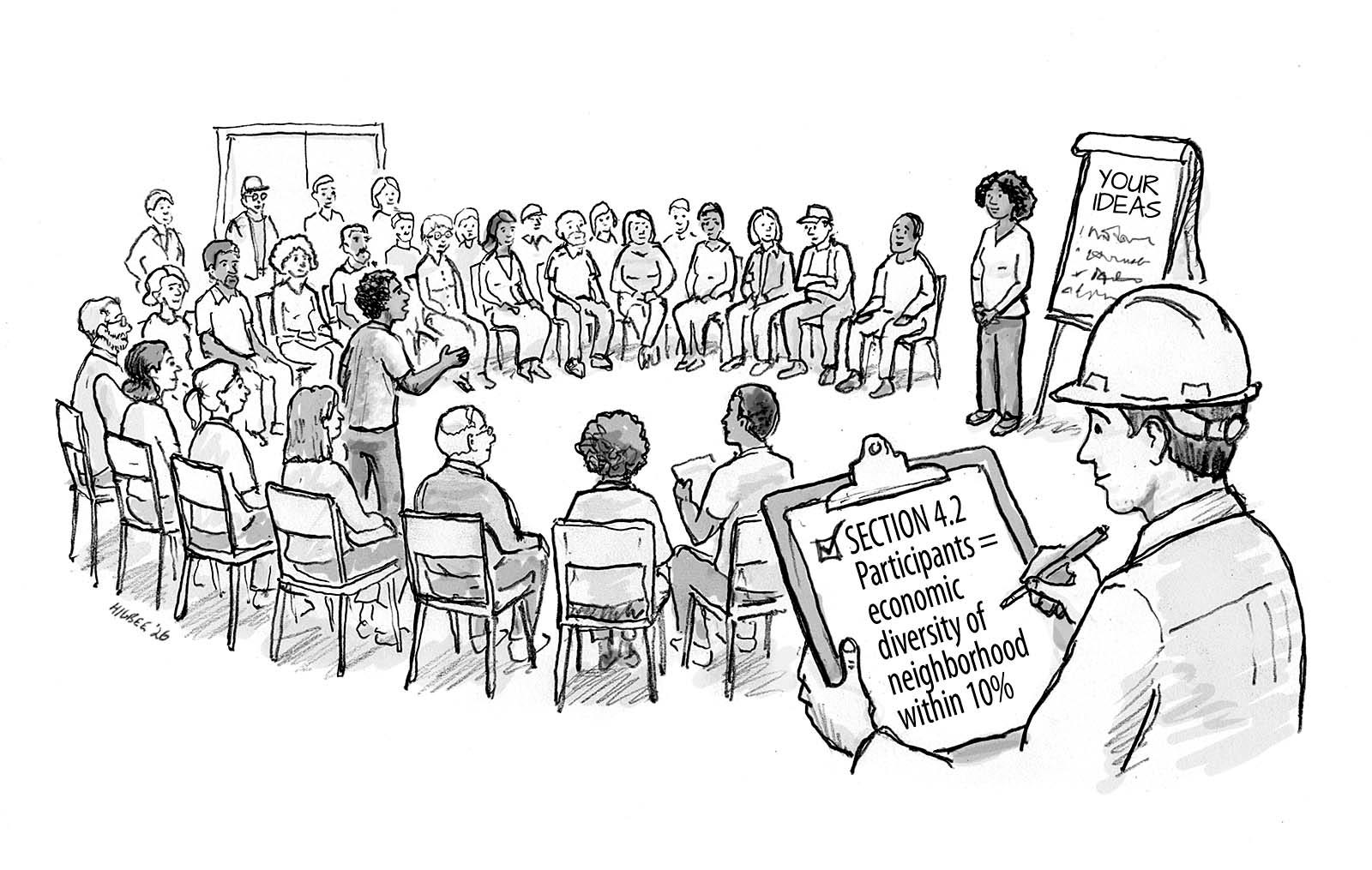
4.2 Participants = economic diversity of neighborhood within 10%
4.3 Participants = political diversity of neighborhood within 10%
4.4 Identity Group Alternate = diversity of neighborhood within 10%
(Diversity in participation is essential for our bridging goals. Again, this uses race/ethnicity, politics, and socioeconomic status as indicators of diversity. But it also allows other identity groups as well through an alternative. )
5.1 Prerequisite: Incorporation of community feedback into outcome
5.2 Community Work Parties
(You might be surprised to see the incorporation of community feedback as a short and simple prerequisite. That’s because incorporating community feedback into the outcome should be assumed — it’s the floor of any engagement process. This measurement standard is about taking the next step. It’s not about out whether the outcomes reflect the community, but how the process generates stronger communities.
Also, community work parties — events where we move into action and use our bodies — are some of the most powerful community-building tools, yet rarely implemented. Incorporating them will help achieve the highest rating in this standard.)
6.1 Increase in Cross-cutting Social Ties
6.2 Increase in Social Networks
(This is the first of three sections at the core of the standard, built off of the Trust for Public Land’s Common Ground Framework, as measured using the measurement tools prescribed in Section 2.0)
7.1 Increase in Place Attachment
7.2 Increase in Sense of Community
7.3 Increase in Social Inclusion
(This is the second of three sections at the core of the standard, built off of the Trust for Public Land’s Common Ground Framework, as measured using the measurement tools prescribed in Section 2.0)
8.1 Increase in Social Capital/Trust
8.2 Increase in Social Efficacy
8.3 Increase in Civic Participation
(This is the third of three sections at the core of the standard, built off of the Trust for Public Land’s Common Ground Framework, as measured using the measurement tools prescribed in Section 2.0)
9.1 Presence or support for an enduring group or institution that fosters community-building.
(Community building is long-term and relational, and it often at odds with the project-based context of top-down engagement. An essential part of enduring impact is ensuring that your community-building work is carried on by a community-based organization or institution (like a local government). Achieving points in this section is a prerequisite for reaching the highest rating in this standard.)
Okay, that’s it. What do you think? A quixotic fool’s errand, or critical catalyst?
Leave a comment, send a message, or join the Substack chat.
And again, if you are interested in joining a working group exploring how to bring this to life, please reach out.
~Eric
Comments
Nothing yet. Say the first thing.
Sign in to join the conversation.