
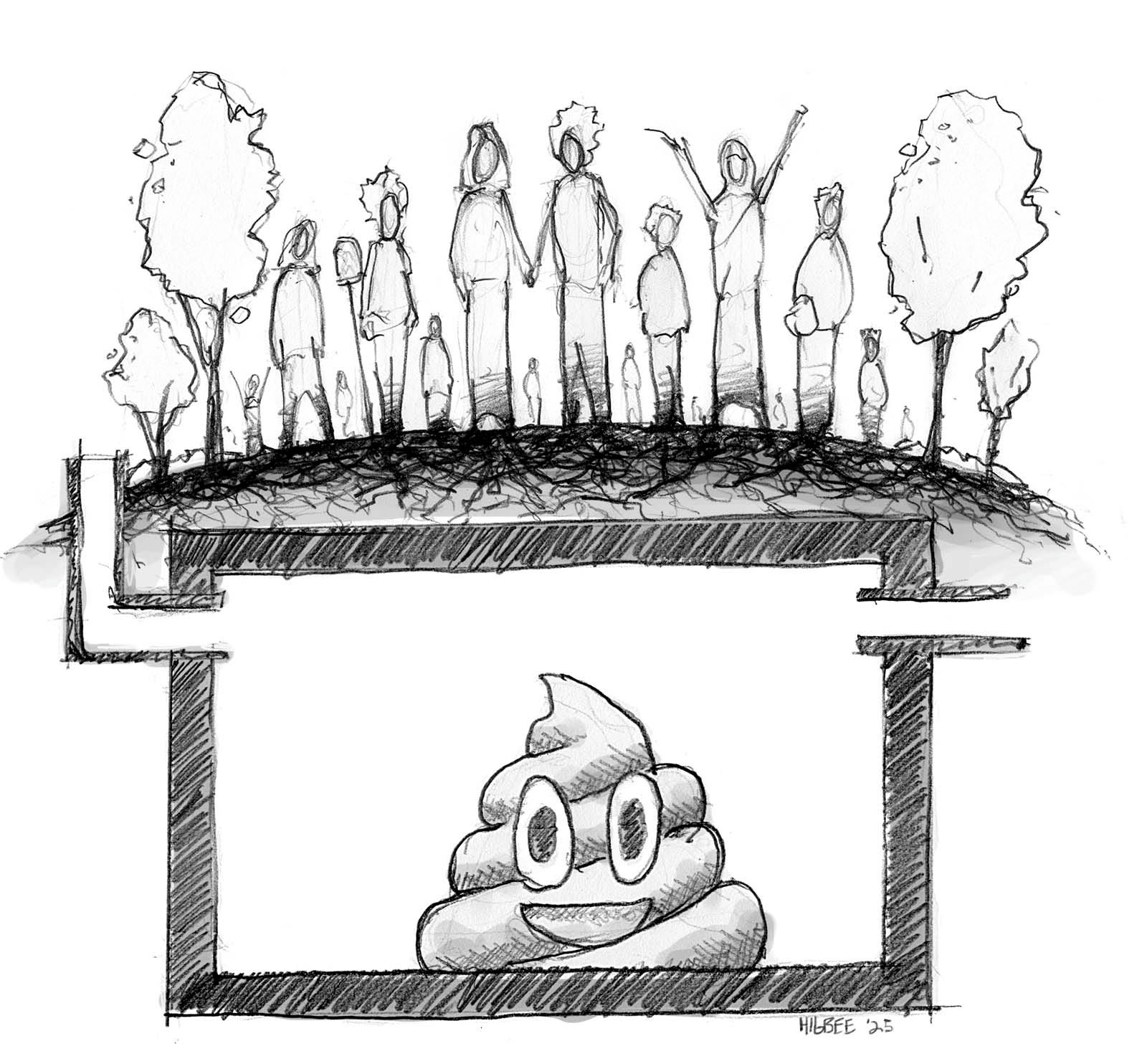
Imagine a community engagement process for the design and construction of an underground sewage storage tank.
Aside from storing feces, this storage tank will have no tangible impact on the community life of its above ground neighborhood. It doesn’t provide a space for people to meet, or share a cultural story. It’s literally underground.
But the engagement process for this new tank is widely successful:
A diverse representative swath of the neighborhood comes together to share their hopes and dreams for the storage tank.
Through a series of community meetings and events, neighbors get to know each other and form lasting bonds.
The tank builder finds ways to include community work parties in the construction process.
An association is formed to steward the tank’s maintenance.
The group holds regular festivals every year that reconvene their community to celebrate their shared tank-life together.
Yes, this is an outrageous example. But it illustrates how an engagement process can have an incredible community-building impact, even if the design product is a container of shit below ground.
I tell this story to illustrate a critical distinction when talking about project-based community engagement in design, planning and policy: the difference between the product and the process.
Shapers of the built environment create incredible community-building products — beloved public spaces and forward-looking plans that are shifting the trajectory of our towns and cities. These are invaluable social infrastructure investments supporting the regeneration of community life.
And the best of this work incorporates processes that solicit input from citizens through community engagement.
But just because the outcomes of this work (ie. the products) are socially regenerative, it doesn’t mean that the processes that created them are as well.
Just because the outcomes of this work (ie. the products) are socially regenerative, it doesn’t mean that the processes that created them are as well.
It’s entirely possible to conduct a community engagement process, even one that informs a great community-supporting final product, without the types of interactions that cultivate community connections.
In fact, it’s done all the time.
For example, many community engagement processes use only online surveys and open houses. Such techniques primarily involve one-way exchanges between project planners and citizens. Community members don’t share ideas or listen to each other. There is no fostering of the in-real-life group-bridging relationships that underpin robust inclusive place-based communities.
But this doesn’t stop folks from labeling these community engagement processes as community-building successes. I see this conflation frequently in portfolios and presentations — the processes and the products get lumped together into one big group. Folks assume that if a project’s final products create a stronger community, then its engagement process did too;
Sadly, this muddling inhibits a deeper evaluation of our engagement processes for their community-building efficacy. If we want to maximize the potential of community engagement as a force for social renewal, then we need to isolate the techniques and outcomes of community engagement practice on their own terms.
It may simply be a manifestation of our inherent human cognitive biases. “Outcome Bias” is one of the many biases that come with being human, captured stunningly in this chart.
Outcome Bias is the tendency to place more evaluative weight on outcomes while dismissing the process by which we reached that outcome. For example, a doctor who prescribes a successful treatment based on incomplete information and ignoring her trusted advisers. The doctor is still praised for her good judgment, even if the process by which she got there was flawed.
Sound familiar?
Another reason may be that humans have a natural preference for the discreet and measurable. It’s just easier to wrap our brains around things that are finished or exist in real physical space.
Humans have a natural preference for things that are discreet and measurable. It’s just easier to wrap our brains around things that are finished or exist in real physical space.
Object and outcome oriented thinking is particularly endemic to the built environment professions and the training we receive. We plan, design, and build things, no? So we place on pedestals the objects of our creativity: our design graphics, our physical spaces, our visions for the future.
Such outcomes are great to show to our clients and our constituents. See? We did it!
How did we get there? Err… it’s complicated.
This all adds up to major blind spot in how our professions and governments articulate and support process — particularly the arts of convening and public participation. It’s virtually absent from our awards, portfolio pages, and measurement tools. It’s also absent from our academic curricula, which is why I began teaching a university course on community engagement.
The results from last year’s community engagement practitioner survey were unambiguous about how engagement processes are critically under-valued and under-resourced. Engagement practitioners cited serious challenges due to a lack of time, money, leadership and training.
The process of community engagement has incredible potential to address the most significant issues of our time — rising disconnection and decreasing social trust and community life. But unless we separate the “how” from the “what” during project-based engagement, we won’t be able to apply the rigor needed to maximize its connective outcomes. We ignore the process at our peril.
Next time, we’ll step into one of the biggest gaps between process and product: what we measure. Stay tuned.
Potentialism then asks: in a world in which everyone has a gift, what kind of society should we build together?
Daniel Yudkin of the The Beacon Project is putting to work all of More in Common US’s amazing research with a compelling new framework called “Potentialism.” Check out his opening salvo. I’m excited to see where this goes — change begins with creating the right story to replace tired old narratives, and they’ve got a good one here.
Human beings are weak, needy creatures. We require encouragement and support in doing what we know is good. And yet we’ve created a world of unprecedented temptations at a moment in history when our old support systems have been dismantled.
I like it when folks get at the root of things. I think that’s why this piece by Damon Linker really resonated with me. He starts off with a rarely stated, but completely accurate truism: the technologies of Attention Economy technologies (cell phones, social media, etc.) are an addiction. Linker then taps into deeper cultural currents of how we have tempered the pleasure-seeking impulses of our human nature, and asks some big questions about this moment in time. Don’t miss it.
Okay, it’s autumn now, but it’s still just as timely (if not more so) to dive into new books, movies and podcasts about how to make the world a better place. Check out this summer reading list from Nandita Raghuram in the Chronicle of Philantrophy’s The Commons. It’s an excellent starting point, although there’s a lot of books I would add to this list. How about you?
Do you have a great example of how a community engagement process helped a community restitch its social fabric, or go from “Us vs Them” to “We.” Or, an example of how a community engagement process went off the rails? I’m collecting stories, and I’d love to talk to you. Please reach out.
Comments
Nothing yet. Say the first thing.
Sign in to join the conversation.