
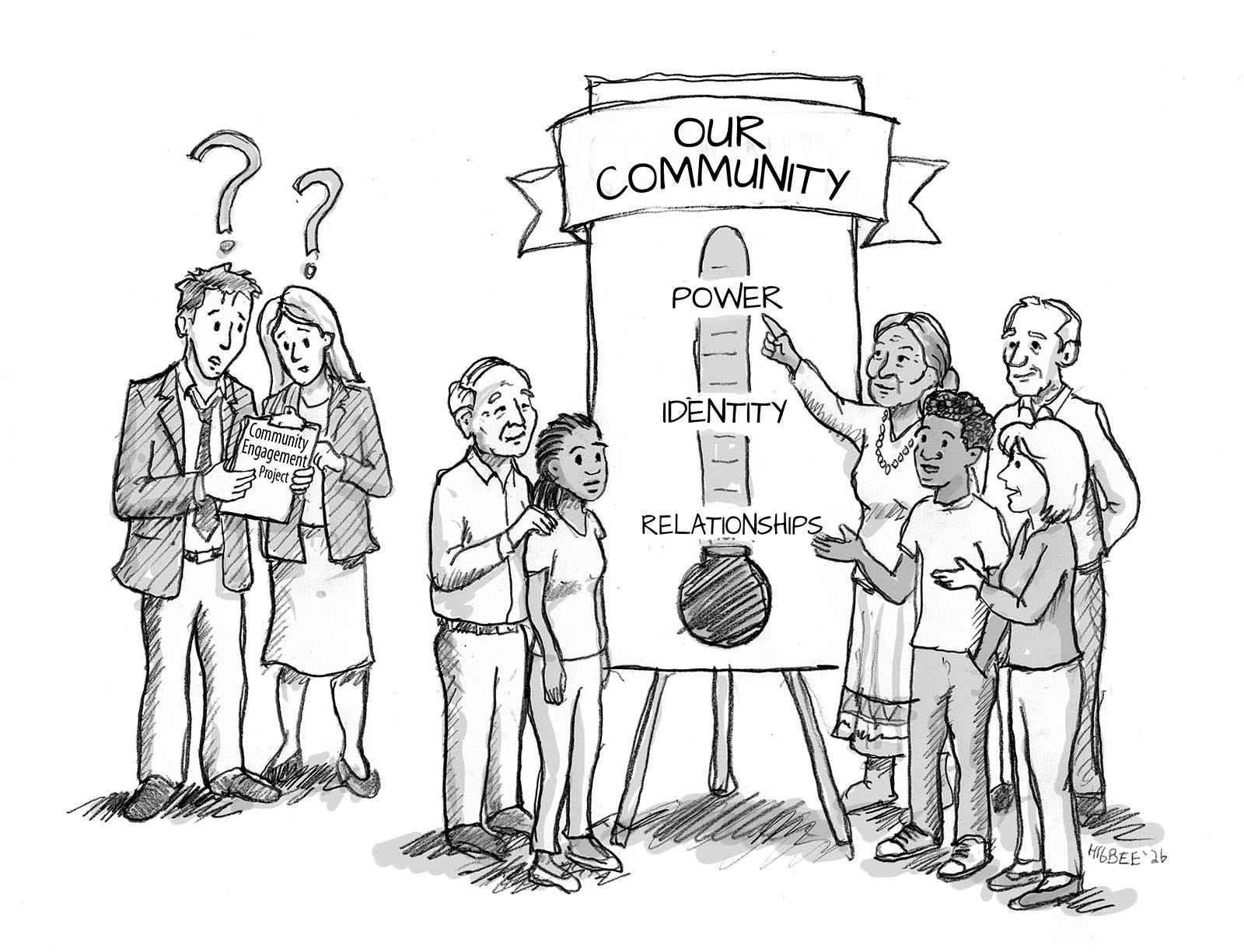
How do you know if your community engagement work is actually building community? That question has been driving this long-running series on measurement, and in this fourth installment, I get into the thick of it: what, exactly, should we be asking?
My goal is to develop two things: a quick, practical survey and a LEED-like standard that can gauge whether engagement work is genuinely strengthening community bonds. To get there, I’m borrowing the architecture of the Trust for Public Land’s Common Ground Framework, which organizes community health into three big buckets: Community Relationships, Community Identity, and Community Power. Each one gets its own set of questions and its own section below.
If you are interested in the full list of measurement questions that I’ve generated, please reach out. I am happy to share them, although they are still a work in progress. But I’m interested in seeing them put into action. Got an engagement project and want to give them a spin? Let’s talk!
We’ve had ways to measure social connection for a long time. But Dr. Vivek Murthy’s declaration of an Epidemic of Loneliness gave us an urgent reason to care. Suddenly, the dusty inventory of survey tools and evolving academic frameworks feel less like a research curiosity and more like a needed set of tools.
For example, take a look at the Ye ‘Ol Social Connection Measurement Tool Inventory, conveniently assembled by the Foundation for Social Connection. The inventory lists about 60 different ways to measure social connection, in all stripes and flavors.
Unfortunately for our purposes, many of these measurement tools are agnostic to place. They look at social connection, but not necessarily connection with people who live near you. All kinds of social connections have value, but place-based community connections are unique in their ability to provide mutual support, belonging, and inclusive shared identities. They are also the pathway to social cohesion and civic engagement.
Moreover, measurement tools that consider community-level connections might not explicitly define “community” as one of geographic proximity. It could be one of the many other ambiguous definitions of community that are bandied about today. A Reddit community? An entire city?
We should have our sights set on place-based communities at the scale of our neighborhoods. It is our most effective unit of change for restitching our social fabric.
So if we are going to measure social relationships in a community, we need to be specific about measuring neighborhood-level connection. Some questions we could ask include:
How many neighbors would you say you know personally, at least as acquaintances?
Of your neighborhood acquaintances, how many of these would you consider to be friends?
I regularly stop and talk with people in my neighborhood.
I wish I had more contact with people in my neighborhood.
We also need to gauge whether folks are connected to nearby community-based organizations. For example:
I take part in some social or civic groups in my neighborhood
I attend religious services in my neighborhood
But the work of social renewal also means bridging across different identity groups. Our fragmented society is rife with deep divisions and media echo chambers. So we want to ensure that our local communities embrace and encourage cooperation between people of all backgrounds and identities — what are called “cross-cutting” social relationships.
Cross-cutting relationships are the foundation of pluralism — people of different identities sharing spaces, institutions, and working together towards common well-being. And communities of geographic proximity have a unique ability, if not an essential role, in cultivating a pluralistic society.
Unfortunately, it gets a little more cumbersome when trying to measure relationships between different identity groups. There’s just so many ways we sort and identify ourselves. So we need to ask: what are the most common cleavages that we can bridge within place-based communities?
I think the big three are politics, race/ethnicity, and income. What do you think?
With these three in mind, we can ask how many connections folks have with people who are different from them. For example:
Of your neighborhood acquaintances, how many are of a different race or ethnic background than you?
…and so on.
In my last couple of posts, I’ve advocated for more measurement of environmental psychology concepts like place attachment and place identity. These are critical components of socially cohesive communities, and the “missing-middle” linking community relationships to community power.
I use the term “place” broadly to capture both the physical (i.e. the environment) and social (i.e. the community) components of a particular geography. This is a more general use than in academia, which typically slices and dices “place” into separate categories.1
Place attachment is the emotional bond between people and the places they inhabit — a bond formed through repeated experience, memory, and shared meaning. Think of the way your hometown has shaped you, or places that give you a sense of belonging. Decades of research confirm that these bonds are not nostalgia, but are integral to our well-being. The purely social component of that attachment — belonging not just to a place, but to its people — is what researchers call a ‘sense of community.’
Place identity is the cognitive sibling of place attachment. If attachment is something you feel, then place identity is about meaning-making. Our places anchor our sense of self and telling us something about who we are and where we belong. “I am of this place. It represents me.” When that meaning is shared — when a whole community is salient about the value of the place in which they reside together — this is called “Community Identity.”
Like social connection, academics have concocted a lot of ways to measure our place attachments and identities. My research has turned up about three dozen measurement frameworks. But we only have space for a few questions to capture the essence of these concepts. As with social connection, I’ve combed the literature and pulled out a few that I think are good candidates, like:
Being of this neighborhood is an important part of who I am.
Living in this neighborhood gives me a sense of community.
I feel attached to my neighborhood.
I am motivated to understand the thoughts and feelings of people who are my neighbors.
And as with our social connections, we need to ensure that our place attachments and identities are inclusive and tolerant of people of different backgrounds and groups.
We can test this by probing for false positives. For example, if an intolerant community, like a street gang or white supremacy group, scores highly on a measurement tool, then it’s not accounting for inclusiveness or tolerance. Such groups are extreme examples of the “dark side” of community — providing a sense of shared identity and belonging, but forged through intolerance or violent exclusion of outsiders. Robert Putnam, in Bowling Alone, describes such groups as having excessive “bonding” social capital and little “bridging” social capital. Without the bridging, we cultivate social fragmentation, not social renewal.
This is called “social inclusion,” and to measure it we can ask questions like:
People living in my neighborhood are willing to accept people from different racial and ethnic groups (or political viewpoints or economic status) as neighbors.
Place-attachment, identity, and inclusion add up to a socially cohesive community. Or at least this is my definition of social cohesion — it’s another one of those terms that has many different definitions!
Everything we’ve talked about so far — relationships, attachment, identity, inclusion, is a prologue. The point of restitching our social fabric isn’t just to feel less lonely. It’s to build communities that have actual power over their own futures: inclusive, trusting, capable of collective action.
This is where the concept of ‘collective efficacy’ becomes essential. Coined by sociologist Robert Sampson in his landmark research on Chicago neighborhoods, it describes a community’s shared belief in its own ability to work together toward common goals. Collective efficacy is the difference between a neighborhood full of friendly people and one that can organize a cleanup or support a struggling family.
Collective effectively dances with concepts like social capital, social trust, and civic participation to give us a complete sense of community power and capacity. We can measure these concepts with some straightforward questions. For example:
People around here are willing to help their neighbors.
If there is a problem around here, the neighbors get together to deal with it.
People in my neighborhood can be trusted.
I would be willing to work together with others on something to improve my neighborhood.
Measurement is a form of storytelling. When we decide what to measure, we declare what matters.
The questions above are an attempt to tell a different story about our community engagement work — one that strengthens relational infrastructure and cultivates a pluralistic society. The goal is to spur some change within the practices of engagement - to give tools to reframe our work as not just as soliciting input to inform a design, plan, or policy, but as a force for social renewal.
Engaging communities is a unique context that differs significantly from measuring public health or public participation. The measurement questions here are a draft, culled from deep dives into other allied disciplines. As I refine this framework, I’d love your input. What questions resonate? What’s missing? What would you want to measure in your own work with communities? Drop a comment below or reach out directly. The answer, as always, is community.
~Eric
The Answer is Community continues to fill a unique niche amidst a surging interest in social and civic renewal. It is inspiring minds and changing practice for those engaging with communities. Your support will help me expand my audience, and let me prioritize my writing amongst a host of competing demands for my time.
I’m offering a free T-shirt to anyone who steps up to become a paid subscriber, or gives a subscription as a gift. Featuring my hand drawn “Hello, My Name Is” graphic. It’s your new essential piece of community engagement gear!
Check out the offer, and the T-shirt, in my previous post. Thank you for your support!
The environmental psychology field is still unsettled about all the mechanisms that shape our relationships with places. Besides place attachment and identity, there’s a whole tangle of other concepts: sense of community, community identity, community dependence, and more. I’m going to keep it simple and stick mostly to place -attachment and -identity.
Comments
Nothing yet. Say the first thing.
Sign in to join the conversation.