
Two weeks ago, I asked the question “is pirating anime really that bad?”
I tried to have a balanced and nuanced conversation where I attempted to approach the conversation from the perspective of anime viewers and manga readers. My initial argument was that I didn’t think that pirating was an inherently bad thing.
I also said that I felt like Japanese companies don’t understand how important pirating is to anime’s current success.
Of course, I expected some push back. It’s not like I don’t understand people who are staunchly pirating.
And while I did get into a pretty heated discussion, this discussion was ultimately fruitful. I’m revisiting this topic because I realized that in my efforts to be inoffensive, I was censoring myself and my own feelings.
So, let’s try this again.
Grab your sencha and let’s get into this week’s Sencha Session 🍵🫖
So what is my actual opinion about pirating anime or manga?
I don’t think of pirating as an inherently bad thing. I do see it as a symptom of a problem, and that problem is a lack of access.
Anime has an accessibility problem.
I don’t care about profits or return on investments or anything like that when it comes to companies. The current economic organization of the economy is about capitalizing profits, extracting as many pennies, nickels, and dimes from customers while raising prices despite the fact that we’re all suffering financially globally.
The cost to view anime isn’t about providing a service, it’s about making money. It’s about greed.
Mangakas, animators, and fans are caught in the middle pointing at one another, when the culprit for our angst are multimillion and multibillion dollar companies.
Anime, as an industry is projected, to make $60 billion by 2030.
And somehow, there is no room for affordable anime streaming? No room for ad-supported streaming like we used to have during the era of Funimation or Crunchyroll’s early days? I say bullshit.
It’s not hard to put two and two together.
Companies are focused on the number of new subscriptions because that’s guaranteed money.
Someone watching anime with ad-breaks may or may not commit to buying a subscription.
Crunchyroll is, for all intents and purposes, the biggest streaming platform for anime, and they have effectively cut off access to free and legal anime streaming.
Their competitor, Funimation, used to have ad-supported content, and they bought them a few years ago.
If the argument is to just choose a streaming platform to watch anime legally, you’re not looking at the bigger picture.
In order to adhere to a complete aboveboard anime watching experience, you need to have subscriptions to multiple streaming platforms.
Some anime titles are only available on certain platforms.
So let’s look at the cost breakdown of every platform that offers anime:
Hulu subscription at $9.99/mo = $120/yr
Netflix subscription at $8.99/mo (w/ ads) = $107/yr
Amazon Prime subscription at $14.99/mo = $180/yr
Disney+ subscription at $11.99 (w/ads) = $144/yr
Crunchyroll subscription $9.99/mo = $120/yr
And HIDIVE subscription at $6.00/mo = $72/yr
The costs add up very quick.
I’m not asinine, so yes, you could, in theory buy a subscription during the time of an airing of a season or what ever the circumstance may be.
But paying for various platforms and starting and canceling subscriptions is just a lot to ask of customers. People will forget to cancel and there’s another $6 to $15 that you actually needed for things like bills or groceries just being sucked up by a company who’s not even really interested in catering to you.
Yes, you could also ask to share passwords with friends or family, though there has been a fierce crackdown on sharing passwords. Some people get dinged while traveling for long periods of time.
Streaming is supposed to be making watching our favorite shows convenient. Netflix’s whole shtick was no ads, and now the lowest subscription tier has ads.
Pirating becomes a very easy choice for people who just want to watch their shows without the hassle of logging into seven different platforms or asking for 20 different platforms.
So, I will say it again: streaming companies have to offer free anime that is ad-supported.
It is a viable solution that has precedence.
And, actually, it’s not the only solution.
A mutual of mine on a different platform mentioned that there is possibly a future for anime on YouTube. In fact, he mentioned that a big part of the issue for streaming is Japanese licensors disliking incremental income from ad revenue. The preference is for a minimum guarantee up front.
While creating a completely new site is technically an option, he argues that Japan should leverage YouTube audiences by modeling their channels after creators.
TV Asashi’s treatment of Akane Banashi and Glitch with The Amazing Digital Circus prove that YouTube’s platform could be a real way to distribute anime to fans.
And I agree.
YouTube is where many people watch their content and there would be really easy ways to monetize the channels without putting roadblocks.
Subscribers with memberships could access the show early or receive exclusive merch.
The possibilities are really endless and I hope to see more investment in that direction.
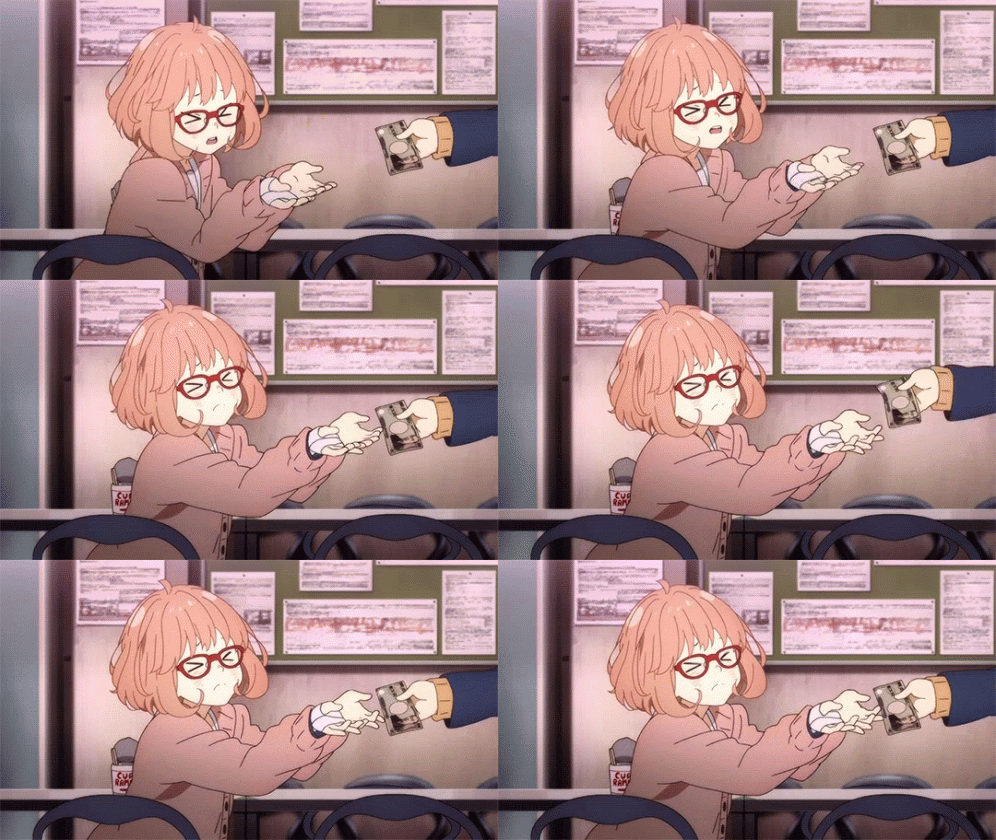
I didn’t touch on this in my first go at this conversation, but pirating actually does have an extremely important role in anime. This goes for manga as well.
There is no centralized archive of anime or manga for fans to access like Netflix or Crunchyroll. No one is there to fill the void when you’re looking for a really obscure anime that maybe aired once the first time it was released.
Well, almost no one.
Besides the team at the Internet Archive or the efforts of fans who go out of their way to find lost media, pirating sites often have titles of anime and manga that are no longer in print, available for purchase, or can’t be found on streaming platforms.
If you want to watch Peach Girl, sucks to suck. Not a single streaming site has it available for you to watch it legally.
But you know what would? HiAnime. The very pirating sites that are being shut down.
I don’t think it has to be that way. Crunchyroll, for all of its short comings, can and should really put in the effort to be the actual place for anime to live.
I found out that Crunchyroll hasn’t put out many titles that they acquired in the merger with Funimation.
Now that I have some more insight into how IP works in Japan, I suspect there is a bunch of bureaucracy and red tape, with a sprinkle of “I can’t be bothered” in the mix.
I argue that transparency with subscribers would be beneficial. People want to know where these titles are and why they’re not available. If they’re working to reinstate shows, let people know.
It’s actually mind boggling to me that Crunchyroll, former anime pirating site, doesn’t also function as an archive for anime and manga.
And I know that the answer is money. The answer for why something isn’t a certain way is nearly always about money.
But is this not the bare minimum that the most popular anime streaming site could do?
I don’t want this to just turn into a ranting monologue that goes on forever, there’s so much more that I want to say, but I’m going to wrap up. Just give me a few more minutes of your time.
One of the most brought up issues about pirating is hurting animators and that’s why you shouldn’t do it.
To be abundantly clear, I am an advocate for animators and mangaka rights. I think that if people were able to unionize, conditions and wages would improve drastically.
If you didn’t know this already, but, as far as I know the anime and merch revenue is completely separate from what animators and mangakas are paid. So, their payment is also structural and a result of not prioritizing their wellbeing or fairly compensating them for their work.
Regardless, I will always advocate for people to watch anime legally and buy manga legally. I personally have a collection of my favorite manga myself.
I also have a deep understanding and empathize with people who cannot pay for subscriptions and pirate anime. I understand what it’s like to have zero disposable income to keep up with monthly subscription costs.
I do think that the conversation about pirating ends up in a binary loop, when it truly does require more nuance.
Anime fans that pirate also buy official merch. They go online, to cons, or their local book stores to buy official DVD sets of their favorite anime or volumes of the manga they’re reading. They do still support animators and mangakas, but sometimes they can’t commit to hundreds of dollars worth of subscriptions.
Why? Because they want the people who created the thing they love to also be paid for their labor.
There has to be a change of the system and it’s not like people’s employers are going to just randomly give them buckets of money, so the change has to be from the companies.
The last thing I’ll say, and I promise this is the last thing, is that the people who create manga and anime also understand that there is an issue with the system we have right now. I’m thinking of specifically something I saw while scrolling on Twitter (I do not, and will never call it X).
The creator of Dr. Stone, Boichi said the following about the issue of access to legal manga:
“The first people to pay for legitimate manga services will, in many cases, be the very readers who once relied on piracy. They are not enemies of the industry—they are its earliest supporters in waiting.”
He continues:
“Pirated manga readers are not our opponents. They are our future audience.”
And he ends with:
“We learned, through experience, that the joy of not paying cannot compare to the deeper satisfaction of supporting and sustaining the culture you love. Piracy users were never the enemy. They were simply manga fans. And all manga fans, in the end, are on the same side.”
Pirating, is ultimately a servicing problem.
Until companies decide that losing a few coins is worth providing a good service, a service that is better than what pirating sites are offering, they’ll be playing whack a mole until the end of time.
For the sake of those of us who do love anime, I hope that change comes soon.
So yeah, those are (some of) my honest opinions about pirating.
I’m sure we’ll have this conversation again in the future.
Until next time.
Peace, love, and light
dani-chan 🌱
Comments
Nothing yet. Say the first thing.
Sign in to join the conversation.