
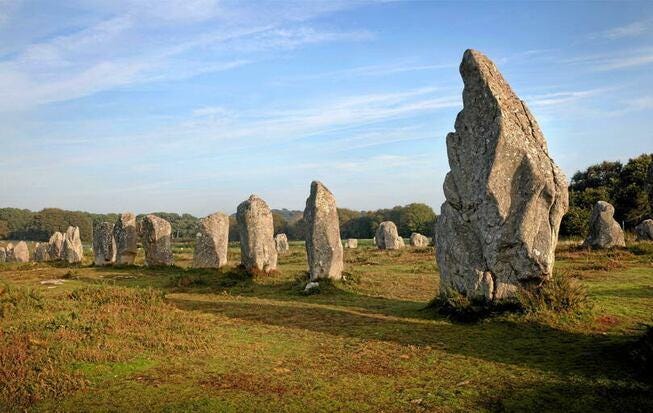
3,000 stones standing in a field. Some weighing several tons. A monument older than Stonehenge and even older than the Great Pyramids of Giza.
But... why?
Well, this is one of the biggest and most mysterious prehistoric monuments in the world, located in Carnac, France.
Known as the Carnac Stones, these thousands of standing stones, called menhirs, are arranged mostly in long, remarkably straight rows known as alignments.
If you compare this with Stonehenge, Carnac is much larger in scale, yet it is significantly older—dating back to around 4500–3300 BCE, making it one of the oldest monumental landscapes ever built.
But why did people build this? How did they transport and raise thousands of massive stones without modern machines?
That's where the mystery begins.
This newsletter is made possible by readers like you. If you enjoy our articles and would like to support our work, please consider becoming a member.
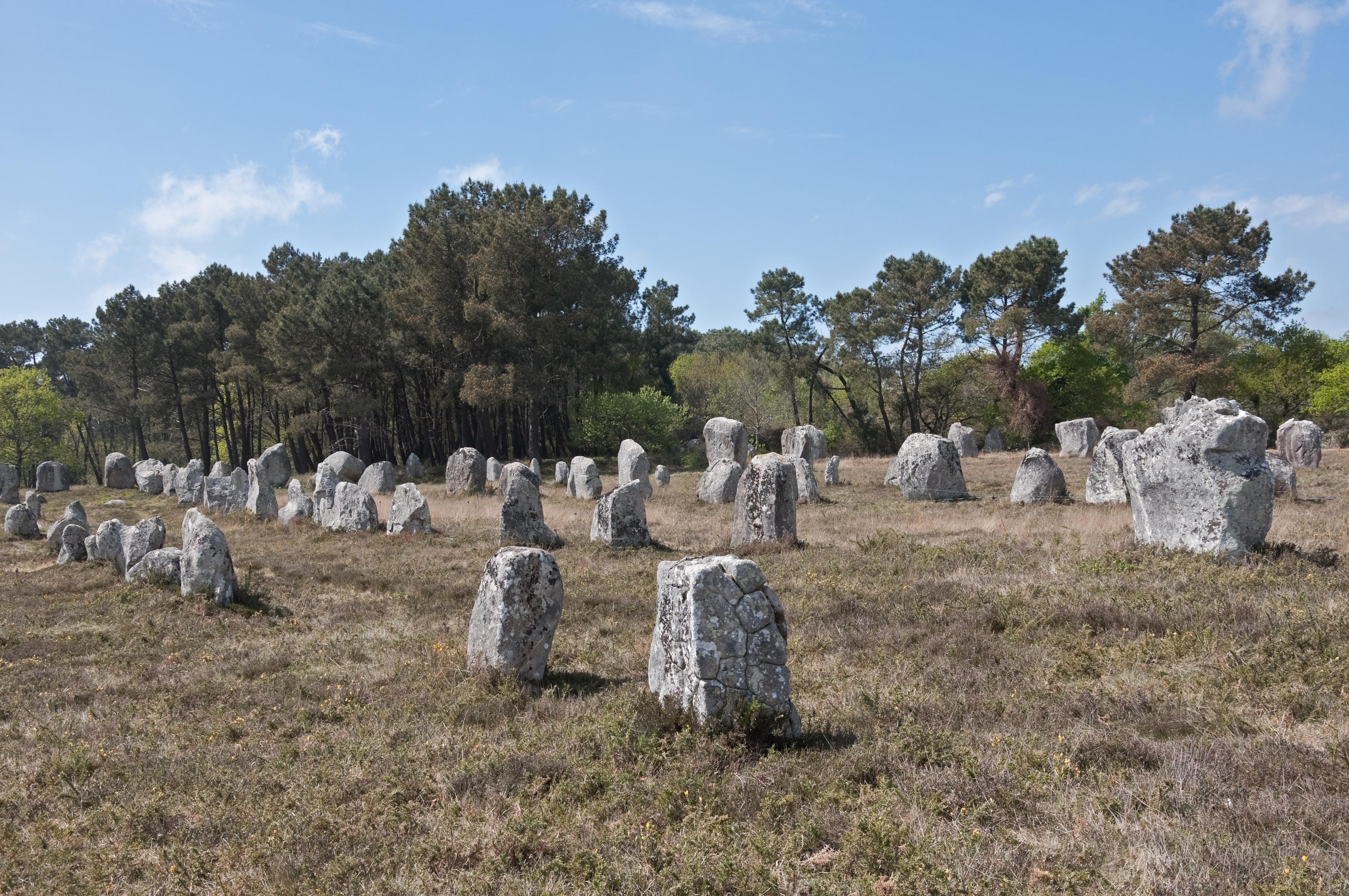
The Carnac complex contains more than 3,000 standing stones, spread across several kilometers. These stones are divided into different groups.
Ménec Alignment – about 1,100 stones arranged in 11 rows.
Kermario Alignment – around 1,000 stones.
Kerlescan Alignment – about 500 stones, ending in a stone circle.
Some of these stones stand over 6–7 meters (20+ feet) tall and weigh several tons.
Now that we know what these stones are, the most important question remains...
Why?
Why were they built? And how did people thousands of years ago transport and erect such enormous stones?
Like many ancient mysteries, we only have theories.
Many archaeologists believe the site was used for religious or ceremonial rituals.
Since several burial sites and passage graves have been discovered nearby, some think the alignments were connected to ancestor worship or funeral ceremonies.
Another theory suggests that certain rows align with the rising or setting Sun and Moon during important times of the year.
However, this idea remains highly debated, and there is no clear evidence that the entire site was built as an astronomical observatory.
A third theory is that the stones may have served as territorial markers—perhaps marking the boundaries of different communities or tribes, much like borders today.
One fascinating detail is that these 3,000 stones were not erected all at once. Archaeologists believe they were raised over many generations, possibly spanning hundreds or even more than a thousand years.
That tells us something important.
Whatever purpose these stones served, it must have been important enough for generation after generation to continue building and preserving the alignments.
And yet...
We still don’t know exactly what they meant.
It’s entirely possible that every theory we have today is wrong, and the stones served a completely different purpose that has been lost to history.
That’s what makes places like Carnac so fascinating to me.
Whenever I look at ancient mysteries like this, where no one has a definitive answer, it makes them even more intriguing.
Everyone has their own theory, and each one makes you imagine the lives of the people who built them.
Sometimes it reminds me how little we truly know about ancient civilizations. We often assume we understand them, but sites like Carnac show that there are still chapters of human history waiting to be uncovered.
These stones have stood silently for more than 6,000 years.
Millions of people visit them today, yet their true purpose remains hidden—quietly keeping one of history’s oldest mysteries.
Partner with Ancient Explain
Looking to reach an audience passionate about archaeology, ancient history, and lost civilizations?
If you have a brand, project, publication, book, course, or website that would resonate with our readers, we'd be happy to feature it in one of our in-depth posts. It's a great way to introduce your work to an engaged community that shares your interests
Click here to become a sponsor.
Stay Curious,
Ancient Explain
No posts
Comments
Nothing yet. Say the first thing.
Sign in to join the conversation.