
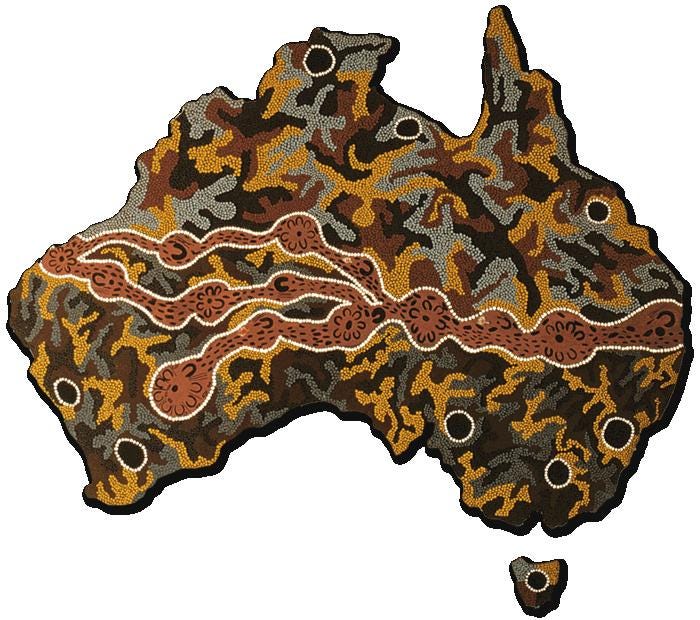
When we think about preserving a civilization’s culture, rituals, stories, and knowledge, we usually imagine some kind of writing system—like Egyptian hieroglyphs or Mesopotamian cuneiform.
But what if there was a culture that used songs to preserve its history, laws, traditions, and even maps to navigate across hundreds, and in some cases thousands, of kilometres without ever developing a writing system?
These are called Songlines. And as the name suggests, they are routes encoded into songs, stories, dances, and ceremonies.
Somehow, they managed to preserve all of this with such precision that many of these traditions have survived for thousands of years—and some continue even today.
But first, let’s understand what Songlines actually are…
Songlines, also called Dreaming Tracks, are routes that crisscross Australia, many of which still follow real landscapes that exist today.
These routes act like a living database where songs, stories, dances, ceremonies, and cultural knowledge are encoded.
And a person who knows the song can navigate across vast distances, locate waterholes, identify sacred sites, and understand the cultural significance of the landscape.
In simple words, someone who knows the song has access to their version of Google Maps.
And that’s where the mystery begins.
The obvious question is: how were they able to create such a complex system of preserving knowledge without ever developing a writing system?
Archaeologists have found no evidence of an indigenous writing system among Aboriginal Australians, yet they have found evidence that many Songlines and the traditions connected to them are still remembered and passed down by Aboriginal communities today.
Now comes the even more interesting part,
Some of these stories describe land that now lies beneath the ocean, islands that were once connected to the mainland, and ancient coastlines.
These stories have been passed down through generations, and geological evidence shows that sea levels rose dramatically between about 7,000 and 10,000 years ago.
Some researchers suggest these traditions may preserve memories of those ancient landscapes.
And all of this happened without a single writing system.
Many Songlines pass through the lands of different Aboriginal groups, showing that knowledge could be shared and maintained across communities.
Some Songlines stretch for hundreds—or even thousands—of kilometres across deserts, mountains, and plains.
Even though Songlines were used by Aboriginal tribes, not every Songline was meant for everyone.
Some were sacred and could only be known by elders, community leaders, or initiated members because they contained important cultural and spiritual knowledge.
As a result, archaeologists cannot study every Songline in detail. Parts of this knowledge remain intentionally protected, which means our understanding is still incomplete.
So looking at these it clearly shows that building and preserving such a system required an incredibly advanced memory tradition.
Unlike monuments such as Stonehenge or the pyramids, Songlines leave almost no physical evidence.
The “map” exists mainly in living memory, songs, ceremonies, and cultural practice.
Researchers are still trying to understand how such detailed geographical information could be passed down accurately through oral tradition alone for countless generations. (I think we can also talk about Vedas as well and how they were -passed down orally for thousands of years in future)
So while we still don’t fully know how they preserved such vast amounts of geographical and cultural knowledge with remarkable continuity over thousands of years, Songlines remind us of something important.
When we think of advanced ancient civilizations, we usually focus on those that built monuments or developed writing systems.
But the Aboriginal peoples of Australia show that a civilization could preserve its history, culture, stories, rituals, and even navigation across an entire continent using nothing more than songs—an extraordinary achievement that continues to survive through generations even today.
If you enjoyed this post, you'll definitely love our mini guide exploring 5 Ancient Mystical Rituals from Around the World.
Click here to get your copy.
Go beyond the newsletter!
If you enjoy reading our posts and would like to support this publication while unlocking exclusive member-only content, join the Insider Membership.
Get
work-in-progress updates
members-only insights,
ask me questions anytime,
and special shop perks
—all while helping support publication.
➡ Click here to become a member.
Stay Curious,
Ancient Explain
No posts
Comments
Nothing yet. Say the first thing.
Sign in to join the conversation.