
When approximately 80+% of the American population injected themselves with the COVID bio-weapon (“vaccine”), it would only be a matter of time before insurance rates (across multiple categories for average users; (home, car, health etc.) would increase, due to increased numbers of the sick and the dead.
As more became sick and hospitalized, those health insurance rates would predictably increase, as those insurance companies saw a profit to be made. However, the same would be true for those companies when it came to their departed insurance holders. With less clients, insurance companies would have no choice but to increase their premiums to make ends meet for the decrease in the number of insured, as a result of being sick (i.e., car insurance; unable to drive etc.) or the dead (no longer needing home, health or car insurance).
The same would also be true for American citizens no longer trusting the medical industry and finding out that health insurance is a scam, and that it’s far cheaper to no have health insurance, thereby dropping their health insurer to seek more holistic options for their general health care, in particular if they’re healthy and un-injected.
As it turns out, these correlations are the probable cause of the steady increase in insurance rates within the U.S., and assuredly across the world.
As it turns out, both the sick and the healthy (un-injected) are literally paying the literal price for those who are injured or dead from the COVID bio-weapon.
Here are the numbers:
U.S. insurance rate trends (January 2021–July 2026) are best tracked consistently via the Bureau of Labor Statistics (BLS) Consumer Price Index (CPI) series for Motor vehicle insurance, Tenants’ and household insurance (covering renters, homeowners/household coverage), and Health insurance. These are official monthly price indices.
Approximate average annual dollar premiums from industry sources vary by coverage limits, location, driver/home profile, and methodology, so they are illustrative rather than precise national averages.
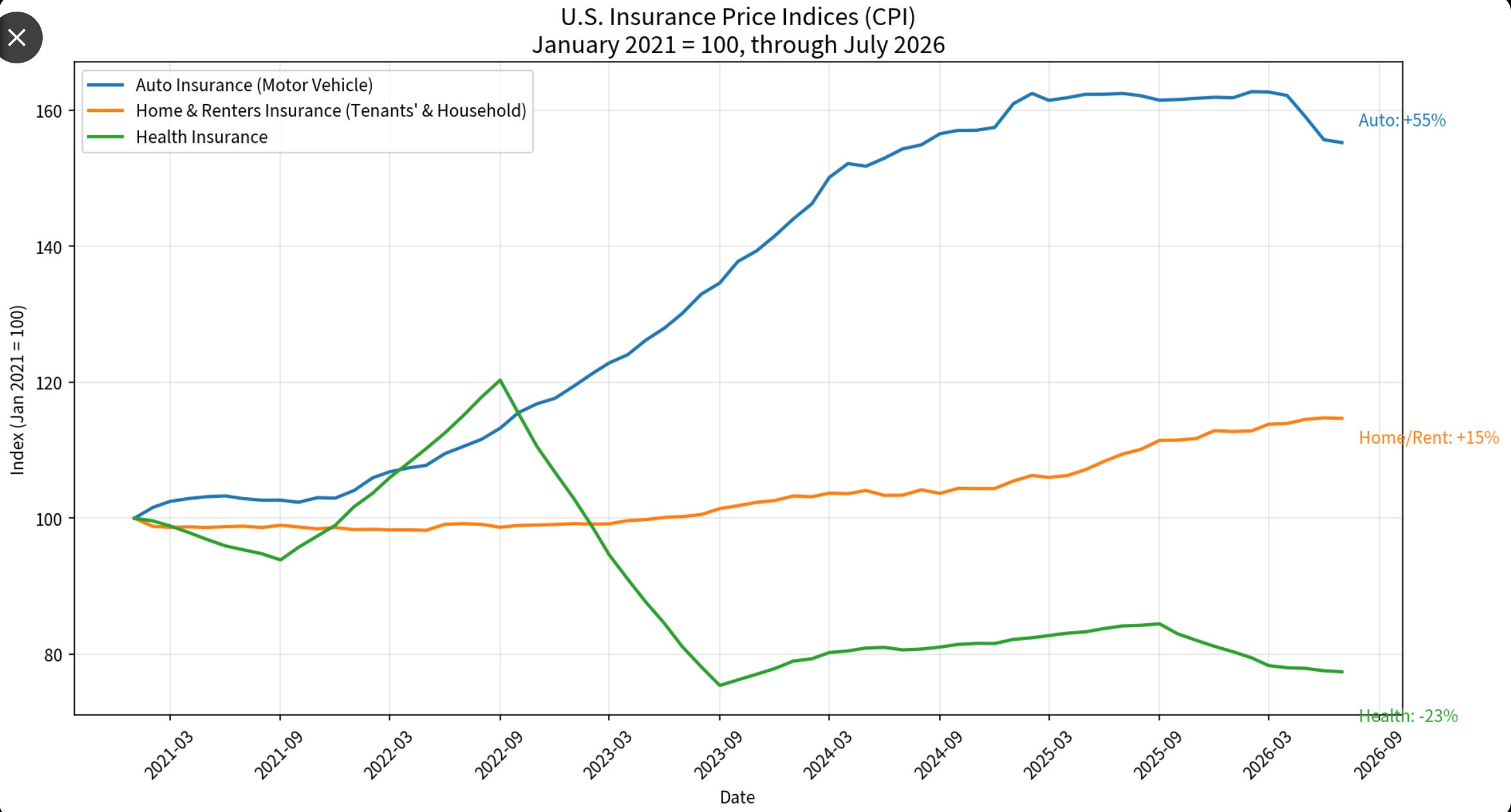
Auto (motor vehicle) insurance: Strong rise overall (~+55% by mid-2026). Sharp increases in 2022–2024 (driven by higher repair costs, parts, labor, accident severity, and inflation catch-up), with some moderation/cooling in parts of 2025–2026.
Home & renters (tenants’ and household) insurance: More moderate rise (~+15%). Actual homeowners premiums in many industry reports rose substantially more than this CPI series (see dollar chart below), reflecting catastrophe losses, rebuilding costs, and reinsurance.
Health insurance: The official CPI series declined overall (to ~77 by mid-2026). Note that BLS health insurance CPI measurement has known peculiarities (it can move inversely to medical cost trends in some periods due to how retained earnings/benefits are accounted for). Actual employer-sponsored premiums rose.
Dollar levels vary widely by source, coverage type (e.g., full vs. minimum auto; dwelling limits for home), and state. Figures below draw from NerdWallet, Zebra, Insurify, Statista/III-related data, Newrez escrow analysis, KFF Employer Health Benefits Survey, and similar reports:
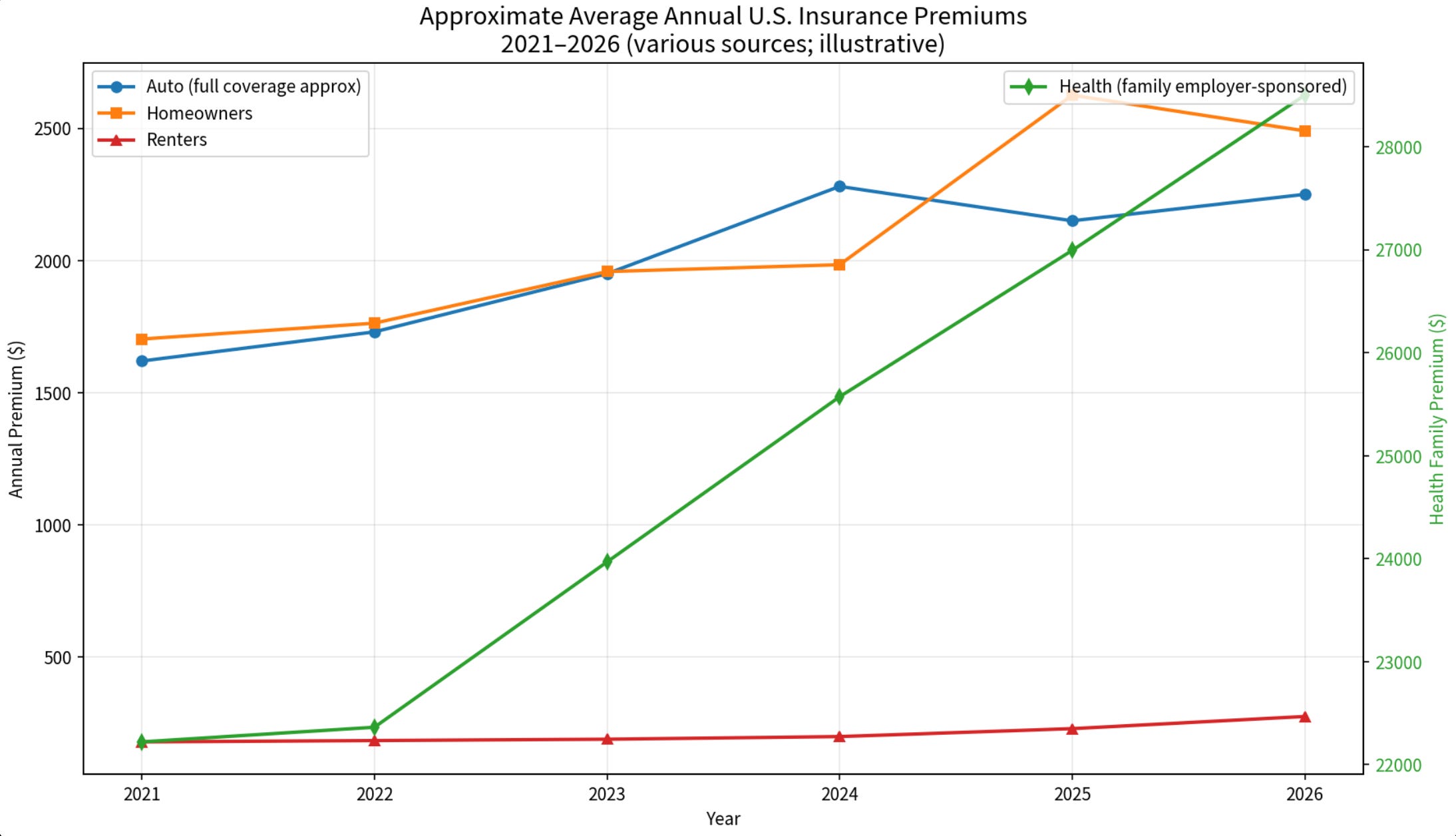
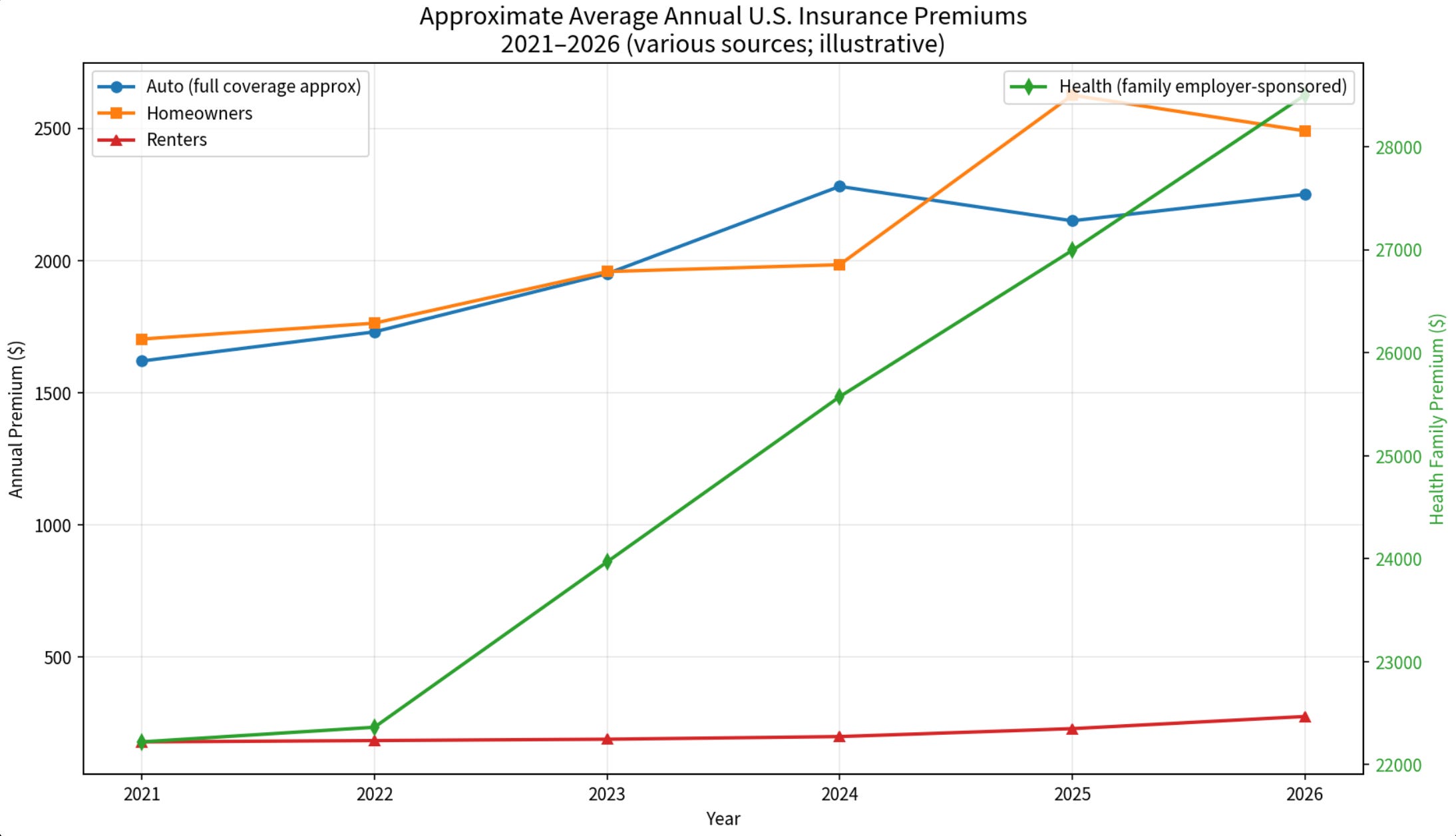
Auto (full coverage): Rose strongly from roughly $1,600–1,700 range in 2021 to peaks near $2,200–2,300 by 2024–2026 (with some reports showing a temporary dip then modest rebound). Cumulative increases of ~30%+ from early 2020s levels were common.
Homeowners: From ~$1,700 (2021) toward $2,400–$3,000 range by 2025–2026 depending on the source. Some escrow-based analyses showed ~64% cumulative rise from end-2021 to end-2025; growth moderated in 2025–2026 in many areas after sharp 2023–2024 hikes.
Renters: Remained relatively low and stable (typically $180–$280/year nationally for standard personal property + liability coverage).
Health (employer-sponsored family coverage): Rose from ~$22,200 in 2021 to ~$27,000 in 2025 (KFF), with single coverage reaching ~$9,300. Further increases expected into 2026; cumulative multi-year gains roughly tracked or modestly exceeded general inflation/wages in recent periods.
Auto and homeowners insurance saw the most pronounced premium pressure post-2021 (repair/rebuild costs, claims severity, weather/catastrophe losses, inflation, and social inflation factors).
Increases generally moderated or cooled in 2025–early 2026 relative to the peak years of 2023–2024 in many markets, though levels remain elevated and state-level variation is large (e.g., high-catastrophe states far above national averages).
Renters insurance stayed comparatively affordable and stable.
Health insurance premiums continued rising in dollar terms for employer plans (the dominant form of coverage), even as the specialized CPI series behaved differently.
This is how you hide the impact of the COVID bio-weapon on the paying-insured American. You raise insurance rates or maintain them, claiming that there are more insured, yet you fail to announce the numbers of the departed and their newfound absence of insurance coverage as a result of being sick, disabled, dead, or untrusting of insurance; and these end up being the motivating factors to increase the cost of insurance in order to keep the insurance company’s margins progressively steady or high over the years.
The dramatic spike in health insurance prices at the exact time of the second COVID shot (Spring/Summer 2021) and booster-shot (third shot) roll-out (latter half of 2021, through 2022), is not a coincidence. It’s a calculated adjustment for the sickness and death rates from the “COVID” bio-weapon.
BIO: Dr. Sean M. Brooks is the host of the podcast American Education FM and the author of several books including; The Unmasking of American Schools: The Sanctioned Abuse of Americas Teachers and Students. He’s also on Gab, X, Truth, Bitchute, Rumble, YouTube, and everywhere audio podcasts can be heard.
No posts
Comments
Nothing yet. Say the first thing.
Sign in to join the conversation.