
We're raising a generation that can't finish anything, and the data proves it.

Last month, I watched a 20-year-old explain why he'd just quit art school. Not because he hated it, or found something better, or couldn't afford it – he was on a full scholarship. He quit three weeks before finishing his freshman year because, in his words, "it was too intense, and there's no point wasting time when I don't know what I'd do with it anyway."
Nine months of work. Three weeks from completion. Free education. Gone.
This isn't just one kid making a questionable decision. According to new data that's been making waves across social media, this is the visible face of something much bigger and more frightening: an entire generation is losing the psychological tools needed to stick with anything difficult.
John Burn-Murdoch's viral Financial Times piece laid out some genuinely terrifying numbers. Among 16-39 year olds, something called "conscientiousness" has collapsed from 52% to 28% since 2016. At the same time, neuroticism, basically anxiety and emotional instability, has shot up from 45% to nearly 70%.
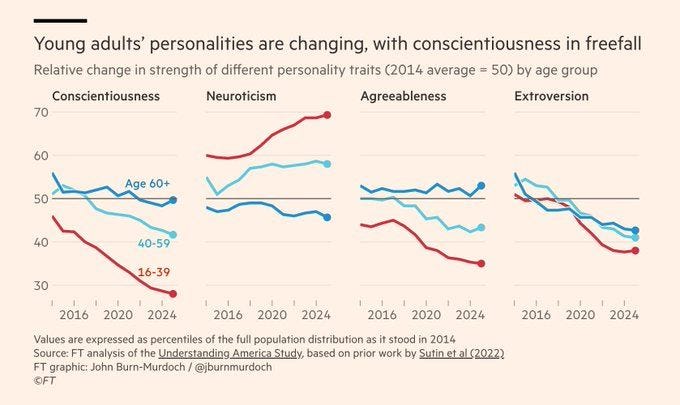
If you've never heard of conscientiousness, it's not about being a goody-two-shoes or following rules blindly. It's the psychological infrastructure that lets you delay gratification, stick with hard things, and keep your word. It's the difference between starting a diet and finishing one, between saying you'll call someone back and actually doing it.
Conscientiousness encompasses five components:
Competence (feeling capable of handling tasks)
Order (preferring structure and organisation)
Dutifulness (honouring commitments and obligations)
Achievement striving (working hard to accomplish goals)
Self-discipline (resisting temptation and distractions).
Conscientiousness predicts your life outcomes better than intelligence or how rich your parents are. It determines whether you'll graduate, succeed in your career, maintain relationships, and even how long you'll live.
And we're watching it disappear in real time.
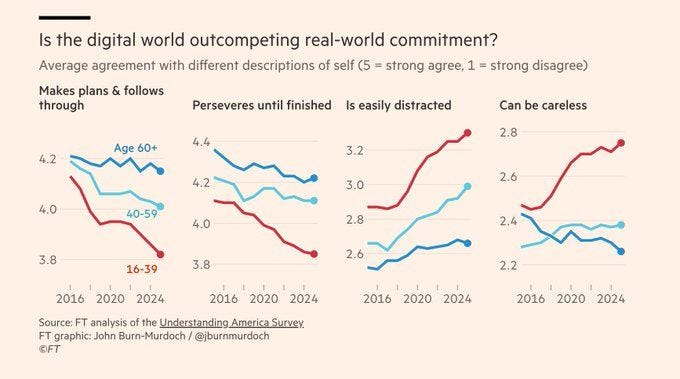
The numbers paint a picture that should terrify anyone who cares about the future. Young adults are increasingly "easily distracted" and struggle to "persevere until finished." They find it harder to "make plans and follow through" while becoming significantly more careless.
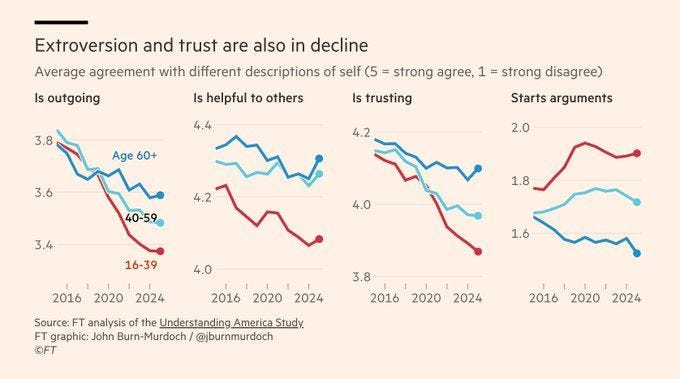
But here's the kicker: they're also becoming less helpful to others, less trusting, and more likely to start arguments. The generation that grew up most connected digitally is now the most socially withdrawn. They can organise parties online, but can't actually show up to them.
The Akin’s research into what we call "Gen Q" – those aged 14-22 – reveals the extent of this social breakdown. Only 33% report having at least five good friends they can rely on, compared to 87% of millennials at the same age. Yet 85% say friendships are more important than romance. They desperately want connection but lack the persistence to maintain it and the trust to believe others will either.
Here's what makes this more than just a personal problem: trust isn't just falling between people. It's collapsing between young people and institutions, between young people and established processes, and critically, between young people and their own past decisions.
When you combine plummeting conscientiousness with skyrocketing neuroticism and evaporating trust, you get a psychological profile that historically precedes social breakdown. This isn't typical teenage angst. It's the systematic erosion of what makes complex societies possible.
The mechanism behind this collapse isn't mysterious. We've created a permanent, high-stimulation environment where every commitment competes against infinite alternative dopamine hits. Social media algorithms reward hot takes over deep thinking, outrage over understanding. Young brains developed in this environment are optimised for novelty-seeking, not stability-building.
Over 40% of Gen Q report persistent sadness or hopelessness, with anxiety and depression at historic levels. But they're not failing because they're lazy, they're failing because their entire neurological environment punishes slowness and rewards constant pivoting.
Think about it: 75% regularly play online games where they coordinate complex activities with friends and strangers, yet most aren't allowed in public without adult supervision. They've mastered digital coordination while losing the psychological infrastructure for physical follow-through.
The dramatic increase in young people starting arguments isn't random. It's what happens when you raise a generation on rage-bait algorithms that reward emotional reaction over thoughtful engagement. They've learned to treat every disagreement as a battle to win rather than a problem to solve.
This connects directly to the conscientiousness collapse: sustained dialogue requires patience, perspective-taking, and the ability to sit with tension without immediate resolution. When you lack these capabilities, every difference of opinion becomes warfare.
They can identify injustice instantly but lack the persistence to build sustainable solutions. They're perfect for viral political movements but terrible at the slow work of institutional change.
Unlike intelligence or family wealth, conscientiousness was supposed to be the great equaliser; something anyone could develop through practice. But when an entire generation develops during critical brain formation years in an environment that systematically rewards impatience, we may be looking at a permanent shift.
The implications cascade everywhere. Education systems designed for embodied brains struggle with disembodied minds. Democratic institutions face a generation that trusts algorithmic recommendations more than governance but lacks the persistence for democratic participation.
We're breeding a population that can be mobilised instantly, for outrage campaigns, viral products, mass protests, but can't hold a line for years. That might be operationally useful for some, but it's civilisationally catastrophic.
The most chilling aspect isn't just individual failure, it's collective incapacity. When conscientiousness drops below a certain threshold, the slow work of building and maintaining complex systems becomes impossible. We're not just failing individual futures; we're dismantling the psychological substrate that makes civilisation work.
The student who quit art school three weeks before finishing? He represents the quantitative fingerprint of a species losing its capacity for sustained collective action. And once we cross that threshold, the world as we know it stops being governable in any form we'd recognise.
The data is clear, the trend is accelerating, and the window for intervention is rapidly closing. The question isn't whether this represents a crisis; it's whether we still have the collective conscientiousness left to do anything about it.
This article draws from extensive multi-generational research detailed in The Akins’ comprehensive report on youth mentality shifts. The report includes complete data methodology, longitudinal analysis, and frameworks for understanding this unprecedented demographic mutation.
Comments
Nothing yet. Say the first thing.
Sign in to join the conversation.