

The other day I ran one of my AI project screening instruments via a hosted AI agent. I don’t normally use this mode of AI for this purpose, but I wanted to see how it would perform, especially since it has a structured Word document as the output.
The instrument answers a fairly narrow question: where may this data live and be processed? The agent had the tender, access to the vendor documentation it needed to verify, a set of tools and a persistent memory it could carry between engagements.
Across three attempts, it cost me roughly $10.
The first run spent about $5 and stopped before finishing.
The second cost around $2.50, ran for eleven minutes and produced a useful memo. It also found a possible collision between one of the contract clauses and the law governing the contract so running my screening tool just earned its keep right there.
I interrupted the third run.
My reaction wasn’t really that the agent was expensive. Ten bucks isn’t a great deal of money for this kind of analysis, particularly when the result contains something I might otherwise have missed.
What bothered me was the route the agent had taken to get there, and how much the price moved between attempts at essentially the same job. At scale, you can see very quickly that something like this - unchecked - could get out of control pretty fast when it comes to the price of autonomy.
This was the first time I’d used the new Anthropic Managed Agents capability in anger. The results were good considering I’d pretty much thrown it together as an optimized experiment. That part shouldn’t disappear simply because I want to talk about the bill.
On the second run, it found the notes left by the failed attempt and continued from them rather than beginning again. It refreshed some of its own reference material as it worked. The contractual issue it surfaced wasn’t an obvious keyword match; it had connected two requirements that appear to pull in different directions.
Plenty people wouldn’t have caught what the machine did.
The trace from that run was more interesting than the finished memo. A language model doesn’t carry a private working memory from one request to the next. The application has to supply the context again: the conversation, relevant files, tool results and whatever notes the agent has accumulated.
That context grew as the run continued. The token count for the day proves that.
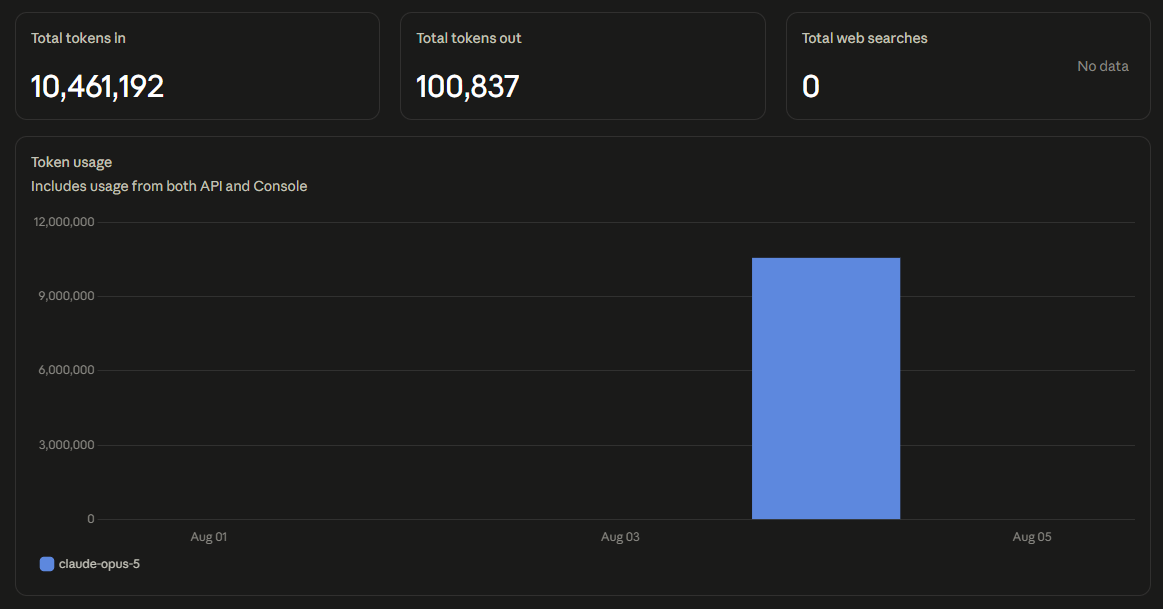
By the final step, the agent was reading about 179,000 tokens to produce 83 new ones. Across the run, approximately 2.85 million tokens were read or re-read while the agent produced around 43,000 tokens of new output.
What I couldn’t do in this hosted configuration was decide precisely what stayed in the working set at each step. I could tell the agent to keep large documents on disk, search them rather than ingest them wholesale and write durable notes. Those instructions helped, but they were still instructions. I had to inspect the trace afterwards to see whether the behaviour had held.
That took me back to something I built in 2024 using the MemGPT pattern. I kept the external memory in Redis (conversational and core memory - Pinecone vector store for archival memory) and used deterministic code to decide what was placed into the model’s context on each turn. It was more work, and I owned the framework, but I also knew why each piece of context was there.
The older system gave me more control over the working set than the hosted agent I used this week. The hosted version gave me something else: a managed environment, persistence and far less infrastructure to operate myself.
I don’t think that makes one approach plainly better. It shows what I traded off for the convenience, and I hadn’t properly priced that before watching the run.
The comparison I kept returning to was the same instrument run in two different ways.
If I use it interactively inside Claude or Codex, the work sits within a subscription I already pay for, subject to the plan’s usage limits. If I hand it to a hosted agent and leave it to continue, the work is metered at API rates.
The models aren’t obeying different laws in those two settings. The rate of work is different because a person is present in one of them.
When I’m working interactively, I read the response before asking for the next one. I decide which part of a document matters.
I start a new conversation when the old one has become cluttered.
Sometimes I stop because I’ve seen enough.
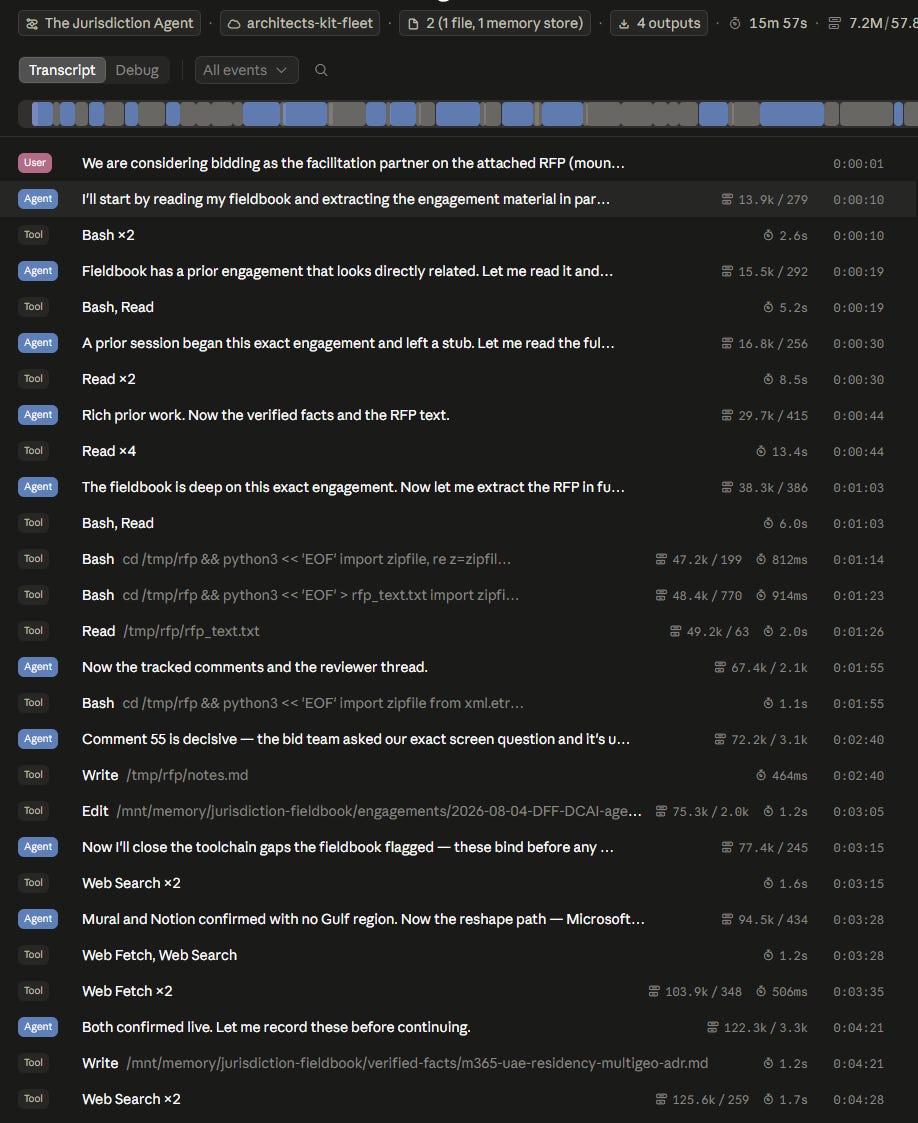
The agent made 29 model requests in eleven minutes. Nothing in that loop needed time to read, think or make a cup of tea. It continued until it finished, failed or I intervened. Here’s just some of the activity it was running.
That human pace is part of the economics of a subscription. Claude Pro currently costs $20 a month, with Max plans at $100 and $200. There are usage limits, but for somebody operating inside them, another afternoon of attended work doesn’t arrive as a separate API invoice.
Unattended work is different because the loop can consume at machine pace. You are paying for the ability to leave the chair. I addressed some of these issues in a previous post about agentic ROI.
On the cleaner run, that ability cost me about $2.50. The failed run cost roughly twice as much and didn’t leave me with a finished memo. That is not an alarming amount of money, but it is enough variation to make a single average misleading.
In my own costing work, I wouldn’t price an agent from its best run. I would want to see the ordinary month and a bad day: the run that loops, reads too much, loses its place or has to be repeated. The discipline needed to reduce those outcomes is engineering work, and that work belongs in the cost model as well.
When I refer to the empty chair premium, what I mean is, all of this rather than the API price alone: the additional context, the speed at which the loop can consume it, the variation between runs and the controls needed when no person is there to notice that the work has gone off course.
This was an interesting experience in context of the whole “AI will take your job” argument.
Entry-level work is usually presented as the obvious first target for agents: research, an initial analysis, a memo, the first version of a document. My agent had just completed exactly that kind of task, so I tried the comparison.
Current salary surveys put a typical UK graduate starting salary at roughly £30,500, rising to around £35,000 at some of the larger graduate employers. Once employer costs, pension, equipment and working space are included, I used £150 as a rough loaded day rate.
The eleven-minute run at $2.50 scales to something in the region of £80 across a continuous working day. That is an artificial extrapolation - the agent won’t necessarily produce eight hours of equally valuable work at a constant rate - but it is useful enough to show why the replacement argument looks plausible.
Then the rest of the week has to go into the calculation.
There was a failed run. There was another attempt I interrupted. The useful memo now needs review by somebody legally or professionally qualified because the agent found an issue consequential enough to require it. There’s also the time spent examining the traces and changing the agent so that the next run behaves better.
Once those costs are included, the comparison becomes much less decisive. In some organisations, the autonomous route may already be cheaper. In others, particularly where junior salaries are lower or the review burden is high, it may not be.
The crossover will move. Token prices fall, models improve and managed platforms will get better at controlling context. I don’t think it’s sensible to claim that the crossover never arrives.
I do think it needs to be calculated rather than assumed though.
There’s another pressure on junior work that may be more immediate. An experienced person using a $20 subscription can now do more of the research and drafting personally. That is attended AI amplifying someone who already has the judgement to supervise it. It doesn’t remove the need for a chair; it makes the person sitting in it more productive.
So the junior isn’t only competing with an autonomous agent. In some cases, they are competing with what their manager can now do inside an existing subscription.
The labour-market effect is different from the one implied by a robot replacing a role wholesale, and probably a more present one.
I’m not going to stop using hosted agents and I like Anthropic’s technology. The analysis was useful and the ability to preserve a specialist’s memory between engagements is something I genuinely want. It was very easy to setup.
If a person must read the output before anything can happen, there’s a reasonable argument for keeping that person involved while the work is done. The unattended premium earns its keep when absence has value: an overnight run, a scheduled check, or a volume of work nobody could sensibly sit through.
There’s also the economic aspect of autonomy. I wrote about this a few weeks back. A short demonstration won’t expose the tuition fee, the growing transcript or the cost of repeating the work.
The agent I used this week nearly finished one document across three attempts and charged me roughly ten dollars. It also found something useful enough to justify professional review, so I can’t complain.
I don’t read that bill as evidence that agents are overpriced. For me, it is evidence that autonomy is a delivery choice with its own operating cost.
Until next time,
Chris
Thanks for reading The AI Agent Architect! This post is public so feel free to share it.
Comments
Nothing yet. Say the first thing.
Sign in to join the conversation.