
(By Fr Fabian Dicom)
Rejoice.
That is the word placed before us today.
But it is not an easy joy. It is not decorative joy.
It is the kind of joy that dares to rise from the desert.
Isaiah does not speak of joy coming from temples, palaces, or centres of power.
He speaks of wastelands flowering, of dry ground breaking into song.
God’s joy does not begin where things are already impressive.
It begins where life feels parched, delayed, and forgotten.
And that image touches something close to home.
We look at the Church today - and we sense the tension.
A Church often busy, active, well-intentioned…
yet not always centred deeply and honestly on Christ.
In these weeks of Advent, we see parish programmes filling our calendars -
Christmas trees going up, Santa Claus appearing, parties being planned, lights being switched on.
None of these are wrong.
But they can quietly replace the Gospel rather than serve it.
And all the while, beyond the decorations,
the poor are still anxious,
the vulnerable still unsafe,
the margins still waiting - for justice, for dignity, for protection.
Even leadership, in society and sometimes in the Church,
can be distracted by power, image, and externals
while the desert grows wider.
Isaiah speaks directly into this moment:
“Strengthen the weak hands. Make firm the feeble knees.”
Not “beautify the façade.”
Not “manage impressions.”
But restore what is broken in the human person.
Then we hear the Gospel.
John the Baptist - the fierce prophet, the voice of certainty -
now sits in prison.
And from that dark place he asks,
“Are you the one who is to come, or should we wait for another?”
This question is deeply consoling.
Because it tells us that doubt is not the opposite of faith.
Sometimes doubt is simply faith that is tired.
Jesus does not give John an explanation.
He gives him signs:
the blind see,
the lame walk,
the poor hear good news.
In other words:
Do not judge me by religious success, festive activity, or appearances.
Judge me by what happens to the wounded.
James then invites us to patience - not the patience of resignation,
but the patience of people who trust that God is still working,
even when change is slow and the waiting is hard.
And perhaps this is where the Word finally turns personal.
Each of us carries a desert within.
A place of dryness.
A question unanswered.
A hope delayed.
A weariness we do not easily speak about.
Advent does not ask us to escape that desert.
It asks us to stand there honestly,
trusting that God does His most surprising work
not in the noise of celebration
but in the quiet soil of our vulnerability.
So today we rejoice - not because everything is resolved,
but because God has not abandoned the desert.
And if we allow Him,
that desert - personal, ecclesial, and social -
will be the very place where new life begins.
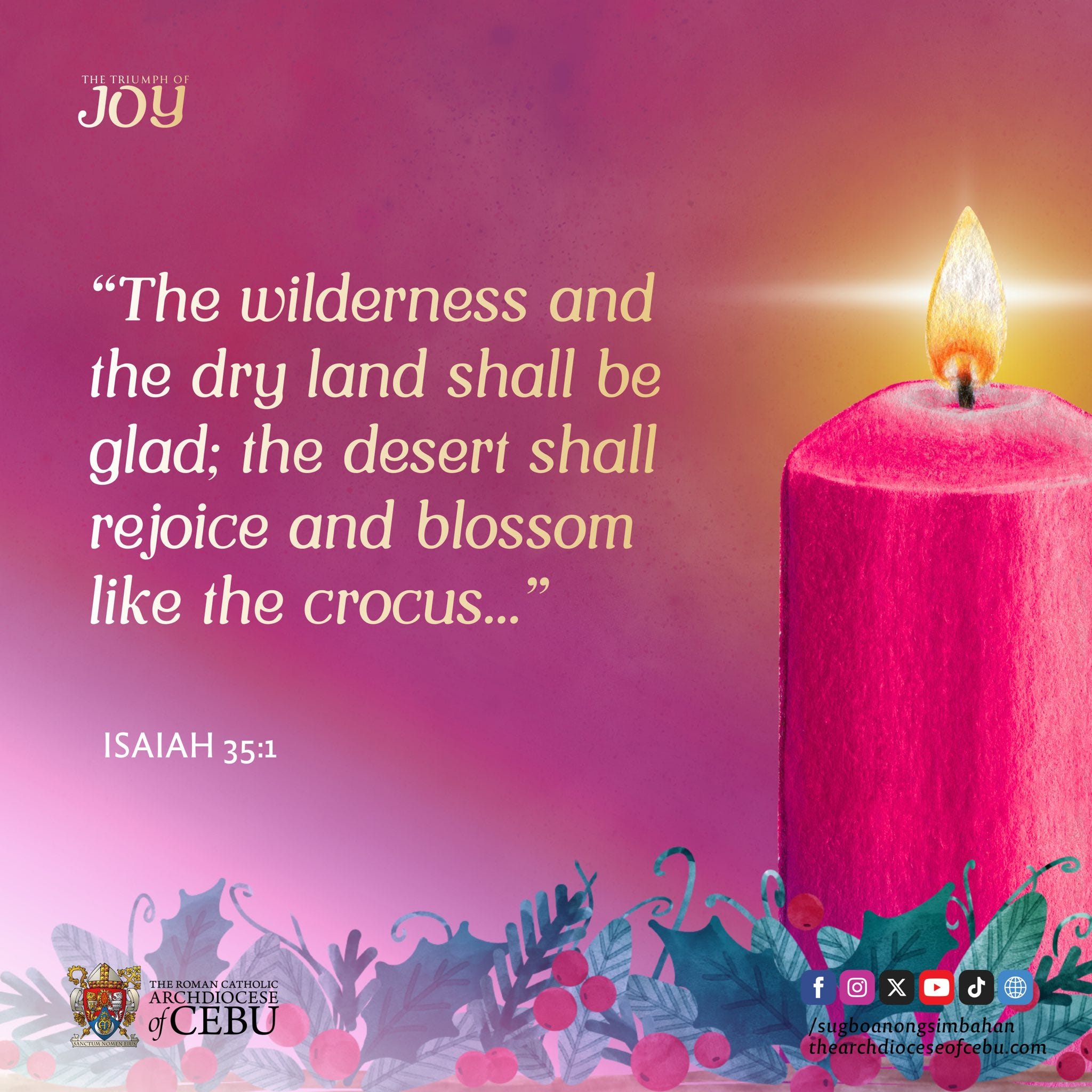
Image credit: Archdiocese of Cebu FB
“I’ve been waiting for a quarter of an eternity” - Impuriel, The Christmas Mystery - Jostein Gaarder
Comments
Nothing yet. Say the first thing.
Sign in to join the conversation.