
Dear Friend,
I’m reading Tran the way you should read anything that might rearrange you: out loud, a little hungry, pen at the ready. What follows are two close looks at poems from the first section of All the Flowers Kneeling, joined by a question: What happens when “knowing” is defined by the systems that want to count you, or count you out?
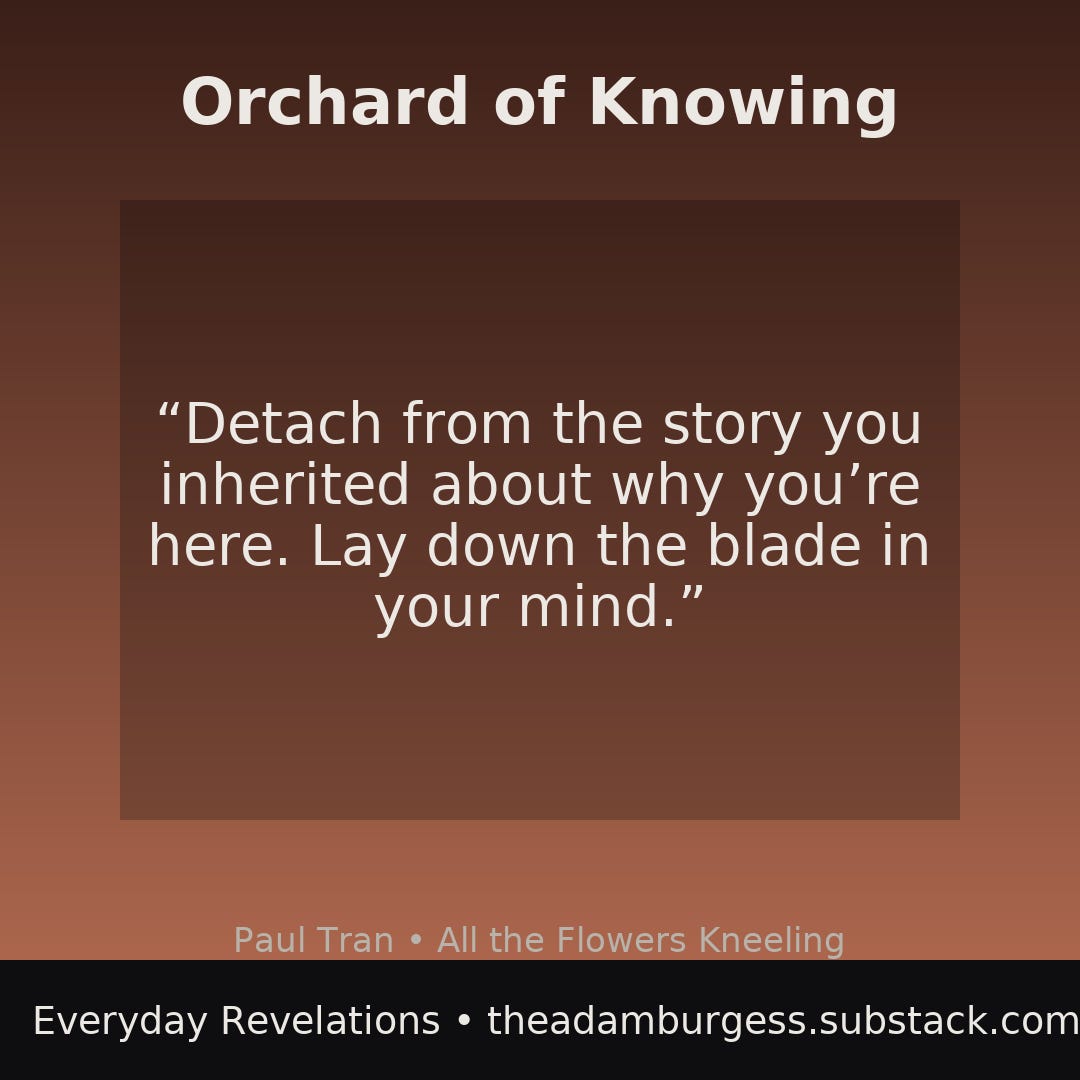
This isn’t an orchard as much as a hunting ground. The first image detonates: a “necklace / of nine hundred and ninety-nine index fingers.” Not ears, not teeth, but index fingers. The poem picks the body part that points, accuses, instructs, indexes. It’s a semiotics of horror smuggled in as jewelry. And the count matters: 999 is the almost-completed project of empire; the next body (mine? The speaker’s?) would round it to the satisfying tyranny of 1000.
Then the mission statement: “to return to your kingdom by returning to your king / a thousand human sacrifices.” The hunter’s loyalty is vertical, feudal, unquestioned. The poem names what so many myths launder: purpose as blood quota. Knowledge, in this orchard, isn’t apples and ladders; it’s tallies and trophies.
The chase begins. Sword out, mandate clear. But the speaker refuses to play the final integer. The poem pivots on one line: “I’ll surrender, I tell you, / when you detach from your received idea of purpose.” That little phrase—received idea—is the poem’s trapdoor. Purpose here isn’t calling; it’s programming. It was handed down with the scabbard.
When the hunter obeys, sets down the weapon, the poem springs the distinction: I didn’t mean the blade in your hand. I meant the blade in your mind. It’s funny the way a fire alarm is funny after you’ve already smelled the smoke. The poem redefines danger as thought armed with tradition. Violence persists even when the arm is tired; it lives in the idea of obedience that feels like virtue because someone powerful called it that.
Back to the title: If this is an orchard, its fruit is the pointing digit, what we pluck to prove we’re right, who we are, who’s to blame. The poem asks a mean, necessary question: what counts as “knowing” when your metrics are trophies? What ripens in a kingdom that runs on scalps?
The speaker offers mercy: detach from the story you inherited about why you’re here. The poem doesn’t argue with the sword; it argues with the story that forged it. That’s the ethics at work, not pacifism, exactly, but a demand that purpose be audited before anyone else gets added to a grand total.
Two small notes in the margin:
999 isn’t only arithmetic; it’s a theology of almost. Systems that need round numbers will always need one more body. Decline the symmetry.
The index finger is the curriculum of power: the lesson that says you, there. Taking it for a necklace turns pedagogy into plunder.
Here’s an idea: list three “received ideas of purpose” you were handed (religion, family, country?). Circle the one that asks for a sacrifice from someone who isn’t you. Now rewrite it without a king. What do you get?
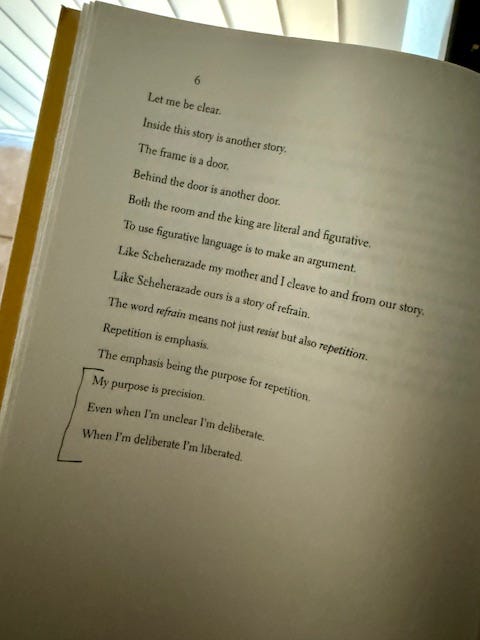
This poem walks in wearing a clipboard. It doesn’t describe the night so much as process it, run it through a bureaucratic throat until the scream comes out as checkboxes. The refrain—“The form said…”—isn’t a gimmick; it’s the machine that converts pain into legibility. By the end, I could feel the page having teeth.
Tran builds a chilling syllogism: the form named me → naming gave me form. That’s a kind of terror. What gets written becomes what happened. The poem keeps turning nouns back into procedures: Time becomes measurable; Incident becomes definable; both “have a form.” The grammar is clean as hospital light, and that’s the point. The tone of objectivity is itself a kind of force.
The poem’s most devastating maneuver is lexical drift. Affiliation/affliction. Residence/residual. Two letters slide and suddenly the truth shows its underbite. These rhetorical “misreads” are x-rays. The speaker’s eye refuses the department’s diction and reads what the body knows: the “residence” isn’t where you live, it’s what won’t leave. The “affiliation” isn’t a campus club; it’s the condition you’re stamped with afterwards.
Then there’s the parentheses, those little privatized rooms inside the official house:
(Asian. Bottom. 4 Now.) → a self, written in the hookup app’s dialect of desire.
(Looking 4 Fun. No Strings Attached.) → consent language drafted before the fact, weaponized after.
(I won’t say the Name.) → survivor logic: anonymity as a thin blanket.
These asides are both evidence and refusal. The police report wants a chain of custody, but the poem offers a chain of consciousness and withholds the link it won’t surrender.
The capitalized Name is genius and gutting. Bureaucracy loves proper nouns because they make neat defendants. The poem answers with a variable that remains unspoken, not out of coyness but because some truths are safer as algebra. Meanwhile the “Name” acts—hits, chokes, presses the towel—and the form trails behind, requesting Please specify. It’s obscene how patient the clipboard sounds. The repetition turns into a metronome of disbelief: specify, specify, specify—as if the failure is yours for not annotating your own suffocation.
And then, the ice cream truck. The towel “smelled like sugar.” Outside, a melody designed to summon childhood arrives like a jump scare. This isn’t juxtaposition for shock; it’s the neurobiology of memory. Terror files itself next to whatever sounds and scents were available. Afterward, summer will always carry sirens you can’t explain.
What the poem exposes is the ethics of schemas. Institutions promise that if you can be measured, you can be protected. Tran answers: measurement is also a marking: “Naming was marking. / I marked the form.” The survivor completes the ritual, knowing the signature is both agency and scar.
Two notes from my margins:
The poem’s tense work is surgical: Time occurred to me after the Incident. This is how trauma edits chronology. The event teaches you what time is, and only retroactively.
“I had no option. / I went along with the Sex.” sits in the dead zone between listed options and lived reality. Consent as UI/UX failure.
A writing exercise: Copy the scaffold and replace “The form said” with any phrase of institutional care you trust (“The syllabus says,” “The policy says,” “The handbook says”). Write five lines. Now strike every noun you didn’t choose for yourself. Read what remains out loud. That friction, what you cannot keep saying, is the poem’s argument.
Both poems are obsessed in the best way with how form decides what can be known. One straps on myth’s armor; the other straps you to the intake desk. In each, Tran asks us to watch where power hides: in the blade we call “purpose,” in the box we call “specify.” The work is not to refuse structure outright, but to refuse structures that demand a body to balance their books.
If you’re reading along, tell me where you paused. What did you want to pocket? What did you refuse to carry?
“Who can determine what’s inside another?” —Paul Tran
Love,
~Adam
| Instagram | Facebook | TikTok | Archive | Meditations |
All work found on theadamburgess.substack.com is copyright of the author and cannot be borrowed, quoted, or reused in any fashion without express, written permission of the author.
No posts
Comments
Nothing yet. Say the first thing.
Sign in to join the conversation.