
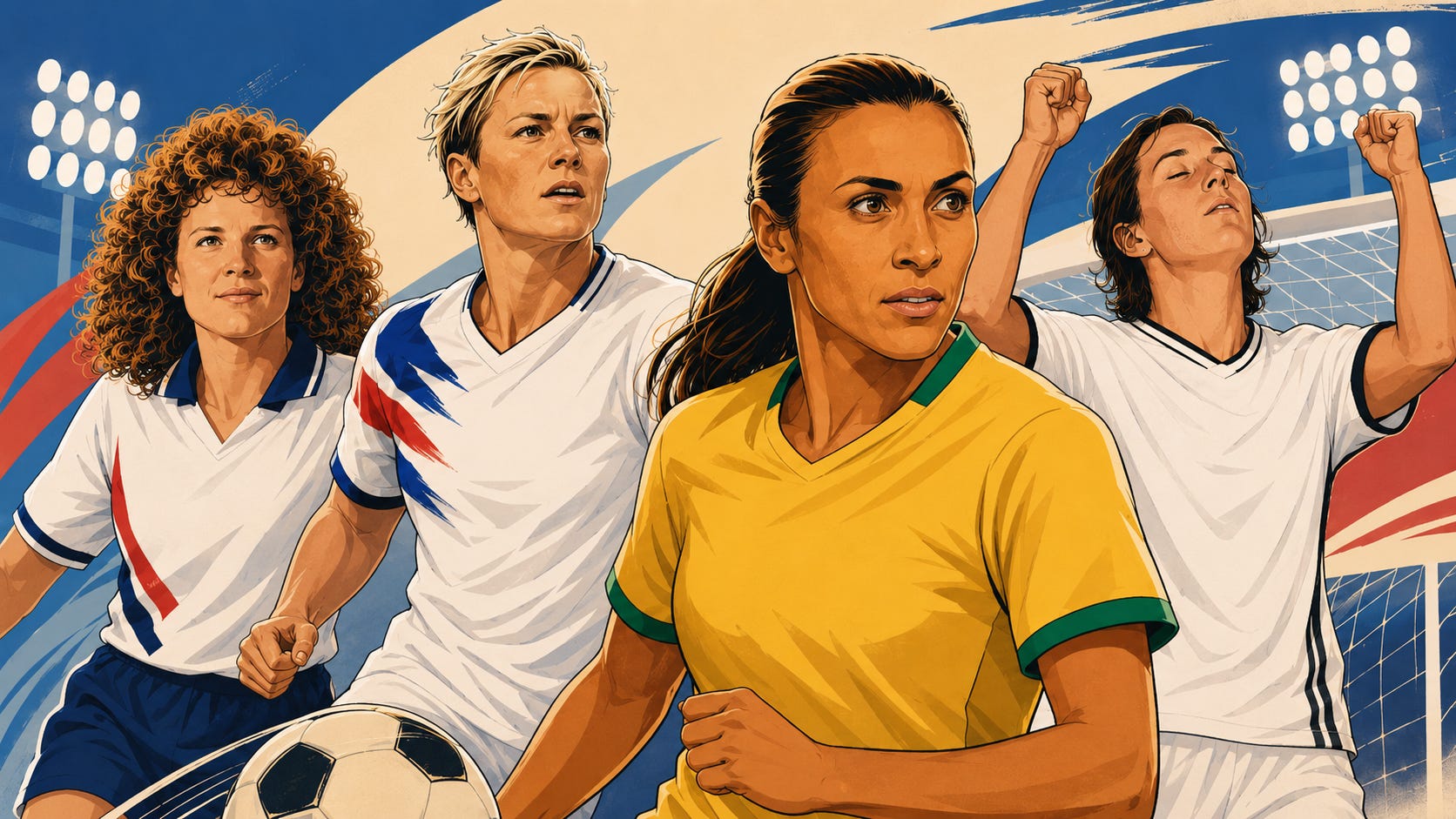
Lionel Messi may now sit above Marta on the combined men’s and women’s World Cup scoring list.
But in the women’s tournament, Marta stands alone.
Since the first Fifa Women’s World Cup in 1991, more than 1,000 goals have been scored at the finals. Some belong to household names. Others belong to players many fans have never heard of.
Together, they tell a bigger story.
The Women’s World Cup scoring list is not just a table of finishers. It is a map of the game’s modern history: the USA’s early dominance, Germany’s golden era, China and Norway’s great teams, and the Brazilian genius who turned goalscoring into art.
So, while the Men’s World Cup dominates the conversation, this feels like a good moment to follow the goals in the women’s game too.
Who are the greatest goalscorers in Women’s World Cup history?
Let’s start at the beginning.
Michelle Akers
Michelle Akers was the first modern superstar of women’s football.
Born in 1966, Akers was a powerful, relentless forward who played college football (soccer) with the University of Central Florida between 1985 and 1988.
She became UCF’s all-time leading goalscorer with 52 goals and also recorded 30 assists.
During this period, the U.S. women’s national team played its first international match.
In a bid to become the best, they travelled to Europe to play against the top teams at the 1985 Mundialito - the mini World Cup.
Organised by the Italian women’s football federation, this pre-Fifa World Cup provided the brand new USA team with a yardstick to measure themselves by.
Akers was part of the squad but couldn’t play the first game because of an ankle injury. She made up for lost time and in the second match scored the United States Women’s National Team’s (USWNT) first international goal, against Denmark.
And she continued to score.
Over the next 15 years, she scored 107 goals from 155 matches.
On the Fifa World Cup table, she is the third highest goalscorer with 12 World Cup goals in 13 matches. Not the highest total, but nobody matches her goals-per-game rate.
Akers scored 10 goals at the first official tournament in China in 1991.
You read that right: 10.
Five of them came in their quarter-final against Chinese Taipei.
She inspired the USA to their first World Cup trophy just six years after the team made their debut - and she’d scored their first international goal.
In 2002 she was named Fifa Female Player of the Century, alongside China’s Sun Wen.
And in 2004, Pelé named Akers on his list of 125 greatest living players as part of Fifa’s 100th anniversary celebrations.
She was inducted into the U.S. National Soccer Hall of Fame in 2004.

Abby Wambach
Taking over the mantle of Akers for the US team was Abby Wambach.
Akers played her last World Cup in 1999 and Wambach took over as lead goalscorer from 2003.
Wambach became one of the greats.
Her fearlessness on the pitch and in front of goal had defences quaking.
During her international career, she played 255 times for the USWNT and scored an incredible 184 goals. She remains the leading goalscorer for her country.
She had always been a goalscorer.
While at college, Wambach set records at the University of Florida with 96 goals, 49 assists, and 10 hat-tricks.
Her international career began in 2001 before she even had a senior club team.
Abby was named U.S. Soccer’s Female Athlete of the Year in 2003 — and again in 2004, 2007, 2010, 2011, and 2013.
Wambach scored big goals.
In the 2004 Olympics final, she scored a header in the 112th minute to secure the gold medal for her country.
She broke her leg just before the 2008 Olympics, but in 2012 scored five goals, hitting the back of the net in every game except the final, which the U.S. won anyway.
Despite her goalscoring record (she was the world’s top goalscorer at the time), Wambach didn’t win a World Cup until her final tournament in 2015.
During her career, Abby Wambach won the U.S. Soccer Athlete of the Year award six times, won both a Bronze Boot and Silver Ball at World Cups, was voted Fifa World Player of the Year in 2012, won two Olympic gold medals, a World Cup, and was named on the Time 100 list as one of the world’s most influential people in 2015.
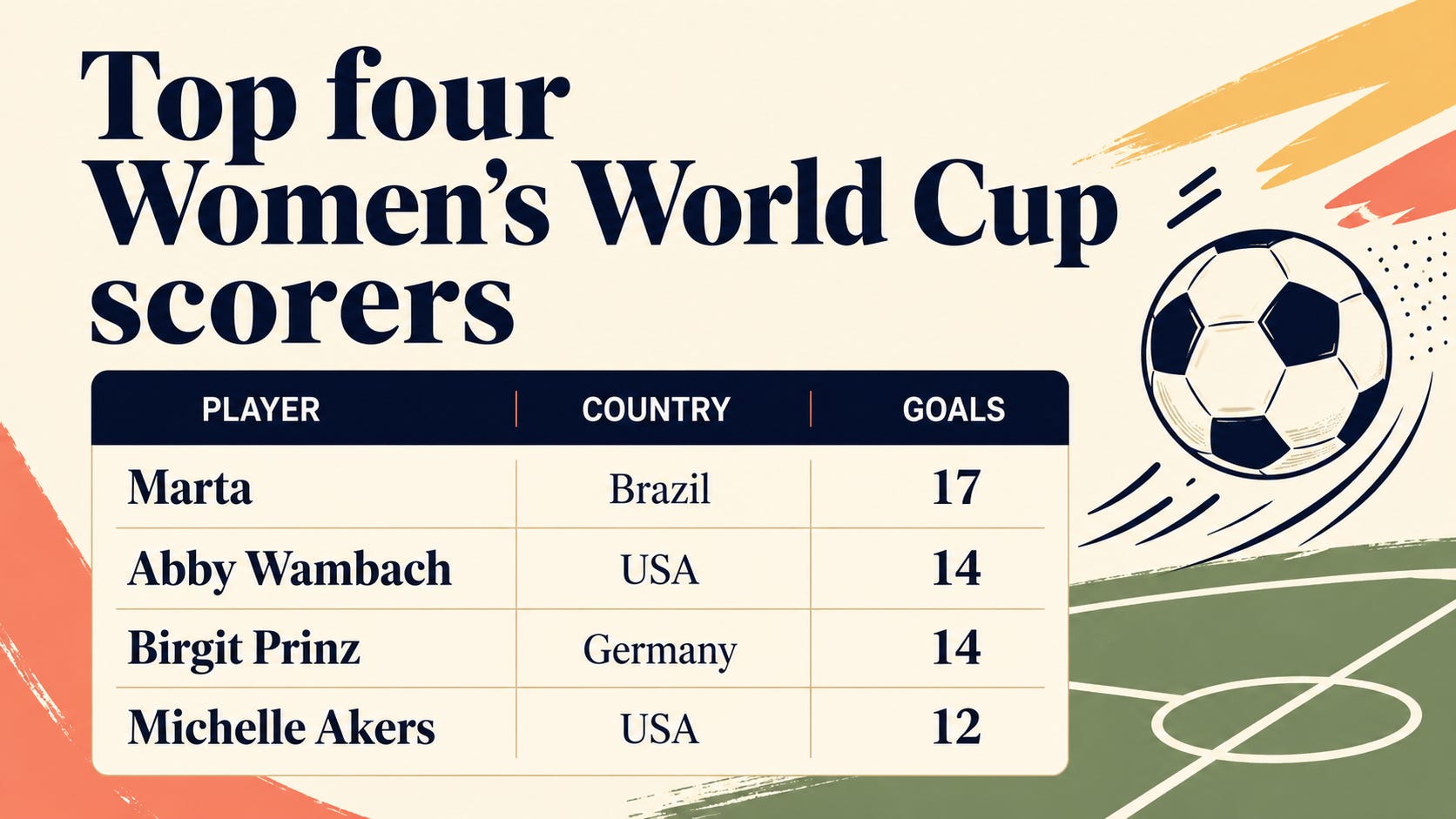
She finished her career with 14 World Cup goals, sharing second place with Germany’s Birgit Prinz.
Birgit Prinz
Germany’s Birgit Prinz is Europe’s top World Cup goalscorer. Her 14 goals are three ahead of fellow countrywoman Bettina Wiegmann.
If Akers and Wambach tell the story of American dominance, Prinz tells the story of Germany becoming a major tournament machine.
Prinz began her senior career at FSV Frankfurt in 1993.
During her time there, FSV Frankfurt won two Bundesliga titles and two German Cups.
She was the top scorer in the league in 1997 and 1998 and scored 45 goals in 57 appearances for them.
She moved to local rivals 1. FFC Frankfurt in 1998 and over the course of 13 seasons scored over 200 goals, won the league’s top-scorer award twice more, won six Bundesliga titles, eight German Cups, and the UEFA Women’s Cup three times.
She won German Female Footballer of the Year eight times, and was Fifa World Player of the Year three times, as well as coming runner-up to Marta four more times.
She made her international debut aged 16. She came on as a sub and scored the winner. The bar was set.
The 17-year-old Prinz became the youngest woman to appear in a World Cup final in 1995 (a record that still stands). The same year, she scored in the Euros final.
During her career, Prinz won five Euros, three Olympic bronze medals, and two World Cups.
She is Germany’s most capped player (214) and top goalscorer (128).

Marta
And so we arrive at the Fifa Women’s World Cup’s all-time top scorer: Marta.
Marta has played in six World Cups and sits alone at the top of the Women’s World Cup goalscoring pile with 17 goals.
And we’re all hoping she’ll be at her home event in Brazil next year, to top off her magnificent career.
Marta is justifiably considered by many to be the greatest women’s player of all time.
With over 120 goals for her country, it’s hard to dispute.
She was the first player to score at five different World Cups and the first player to score at five Olympic Games.
She is a goalscoring phenomenon.
Born in 1986, Marta is Brazilian-Swedish and has played at club level in both countries.
Aged 14, her talent was spotted, and her career began with Vasco da Gama in Rio de Janeiro.
In 2004, she moved to Sweden to play her club football with Umeå IK. The same year, she was awarded the Golden Ball for best player at the Fifa Under-19s Women’s World Championship.
During her five years at Umeå, she scored an astonishing 111 goals in 103 appearances and won seven league titles.
Marta moved to the U.S., winning Golden Boots and Most Valuable Player (MVP) accolades wherever she went.
She moved back to Sweden for a few years before returning to the US with Orlando Pride - where she still plays.
During her career, she’s won Fifa World Player of the Year six times - five of them consecutively between 2006-2010 and again in 2018.
Her flair, skill, and creativity have earned her the title of the greatest of all time.
Fifa honoured that legacy in 2024 with a Special Award at The Best Fifa Football Awards. They also created a new award in her honour for the best goal scored in women’s football each year. It’s known as the “Marta Award”.
Marta had appeared to be stepping away from international football after 2024, but she has since returned to the Brazil set-up.
Could we see her at the 2027 Women’s World Cup to reclaim the all-time top World Cup scoring record from Messi?
If she thinks she can still play at that level, you can be sure of it.

Top 20 (ish)
#1 Marta*, Brazil - 17
#2 Birgit Prinz, Germany - 14
#2 Abby Wambach, USA - 14
#4 Michelle Akers, USA - 12
#5 Sun Wen, China - 11
#5 Cristiane*, Brazil - 11
#5 Bettina Wiegmann, Germany - 11
#9 Ann Kristin Aarønes, Norway - 10
#9 Heidi Mohr, Germany - 10
#9 Christine Sinclair, Canada - 10
#9 Carli Lloyd, USA - 10
#12 Linda Medalen, Norway - 9
#12 Megan Rapinoe, USA - 9
#12 Alex Morgan, USA - 9
#12 Hege Riise, Norway - 9
#16 Celia Sasic, Germany - 8
#16 Marianne Pettersen, Norway - 8
#16 Kerstin Garefrekes, Germany - 8
#16 Liu Ailing, China - 8
#16 Eugenie Le Sommer*, France - 8
#16 Mia Hamm, USA - 8
#16 Homare Sawa, Japan - 8
#16 Kristine Lilly, USA - 8
* still active at international level
Akers gave the tournament its first great goalscoring story. Wambach’s consistency inspired generations. Prinz helped make Germany a global force. And Marta made the whole world stop and watch.
And now, with Messi moving the combined World Cup record on the men’s side and Brazil preparing to host the women’s tournament in 2027, the story might not be finished...
Comments
Nothing yet. Say the first thing.
Sign in to join the conversation.