
Manifest x DC was under Chatham House rules, so I’ve replaced all attendee names and organizations with ecclesiastical pseudonyms. I chose this because the conference was held in a former rectory building with a giant cross, stained glass, and a priestly ethos. During the opening talk we sat in rows to hear a benediction about our congregation’s shared identity, history, and divination skills. I thank Father Benedict for the invite and his tireless organizing.
I am not a forecasting or prediction markets expert, but I really enjoyed the event. I read forecasters when I’m trying to understand world events or trends. I think markets are powerful and have a pretty good track record of incentivizing well calibrated predictions. I’m glad people are thinking about how to improve decision making in key institutions since most ‘expert’ punditry is bad (or never even checked).
That said, Manifest x DC felt more like a fun place to chat with like-minded people than a professional conference— so much so that the esteemed St. Howard of the Georgios Missionary Union mused that attendees might be limiting the reach of their ideas by having “too much fun,” or inversely that sects like EAs might lose creativity by optimizing for “serious” networking. I learned some interesting things at this unconference, but it was not “serious.”
The event started with unstructured chatting. As with most conferences, the most interesting stuff happened here. I was amazed at how quickly attendees naturally sorted themselves by dress code. I saw the technology brother t-shirt cluster, the real finance guys polo cluster, and the one guy wearing a suit + grown ups cluster. In these conversations I learned that a major AI lab uses internal prediction markets for its decision making. I also heard that Kalshi’s terrible ads are bad on purpose to attract both dumb money and the wolves that follow it.
After half an hour of mingling had passed, none of the Manichaeans (who sponsored the event) had arrived yet. Someone shouted out that we should make a prediction market for when they would arrive (to tepid laughs). They arrived shortly after this announcement, so I can only assume they were waiting in the bushes outside to collect their mana.
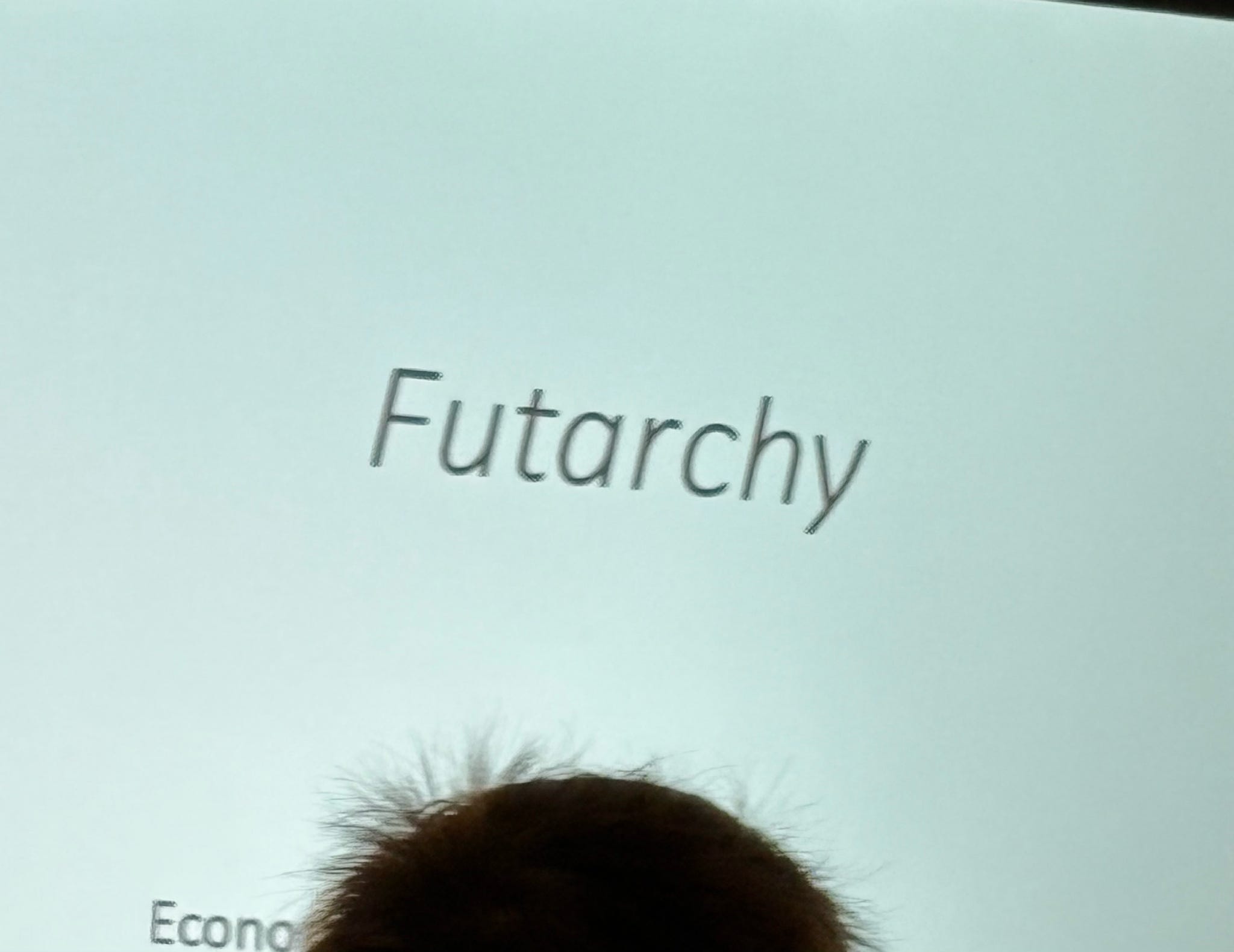
During one of the first talks, someone set up a large monitor and desktop computer at the back of the room with an ergonomic split mechanical keyboard. It was unclear to me whether he was an organizer or if this was just a thing that happens at forecasting meetups. The clacking of the keys annoyed me at first, but then I remembered our venue and shared purpose. Today our organists play different instruments for a different age. I let the sound soothe me as I listened to the talk on futarchy.
St. Howard of the Georgios Missionary Union argued that by running two decision markets (i.e. one for the price of their stock if they keep their CEO and another for if they fire him), firms could get valuable information and take the action that maintained the higher price. However, he flagged a major problem that decision markets and Manifest attendees might both share— they boldly output literal-minded information without reading the etiquette of office politics. It might be hard to promote either to the level of C-suite decision makers.
He also responded to more than one audience question by just pointing at a picture of the decision theory expected utility formula he had projected onto the giant screen behind him. He didn’t need to say more. I admired this, but it felt more like a Zen koan than an academic talk.
The gender ratio was about what you’d expect, but St. Theresa of Ávila ran an interesting meditation workshop, sister Thérèse promoted the event to her devout followers, and St. Catherine asked great iconoclastic questions throughout the event.
A researcher at Metanoia also ran a fun “split the room” prediction workshop where she taught a method for helping non-forecasters get comfortable calibrating their predictions. The goal was to state a prediction that would make 50% of attendees take the over and 50% take the under. We were split over Putin leaving power before 2035, and it was cool to see how people reasoned about their guesses— actuarial tables for old men, base rates of Russian leaders dying in office, and whether AGI will flip the game board. AI risk was not on any official conference programming but simmered at the edges of many conversations.
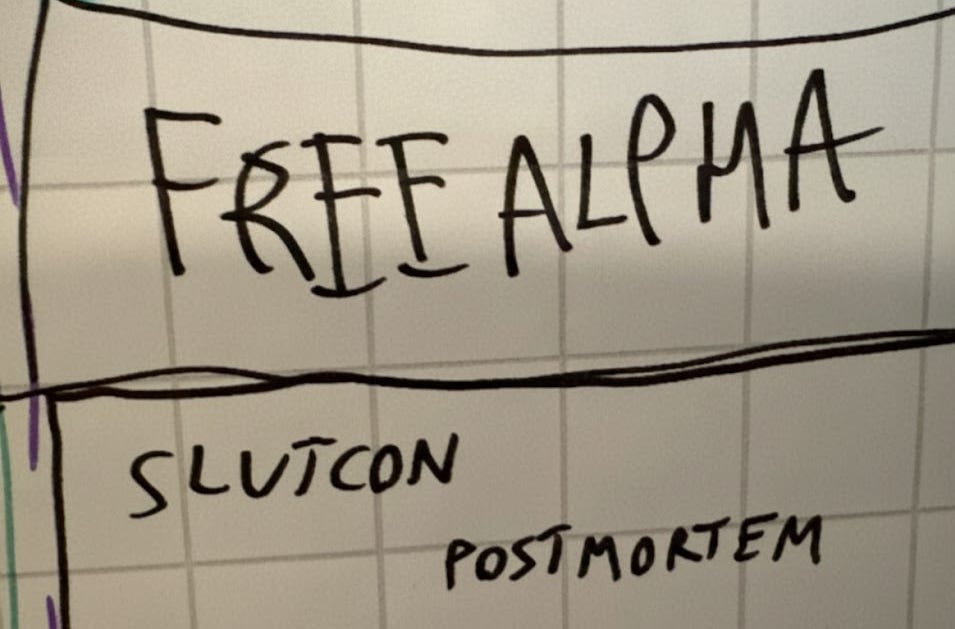
I sadly don’t actually have much to say about the Free Alpha or the Slutcon Postmortem talks. The former did provide alpha by getting to see the thought process of a smart trader considering the government shutdown or the market’s recent skittishness around tech stocks, which I enjoyed. It’s 2025, so much of the discussion involved deciphering Michael Burry’s 5’6” tweet and Trump’s post on giving Republicans potential outs on healthcare or ending the filibuster.
The Slutcon Postmortem described how roughly a third of men still struggled with social anxiety by the end of that conference (if you are unaware of Slutcon, God bless you). The speaker argued that male insecurity is often driven by safety behaviors and gave some tips for self-confidence. He said “good flirting exists in a superposition of cringe or confidence that only collapses when observed,” and discussed how men at Slutcon had partly been coached to “chase cringe.”
As he said this, I remembered that actual priests used to live and pray in this room. I wondered if they could have ever predicted a future like this.
At one point during the event I noticed that “Fire! 🔥” had risen to 23% on the “What will go wrong at this conference?” prediction market. I considered whether any attendees were zealous enough to risk lives, property, and prison time for fake internet points on a public market. I ultimately bet the position down. I was pretty sure someone was just having fun trolling the organizers, but I did feel weird about the moral hazard of making that market more liquid.
(To be clear, there was no fire. A great organizer gave thoughtful instructions at the start of the event about respecting the venue which I believe everyone obliged by. The market had corrected to ~1% when I checked a few hours later.)
By far the most traditional talk was by a real financial trader who had traded millions of dollars on the legal US prediction markets. I thought he would also discuss his alpha, but instead his talk was delightfully prosaic. Almost all of it was about tax compliance issues, the importance of personal record keeping, and watching out for trading fee increases on the markets. He mused about how hard it is to get a proper 1099 form and then a few attendees broke off into a discussion on writing scripts to automate this process. It was refreshingly banal.
At the end of the day, Father Whittaker gave a talk on forecasting AI forecasting— how good are AI systems at making their own probabilistic forecasts of future events? What are the trends in their performance on benchmarks and in tournaments, and when might they reach parity with experts like himself? I really enjoyed hearing about the organizations building these benchmarks and noticing steady gains in AI capabilities, primarily driven by better base models. The speaker’s median forecast was true parity by 2029.
Then the Q&A got derailed by a bunch of interesting but outside-the-scope-of-the-talk questions about how relevant AI forecasting will be for the real economy, whether providing a well calibrated percentage estimate would even replace many analyst jobs, and how to even define AI progress. This was probably the moment where the theological disputes between the participating sects felt most clear.
The afterparty was fun but uneventful. People chatted about similar topics to similar people in a well-lit room with some music playing. The party hosts graciously provided snacks, drinks, and good company. [edit: I’ve been told that I left the party before “the lights dimmed and the duels began.”]
In the end, the “what will go wrong” prediction market partially resolved to “Everything went fine, nothing is ruined,” but only at a 20% payout. The rest went to minor issues like the venue limiting the number of attendees.
I was silly in this post but I’m genuinely grateful to have been there and to live in a world where these people can find each other. The future seems very strange to me. I’m glad Manifest x DC helped me consider some new ways I might try to make sense of it and I look forward to reading more.
No posts
Comments
Nothing yet. Say the first thing.
Sign in to join the conversation.