

Watch her for a moment.
The room is not easy. A project has gone sideways and in a public way. The kind that involves stakeholders, missed commitments, and a team that is equal parts demoralized and defensive. She’s called the group together. They’re watching her.
This is leadership in difficult moments. It’s not for what she says, but for what she does before she says it.
She takes a breath. Just a beat, deliberate enough to be a choice rather than a reaction. Something shifts in how she’s holding the room before she’s said a word.
She starts by naming what happened. Not who caused it, just what happened. Specific, behavioral, without verdict. The team, braced for blame, relaxes slightly. She asks a question: what do we think got in the way? She listens to the answers. Actually listens, tracks the emotion underneath the words, notices the person in the corner who hasn’t spoken and whose silence is saying something. She asks them directly. Gently. The answer is more useful than everything else combined.
She doesn’t pretend the situation isn’t serious. She doesn’t cushion the standard. She names what needs to change and she states it clearly. But she frames it around where they’re going rather than where they failed, and somewhere in the framing the team stops being an audience for a difficult conversation and starts being participants in finding the way out.
The meeting ends. Something that was stuck starts to move. Not because she said the perfect thing, but because she was present enough, regulated enough, attuned enough to the people in the room that the conversation could go somewhere real.
If you’ve been reading this series, you know exactly what just happened. You watched the Ladder of Inference get checked before the story closed. You watched SBI land inside a high-stakes room. You watched the Trust Equation’s empathy variable show up in the question asked of the person in the corner. You watched the coaching posture hold the space open rather than filling it with answers.
You didn’t see a framework. You saw a leader. The frameworks were underneath, doing their quiet work, the way a foundation does its work. Invisible when it’s solid, catastrophically apparent when it isn’t.
That’s what emotional intelligence looks like when it’s working. Not a personality type, not a natural gift. A set of skills, built deliberately, practiced consistently, visible in the specific choices made in the moments that matter most.
We’ve been building them for last eight articles. This is what we’ve built.
“Either you have it or you don’t.”
It is the most limiting belief in leadership development and the one most likely to go unexamined, because it masquerades as self-knowledge. The leader who says “empathy isn’t really my strength” or “I’m just not naturally attuned to the emotional side of things” sounds like someone who knows themselves well. They’re actually someone who has filed an undeveloped skill under a fixed trait and stopped there.
EQ gets treated as temperament. The warm leader, the emotionally attuned one, or the person who just naturally reads rooms well. Which means leaders who don’t naturally operate that way file it under “not how I’m wired” and move on, leaving the most important variable in their leadership effectiveness unexamined and largely undeveloped.
The second version of the lie, equally persistent: “EQ is about being nice.”
It isn’t. The conflation of emotional intelligence with agreeableness is one of the most reliably wrong ideas in professional development. High EQ leaders are not necessarily warm, easy, or conflict-averse. They are clear, accurate, and effective across the full range of human situations. Including the hard ones, especially the hard ones. The leader who had the crucial conversation in the last chapter wasn’t being nice. The manager who finally stopped doing the 9pm edits and gave real feedback wasn’t being nice. The leader who named their role in the Drama Triangle and changed their behavior wasn’t being nice.
They were being emotionally intelligent. Those are not the same thing.
Every difficult moment in this series has been an EQ moment. Every piece of feedback that landed. Every ladder descended before acting on a story. Every coaching question asked instead of answered. The skill running underneath all of it wasn’t warmth. It was intelligence applied to the emotional and relational dimension of the work, with exactly the rigor most leaders reserve for the technical dimension.
Daniel Goleman’s research on emotional intelligence identified four domains. Two that govern how you manage yourself, and two that govern how you manage your relationships. They build on each other in sequence. And if you’ve been following along, you’ve been developing all four without necessarily having a name for them.
Here they are. With everything you’ve already built mapped inside them.
Knowing what you’re feeling, why you’re feeling it, and how it’s affecting your thinking and behavior in real time. Not in retrospect but in the moment while it’s happening, before it becomes your response.
This is the foundation domain. Nothing else works without it. You cannot manage what you cannot see. You cannot read a room accurately if you’re unaware of how your own emotional state is filtering what you perceive. You cannot build real relationships if the version of yourself you’re presenting has never been honestly examined.
The work we’ve already done here:
The personal retrospective and values audit were the beginning. They’re honest examination of where you actually are, not where you intend to be, against the values that are supposed to be running your operating system. The Ladder of Inference work was self-awareness in real time. The practice of noticing when you’ve started filling in gaps with story rather than data, catching it before it becomes a decision. The Drama Triangle work required you to identify your role in a dynamic while you were in it, which is one of the harder self-awareness moves available.
Self-awareness is the domain most leaders overestimate in themselves. The gap between how leaders rate their own self-awareness and how their teams experience their leadership is one of the most consistently documented findings in leadership research. Self-awareness is genuinely difficult and the feedback loops that would correct it are often absent or muted.
The practice: the retrospective isn’t a year-end event. It’s a weekly question. What did I bring into that room that wasn’t about what was in the room? Asked honestly, consistently, over time and that’s the self-awareness muscle being built.
The space between stimulus and response is where leadership actually lives. Self-management is what happens in that space. It’s the regulation of your emotional response well enough to choose what comes next rather than simply react to what just happened.
This is not suppression. The leader who flattens their emotional response until nothing shows is not demonstrating self-management. They’re demonstrating disconnection, and their team reads it as such. Self-management is the ability to feel the thing and still choose the response. To be frustrated and stay curious. To be anxious and stay regulated. To be under pressure and remain present.
The work you’ve already done here:
The ownership absorption chapter was self-management at its most foundational. Learning to distinguish between what’s yours to carry and what isn’t, and putting down what belongs elsewhere before it becomes your team’s problem. The crucial conversation work was self-management under fire. Staying regulated enough to say the thing that needed to be said to the person who made it most expensive to say. The Rescuer to Coach shift required self-management of the most seductive kind. Regulating the impulse to solve, which feels like helpfulness, in favor of the patience to ask, which feels like restraint but produces growth.
Self-management is where the work of self-awareness pays its first dividend. Awareness gives you the data. Management gives you the choice. The leader who can hold a difficult conversation without going silent or going aggressive, who can receive feedback without deflecting or collapsing, who can stay present in an ambiguous situation without defaulting to false certainty, is demonstrating self-management in its most practical and most visible form.
The practice: the next time you feel the pull of a strong reaction such as the urge to fix, to defend, or to close the conversation down, pause long enough to name what you’re feeling internally before you act on it. I’m feeling defensive right now. I’m feeling the urgency to solve. That naming is the gap. The gap is where the choice lives.

Reading what’s actually in the room. Not what you expect to find. Not what confirms what you already think. What’s there in the emotional reality of the people in front of you, in the dynamic between them, and in the thing nobody is saying that is somehow present in every exchange.
Social awareness is the domain that most directly determines how good your data is. A leader who reads rooms accurately has better information than one who doesn’t. Better information about what the team actually needs, about where the friction is before it becomes a crisis, and about what the person across from them is experiencing beneath the surface of what they’re saying.
The work you’ve already done here:
The Ladder of Inference work built social awareness from the bottom up. The discipline of staying in observable data rather than rushing to interpretation, which is the prerequisite for reading others accurately rather than reading your own projections of them. The active listening work is social awareness in practice. Every time you ran that framework in a real conversation, you were developing the muscle for reading what’s underneath what’s said. The Trust Equation’s empathy variable is social awareness translated into behavior.
Social awareness is the domain that makes problems visible before they become crises. The leader with high social awareness notices the shift in the team before it calcifies into disengagement. They read the meeting for who’s present, who’s performing presence, who went quiet and why. They read it accurately enough to make a real-time adjustment. They hear what isn’t being said with the same attention they give to what is.
The practice: in your next meeting, spend the first five minutes watching before you lead. Not passively, but deliberately. Who is in the room? What’s the energy? What’s present that hasn’t been named? Let what you observe shape how you open rather than leading with the agenda you brought in.
This is where the first three domains become visible to everyone else. Relationship management is the skill of taking what self-awareness, self-management, and social awareness give you and using it to build, maintain, and repair the relationships that make leadership possible. Deliberately, consistently, and across the full range of human situations.
It is the domain most visible to others and most invisible to the leader. It shows up in whether people bring their best thinking to you, whether they stay when they have options, whether they tell you the truth when the truth is uncomfortable. The cumulative score on relationship management is the answer to the question your team is always answering, even when nobody has asked it out loud: what is it actually like to work for this person?
The work you’ve already done here:
The Trust Equation: the full formula, including the denominator. Building credibility is relationship management. Managing self-orientation is relationship management. The work of identifying which variable is doing the damage in a specific relationship and addressing it directly, that’s relationship management applied with precision. The Drama Triangle and the Empowerment Dynamic were relationship management at the systemic level. Understanding that the roles you play are co-created with the people around you, and that changing your role changes the dynamic for everyone in it. The SBI feedback method is relationship management in its most practiced form. Delivering honest information in a way that the relationship can hold and the person can use. The crucial conversation was the hardest relationship management move. The willingness to say the thing to the person who makes it most expensive to say, because the relationship is worth the discomfort of honesty. The GROW model is the relationship management skill that compounds longest. The coaching conversation that builds capability in someone else, one question at a time, over a sustained period of investment.
The practice: at the end of each week, ask yourself one question about the most important relationship in your team or with your peers right now. What did I do this week that built that relationship? What did I do, or not do, that cost it something? The accounting doesn’t need to be formal. The noticing is what matters.
Here’s the all the tools we’ve discussed so far, mapped to the EQ domains.
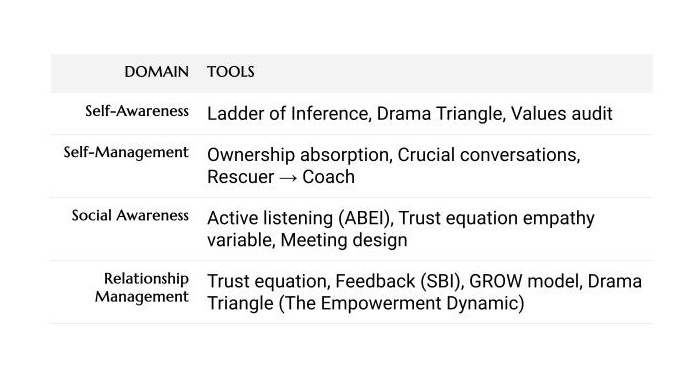
You didn’t learn these as EQ skills. You learned them as tools for specific problems: the story you made up about your team, the trust that felt off, the meeting nobody wanted to be in, the feedback that wasn’t landing, the conversation you kept avoiding, the person you kept rescuing instead of developing.
The problems were real. The tools addressed them. And underneath all of it, in every chapter, the same four capacities were being built: knowing yourself, managing yourself, reading others, and building relationships that make the work possible.
That’s emotional intelligence. You’ve been doing it the whole time.
One more thing before the close, something the frameworks don’t always make explicit.
EQ isn’t applied uniformly. It navigates up, across, and down. And the application looks different in each direction.
Navigating down with your team: is the most practiced direction for most leaders. The majority of our recent articles lived here. The EQ challenge going down is self-orientation: staying genuinely focused on their development rather than your own comfort, your own efficiency, your own need to be the one with the answer. The tools were largely built for this direction. Use them.
Navigating across with your peers: is the direction most leaders underinvest in and most organizations undervalue. Peer relationships are where the Drama Triangle does some of its most reliable work in the background (the alliance that quietly becomes a triangle) and where the Trust Equation becomes most handy (the peer whose trust has been slowly eroded by a pattern neither party has named). The ability to read peer dynamics honestly before they become political problems and to name the thing between equals when there’s no hierarchy to fall back on is social awareness applied laterally. And it’s one of the most valuable and least developed EQ skills in most leadership teams. Invest in it deliberately.
Navigation up with your boss: is the hardest direction and the most avoided. The self-management challenge going up is regulating under a power differential: staying calm enough, clear enough, and courageous enough to say the thing that needs to be said to the person who holds significant influence over your career. Leaders with high EQ going up are not fearless. They are regulated enough to act despite the fear. That’s not a personality trait. It’s the practiced outcome of everything in this section applied in the hardest direction available.
The four domains are the same in every direction. The courage required to apply them changes with the altitude.
Here is the most important thing I want to leave you with at the end of this section.
Emotional intelligence is not fixed. It is not a score you receive and carry unchanged through a career. It is not the exclusive territory of people who were born warm, or naturally empathetic, or instinctively attuned to the people around them.
It is a practice. Built through deliberate attention. Developed in real situations. Grown through exactly the kind of honest self-examination and behavioral change that is hard and uncomfortable and worth it.
Every retrospective run honestly is self-awareness being built. Every ladder descended before acting on a story is self-management being practiced. Every time you listened for the assumption underneath the question rather than just the question is social awareness being developed. Every coaching conversation held open when the instinct was to close it with an answer is relationship management being exercised.
That is the program. Not a two-day offsite. Not an assessment with a debrief. Not a competency framework filed in a drawer after the workshop ends. The real situations, engaged with real attention, over a sustained period of time. That’s real EQ development, and that’s the leadership job.
The research is clear and consistently underestimated: unlike cognitive intelligence, which largely stabilizes in adulthood, emotional intelligence is genuinely developable across a career. Leaders who commit to the practice demonstrate measurable improvement over time. The ceiling is not fixed. The work is never fully done.
Both of those things are true. Both of them are good news.
Because it means the gap between the leader you are and the leader you’re capable of being is not a personality problem. It’s a practice problem. And practice problems have a solution: keep going.
One question to ask: Which of the four domains is doing the most work for you right now? And which one, honestly, is where the friction in your leadership currently lives? Not the domain you’ve been told needs work. The one you know, in the specific recurring situation that keeps showing up, is where the gap is. Name it. That naming is self-awareness. Everything else builds from there.
One behavior to stop: Stop treating EQ as a fixed trait in yourself or in the people you lead. The next time you catch yourself saying “that’s just not how I’m wired,” reframe it: that’s a skill I haven’t practiced enough yet. One version is a ceiling. The other is a direction.
One practice this week: Pick one domain. Pick one tool from this section that lives in that domain. Run it deliberately in one real situation. Notice what’s different. Notice what’s hard. Notice what opens up that didn’t before. That noticing is the self-awareness that starts the cycle again. Which is, perhaps not coincidentally, exactly where this whole section began.
Go back to the leader in the opening scene for a moment.
She wasn’t born knowing how to hold a difficult room. She wasn’t naturally attuned to the person in the corner whose silence was saying something. She didn’t arrive in the role with a fully calibrated self-awareness practice and a reliable self-management muscle and a set of relationship management skills that made the hard conversations feel manageable.
She built them. In the specific situations that required them, through the tools that gave them shape, over the years it took to move from recognizing the right thing to do to actually doing it reliably, under pressure, in the moments when it mattered most.
That’s the path. Not a straight one. Not a fast one. Not one that ends with a certification or a score or a completed curriculum. A path that runs through every difficult conversation, every honest retrospective, every moment you chose the question over the answer, every time you came down the ladder before you acted on the story, every piece of feedback you gave that cost you something to give and changed the relationship because of it.
Every chapter in this section was a step on that path. Every tool was a waypoint. Every Monday Move was an invitation to take the next step rather than read about it.
You know what the tools are now. You’ve seen them in practice, in the stories of leaders navigating real situations with real stakes and real people watching. You’ve been applying them in your own leadership, in your own team, in the relationships that determine whether the work you’re doing together becomes what it’s capable of being.
Next is where you take what you’ve built and turn it toward the system. It’s the vision that sticks, the decisions that scale, the operating rhythm that keeps the whole thing moving in a direction that matters.
But the system is only as strong as the leader at the center of it. And the leader at the center of it, the one who knows themselves, manages themselves, reads the room, and builds the relationships that make everything possible, that’s who you’ve been becoming.
The work continues. It always does.
That’s not a warning. That’s the point.
If this landed, share it with a leader who has been doing the work and is ready to see what they’ve built.
No posts
Comments
Nothing yet. Say the first thing.
Sign in to join the conversation.