
There’s a version of this I lived.
It looked like this: a member of my team would turn in work that was slightly off. Not the kind of miss that triggers a formal conversation or sets off alarms. Just not quite there. A gap between what was submitted and what needed to go out the door.
I would close the gap. Usually late at night when the world was quiet, and I could tell myself I was being a good manager. I’d open the draft, smooth the rough edges, tighten the structure, send it back with a note that said something like “small tweaks!” Cheerful, low-stakes, completely invisible.
I told myself it was faster. I told myself I had a higher bar, and it was easier to just do it. I told myself I was protecting them from a stakeholder who wouldn’t have been kind about the gap.
Every one of those things was true.
None of them were the real reason.
The real reason was simpler and less flattering: I had confused having the answer with doing the job. I was so practiced at solving problems, so rewarded for knowing what to do, so comfortable in the role of the person who figured things out, that I had built an entire management style on a foundation of my own competence. And the people around me had stopped growing because there was no room. I was standing in it.
I wasn’t a bad manager. I was a very efficient one. But efficiency, applied to the wrong problem, is one of the most expensive habits in leadership.
Here’s the distinction nobody puts in the job description.
A manager makes sure the work gets done. Tracks the output. Fills the gap when it falls short. Defines success as delivery. The right thing, on time, to the right standard. All of which is necessary and all of which is real work. None of which develops people.
A leader makes sure the people grow. Tracks the person. Holds the standard without absorbing the gap. Defines success not as this deliverable but as the capability built in the process of producing it. It’s not just what came out the door this quarter, but who is walking through the door next quarter, and whether they’re more capable than the person who walked in.
Those are different jobs. They require different skills, different beliefs, different instincts about what to do when someone falls short. Most people who get promoted into leadership were promoted for being exceptional managers. They were promoted for the output, the execution, the getting things done. Then handed a leadership role without anyone explaining that the job had fundamentally changed.
Phil Jackson won eleven NBA championships. He did not score a single point in any of them. He never took a three-pointer in the fourth quarter, never posted up in the paint, never ran a fast break when the game was on the line. His job was to develop the people who did. To build the conditions, ask the questions, hold the belief in his players’ potential long enough and consistently enough that the players started holding it themselves.
Sir Alex Ferguson managed Manchester United for twenty-seven years. He won thirty-eight trophies. He never made a tackle. He never played a through ball or headed a cross. What he did, relentlessly across nearly three decades, was develop players into versions of themselves they couldn’t see yet. He built a culture where growth was expected, standards were held, and the belief that you could be better than you currently were was not a compliment but a requirement.
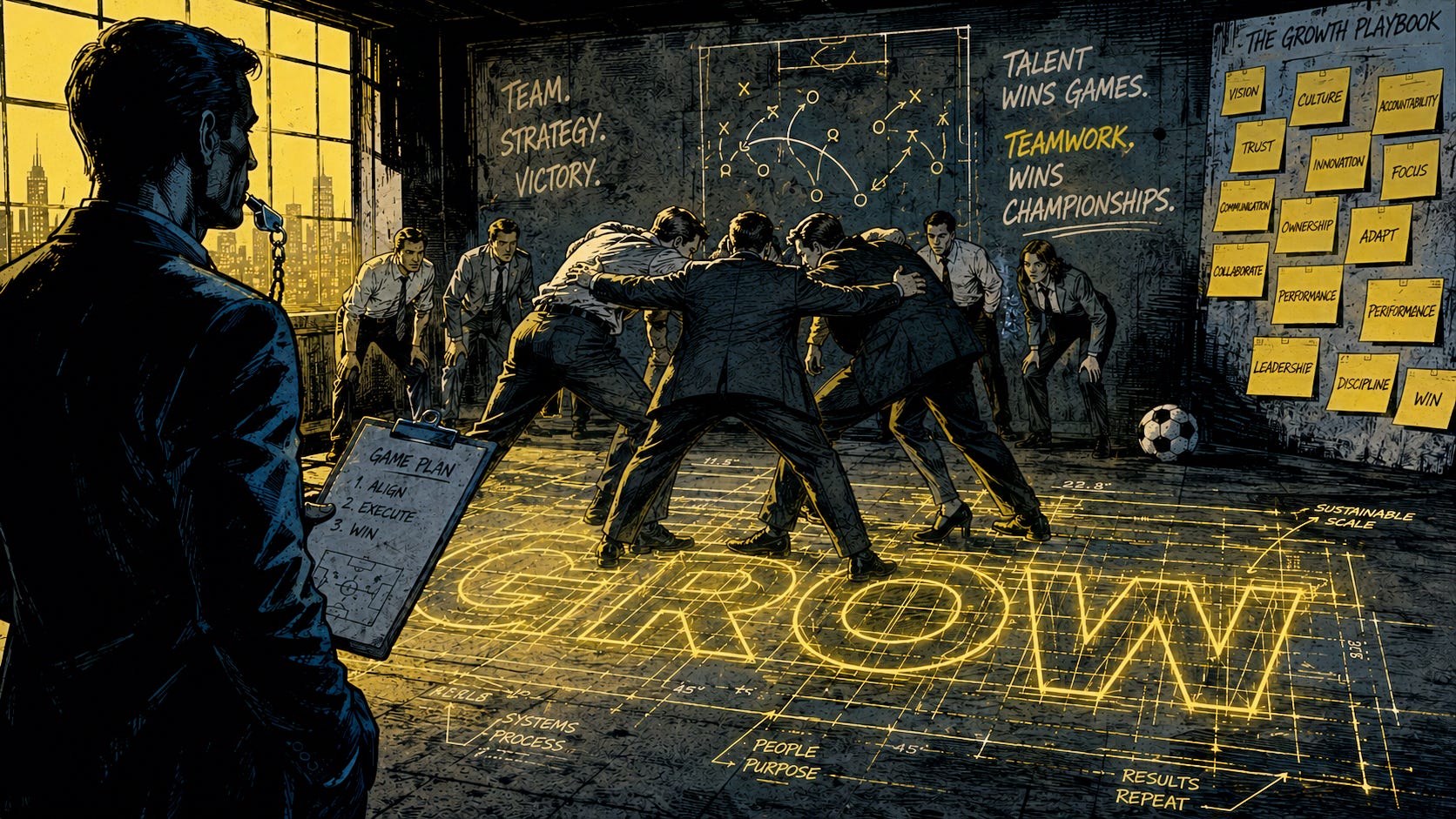
The best coaches in any sport are remembered not for what they did on the field but for what they built off it. The players are remembered for the performance. The coaches are remembered for making the performance possible.
That dynamic doesn’t change between the pitch and the cubicle. The context is different. The jerseys are different. The principle is identical. Fevelop the person, not just the output.
“It’s faster if I just do it.”
True today. Expensive over time. Every time you absorb a gap that belongs to someone else, you make a small deposit in the wrong account. You become slightly more indispensable, they become slightly less capable. Do it once, it’s pragmatic. Do it for a quarter, you have a team that’s stopped growing. Do it for a year, you have a team that’s stopped trying. They’ve built their picture of their own competence on a foundation you constructed for them without their knowledge. That’s not development. That’s a very elaborate fiction.
“I’m protecting them.”
From what, exactly? From the experience of falling short and learning from it? From the accurate feedback that would tell them where they actually are? From the discomfort that has preceded every meaningful growth in every context that has ever produced it?
Protecting someone from their own development is not kindness. It is control dressed up as kindness. The intention is generous. The impact is the opposite. Every gap you absorb invisibly sends a message the other person can’t hear: I don’t think you can handle what’s real. You think you’re having their back. You’re deciding their back isn’t strong enough and never giving them the chance to prove you wrong.
“What if they can’t do it?”
This is the most honest of the three and the one most worth reflecting upon. Because here’s the coaching answer: you won’t know until you ask. Asking with the genuine belief that the answer exists inside the person you’re asking is the act that most often produces the growth. People rise to meet the belief of the people who hold them capable. Not always but more often than the 9pm editor ever found out.
Here is the thing about coaching that no model can give you and no framework can install: it only works if you genuinely believe the person across from you can find their own way to the answer.
Not probably, not maybe, but genuinely.
Because people can feel the difference between a leader who is asking questions to guide them to a predetermined destination and a leader who is asking questions because they’re actually curious about what’s there. The first feels like a maze. Technically open-ended, actually constrained. The second feels like a conversation with someone who is on your side and believes, without needing to perform it, that you’re capable of more than you’re currently doing.
That belief is the coaching mindset. Everything else, the model, the questions, the structure, is the technique that gives the belief a shape.
The manager asks: how do I get this done?
The leader asks: how do I develop this person?
Both questions are legitimate. Only one of them compounds.
Four stages. Four sets of questions. Simple enough to remember under pressure, structured enough to keep the conversation from drifting into advice.
One note before we start: GROW only works when the leader is genuinely curious about the answers. Run it as a structure for arriving at the answer you’ve already decided on and the person across from you will feel it within the first exchange. It will feel like a maze, not a conversation. Curiosity is not a technique. It is a mindset the model gives shape to. Hold the mindset first, learn to listen, then use the model.
Not the task, but the outcome. The distinction matters. Tasks are assigned, outcomes are owned, and coaching works on ownership.
The goal question is about getting clear on what success looks like for this person, in this situation, beyond the immediate deliverable.
Try:
“What would a great outcome look like for you here?”
“If this went exactly as you hoped, what would be different?”
“What does success look like not just for the work, but for you in this?”
This phase often takes longer than leaders expect and is almost always worth it. People aren’t usually clear on what they’re actually trying to achieve beyond the surface task. Slowing down here isn’t inefficiency, it’s the work. A coaching conversation without a clear goal is a conversation with nowhere to go.
A good sports coach doesn’t start practice by drilling without a purpose. They start by naming what winning looks like in the specific context of this game, this opponent, this week. The goal phase is that conversation. Get it clear before anything else.
Honest, specific, and without verdict. This is where the SBI skills from the feedback article do their work inside the coaching conversation. Stay on the bottom rung of the Ladder of Inference, describe what’s observable, resist the interpretation.
The reality question is where the Rescuer instinct is hardest to hold back. The gap is visible. The solution is right there. The leader knows exactly what needs to happen.
The coaching move is to ask anyway.
Try:
“What’s actually happening right now?”
“What have you tried so far?”
“What’s working? What isn’t?”
“What do you think is getting in the way?”
Because the person’s own honest assessment of their reality is more useful than yours. Not because you’re not right, but because that act is itself part of the growth. It’s the act of naming it honestly, out loud, with someone who is listening rather than waiting to solve it. People who can accurately assess their own reality can improve it. People who have always had it assessed for them can’t.
The football manager who does all the tactical analysis for the player and just tells them where to stand produces a player who is dependent on being told where to stand. The one who asks the player to read the game and then helps them understand what they’re seeing produces a player who can read it next time on their own.
Not the right path. All the paths. This is the generative center of the GROW conversation. The phase where most people, given real space to think, surprise themselves and the leader sitting across from them.
Try:
“What options do you see?”
“What else could you try?”
“What would you do if the obvious constraint wasn’t there?”
“What would you tell someone else to do in this situation?”
That last one has an extra bonus and worth considering. People consistently give better advice to hypothetical others than they give to themselves. The question sidesteps the self-doubt and accesses the thinking that was already there. The thinking the person couldn’t reach directly because their own situation felt too close and too charged.
The leader’s role in the Options phase is to expand, not to direct. Add to the list “have you considered X?”, but never collapse it to the option you prefer. The person needs to own the choice that comes out of this phase. Ownership requires real selection, and an authentic selection requires a list that wasn’t quietly narrowed to one before the choice was offered.
This is the part the Rescuer finds most difficult. The answer is right there. The efficient move is to name it. The coaching move is to hold the space open long enough for them to find it , and to stay curious about whether what they find might be better than what you had in mind. Sometimes it is.
Commitment, specificity, and timeline. This is where the conversation graduates from thinking to action. It’s also where many coaching conversations dissolve into vagueness if the leader doesn’t hold the close.
Try:
“What are you going to do, and by when?”
“How committed are you to this on a scale of one to ten?”
“What might get in the way, and how will you handle it?”
“What do you need from me to make this happen?”
The commitment scale is more useful than it looks. A six or seven says something is still unresolved, and it’s worth finding out what before the conversation ends. A nine or ten is a genuine commitment the person has arrived at themselves. That’s a fundamentally different category of accountability than one assigned from above.
The last question “what do you need from me?” is the one that redefines the leader’s role in the relationship. They’re not the solver, not the fixer, but the resource. The person whose job is to remove the obstacles between this person and what they’re capable of.
That’s the job. That’s always been the job. It just took a model to make it visible.
This is the last full tool in my current kit on leading others. This one is about coaching, and it’s here at the end because coaching is where everything before it becomes a practice rather than a concept.
You cannot coach someone you’ve misjudged. The Ladder of Inference runs underneath every GROW conversation. You have to be genuinely curious about their reality rather than collecting confirmation of the story you’ve already written about where they are and what they’re capable of.
You cannot coach without trust. The Trust Equation determines whether the person across from you is in the conversation or in self-protection. The empathy variable and the self-orientation check from that chapter “whose interests are really being served here?” are alive in every coaching exchange.
You cannot coach from inside the triangle. The Rescuer asks questions to get to the answer faster. The Coach asks questions because they believe the answer exists in the person. The questions can look identical. The belief underneath them is completely different. That difference is what the person across from you can feel.
You cannot coach without listening. GROW is a listening structure. The reflect-validate-empathize sequence is what happens between the questions. It’s how the person knows you heard the Reality phase before you moved to Options, how they know the Goal they named was received, how they know the commitment they made in the Will phase was witnessed by someone who was actually present.
You cannot coach without honest feedback. The Reality phase of GROW is where the SBI method lives inside a coaching conversation. If you haven’t developed the ability to name what you observe specifically and without verdict, the Reality phase drifts into vagueness and the conversation loses its ground.
And you cannot coach someone whose crucial conversation you’ve been avoiding. If there’s something unsaid between you, something that’s been managed around rather than addressed, it will sit in the room during every coaching conversation you try to have, taking up the space where trust should be.
Coaching is not a separate skill. It is what leadership looks like when all the other skills are working.
One question to ask: Think of someone on your team you’ve been quietly carrying. When did you last give them accurate information about where they actually are? Not the cushioned version, the real one. That honest conversation is not the opposite of coaching. It is the beginning of it.
One behavior to stop: Stop giving answers to questions that haven’t been asked yet. The next time someone comes to you with a problem, run the Goal question before you go anywhere else. “What would a great outcome look like for you here?” Wait for the answer before you say anything. The answer will tell you more about what they need than the solution you were already forming.
One practice this week: Run one GROW conversation. Pick someone working on something that matters. Take them through all four phases. In the Options phase, resist the collapse, don’t let the list narrow to your preferred answer. Hold the space open and see what they find. Then notice what it feels like to watch someone arrive at their own answer to a question you already knew the solution to.
That feeling, more discreet than pride and more satisfying than solving it yourself, is what the job actually is.
I want to tell you what happened to the person I used to fix things for at 9pm.
When I stopped, not through any principled decision, but because I genuinely ran out of capacity to keep doing it, something happened that I did not predict. He got better, fast. Not because the feedback I finally gave him was magic, but because it was real. Because for the first time he could see the actual gap, and seeing it meant he could do something about it.
Within a quarter he was producing work I wouldn’t have touched. Within six months he was the person others were going to with questions.
He grew. He just needed someone to stop standing between him and the truth of where he was. Then he needed someone to believe, genuinely, and in the form of questions rather than answers that he could close the gap himself.
That’s what the GROW conversation is. Not a framework applied to a problem. A structured expression of a belief. That the person across from you has more capability than they’re currently accessing, and that your job is to ask the questions that help them find it rather than provide the answers that prevent them from looking.
The best coaches in sport are remembered years later in player interviews. Not for the tactics or the drills or the halftime speeches. For the thing they said that the player didn’t believe yet but the coach did. And kept believing, through the missed shots and the bad games and the slow quarters, until the player started believing it too.
My coach believed I could do things I didn’t believe yet.
The belief, that the person in front of you is capable of more than they’re currently doing, that has to be yours. Genuinely. Before you open your mouth. Build the belief first. The model gives it a shape. The questions give it a voice.
That’s the job description. In sport and in the cubicle, across every team in every industry, it doesn’t change.
If this landed, share it with a manager who is ready to become a leader.
No posts
Comments
Nothing yet. Say the first thing.
Sign in to join the conversation.