
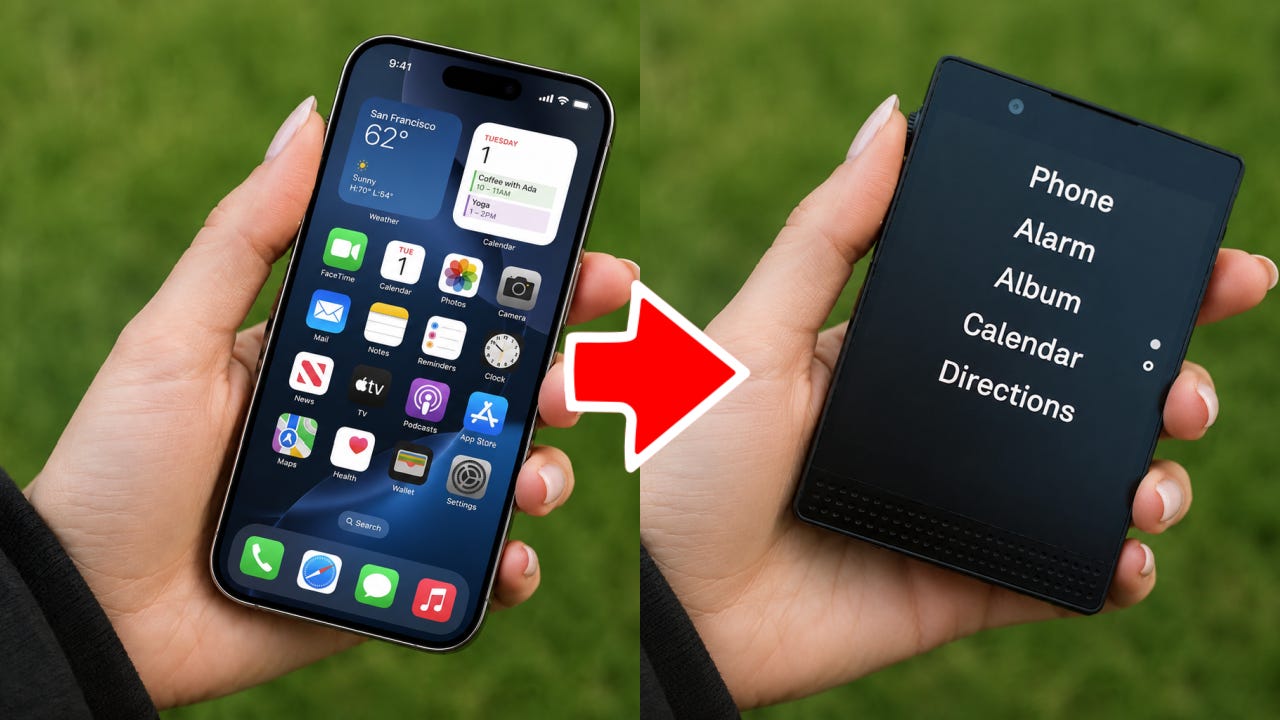
It’s been about one year since I started the process of ridding my life of a smartphone. In April of 2025 I deleted about 50% of the apps on my phone and over the next 6 months I proceeded to delete more before finally just getting rid of the entire thing and getting a dumb phone. (I currently use a Light Phone, but there are a lot of options.)
When I first stepped my toe into the water of using my phone less, it really was just about a hope to mindlessly scroll a little less. I didn’t love that I’d find myself sucked up into scrolling at all sorts of little quiet times throughout my day. I figured by removing some of the most time-sucking apps, I could decrease my screen time.
But the unexpected outcome was each time I removed an app, I regained a little bit of time and agency. And that made me want to get rid of more.
I started with the obvious ones: social media. This was probably the biggest shock. It was humbling to realize how often I had grabbed the phone to mindlessly scroll it when it wasn’t there. I would occasionally pick up my phone without even realizing it until I had it open and then remember I didn’t have what my mind had auto-piloted to look at. I think most of us believe we don’t scroll that much, or we use good time limits. I didn’t. We don’t. You probably don’t.
What I’ve realized is human willpower isn’t enough. The apps on your phone, and the phone itself, is designed to keep you there. Currently the five largest companies in the world (Apple, Nvidia, Microsoft, Alphabet (Google), and Amazon), all five of them are tech companies and 4 of the 5 have billions of people who use their products more or less continuously. And the data monetization of those people is central to keeping them running.[1] Some call this the “attention economy,” meaning your attention is these businesses’ currency. Meaning in order for them to be successful they need you locked in as much as possible.
And they are really good at it. Individual human willpower is not enough against infrastructure that is the attention economy.
Quitting social media was definitely a big first step, and I made a whole video about it here you can watch. But it was just the start. Even with social media gone, I found myself still picking up my phone in moments of boredom. It was a lot less, but the design of the smartphone is quite addicting on it’s own. We can check our e-mails continuously (even if we’re not expecting anything important), re-check the weather again, Google any random thought that comes into our head, read the never-ending news. Most of us signal out social media as the culprit, and to be fair I do think they are one of the worst offenders, but you’d be surprised how many of the apps on that device you carry around everywhere can pull your attention endlessly.
Let’s look at email as an example. Most people wouldn’t consider email as something as bad to be checking, it appears productive. But just like social media and similar apps, it taps into the brain’s attraction to uncertainty and intermittent rewards. We compulsively check social media the same way people might keep pulling a slot machine lever. You never know what you might get. Essentially, most the time we check our inbox it’s not for a real reason and there isn’t much there, but every so often there’s something exciting or important, and that unpredictability keeps people coming back in the same way slot machines might. This same thing applies to news apps, shopping apps, and more.
Eventually, over the next 6 months since that first fateful day of deleting social media from my phone, I now had deleted essentially every available app. All the shopping apps, my email app, the internet browser, and more. The only few that were left were the essential (or so I told myself) ones I needed to manage the products in my life that needed them - our robot vacuum, the kids’ sound machine, our smart locks on the house. You quickly realize how much in our life is tied to our smartphones.
Over this 6 months, I encountered, at every turn, more and more benefits. So much so that in the fall I got rid of my smartphone completely and now use a minimal phone with no internet, apps, email, and so on. What started as just a hope to mindlessly scroll a little less instead wound up totally upending my life in a way I absolutely did not expect and lead to so many additional life changes. It was like a shock of cold water and I felt jolt back into the real world when suddenly I didn’t have this thing stealing all my time, my attention, and my brain cells.
So here are some of the (maybe surprising or unexpected) things I got back when I gave up my smartphone.
I think one of the most humbling parts of removing smart devices from my life has been how much more time I have, because it’s a true admitting of how much time they were sucking away from me.
I have found that so many things in life are sold to use as conveniences aren’t actually conveniences at all. They are just a shuffling of work. For example, you can have a smart robot that vacuums for you every night. On the surface this is great! Now I can save so much time because I don’t need to vacuum! But what ends up happening is now I have this tool I need to tend to. After a bit of time it’s gone to need some type of maintenance, I need to spend 45 minutes troubleshooting how to open the spinner brush and cleaning it. When it has an error I need to spend time in the app figuring out why it stopped, why won’t it dock? Where is the “filter head”? Google “what is error 547.” I need to perform a resuce mission from under the chair leg. As it turns out, it’s not really saving me all that much time from just quickly vacuuming at the end of the day…
If you really want to get mad about this topic I suggest reading More Work for Mother by Ruth Schwartz Cowan who saw this problem before we even had the internet.
I can say, without a doubt, not having a smartphone has given me way more time than the smartphone ever “saved” me. It’s clear in the fact that I suddenly have time for things I swore I didn’t before.
As we have already discussed, not only are smartphone designed to hijack our attention but then once they have it they are so expertly crafted to keep us there, further degrading our attention because the attention we give to our phones isn’t long, hard, deep focus. Reels are short, we scroll through tons of feeds and articles, skim instead of deeply read, quickly reply, scroll, tap scroll like tap tap tap…and that constant switching is very taxing on our brains.
(And listen don’t just take my word for it, there are so many studies and books out there you can read that prove this point again and again. Stolen Focus by Johann Hari is a good place to start.)
When I first deleted things from my smartphone I noticed a sort of restless feeling, because I had become so accustomed to this quick checking and scrolling for little bursts of dopamine. But after a month or so, the restlessness had really decreased. I started finding a lot of enjoyment in slower tasks. I actually liked just sitting with my thoughts. I very vivid memory was going to grocery pickup. In the past when I would sit and wait for my groceries, I would scroll. But without the scroll I just…sat. I looked out the window. I saw the trees gently blowing, realized a train was going by. I’m not sure I ever realized there were train tracks near my grocery store. (Now it’s been months that I’ve even used grocery pickup because turns out I actually do have time to go to the grocery store when I’m not spending hours a day on my phone.)
Overtime I found it easier and easier to deeply focus and for longer periods of time. I could write for longer lengths. I could read full articles without getting bored or distracted. I found I could work for longer periods of time without getting fatigue. Now, not only can I sustain on things longer, but I seek them out. I feel like I’ve traded a lot of shallow bits of attention, for long, deep, focused attention. I felt like I had my brain back, which I get is dramatic, but it’s how I felt. I blamed mom brain for everything, and to be fair mom brain is real, but I never considered I had tech brain.
I read the book The Chaos Machine and I’ll be honest I was never able to look at any social media platform the same, ever again. Max Fischer, the author, breaks down how all algorithms naturally favor high-arousal posts because they typically get more engagement. If you think about a post that’s a cute puppy or a post that’s about how Tylenol will give your baby Autism, which one do you imagine will get more engagement in the form of comments and shares? Tylenol right. Whether it’s because they agree, disagree or are just scared, people react to this. People are more likely to just consume positive posts like puppies and recipes, but engage with negative ones because of anger, fear, or shock.
And since social medias are engagement platforms, all they care about is your engagement (remember when we talked about attention economy?) and how long you spend on the platforms. So feeds don’t just show outrage, they select it. One report even found Facebook weighted the angry reaction five times more than a like [3].
Removing that extra negativity from my life has left me with a lot less random outrage or fear over posts that have nothing to do with me or my life. I realized I don’t need to know every little news story, deal with the noise of everyone’s opinions, or hear every “mom hack” to make my life better. And not even that, but they were making me less happy.
A pretty obvious reason why social media quietly raises our stress is comparison overload. I think most of us our aware of this. We know that social media feeds are curated but it still gets you. Even if you consciously say “this isn’t real” to most of what you see as you scroll, there will still be a post or two that get under your skin. Maybe someone working out and you say “ugh I can’t believe I don’t make time to workout” or a woman making a homemade dinner and you feel guilty for doing chicken nuggets again (which shoutout to you, we did nuggies in our house last night.)
Experiments have found that even brief exposure to appearance-focused content can worsen body satisfaction and mood.[4] People who use social platforms more frequently report lower trait self-esteem. [5] And Lab and field studies show that passively viewing others’ curated lives decreases well-being.[6]
I’ve become less stressed, happier, and notably less self-conscious of my choices. I hadn’t realized how much social media had made me worry about every choice I made in comparison to the choices other people were making.
Smartphones can give us the impression of socializing… but it’s not exactly the same.
We think we’re keeping up with people because we see their updates on social platforms. There’s something called ambient intimacy. It’s defined as the feeling of connection you get with people, even if you don’t see them often, because you keep up with their daily lives through photos, and updates on social media. People stay top of mind without anyone actually showing up for one another. You feel current on that persons life, but you haven’t actually connected with them.
Much of this is one way, through comments and replies without real-time response. Your brain sees this as social time, but it isn’t really reciprocal, a keystone of social interaction.
In-person time is different. Not only is it in real time, but there is all sorts of things online and phone interactions strip away like tone, eye contact, shared laughter, pauses, facial expression. [7] In-person discussion also creates something called synchrony. When you share a moment, even just everyday moments like walking with someone, cooking, just sitting side by side, it literally lines up your rhythms. It deepens rapport. And all this builds real accountability. Seeing someone in real life makes it easier to show up and listen to them. Just like how being online makes it feel the opposite and people can find themselves leaving nasty comments they’d NEVER say in person. In person builds more meaningful connections and you feel more invested in that person.
I heard a quote once I can’t stop thinking about that someone said, in reference to how the internet has changed how we interact, and it said with the internet “everyone is replaceable” We feel less invested in forging the relationships we have because the pool is so much bigger.
Removing my smartphone has removed that kind of false feeling of socializing and in turn, has led me to turn inward to my local community. I participate in more local events, I’ve gone out of my way to get to know neighbors better, I’ve worked harder to maintain relationships than I had in the past.
Agency is ultimately the feeling that your life is being directed by conscious choice rather than constant reaction - it’s the feeling that you have control over your life. Smartphones are designed to be incredibly useful tools, but in reality they just very easily pull you away from what you meant to do. You grab your phone to check the weather, and suddenly you’ve been scrolling for twenty minutes. You answer one text, then somehow end up in email, Instagram, and looking at stuff you never planned to buy.
Getting rid of a smartphone gave me back a feeling of control.
You stop automatically filling every quiet moment. Waiting in line, sitting in the car, or standing in the kitchen can just be time to think, notice things, reflect, or even be bored for a minute.
As discussed, it’s easier to focus.
You’re more present in moments because you’re not pulled away or distracted.
You start figuring out what actually matters to you instead of constantly reacting to reminders, streaks, recommendations, and endless feeds.
Time can feel different. A lot of people say their days feel calmer and longer when they’re not checking their phone every few minutes.
I realized that marketing, trends, influencer culture, and online hype in general doesn’t matter as much. I care less about knowing what’s trending. I find way less pressure to compare myself to what others are doing.
I feel more capable. Things I would happily outsource to my phone now I do myself, and I actually get more fulfillment from them. I have to remember the directions to get somewhere instead of relying on a GPS or start to memorize from recipes I cook often instead of relying on looking them up.
Ultimately I feel like I have a lot more control over my choices and my life. Which, ironically, I didn’t realize I DIDN’T have that control until I got it back. So many of the points I make in this article weren’t glaringly obvious issues until I removed the smartphone.
Overall, I think the entire process has given me peace. So many of the above benefits (more time, more happiness, more agency, more community) all have lead to more peace in my life. Yes, life is hectic raising small kids. No, I don’t feel zen all day long. But my overall tone in life feels SO MUCH more at peace. And it’s not something I’d ever be willing to give up again.
SOURCES:
1- The Friends of Attention. Attensity!: A Manifesto of the Attention Liberation Movement. Crown, 2026.
2- Fisher, M. (2022). The chaos machine: The inside story of how social media rewired our minds and our world. Little, Brown and Company.
3 - Merrill, Jeremy B., and Will Oremus. “Five Points for Anger, One for a ‘Like’: How Facebook’s Formula Fostered Rage and Misinformation.” The Washington Post, 26 Oct. 2021.
4- Fardouly, Jasmine, et al. “Social Comparisons on Social Media: The Impact of Facebook on Young Women’s Body Image Concerns and Mood.” Body Image, vol. 13, 2015, pp. 38–45. Elsevier, https://doi.org/10.1016/j.bodyim.2014.12.002.
5- Valkenburg, Patti M., et al. “Social Media Use and Self-Esteem: A Meta-Analysis.” Media Psychology, vol. 25, no. 6, 2022, pp. 920–948. Taylor & Francis, https://doi.org/10.1080/15213269.2021.1920840.
6- Verduyn, Philippe, et al. “Passive Facebook Usage Undermines Affective Well-Being: Experimental and Longitudinal Evidence.” Journal of Experimental Psychology: General, vol. 144, no. 2, 2015, pp. 480–488. American Psychological Association, https://doi.org/10.1037/xge0000057.
7- https://en.wikipedia.org/wiki/Media_richness_theory
No posts
Comments
Nothing yet. Say the first thing.
Sign in to join the conversation.