
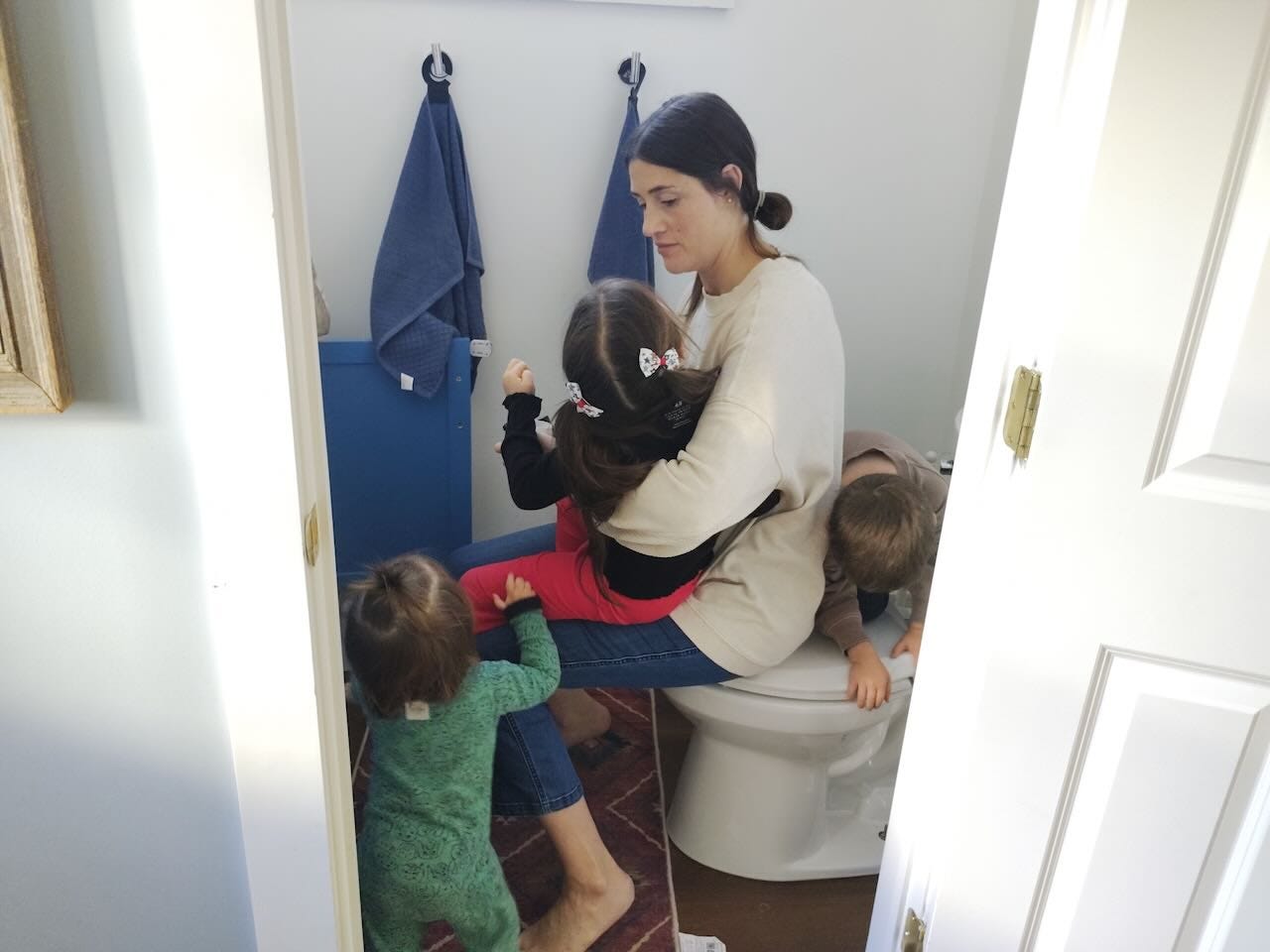
I think I have writer’s block. Only 4 weeks into my write-once-a-week challenge doesn’t seem to be a good sign haha.
I have started about 5 different posts but can’t seem to pull my mind around any of them to finish them. Which I actually think is less writer’s block, and more a lack of having a chance to sit for a sustained period of time to write a cohesive thought. I keep trying to squeeze in 15 minutes of writing here, and 10 minutes here. As I write this at my dining room table at 5:28am, my youngest just woke up has started to call out for me. And it’s one of the harder parts of motherhood for me, often, the constant pulling in multiple directions.
It’s hard to get long, sustained periods of time to focus on anything. It makes me feel like my brain is sort of constantly humming.
We have so many things we want to do. I want to do 30 minutes on my incline treadmill every morning, and get in 15 or 20 minutes of pilates. I want to read both fiction and non-fiction, a never ending “to read” list. I want to bake from bread. And that’s just the wants, don’t forget the needs. I need to make the grocery list or we’ll have nothing to eat this weekend. I need to cook everyone breakfast. I need to switch the laundry. I need to complete a task for work. I need to sleep ideally 7 hours to be a functional human.
And there is simply not enough time in the day.
I often end up having to push the things I want to the side. Even if the want is also a little bit of a need (I mean, sure I want to walk on the treadmill because it makes me feel good but it’s also a need because it’s good for my body.)
So my life always feels sort of like putting a puzzle together and you get to the end and instead of missing a few pieces you have too many. Where do they all go?
The modern mom has all heard the stat a hundred times about how in 1965, mothers spent about 54 minutes per day on childcare but by 2012, mothers were spending about 104 minutes per daily. “Today’s parents spend more time with their kids than moms and dads did 50 years ago” read headlines everywhere. [1] Or that the U.S. Surgeon General issued an advisory titled “Parents Under Pressure,” officially declaring parental stress a public health crisis. [2] I’ve read the entire advisory front to back (twice). Pew Research found that 90% of mothers often feel rushed or short on time. [3]
The question plaguing all of us is why? You can find no shortage of articles, papers, and commentary about why the modern mother is stressed, overwhelmed, and has no time for herself. Answers like lack of community, more expectations, more working mothers, less support, rising costs.
But, is that the case. Have, perhaps, mothers just been stressed since the dawn of time? In Ruth Schatz Cownan’s book More Work for Mother, she shared some interesting quotes from women’s letters and diaries over the last few decades:
“A woman’s work is never done, and happy she whose strength holds out to the end of the [sun’s] rays.” from a diary from 1795 of Martha Moore Ballard
“I am daily dropped in little pieces and passed around and devoured and expected to be whole again next day and all days and I am never along for a single minute” by Mary Hollock Foote in the late 1800’s about taking care of her kids and home.
The well-known Harriet Beecher Stowe wrote to her husband in 1844 that “The arranging of the whole house…the cleaning…the children’s clothes, and the baby have seemed to press on my mind all at once. Sometimes it seems as if anxious thought has become a disease with me from which I could not be free.” [4] (And mind you Harriet Beecher Stowe being a women of the middle-class mostly likely had hire household workers to help with these things.
I’m not sure overwhelm is just the modern woman’s problem. Women have been describing exhaustion, isolation, endless work, and mental overload for centuries. Mothers have always been overwhelmed. The question, instead, might be why now, despite eliminating so much of the physical labor of motherhood (washing machines, crockpots, grocery pickup, robot vacuums, dishwashers, online ordering etc.) do we still feel like we have less time?
In Cowan’s book she argues that while many things removed labor and time, they added a new one. Once we owned washing machines we now could own more clothes (that’s more to wash, more to fold, more to put away.) Dishwasher meant the same with dishes, and they were expected to be more clean. Many things meant the jobs was “easier” but they were consolidated into a more intensive routine that was held to a higher standard and often created other new chores.
If you go back to the U.S. Surgeon General advisory, he calls out seven major causes of what he believes is causing the mental health crisis in parents.
Financial Strain and Economic Instability, mentioning that one in four US parents said there have been times in the past year they didn’t have money for basic needs like food or housing and highlights the 26% increase in childcare costs.
Time Demands, which highlights that not only are parents working more (mothers working 28% more hours than in 1985 and fathers working 4% more) But that we are also spending more time on primary child care with mothers weekly primary child care increasing 40% and fathers increasing 154%.
Children’s Health, in which it cites that parents are becoming increasingly concerned about their child struggling with anxiety or depression and that one in 5 children have a special health care need.
Children safety, with parents worrying at alarming rates about everything from kidnapping to problems with drugs.
Loneliness, where it cites that lack of social support creates heighten stress and the average percent of parents who say they experience loneliness is 71%.
Tech and Social Media, where is say the majority of parents are concerned about their child’s use of tech and social media.
Societal expectations, including cultural pressures for children to meet “perceived parenting standards” that leave most parents feeling not good enough.
At the end of the advisory there is a take action section where it gives some suggestions on what we can do as a nation to help. It felt very short and abbreviated to me. (But to be fair, it was also the first U.S. Surgeon General advisory I’d read front to back, so maybe they always are.) The suggestions were:
governments should expand paid leave, childcare, mental health care, and economic supports
employers should create family-supportive, flexible, and humane work environments
communities should reduce isolation and proactively support parents
and families and friends should offer practical help and connection.
The core message of the whole thing was that parental stress is a public health issue that requires systems to change, not just parents trying harder. Because I think most of the stressors come back to parents TRYING very hard, to the point of stress. We’re trying so hard to parent correctly, and afford a standard of life, and keep our kids safe from every danger. Trying isn’t our issue.
I applaud this advisory and the awareness it’s bringing to the topic. But the reality is that the Surgeon General advisories rarely cause immediate system changes. They just bring light to a topic, which certainly can result in policy and program changes, but usually it takes YEARS if not decades for that to trickle down the pipe. So, if you’re a parent NOW, it doesn’t change much right in this moment. For many of us, our kids will be moved out and we’ll be empty nesters before the benefits from this advisory start to play out.
But, immediately upon reading this advisory, I noticed how almost all of the stressors tied back to the online world. It’s why in coming to understand this I have made a personal effort to cut back the amount of time I’m personally online. I became acutely aware of the stressors of being constantly plugged in had created in my life. And in reading this advisory, it really all made sense. Of the 7 main stressors, 6 of them, tie back to (for many almost directly) to social media and the online world.
Time Demands. Tech sucks our time. It’s estimated we spend, on average, we spend 4-1/2 hours on our phones a day. About 141 minutes of that being just scrolling social media. This one is tricky because it can easily be turned into shame. How dare you waste all your time one your phone, it’s your fault you’re stressed. NO. Let me clearly state that the point of this article is not to shame anyone about the amount of time they spend on their phones or on screens. Smartphone’s are expertly designed to keep you there with four of the five largest companies in the world all pushing it. Our attention is their currency. Individual human willpower is not enough against infrastructure that is the attention economy. Most of us can’t just be more disciplined about it.
Children’s Health. This one can’t be accounted 100% to tech, but considering one of the biggest concerns of parents is their pre-teens and teens developing anxiety and depression and considering between 2009 and 2019, U.S. high school students reporting persistent feelings of sadness or hopelessness increased from 26% to 37%, among teen girls, the increase was even steeper, reaching 57% by 2021, it’s safe to say there’s some correlation.
Children safety. We hear about every kidnapping, we see videos showing us how to keep our kids safe from being taken when we’re shopping at Target, we learn about every ingredient listed on Goldfish and how they’ll all kill our kids. The internet is RIPE with fear mongering around parenthood. No wonder we’re all more concerned than ever.
Loneliness. In 1990, only about 3% of Americans said they had no close friends. By 2021, a survey by the Survey Center on American Life found that 12% reported having no close friends. In the last 20 years Americans have reduced their face-to-face socializing by about 30% (this stat jumping to 50% for Americans aged 18-29.) The more online connected we get, the less IRL connected we get. And as Juliet Schor makes the point in her book The Overspent American, as people buy larger homes, private yards, more cars, more entertainment equipment, they rely less on communal resources and public gathering places. [5]
Tech and Social Media. This one is pretty cut and dry for me.
Societal expectations. It’s hard to pretend that our windows into everyone’s lives doesn’t make us less sure of our own choices, and feel “less than” more often. A study from the University of Nebraska found that seeing polished, aspirational motherhood content made some women feel worse about their own parenting abilities. [6] A similar study found that mothers who consumed motherhood content online had higher anxiety, envy, lower perceived parental competence, and lower life satisfaction. [7]
And so, we find ourselves at the end of this post where I realize I have made about 3 different detours and now need to bring it all back to some cohesive thought. Which was kind of the problem to begin with…feeling like I couldn’t pull things into a cohesive thought. Luckily I’m writing this portion of the article without who has woken up too early upstairs.
What’s my point? Good question.
I think the point is, mothers have always been overwhelmed. Motherhood is demanding. That’s part of what makes it rewarding (at least for me. I’ll speak for myself here, but hard things have always made me feel more fulfilled to complete than easy things.). My personal attempt at unravelling why it feels so much more overwhelming these days, that we need a health advisory about it as a national health crisis, is that the online work takes every parental stress and amplifies it making it all feel continuous and unavoidable. And the makeup of the online world makes it so it never really seems to turn off.
I grapple with this a lot, because I do think there are benefits to the online world for mothers, too. It can be a place of connection, to read a story about someone else struggling with what you are and feel validated. To get tips from other moms if you don’t have a large community of moms around you. I’ve gotten some legitimately great tips online. But as the online world has changed - from longer form content to short clips, from mom blogs to the aesthetic influencers, from well reported news stories to sensationalism and fake news (MIT did a study that found that fake news spread 70% faster than real news) - I am starting to feel as though the benefits that are there aren’t greater than the risks.
This was week 4 of my 52 week writing challenge to write one article a week. To receive new posts and support my work, consider becoming a free or paid subscriber.
SOURCES
2- https://www.hhs.gov/sites/default/files/parents-under-pressure.pdf
3 - https://www.pewresearch.org/social-trends/2009/10/01/the-harried-life-of-the-working-mother
4 - More Work for Mother, book by Ruth Schwartz Cowan
5- The Overspent American, book by Juliet Schor
6 - https://news.unl.edu/article/nebraska-study-illuminates-social-media-trap-for-new-moms
7 - https://journals.sagepub.com/doi/10.1177/09731342251340521
8 - https://mitsloan.mit.edu/ideas-made-to-matter/study-false-news-spreads-faster-truth
No posts
Comments
Nothing yet. Say the first thing.
Sign in to join the conversation.