
Louis Theroux has a new documentary on Netflix, Inside the Manosphere. If you’re a parent and you haven’t watched it yet, it’s worth checking out. But fair warning, it’s not easy viewing.
Theroux shows up, he’s disarmingly polite and he just lets influencers from the manosphere talk. And the men he’s talking to, the podcasters, the lifestyle gurus, the self-proclaimed alphas racking up millions of views telling young men how to be men, they talk a lot. They can’t help themselves. The camera is basically oxygen to them.
But there are moments where the facade cracks. It tends to happen when Theroux gets them next to someone who actually knows them: a mother, a wife, a girlfriend. The volume drops a little. The certainty gets wobblier. The persona, which had seemed so total, suddenly looks like what it is: a performance. One that happens to be generating an enormous amount of money. And these are multi-million dollar operations, complete with courses, coaching programs, memberships and merchandise. The more extreme the content, the wider the audience, the bigger the funnel. The outrage isn’t a byproduct. It is the product.
That’s actually the thing that stuck with me. Not the opinions they share (as ugly as some of them are), but the performance of it all. These guys are always on. Every word is content. Every interaction is a bit. And you start to wonder, watching it: did they start out like this? Or did something pull them here? I think it’s the latter, and that matters more than we’re giving it credit for.
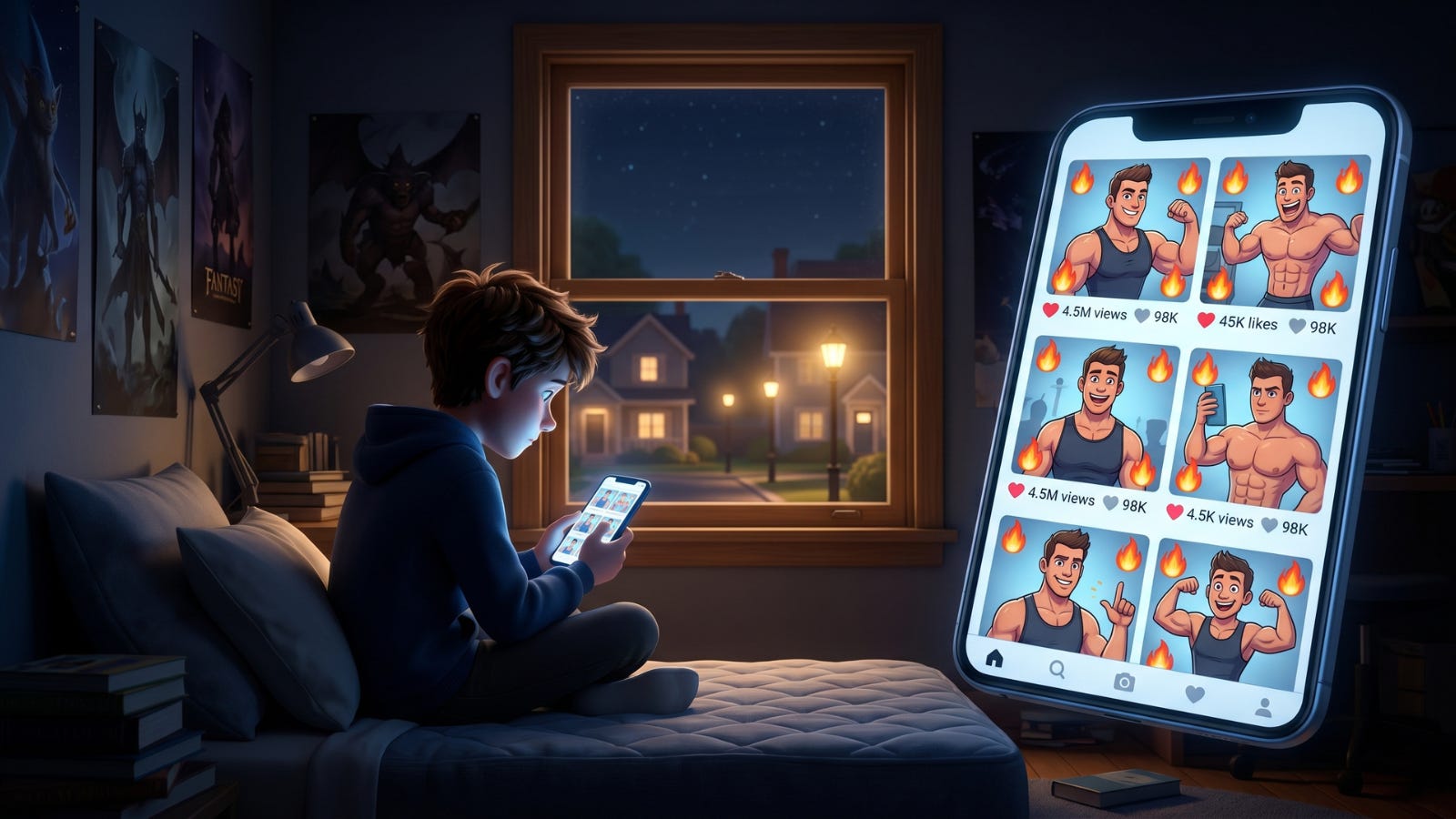
Here’s what I keep coming back to. These don’t seem like men who woke up one day with a fully formed worldview and went looking for an audience. They seem like grifters who found out through trial and error what the algorithm rewarded. Extreme positions travel further than moderate ones. Outrage gets more engagement than nuance. Every time they pushed a little further and the numbers went up, the feedback loop got a little tighter. The platform wasn’t just broadcasting their message. It was helping to shape it, and actively pulling it toward whatever version performed best.
That’s a different problem than a few bad actors with big platforms. That’s a system producing a specific kind of content, at scale, because that’s exactly what it was built to produce. I’ve written before about how the algorithm is optimized for extreme content, and this is just an extreme example of that in action.
And the audience at the end of it (mostly young men, a lot of them teenagers), they’re not idiots. They’re looking for something real. Structure. Identity. Even entertainment. Those are legitimate things to want. The tragedy is that what they’re getting back has been optimized not to answer those questions but to keep them watching long enough to sell them a very dubious course.
I don’t think Theroux quite goes there. He’s more interested in the men than the machine, which makes for a compelling documentary. But it lets the algorithm off the hook, and it’s already working on the next guy.
Here are a few helpful resources in case you want to really dig into today’s topic:
For those of you with older children, it can be a worthwhile exercise to watch the documentary with them. One author watched with her 17-year-old son and discovered that, while he was familiar with the influencers in the documentary, he didn’t know anyone who took them seriously. “It’s one of the biggest stereotypes there is: the big buff dude is a misogynist,” her son explains. “Whether they’re serious or they’re doing it as a bit or a full act, it’s funny no matter what.”
While a lot of people focus on how boys fall into the manosphere, new research out of Australia focuses on how some leave it. According to The Conversation, the disillusionment happens when experiences in the real world don’t match up with what they’re seeing online: “Over time, some participants begin to notice the gap between the ideology promoted in these spaces and their everyday experiences. Positive interactions with women, supportive friendships, or simply observing that relationships in the real world do not follow the rigid rules promoted online can begin to undermine the worldview.”
Too long; didn’t read. It shouldn’t be a full-time job to keep up on industry news, so here is a mercifully quick summary of some other notable developments:
Now that we’re more than 3 months into Australia’s social media ban, we’re starting to get a clearer picture of how the policy is working. According to some estimates, about two-thirds of children under 16 still have access to their social accounts. Australia’s communication minister thinks that Big Tech companies simply aren’t trying that hard to comply: “What we are seeing is evidence of the absolute bare minimum from social media companies, it’s straight out of the big tech playbook … They obfuscate, they try to throw doubt on any regulation.” Sounds about right to me.
The Google AI summary has changed the way a lot of us search the internet. And according to new research, it’s accurate about nine times out of ten. While that sounds like a passing grade, it hits different when you realize that it translates into hundreds of thousands of incorrect answers every minute. Another worrying finding? Facebook and Reddit were the second- and fourth-most-cited sources.
Here are a few more pieces of original writing from me and my team—just in case you’re keen for more:
Last month’s verdict against Meta and Google has a lot of parents questioning the apps their kids use every day. If you’re wondering how you can keep your kids safer online, check out this post from my team.
Google’s AI platform, Gemini, is available to kids under 13. Here’s a post from my team outlining everything you need to know.
No posts
Comments
Nothing yet. Say the first thing.
Sign in to join the conversation.