
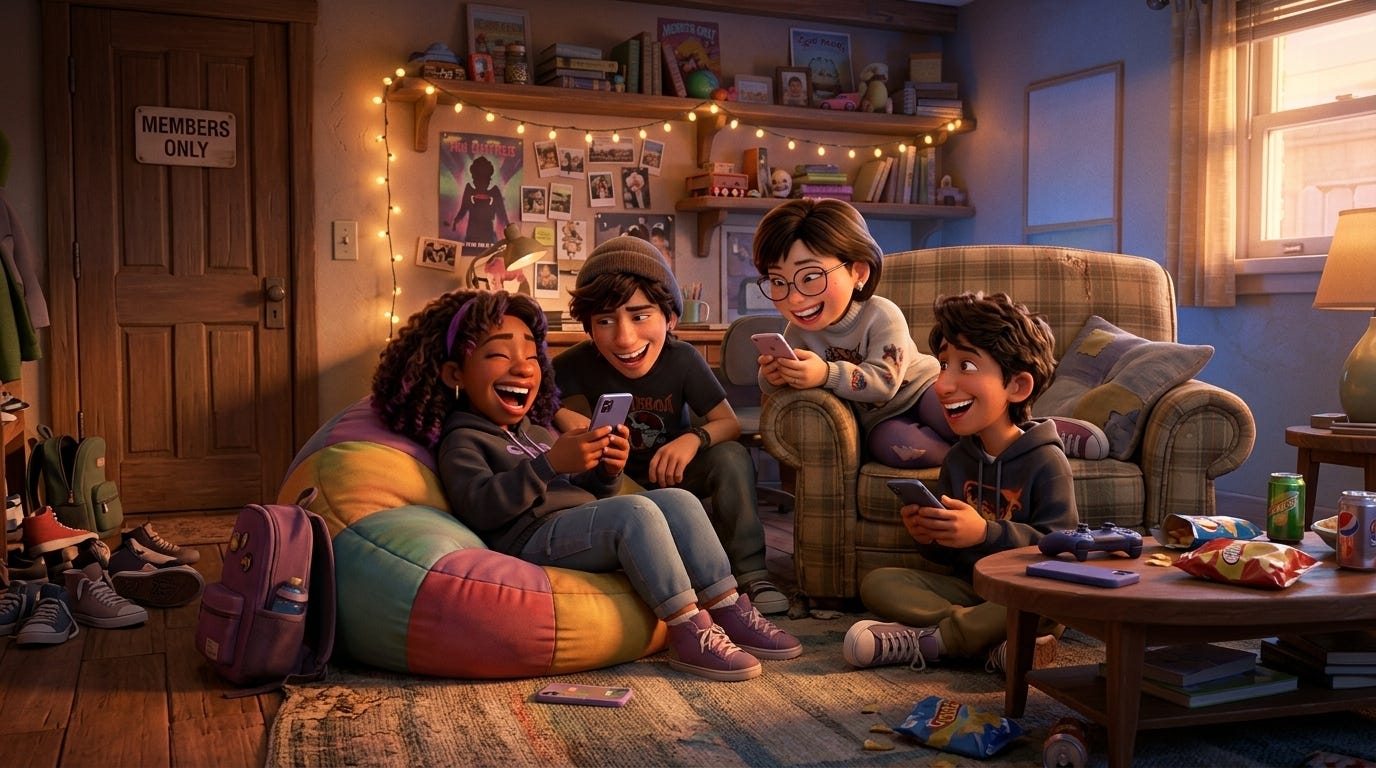
A few members of my team went to Vancouver Web Summit recently, and they came back with a line from a Common Sense Media talk that I’ve been thinking about since. The speaker called the group chat a third space: the new mall, the place kids actually go to hang out now. I think that’s exactly right, and there’s a case for thinking about the kind of screen time differently.
Think about where you spent your time as a kid, in the hours that weren’t home and weren’t school. For me, it was some combination of the food court, a friend’s basement, and a parking lot we had no real reason to be standing in. For you, it might have been the diner or the corner store or the bleachers after everyone else had gone home. Sociologists call this the third place. Not the first place where you live or the second where you work, but the in-between. For kids, this is where you start to figure out who you are without an adult setting the agenda.
Sadly, a lot of those places are gone now, or close to it. Malls are dying, the coffee shop has a time limit and a laptop ban, and the kids who do gather in parks tend to get told to move along. And, the kids growing up today have more supervision and less unstructured time than previous generations. So the “third place” did what any space does when its physical version disappears: it moved online. The group chats on iMessage and WhatsApp and Snapchat have turned into a kind of always-open living room, where the inside jokes and the weekend planning and the late-night venting all happen at once.
This is where it gets complicated for parents. When we see our kids glued to their phones all afternoon, we feel a flicker of unease that we wouldn’t if they’d been at the mall or over at a friend’s house. We hear “I met them online” and brace ourselves, even when what’s being described is the same basic social activity we got from loitering near the Orange Julius for three hours. The discomfort is real, but I’ve come to think it’s often aimed at the wrong target.
Not all screen time is equal. The distinction I wish more of us made is between a closed space and an open network. A group chat is a room with a door. There’s no algorithm deciding what we see or hear, there’s no follower count, no strangers drifting in, and no engagement machinery tuned to keep everyone scrolling well past the point of feeling good about it. It’s a small set of people who already know each other. That’s almost the structural opposite of a public platform built to maximize attention, the kind of place that wasn’t designed for a child’s wellbeing to begin with.
What convinces me most is what older kids are choosing on their own. There’s a genuine movement of young people stepping back from their phones right now: flip-phone summers, deleted apps, a return to vinyl and to seeing friends in person. But when we read headlines about what kids are walking away from, it’s worth looking closely at what they’re actually rejecting, because it’s the feed: the scroll, the metrics, the performance. They aren’t abandoning their group chats. Even the flip-phone kids are still texting. When they pare their digital lives down to what they genuinely want to keep, the conversation with their friends is what survives, which says a lot about which part was feeding them and which part was wearing them down.
None of this means group chats are harmless. They can be genuinely cruel, with the sting of being the one left out, the pile-on, the argument that erupts at 2 AM when everyone should be asleep. I’m not romanticizing them, and I’m not suggesting anyone stop paying attention. But it’s worth being precise about the kind of problem this is. The trouble in a group chat is social, the same human friction that played out at the mall and in the cafeteria and at every sleepover, and it’s the sort of thing a kid can learn to handle with a parent nearby. The trouble with an algorithmic feed is built into the design. When a feed keeps your child up too late and leaves them feeling worse, the system isn’t malfunctioning, it’s doing precisely what it was made to do.
That’s why we can’t treat all screen time as a single undifferentiated threat. Wanting to pull our kids back from the feed is a sound instinct. Cutting off the group chat in the same motion gets it backwards, because that’s the connection worth defending. That’s the third place. That’s the mall.
Here are a few helpful resources in case you want to really dig into today’s topic:
Earlier this year, Rolling Stone published a piece about third spaces and the way that people are turning to online communities to connect. Here’s what they had to say: “Audiences want to participate, create, get to know each other and be known. They want shared rituals, not endless feeds. Online spaces create accessibility, but the real stickiness is in the relationships that form.” A lot of this resonates from a design perspective. Kids especially need digital spaces that help them connect to the people who matter most.
There have been lots of articles lately about digital detoxes and analog options, and it seems like Gen Z is leading the charge. But they aren’t rejecting technology writ large; they’re moving away from social media specifically.
Too long; didn’t read. It shouldn’t be a full-time job to keep up on industry news, so here is a mercifully quick summary of some other notable developments:
We’ve read lots of articles about the dangers of chatbots for kids, but Florida has become the first state to sue OpenAI over child safety. The lawsuit claims that the platform provided information to school shooters, offered guidance on self-harm and addicted young users. Sam Altman, the company’s CEO, was also personally named in the suit.
And speaking of lawsuits against Big Tech, Texas is suing Netflix for allegedly spying on children and users. Reuters reports that “Texas said that for years, Netflix has falsely represented to consumers that it did not collect or share user data, when it actually tracked and sold viewers’ habits and preferences to commercial data brokers and advertising technology companies, making billions of dollars a year.”
Here are a few more pieces of original writing from me and my team—just in case you’re keen for more:
Here’s some good news for parents: screen time guidelines are finally catching up to the real world. Here’s our breakdown of the latest AAP advice.
Kids love to chat with friends while they game, but adult chat apps can be a little dicey. That’s why we built a safer alternative. Learn all about Jams here.
No posts
Comments
Nothing yet. Say the first thing.
Sign in to join the conversation.