
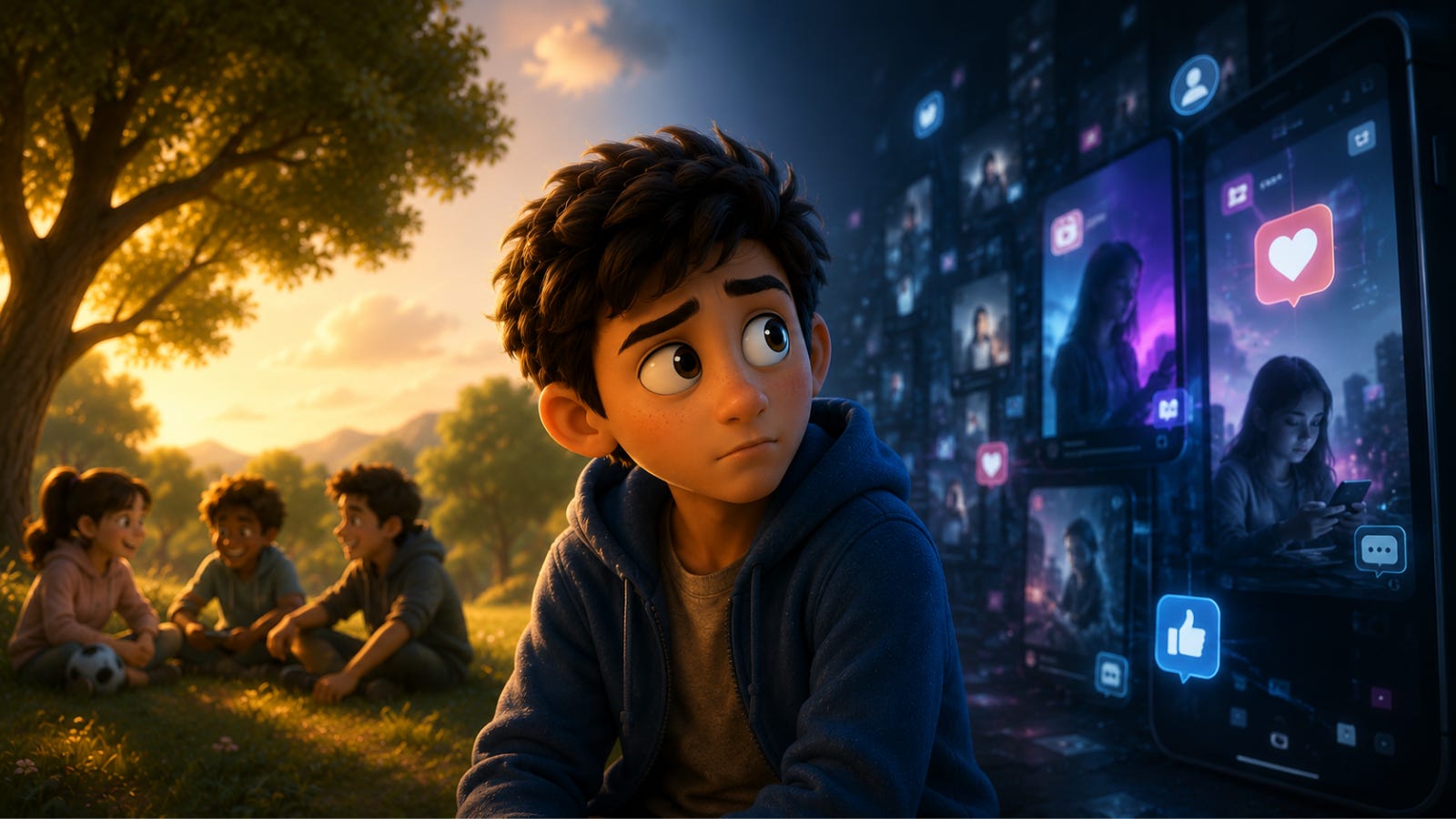
In case you missed it, Snapchat recently rolled out another round of teen safety changes. A few days later, Meta did the same. Read the announcements on their own terms, and they are hard to argue with. More privacy, age-appropriate content, more robust age checks. These are reasonable features, and the sort of thing any parent would have asked for on day one.
But if these protections are so sensible, why did they only arrive in June 2026? It’s not that these Big Tech companies suddenly care deeply about child safety online. It’s that they’re facing unprecedented global pressure from wide-ranging bans to keep under-16s off their platforms. And there’s a pattern that stretches back, where new safeguards seem to follow a lawsuit, a bill, a settlement or some external pressure rather than show up when the product was first built. The features are nice to have, but the timing betrays something fundamental about these companies: they aren’t motivated by child safety. They’re motivated by profit above all else. It’s a pattern we see again and again.
Consider YouTube in 2019. For years, the company told advertisers it was a top destination for kids while telling regulators it had no users under thirteen. That contradiction held until the Federal Trade Commission and the New York Attorney General intervened. On September 4, 2019, Google and YouTube agreed to pay $170 million to settle allegations that they had illegally collected children’s data, the largest penalty ever levied under the Children’s Online Privacy Protection Act. Only as a condition of that settlement did the now-familiar machinery appear: the “made for kids” labels, the limits on data collection, the system requiring creators to flag content aimed at children. But Google didn’t make these changes on its own. The company was forced into it by the FTC.
And then there’s Instagram in the autumn of 2024. On September 17, Meta introduced a sweeping set of default protections for users under eighteen, including private profiles, restricted messaging and parental oversight. The changes were substantial. They also landed one day before the House Energy and Commerce Committee was scheduled to mark up the Kids Online Safety Act. The timing was not lost on the bill’s co-author. Senator Marsha Blackburn called the announcement proof that the industry had no real interest in protecting children, noting that, just like clockwork, the legislation moved forward and the platforms produced a fresh set of guidelines to enforce on themselves.
And then there’s the nudity filter Meta added to teen direct messages in 2024, a tool that automatically blurs explicit images. This is a reasonable feature, plainly. What makes it instructive is a document surfaced through litigation. According to a court filing reported by TechCrunch, the head of Instagram had flagged this very risk in an internal email back in 2018. The awareness was there. The technology was within reach. The product arrived roughly six years later, once the legal and legislative pressure had converged. Knowing was not the thing that produced the fix.
What makes these companies act isn’t some internal guiding principle to keep children safe. If that were true, Instagram would have acted on its nudity filter much faster. But we tend to see action after a federal fine or ahead of a congressional markup. Or, as we’ve seen recently, when momentum builds for far-reaching bans.
The specifics differ each time, but the shape does not. The protective feature trails the pressure. Which brings us back to this year. On March 25, 2026, a Los Angeles jury found Meta and YouTube negligent for designing platforms that harmed young users, the first time a jury had held these companies liable for that harm. During that trial, Mark Zuckerberg testified about various safety features and age checks, at one point stating, “I always wish we would have gotten there sooner, but I think we’re in a better place.” But when these safety features roll out after the fact, it shows that there isn’t a whole lot of appetite to be proactive.
The honest conclusion is not that these companies are incapable of protecting children. They have the engineers, the research and when they choose, the will. We’re seeing that play out in real time with these new protections announced by Snap and Meta (right after the UK announced its under-16 ban). The truth is that capability has rarely been enough on its own. What has reliably moved these platforms is the consequence, the fine, the verdict or the bill. That is a hard thing to build a childhood around. It suggests the safest place for a young person is not a platform that added protections after losing in court, but a product designed, from its first line of code, on the assumption that the children using it deserved protection all along.
Here are a few helpful resources in case you want to really dig into today’s topic:
One of the changes Snap made to protect younger children is giving them a “friends-only” experience for their spotlight snaps. That basically attempts to take the open network and shrink it down to trusted contacts only. The fact is, kids are safer when they’re on a platform that’s closed and controlled, and that’s a big reason we started Kinzoo.
And as for the updates made to Instagram, there are a few changes meant to make the platform safer for teens. There are new content settings, new age assurance and new alerts for parents who supervise their teens’ accounts. As per usual, these features are a reaction to external pressure, not because the company cares about keeping kids safe.
Too long; didn’t read. It shouldn’t be a full-time job to keep up on industry news, so here is a mercifully quick summary of some other notable developments:
The House has passed The Kids Internet and Digital Safety Act. If it turns into law, minors’ use of disappearing messages would be restricted. It would also require AI chatbots to disclose that they aren’t human and make age verification for platforms hosting pornographic content mandatory.
Common Sense Media has released its parents’ guide on AI companions and kids. It’s a pretty thorough explainer on the topic and it outlines the main risks for children, including blurring the lines between real and fake relationships, worsening mental health challenges and reinforcing poor decision-making.
Here are a few more pieces of original writing from me and my team—just in case you’re keen for more:
If you’re curious about the ins and outs of the proposed social media ban for under-16s in the UK, check out this explainer piece from my team.
Governments around the world are also contemplating bans on AI companions. Here’s the latest on what lawmakers are contemplating.
No posts
Comments
Nothing yet. Say the first thing.
Sign in to join the conversation.