
This essay can be read standalone but also follows on from The Shape of Escape and Boundaries, featuring a few callbacks to those essays. I think it’s fine to read the three essays in any order. The ending foreshadows a later chapter in the book, The Silent Part.
This is a reader-supported publication. If you value this work and want to see more, please consider paying for a full subscription, which will give you access to over 180,000 words of my work, or tipping me on my Ko-Fi at ko-fi.com/thaliavacha. If you can afford to do neither but still want to support, please like this essay and share it online and with friends.
Sometime in 2022—during the unrelenting heat of a Riverside summer, for which the fall would barely bring relief—a voice, ostensibly female, came to me in the day. She arrived because I summoned her, because I needed to call on her for help. I sat on grey bedsheets in my small, grey bedroom with its grey walls, wearing, as I always did in those days, some grey sweatpants and a black V-neck t-shirt. I wore this outfit so often, in fact, that, for the final class of the Spring semester, more than half of my dozen or so creative writing students turned up in grey sweatpants and black t-shirts. It’s dress-up-as-Thalia-day, one of my students said—although she called me by a different name—and I remember feeling uneasily flattered by the effort they’d gone just to mock me. I was dressed up as Thalia on this grey day, too, when I summoned this voice, dressed up as another version of Thalia, the version who went by another name, by a man’s name, the version about whom this voice had something to teach me.
Almost everything was grey—the walls, my pants, the feeling in the pit of my stomach—except for the blades of sunlight that sliced through the blinds, cutting across the broad, flat expanse of my chest. I had a problem in my body. I couldn’t seem to move it properly. Sitting on the bed, I tried to stand up, and I dropped back down again. I had just returned from a trip to a liquor store at the nearest strip mall; at some point in my journey, I began walking with a limp, like a janky robot, like someone had poured soda on the control panels for my motor function. Things just weren’t working.
So I got to my room and sat on my bed. I stared at the grey wall, as though it was a mirror, reflecting an abyss. My hand stroked my thigh, but my thigh couldn’t feel it. I had spent my whole life avoiding something, as people say, although I’ve always struggled with the phrase. To avoid what I already know, I must know enough to know to avoid it. I tried to stand up again. This time, my body did little more than twitch. So I summoned, in my imagination, the voice of a woman to whom my merits were worthless, whom I could only please through faithful service, and for whom I would take pain, indulging her sadistic desire. I pictured the dominatrix who had for so long haunted my fantasy life.
I said to her, I know you’re hiding something from me.
You are right, she replied. I am.
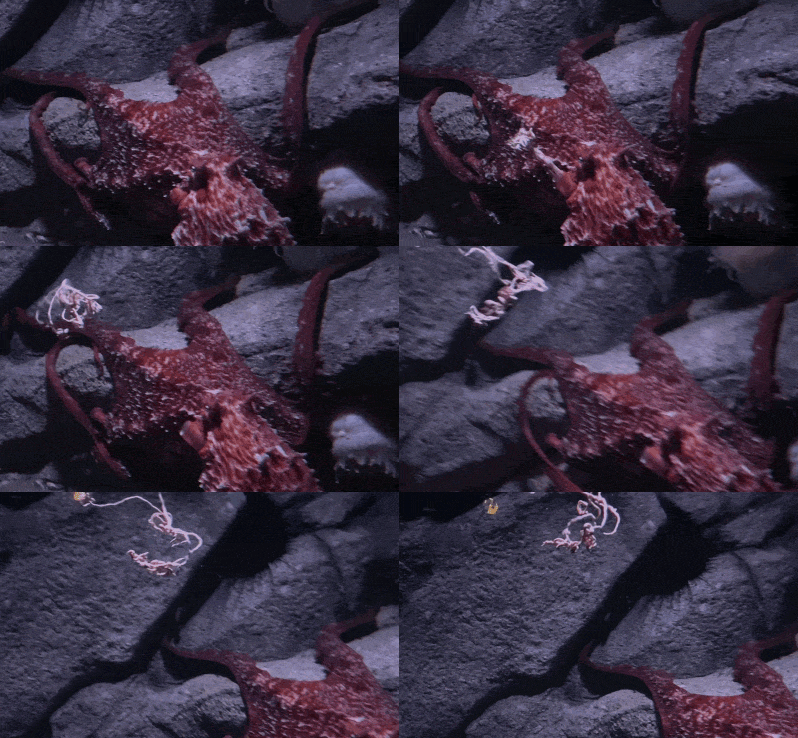
Sometime in the early summer of 2022—as the Bay area spring gave some brief respite from the Riverside heat—I walked with my girlfriend through an aquarium in Monterey. We stopped in front of a tank in which dwelt a great pacific octopus. A tentacle poked out from behind a rock, camouflaging itself to match the rock’s grey. For a while, it was just me and my girlfriend, whom I had met on my MFA, with whom I was, at the time, falling in love. Someone else came to join us in front of the tank, a middle-aged white man with a camera dangled around his neck. The octopus swooped out from under the rock, shifting through a kaleidoscope of brilliant colors, and dashed from the bottom left corner of the tank to the top right, spraying behind it a thick trail of a dark mucus-like substance.
Did they just poop at us? my girlfriend asked. I wanted to believe the octopus was expressing disdain not for me or my girlfriend but only for the man besides us. My girlfriend touched my shoulder. I turned to look at her. Why are you crying? she asked. Then a fire alarm rang, and we all had to leave.
Aquarium visitors flooded the streets of Monterey. My girlfriend and I freed ourselves from the crowds, walking first along the coast before zig-zagging maze-like around the town. We stopped in a bookstore. She bought a postcard of a great pacific octopus and wrote a little love note on it. We had known each other for more than a year, but we had said I love you for the first time just the day before. In my most amateur attempts at writing, octopuses always appeared to symbolize some hidden trauma: maybe some forgotten abuse from the past. Something icky. Something, in any case, that I was hiding from myself, even if I struggled with the term.
While we walked back to the parking lot, where we would begin the long drive back to San Jose, where we had been staying with one of my girlfriend’s best friend, I was quiet. When I was with my girlfriend, I was almost never quiet. We passed the aquarium again, where the streets had returned to normal. I was biting my lip, fidgeting. You want to go see the octopus again, she said, don’t you? I said I did, and we went, so I could cry a little more, so sure, somehow, that this octopus was here to tell me something.
My girlfriend’s friend was living with her parents, and when we were back in San Jose, the three of us sitting on a double bed in the guest bedroom, she was talking about how hard it was, given everything they’d done to her, to be living with them again. I told her that I could only imagine: even though my own parents had never been abusive, I would still go crazy any time I had to share a roof with them. Maybe I heard my girlfriend sigh. I wish I could remember what she said next, but it was probably, in that moment, too much for me to hear.
I had recently started to see a new therapist, with whom I was now doing a form of therapy called Internal Family Systems™: with my therapist’s guidance, I would summon different ‘parts’ of myself and put them into dialogue. We would usually start the sessions by creating a big waiting room in which all the Thalias could hang out. I remember always seeing a Thalia in a lilac ballgown. She was always silent, and the gown bloomed below her waist so that she looked like she was floating. Sometimes an octopus would lurk in the room, too, always slightly out of sight. I was telling my girlfriend and her friend about how I felt this method was helping me grieve my mother’s illness.
I’m not grieving her so much as I am the illness, I said. Really, we had a good relationship. Or it wasn’t bad, anyway. Although there was this time—it was kind of weird, now that I think about it—when I told her and my father that I wouldn’t talk to them unless they promised to do therapy, because they’d always bring their shit to me: they would cry and complain but balk at whatever words of support I offered in return. And when I made my ultimatum, my mother just said no. Eventually, I broke the silence to talk to her more about it. She said that she couldn’t believe a child would do something so awful to their own mother. She never went to therapy. Instead, I let my boundary fall.
That sounds a little abusive to me, my girlfriend’s friend said.
My girlfriend made a noise of assent.
I wouldn’t go that far, I said.
The two of them wanted to go see some wild bunnies that hopped about at a nearby park. I was feeling grey from head to toe; I told them I’d stay behind. My girlfriend said she wanted me to read something while they were gone. She sent a PDF to my inbox. I think you still have a lot to figure out, she said. She specified a particular chapter, and after the two of them left me alone on the bed, I read about the toll it takes on a young child when a parent leans on them too much for emotional support, how an adult who grew up with a parent that was excessively intimate displays similar symptoms to those of incest survivors—feeling repulsed by sex, for example—and how most people who experience this will never face it, because it is too shattering to interpret the intimacy as anything but love.
My girlfriend and her friend were gone for at least an hour, but when they returned to the house, I was still crying, and even when they were back on the bed, each with a hand on my arm, I couldn’t stem the flow enough to tell them why. I also didn’t need to.
Picture my mother and I in a living room in Spain: She is on her scooter again. I am on a sofa adjacent to her. We are talking about a memory from my early childhood: I am crying in the back of a car. My mother, in the driver’s seat, is shouting. And it hurts.
This memory feels like they key to everything, I say.
But it was never about you, I add.
Attempts at sex have always made me wretch and vomit, I say. What else could be behind it?
In the summer of 2022, in the weeks after I returned to Riverside from San Jose, a few days before the grey day on which I sat malfunctioning on my bed, I would go out every evening, once it was dark enough that no one could see my face, once the temperature had dropped to a manageable level, and walk around the maze-like suburb in which I lived. Apart from the strip mall, fifteen minutes-walk away, the area contained nothing but large houses and their lawns. The fact it was still pretty hot, even at this hour, reduced the risk of me passing other pedestrians.
My girlfriend had gone to a writing workshop in Seattle, so we weren’t able to talk much during those weeks. I would walk, usually, for an hour or two. At some point, I would begin to cry, and I would rarely be able to stop until the walk was over. Crying meant gazing at the pain without flinching, I believed, taking a nosedive through the storm’s eye. I was in a freefall. I had stopped grieving my mother’s illness, I told myself, and started grieving the idea I had for her. I believed I could see her now. I felt like I wanted to kill her, but this new version of her had arrived, stillborn, like she had already died another death.
I had spent my life avoiding something, although I’ve always struggled with the phrase. To avoid what I already know, I must know enough to know to avoid it. And yes, surely I’d been pushing away these feelings as long as I’d been alive. Now I was facing them. It hurt. But I was coming to my senses. I felt like I could hear my thoughts for the first time, like color was leaking into the periphery of my grey world. I felt rage, as if for the first time and perhaps actually for the first time since my childhood. I started feeling more alive in my body. Surely, once I’d made it through this grief, I thought, as terrible as it was, I would be free.
I just always think I’ve been a bad mother, my mother says, in the apartment in Spain.
You’re only human, I say.
I just wasn’t a great mother, she says
On one of these late-night walks, I started to experience problems in my body. I couldn’t seem to move it properly. Sometimes, I would start walking with a limp, like a janky robot, like someone had poured soda on the control panels for my motor function. Things just weren’t working. My return from the strip mall, some days later, hadn’t been the first time. And even though it was dark, I wondered how I would look to anyone passing by, even if no one was passing by. I got lost in a story. Or a story was lost in me. Some new mystery. The story of a little girl. The story of Thalia, maybe, weaving its way up my thigh, forcing me to limp, desperate for me to hear her. She was lost. She was lost, and she didn’t think she’d ever be found. She was lost, and the worst was there’s no-one to find her, no-one who cared.
What I heard in the muffled motion of my limp was that I was still avoiding something, even if I still struggled with the phrase. All I knew was that I needed help.
Some days later, I was sitting in my grey room, still wearing the grey sweatpants and black v-neck t-shirt that I surely wore on all those walks, when I decided to summon, in my imagination, the voice of some woman to whom my merits were worthless, whom I could only please through faithful service, and for whom I would take pain, indulging her sadistic desire. I pictured the dominatrix who had for so long haunted my fantasy life. With the logic of dreams, she somehow looked a little like me.
You’ve always been here, I said to her. I know you’re hiding something from me.
That’s right, she said.
If you know it, I said, then surely I know it, too, so why can’t I access it?
You wouldn’t be able to handle it, she said.
I’ve been dealing with my mother, I said. I can deal with more pain. It’s all in the past.
This isn’t the same, she said.
Can’t I just get a glimpse?
Not without seeing the whole.
I don’t want to be like this anymore, I said. This is crazy. I’m limping. I’m talking to myself. I’m talking to a figure from my sexual fantasies, for fuck’s sake. I can’t live like this. You are just another made-up obstacle obscuring something I already know. I must know enough to know to avoid it, so how can I not know how to find it?
Then she left me.
Everything went blank.
I could see a little girl.
She was maybe four or five years old, with platinum blonde hair and glimmering sand beneath her feet, walking along a beach, walking beside her mother, holding her mother’s hand. She wore a red t-shirt with green sleeves and red shorts. She had a look in her eye like the world belonged to her.
She and her mother walked towards a vendor selling translucent trinkets. A cool breeze blew through their matching curly hair.
The girl saw another girl getting her hair braided, the stylist threading the braids through a kaleidoscope of pony beads.
I saw the girl point at the girl getting braids.
I heard her say: Mummy, I want to do it. Can I?
I heard my mother say: No. That’s for girls.
Thank you for reading. This essay is the third in a sequence of essays that begins with The Shape of Escape and Boundaries and ends with a novella-length essay called, The Silent Part, the first chapter of which can be found here.
If you enjoyed reading, please consider becoming a paid subscriber or tipping me on Ko-Fi at www.ko-fi.com/thaliavacha. I put a huge amount of time and effort into this Substack, and I would love to keep doing so.
Comments
Nothing yet. Say the first thing.
Sign in to join the conversation.