

Wheat
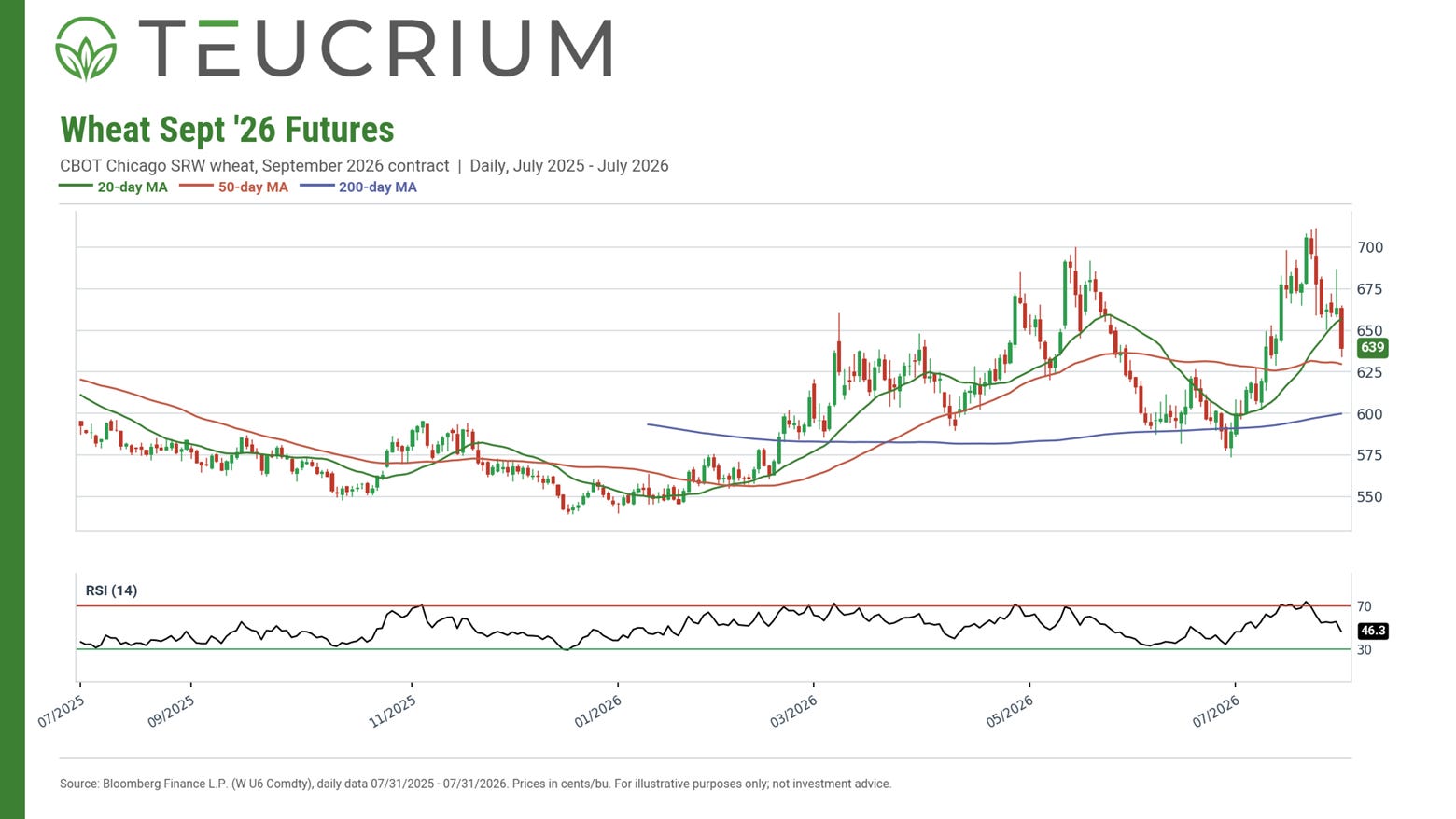
September Chicago wheat settled at $6.39 1/4 Friday, down 24 1/4 cents on the day and 38 3/4 cents for the week. September KC wheat lost 23 1/4 cents to $7.07 1/2, and Pro Farmer had September spring wheat down 21 3/4 cents to $6.89 3/4. All three classes printed weekly low closes, and all three gave back everything the mid-July Black Sea rally built.
The war news got worse and the price went down anyway.
A Ukrainian drone strike inflicted “significant damage” on Russia’s grain export terminal at Taman on the Kerch Strait, a facility Reuters put at 5 million metric tons of capacity, and shipping through the Sea of Azov and the Kerch Strait has been halted since July 10. That corridor handled roughly a quarter of Russian grain exports. Russia still cleared only 374,000 tons of wheat in the week to Thursday, down from 513,000 the week before, and Marex’s Tim Bulfer had Russian August/September FOB offers slipping toward $230 per ton with bids absent because boats aren’t being nominated into port. Cheap offers with no bids behind them is the tell: the market is treating disrupted Russian supply as something well short of missing Russian supply. Turkey lifting the milling wheat export ban it’s had in place since March 2025, on the back of a record 22.8 million ton harvest, gave the bears one more thing to point at.
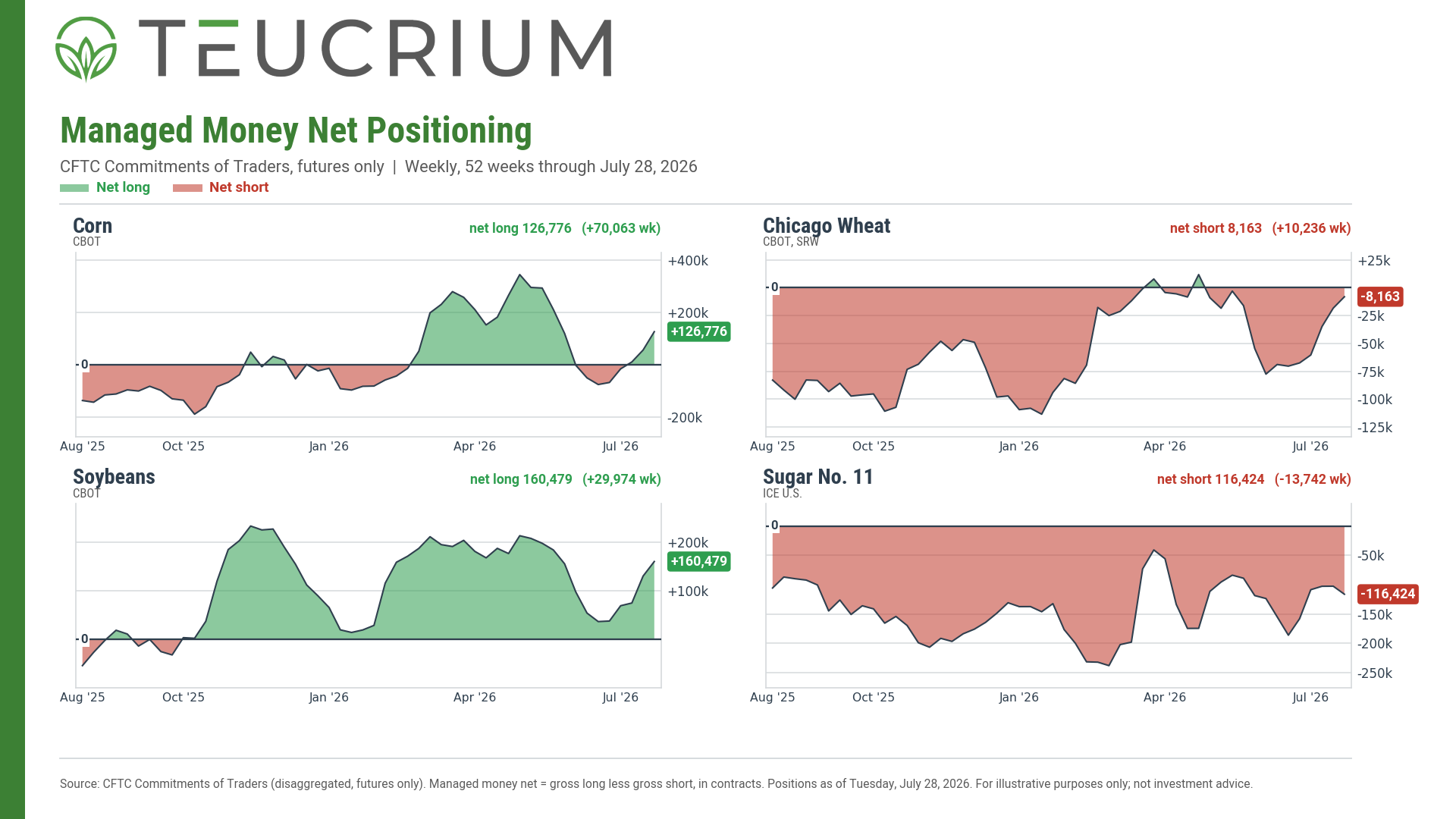
Friday’s CFTC report (full table below, following sugar commentary) explains the velocity. Managed money had cut its Chicago wheat net short to 8,163 contracts as of Tuesday, down from 18,399 a week earlier and 60,432 on July 7, while going net long 31,411 in KC and 7,794 in spring wheat, a class the funds were still net short in mid-July.
The short base that powered the July rally is largely spent, which leaves less covering fuel behind the next headline. Bulfer put 20-day moving average support in the September contract at 657 going into Friday and the price closed well under it. Another escalation could still lift prices, though the last three faded inside a session.
Soybeans
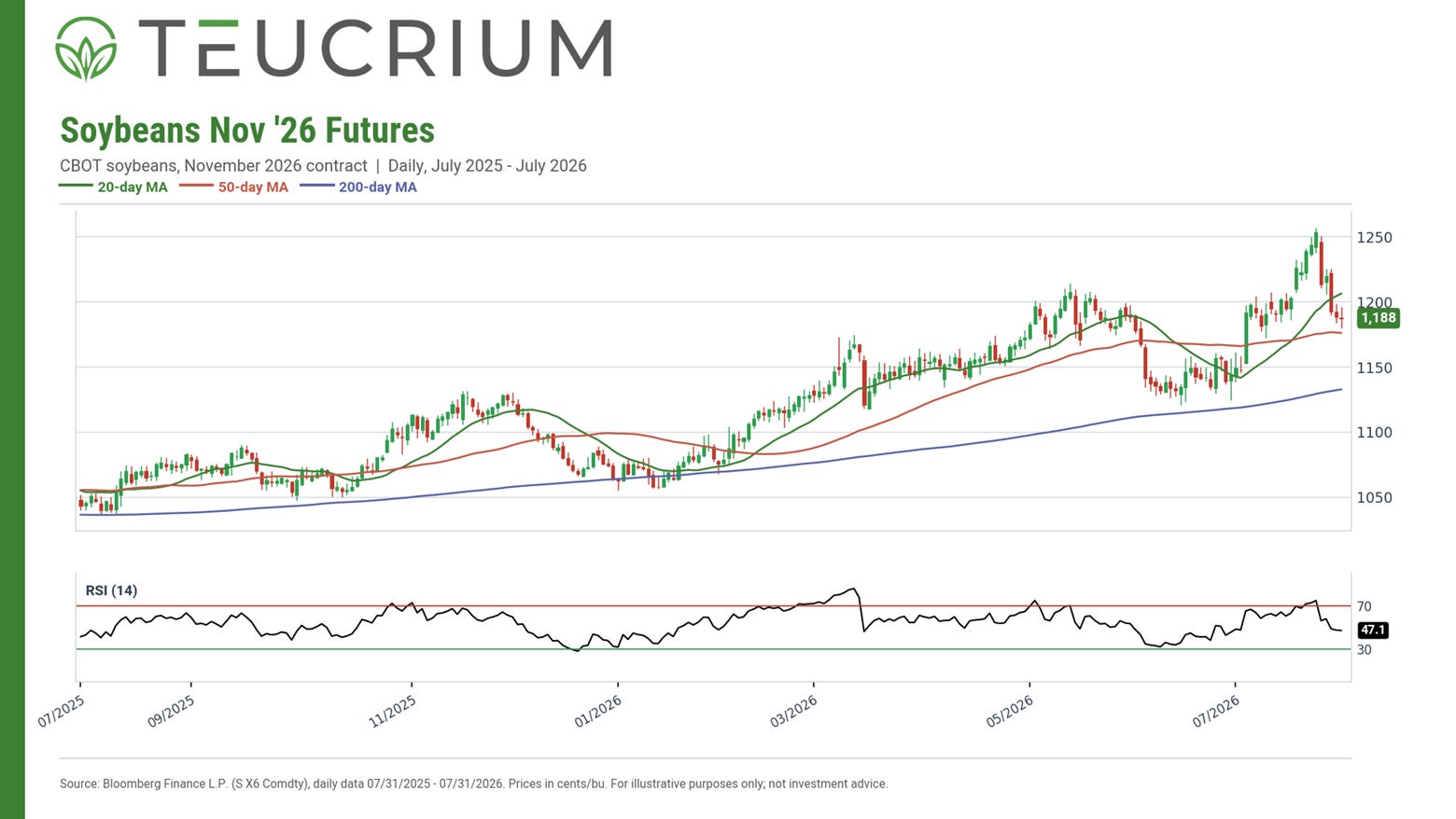
November soybeans settled at $11.87 1/2 Friday, down 1 1/4 cents on the day and 66 cents for the week, the biggest dollar loss in the complex. The contract traded above $12.53 a week ago and hit a three-week low Thursday after slicing through $12 on Wednesday.
A wetter, cooler Corn Belt forecast for the first week of August landed right as the crop entered the month that makes it, and Pro Farmer editor Bill Watts called soybeans the hardest hit, with one to two inches of rain seen for much of Iowa and Illinois. USDA rated the crop 63% good-to-excellent Monday, down 3 points on the week and below the 65% average guess, which bought the bulls exactly one session.
China is the other half of the picture. Standard Grain’s Joe Vaclavik tallied China’s new crop purchases at 3.045 million metric tons against the White House’s stated 25 million ton per year target, and Friday’s 132,000 ton flash sale was the first since Monday. Total new crop commitments of 7.468 million tons are up 196% from a year ago, which is the number the bears keep skipping.
Managed money was net long 160,479 contracts as of Tuesday, up 29,974 on the week, with gross shorts down to just 39,158. Marex had looked for the funds to have sold roughly 2,000 lots. So the money was adding into strength through Tuesday and the break came Wednesday through Friday, after the reporting window closed. With little short base to squeeze, rallies from here may need fresh buyers rather than trapped sellers.
Pro Farmer advised selling another 10% of new crop on July 29, taking cash-only marketers to 55% sold. Domestic crush is the offset: ADM said this week it will add roughly 700,000 tons of annual North American crush capacity across four plants by late 2028, and the average guess for USDA’s June crush due Monday is 217.9 million bushels against 212.4 million in May. Watch whether Xi Jinping’s September visit to the U.S. stays on the calendar.
Corn
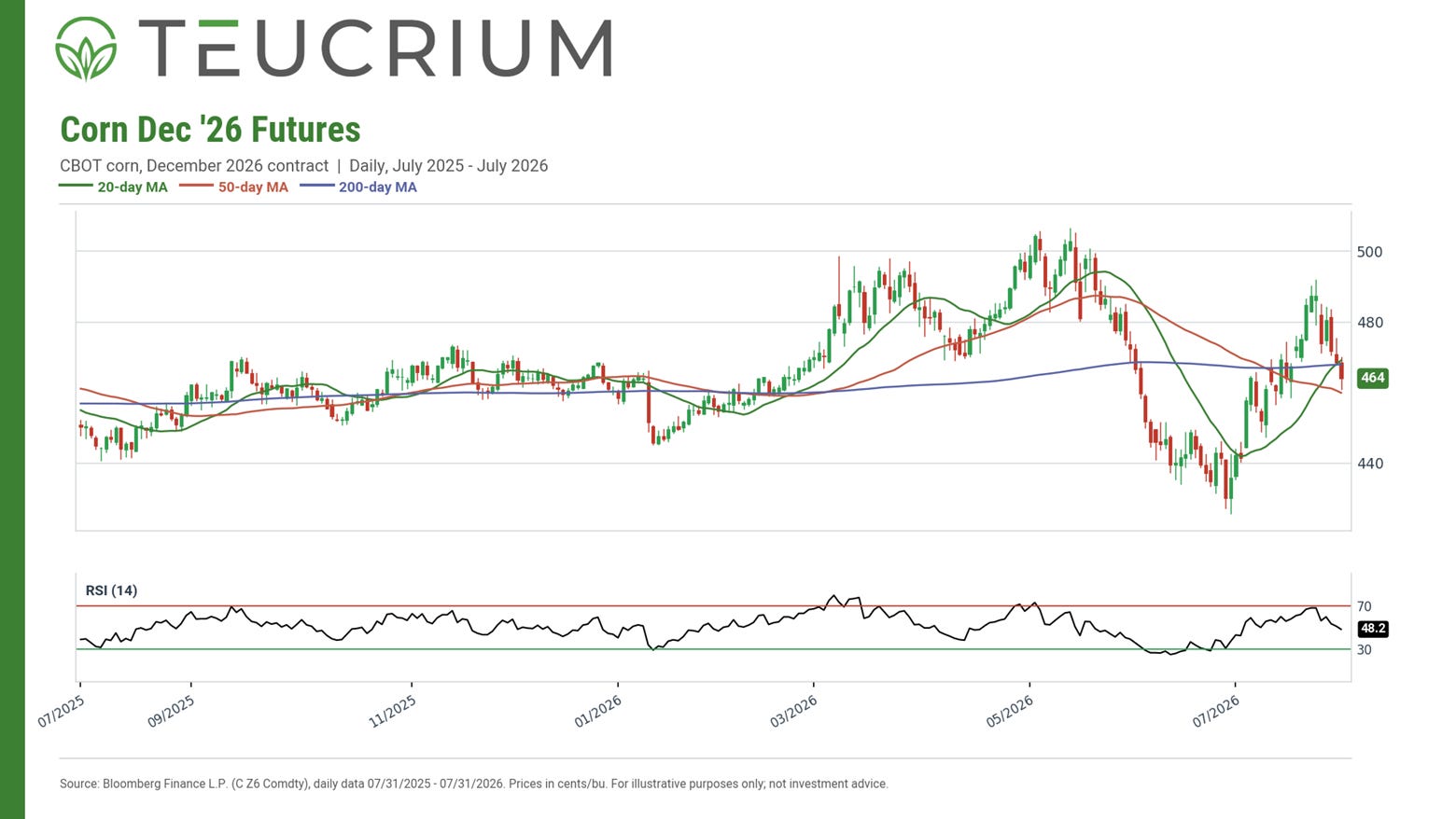
December corn settled at $4.64 Friday, down 4 1/2 cents on the day and 23 1/2 cents for the week. The uptrend that carried the contract through July is gone.
USDA rated corn 63% good-to-excellent Monday, a larger-than-expected 4-point drop that leaves the crop 10 points behind a year ago, and Marex’s Tim Bulfer read it simply: heat counts. December corn popped 6 1/2 cents Tuesday on that number, then spent three sessions handing it back as the forecasts turned wet. Drought hasn’t actually gone away, with Thursday’s USDA Drought Monitor still covering 29% of U.S. corn area, and the gap at 468’2 that Vaclavik had been watching filled on the way down.
The COT is where corn gets interesting. Managed money went net long 126,776 contracts as of Tuesday, a 70,063 contract swing in a single week built mostly by covering 61,365 shorts. Bulfer had looked for something closer to 26,000 lots of net buying, so the trade badly underestimated how fast the long side was rebuilding. Worth keeping in proportion: the funds were net short 14,999 as recently as July 7 and their May peak was 295,620, so this is a quick rebuild rather than a stretched position, and it could cut either way from here.
Demand keeps working quietly in the background, with Algeria taking 10 cargoes for late August, Mexico buying for November, and Korea’s MFG and Taiwan’s MFIG each booking roughly 65,000 metric tons.
Senate Republicans plan to attach permanent year-round E15 to the farm bill at an August 6 markup (that bill still needs 60 votes). Watch Monday’s crop progress and the June ethanol grind, where the average guess of 466.4 million bushels would be down from 474.2 million in May.
Sugar
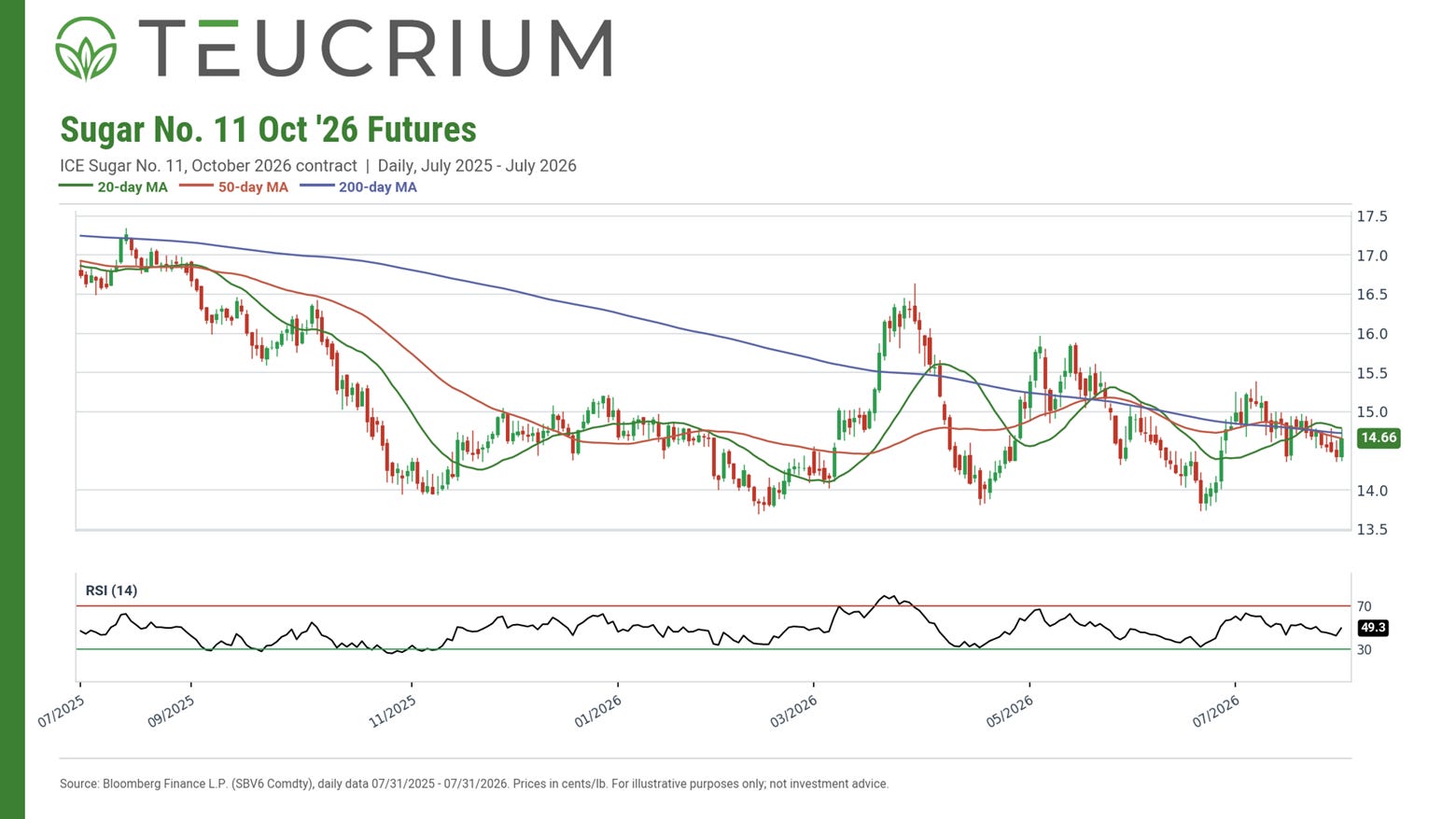
October ICE No. 11 sugar settled at 14.66 cents Friday, up 23 points on the day and down just 11 points for the week. It was the only contract in this note that basically held, and it took a four-session slide to 14.43 and a sharp Friday reversal to get there.
Two forecasts moved in opposite directions and roughly cancelled each other out. Green Pool raised its 2026/27 global deficit projection Wednesday to 3.34 million metric tons from 1.76 million, citing rain that keeps delaying Center-South Brazil milling (pushing mills toward ethanol and away from sugar) plus hot, dry weather cutting European output. StoneX lifted its own deficit estimate to 1.7 million tons the same week, with EU beet production down 15.3% to 15 million tons and Thailand off 15.1% to 10.2 million.
Pulling the other way, India’s monsoon rainfall deficit narrowed to 15% below normal by July 29 from 42% at the end of June, which takes the worst case off the world’s second-largest cane crop. A softer dollar did the rest of Friday’s work: the greenback logged its worst week in three months after Fed Chair Kevin Warsh’s press conference, with Bloomberg’s Dollar Spot Index down 1.2% over five sessions before a corrective bounce Friday.
The funds are leaning the other way from the deficit headlines. Managed money was net short 116,424 contracts as of Tuesday and added 13,742 shorts on the week, so Friday’s 23-point pop reads more like covering into the weekend than conviction buying. That short is nowhere near extreme by recent standards (it ran to 186,290 in late June), but it’s a standing bid if the deficit story firms. Price is sitting on a 20-, 50-, and 200-day moving average cluster compressed into a few tenths of a cent, with RSI near 49, and moves out of that kind of coil can be quick in either direction.
India’s August 1 stockholding limits (400 tons per location, 30-day turnover) and the possibility that thin ending stocks force New Delhi to curb cane juice diversion to ethanol next season are the bullish tail. Watch Brazil’s Center-South mix, which StoneX cut to 46.1% sugar from 47.9%; more ethanol and less sugar out of a 641 million ton crush would tighten that balance further.
COT MANAGED MONEY NET POSITIONING
Comments
Nothing yet. Say the first thing.
Sign in to join the conversation.