
This is technically an announcement that I’m monetising this Substack.
Which feels slightly uncomfortable to say out loud because British people are genetically programmed to become deeply awkward the second money enters a conversation. We can discuss grief, war and bowel issues with surprising openness, but charging £5 for a newsletter suddenly turns us into Victorian chimney sweeps muttering apologies into a hat.
But truthfully, this article is more than me announcing turning on monetisation.
It’s about what happens when the creative industry you built your career around quietly stops functioning the way it used to.
Over not just the past few months, but the past few years, I’ve had a bit of an identity shift. Or an identity crisis. Depends how dramatic we’re feeling today.
I still love sound mixing and sound editing. I always will. There’s still something oddly magical about shaping emotion through sound and helping tell stories in ways most audiences never consciously notice. It’s a craft I care deeply about and one I’m proud to have built a career in.
But if I’m honest, the industry itself feels unrecognisable compared to even two or three years ago.
The ways of working that felt relatively normal in 2022 or 2023 already feel outdated. Work has slowed. Budgets have tightened. Entire sectors feel like they’re operating through a mixture of panic, denial and somebody in finance whispering “AI” every twelve minutes.
Freelancing in sound now often feels less like building a career and more like a competitive endurance sport where everyone’s refreshing their inbox while pretending they’re “keeping busy”.
Which is bleak, obviously.
But it also forced me to start thinking differently.
A couple of years ago I realised I needed to diversify creatively, not because I’d fallen out of love with sound, but because relying on one shrinking corner of one unstable industry suddenly felt like a terrible long term plan. Like building a retirement strategy around scratch cards and emotional resilience.
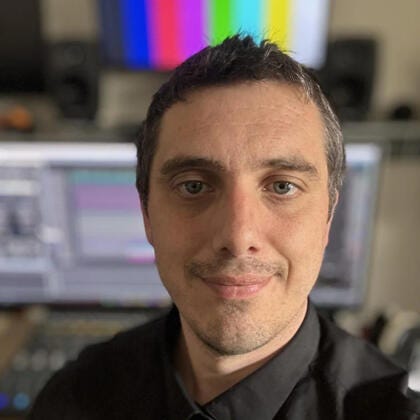
So I moved into education.
I started out in management and, if I’m honest, I found the transition difficult. Having industry experience is one thing. Learning how to apply it effectively in education is something else entirely.
But what I did enjoy was the student engagement, the enrichment opportunities and the teaching itself when I had to cover classes.
I love bringing real industry experience into academic spaces and showing students the things that often become blind spots in traditional education. The practical realities. The emotional realities. The parts nobody tells you about working in film and television.
At the same time, teaching has sharpened me too.
It’s forced me to articulate instincts I’d built over years of working in sound and post production. It’s made me better at communicating ideas, analysing process and understanding creativity in a deeper way. I’ve genuinely enjoyed developing those skills and engaging with students who are entering an industry that looks wildly different to the one many of us stepped into.
Other doors started opening too.
I began working on immersive 360 dome films, which has become one of the most creatively exciting spaces I’ve worked in for years. It’s a format and a community that feels refreshingly open, collaborative and experimental. People share knowledge instead of guarding workflows like they’re protecting state secrets.
There’s a freedom to it that I’d honestly forgotten existed.
At the same time, I’ve been developing a couple of more traditional film projects of my own and slowly leaning further into creating work independently rather than waiting endlessly for permission.
And then earlier this year I finally did something I’d wanted to do for a long time.
I started this Substack.
Not because I wanted thousands of subscribers purely for vanity metrics or to become one of those people who uses the phrase “creator economy” but because I wanted to write.
I wanted to talk honestly about sound, storytelling, filmmaking, post production and creativity with people who care about the craft behind the work.
And honestly, the people I’ve met on here have been brilliant.
It feels like a community of people on similar journeys, creatives trying to figure out how to build meaningful, sustainable work in industries that increasingly feel unstable, oversaturated and held together with electrical tape.
Substack also introduced me more deeply to the Nonde movement and the wider world of independent filmmaking communities. The idea that maybe creatives stop waiting for permission all the time. That maybe we can build our own audiences, our own communities and our own projects outside the traditional gatekeeper system.
Not anti industry necessarily.
Just less dependent on it for survival.
And somewhere in the background from the beginning was the thought that one day I’d monetise this publication.
The question was always how?
Because if people are going to part with their money, even a small amount, I think there has to be genuine value there. Nobody needs another creator shouting vague motivational nonsense into the void while selling “exclusive insights” that could’ve been a tweet.
So here’s where I’ve landed.
The weekly article which I sned out Thursday’s will always remain free.
That’s important to me.
This newsletter is my public space. My calling card. Occasionally my therapy session disguised as industry commentary.
But for those who’d like to go a little deeper, I’m introducing a paid subscription at £5 per month.
For that, you’ll receive at least two additional articles every month alongside the regular free newsletter along with some other perks including Q and A’s, monthly Zoom calls and early previews of other materials I’m working on which include Videos and Courses.
These won’t be filler content or shorter versions of free articles hidden behind a paywall. They’ll be deeper dives into sound mixing, post production, storytelling, filmmaking and the realities of working in the creative industries.
I’ll be sharing more detailed breakdowns of projects and workflows, lessons learned from my years industry, thoughts on creative development, and honest reflections on navigating an industry that’s being rebuilt in real time.
Paid subscribers will also be able to submit questions for regular Q&A and FAQ posts.
Whether it’s sound mixing, editing, post-production, filmmaking, freelancing, education, career development or creative problem solving, I’ll answer as openly and honestly as I can.
In short, you’ll get more access to the things I spend most of my time thinking about anyway.
Less polished mythology.
More reality.
Because I think people are craving that now.
Not the fantasy version of creative careers where everybody’s thriving and effortlessly networking on rooftops in Soho.
The real version.
The version where people adapt. Learn new skills. Diversify. Build communities. Create independently. Try things. Fail occasionally. Continue anyway.
So yes, this is technically an announcement that I’m monetising the Substack.
But really it’s an extension of the same journey I’ve been on for the past few years, figuring out how to build a sustainable creative life in an industry that no longer works the way many of us were told it would.
If that resonates with you, I’d love you to come aboard.
For £5 a month you’ll be supporting the writing, helping me continue building this community and getting additional articles, deeper insights and the opportunity to shape future discussions through your questions.
Either way, thank you for reading.
Even reaching the end of an article on the internet deserves some sort of medal.
Or at the very least a biscuit.
No posts
Comments
Nothing yet. Say the first thing.
Sign in to join the conversation.