
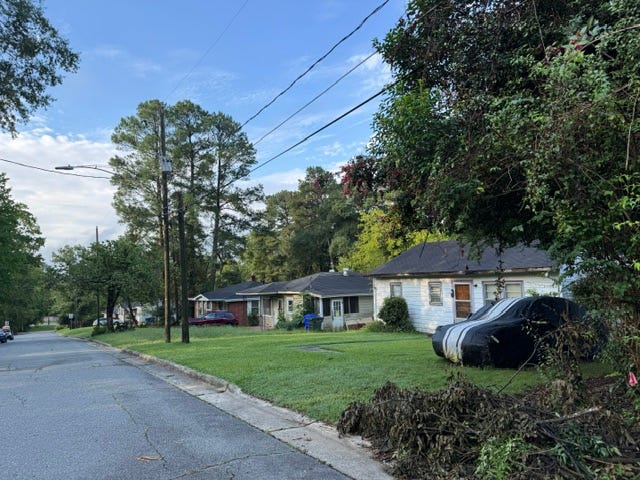
What do you do when the sanctity of your home is permanently disrupted and there’s nothing you can do about it? That’s a question residents throughout Chapel Hill and Carrboro could find themselves asking as both towns pursue infill to create new housing options.
Alabama Avenue: A Carrboro case study
Alabama Avenue in Carrboro is a perfect illustration of how radically infill development can impact your day-to-day life and the long-term investment you have in your home. Long ago, what we currently know as Alabama Avenue was farmland owned by a black family, the Nevilles. Relatives of those original owners still live in the neighborhood. Gentrification began trickling into the neighborhood a few years ago, but the trickle turned into a landslide this summer.
In December 2025, the last of the original Neville farmland, jointly held among several branches of the Neville family, was sold to an equity investor who, in partnership with an out-of-town developer, broke the single 1-acre lot up into three residential lots. Normally, zoning changes require that surrounding property owners are notified and the request is reviewed by both the town’s Planning Board and Town Council in public meetings before any work begins. But in this case, the zoning was just a matter of subdividing, not making any modification to the zoning itself, so it was treated as an administrative change without notification to the neighbors or public.
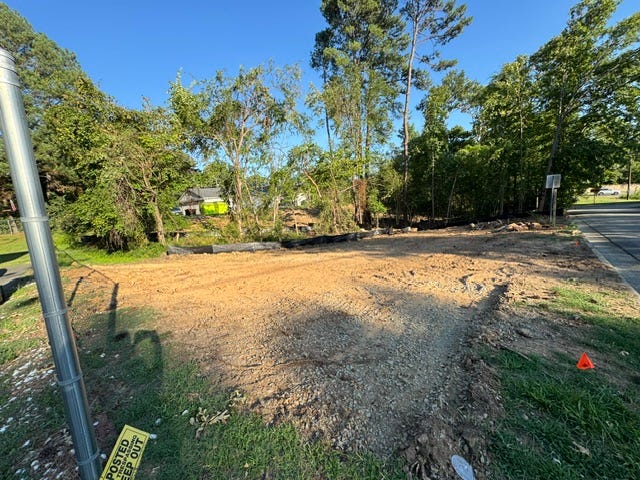
Neighbors learned of the change that was upon them when they woke up early one morning last week to heavy equipment parked along their narrow road and chainsaws buzzing away. Less than 60 days after the rezoning was approved by Carrboro, all three lots were clear cut, leaving minimal buffers around the unnamed stream that bisects them. When one of the trees fell on a neighboring lot, that homeowner had to pay to have it removed.
Neighbors still haven’t seen any plans for what is to come. But that doesn’t really matter because all of these development decisions—the same decisions developers of larger projects have to get reviewed such as where to place new structures on each lot, how to address stormwater, building heights, etc—are being treated as ‘by-right.’
By-Right Development
By-right development is the “approval of proposed projects as a matter of right if they comply with established land use regulations, without the need for discretionary review or approval.” The goal of by-right policy is to speed up the development of new housing. But the developer on Alabama Avenue isn’t building new housing, he’s building what he hopes will be tourist housing, aka AirBnBs, while being awarded all the same perks that a developer of affordable housing would receive.
This move to by-right development via administrative signoffs changes our Chapel Hill-Carrboro community. In the past, citizens played a role in both town governments through advisory boards, task forces, and showing up at public meetings. They could also generally count on the assistance of one or more elected officials. Today, staff make the decisions. Staff marching orders are to speed up the development process and that is what they are doing.
Alabama Avenue residents assumed something was going to happen with the empty lot at the end of their street. Several years earlier, they had fought off a Dollar General. But that was the past, a past when citizens had a larger voice in town government. They weren’t prepared for their powerlessness when this new development began without any notice. The landscape had changed and they weren’t prepared.
Now, an owner with less than one year of a very tenuous connection to the neighborhood is making all the decisions that impact everyone on the street, while those who have called Alabama Avenue home for decades are sitting on the sidelines, watching their previously historically black neighborhood gentrify before their eyes. As an added insult, town staff have told the residents that they no longer use the term “historically black.” The new term is ‘culturally diverse.’
Nothing has been done illegally in all of this. Town staff have followed local ordinances, and some (but not all) have been responsive to questions from the neighbors. But legality is not the same as morality. What does the town owe 40+ year residents as they reduce their rights in order to make room for new, nameless residents and the financial benefit of out of town developers? Some will call my concerns NIMBYism. I call it an expectation for respect.
Speak up! You could be next.
As the two towns proceed with the public workshops/meetings to introduce their rewritten land use ordinances (LUMO for Chapel Hill and UDO for Carrboro), I encourage you to ask yourselves, town staff, consultants and elected officials, what the town owes existing residents. Will new amenities, like greenways, justify the loss of quiet and privacy, the inevitable higher tax values, increased stormwater problems, and more crowded roadways?
Infill development doesn’t have to stomp all over the rights of existing neighbors. We can have more housing without making current residents feel disrespected. The by-right policy can be adapted to the needs of this community—but only if we demand those adaptations. Your neighborhood could be the next Alabama Avenue. Use your voice and advocate for the rights of current residents before it’s too late.
Potential adaptations to the by-right development process:
Surrounding neighbors must be notified at least 30 days before any land is cleared or construction begins.
At least one neighborhood in-person meeting must be held to explain to the neighbors the scope and timeline for the project and answer any questions.
All new development must include stormwater mitigations for the entire lot, even with ADUs.
Heavy equipment may not be operated before 8 am or after 6 pm M-F, before 9 am or after 6 pm on Saturday, and may not operate on Sundays.
What other protections would you want if new construction was going up next door to your home?
Comments
Nothing yet. Say the first thing.
Sign in to join the conversation.