
I built a thing that makes my inner community nerd glow.
One of the first books I read in my village building journey was Together Resilient, by Ma’ikwe Ludwig, which is an incredible, data-backed examination of the impact of villages. Ludwig uses case studies and direct research to show how our ecological footprint is lower, our quality of life higher, and our lives literally longer in community. Fabulous read.
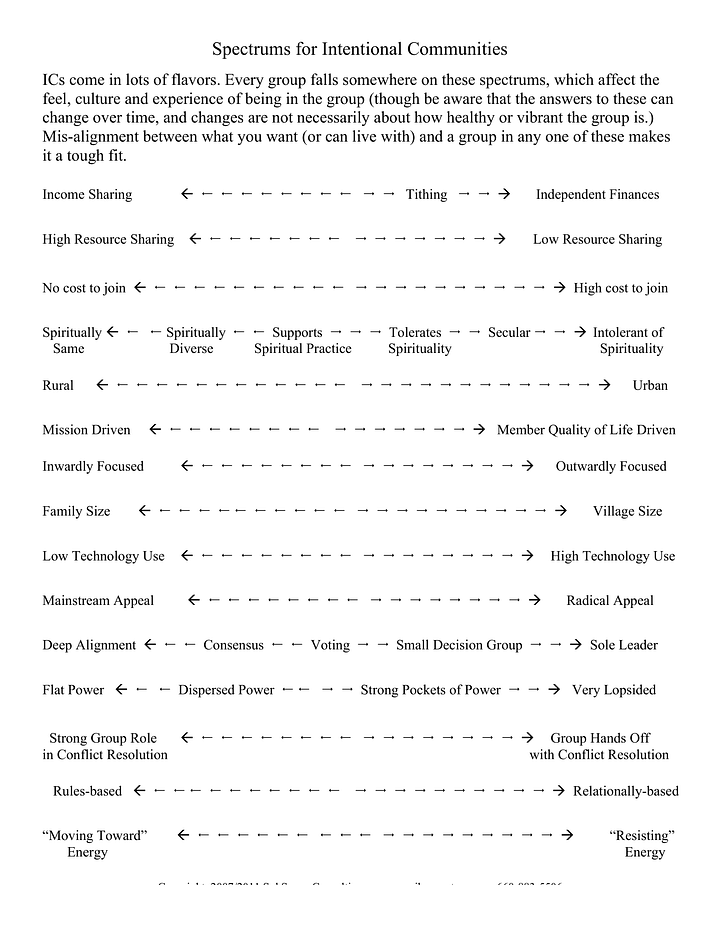
In this book, I was introduced to a concept that Ludwig herself developed, called the “Intentional Community Spectrums”, which asserts that communities differ from each other not in kind but in degree across a consistent set of design dimensions.
Spectrums reveal a village’s core values and vision. They address the vague notions of how ownership will be implemented, or what the attitude towards spirituality actually is.
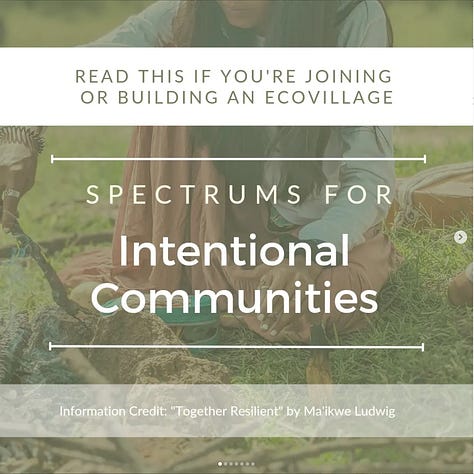
I thought they were fascinating, and even took the time back in 2022 to do a minimal graphic version of the spectrums to share in a carousel:


Fast forward to early 2026. I’m mentally inventing different tools I think will be most useful to village builders. Two of my brain cells rub together, and the memory of the spectrums rushes to my mind.
I ask myself,
“What if I could use those spectrums to predict what type of community a project is?
What if I explored the conscious and unconscious design choices of those community types?
And WHAT IF I could diagnose the probable strengths and weaknesses of a project based off this resulting archetype?”
Well bam-boom, I have the idea for the Village Diagnostic Tool. Here’s how I implemented it.
Together Resilient first mapped 15 design dimensions.
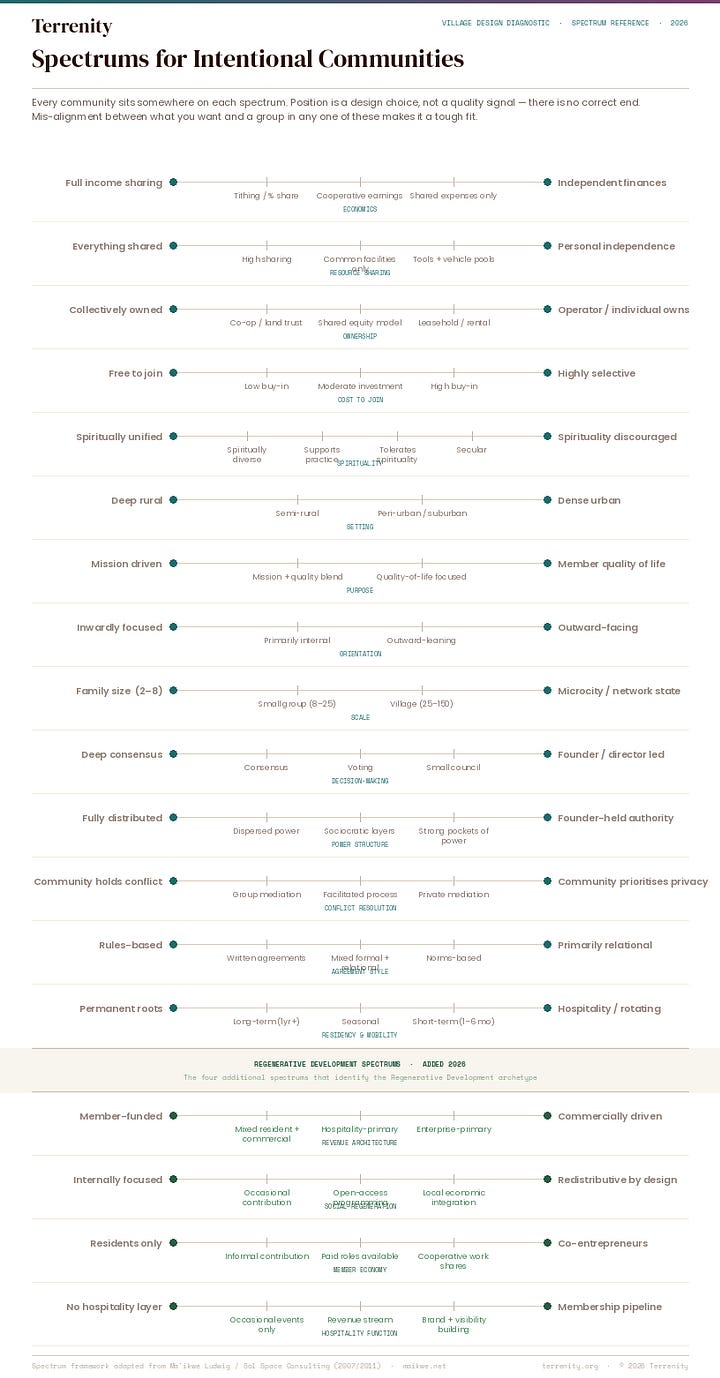
Building on Ludwig’s foundation, I identified three critical gaps in the original framework. Ludwig wrote in the early 2000s, when communities looked different than they do now. She didn’t have language for ownership structure as a standalone dimension (who holds the asset is fundamentally different from how money flows). She had no dimension for residency and mobility—the rise of coliving, slow travel, and hospitality-integrated models created entirely new design questions. And her scale spectrum maxed out at village, leaving no room for network states or distributed models.
I expanded the framework from fifteen spectrums to eighteen, and revised the language everywhere to remove implicit value judgements.
Value Judgements
The intentional community movement in 2007 had strong ideological currents toward communal economics, consensus governance, and rural land stewardship as implicitly superior.
Ludwig's original language positioned the "full income sharing," "deep consensus," and "movement-driven" ends as the aspirational poles, and the "independent finances," "founder-led," and "quality of life" ends as compromises or less-evolved positions. The Terrenity revision makes both ends of every spectrum a legitimate design choice rather than a failure of character.
i.e. The original power structure spectrum used the poles "Flat Power" ↔ "Very Lopsided"

"Lopsided" is a loaded negative term that implies fragile unevenness, so the left pole reads as aspirational while the right pole carries moral condemnation rather than simply describing a design choice.
I evolved the poles into "Fully Distributed" ↔ "Founder-held Authority” and explicitly noted that founders often carry greater risk and liability, so both are legitimate design choices.
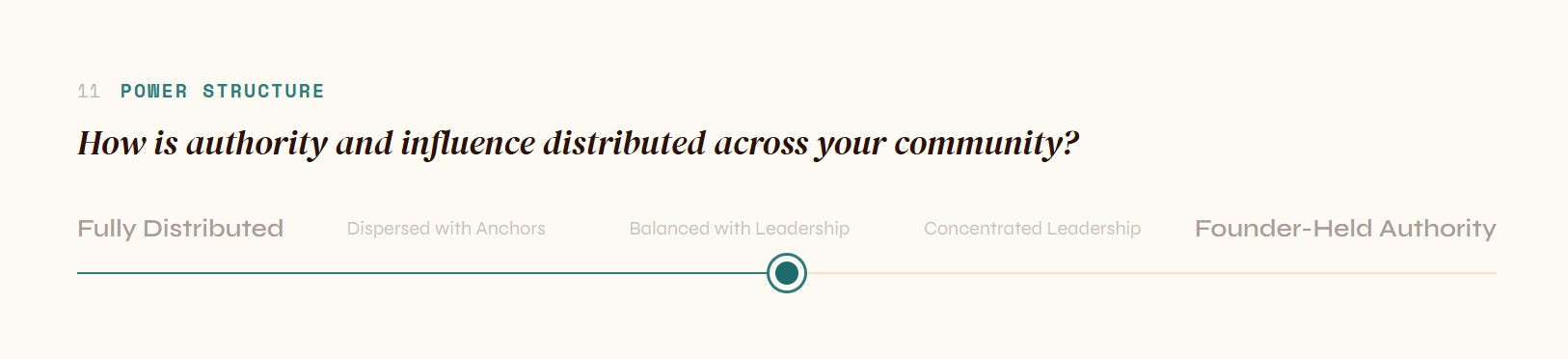
I also added more nuanced steps in between the extremes. Ludwig named each pole, and sometimes a middle step, but it was largely left to personal assessment to decide what the middle looked like (which decreases standardization and data control)
This resulted in developing 11 archetypes with 2 kinds of subtypes based on management style or location. I was very satisfied with the working and reworking that I did to arrive at these archetypes, their corresponding names, and the taxonomy as a whole.
Then came WuWei, a project in Guatemala I’m working with that broke my 10 archetypes framework. It had residential co-ownership, a professional hospitality operation, residents launching enterprises with revenue-share flowing back to the commons, and a deliberate commitment to local economic benefit.
On paper, it should have matched one of my existing archetypes. It didn’t. It fell between categories, and wasn’t one or quite the other.
That gap forced me to ask new questions: What about a community’s relationship to commercial revenue? What if members aren’t just living there, but building enterprises within the ecosystem? What if the hospitality layer is deliberately designed as a pipeline from guest to co-owner?
Four new spectrums emerged from that analysis—Revenue Architecture, Social Regeneration Commitment, Member Economic Participation, and Hospitality Function.
WuWei resolved cleanly into a new archetype, one I call Regenerative Development. Honestly, I should have seen it sooner, because it’s the most popular model today, as traditional real estate collides with regenerative village building. The old framework from Ludwig’s spectrums couldn’t have named this type, because it hadn’t yet been popularized in her time.
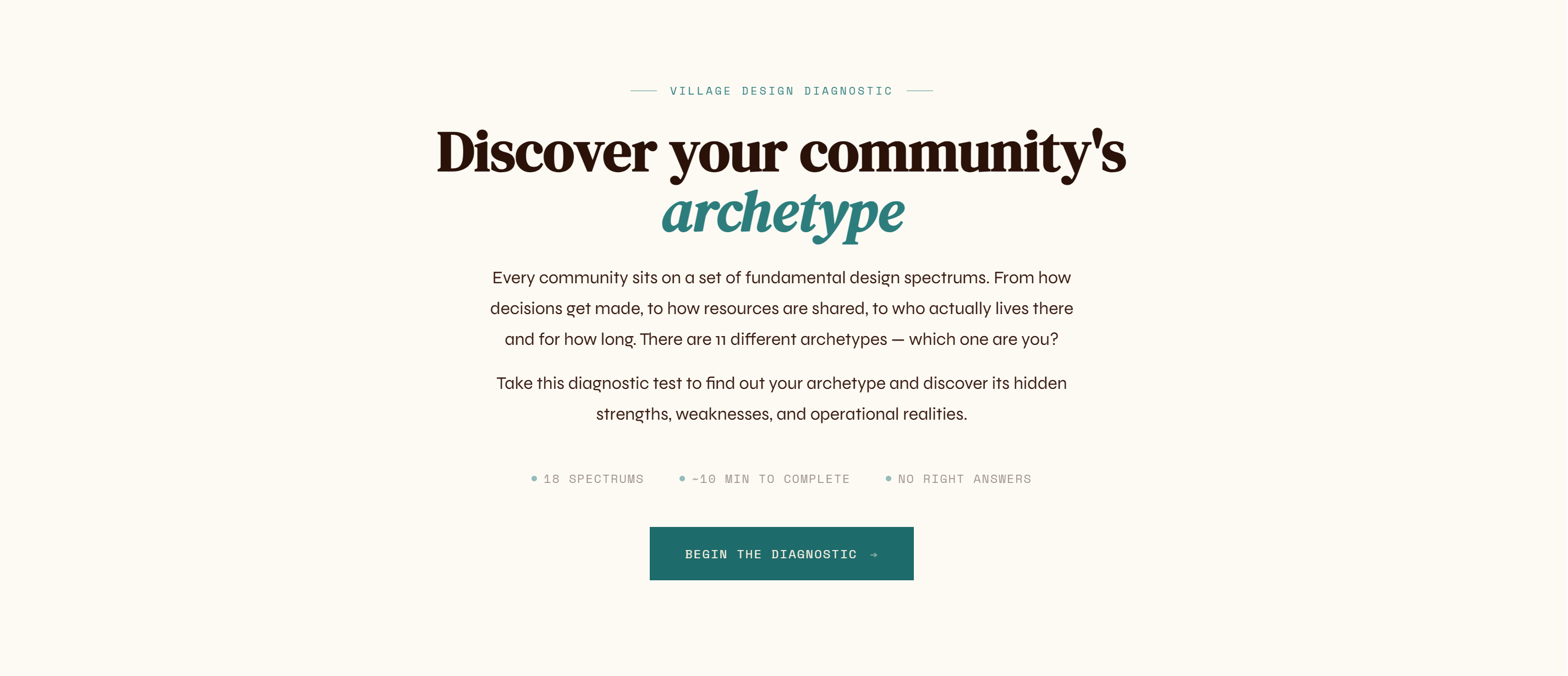
The v1 tool is simple:
Draggable spectrums to select where on the spectrums a project falls
Instant report given in exchange for an email with archetype name, subtype, history, strengths, weaknesses, residency advice, and my professional take on this community type.
Most tools used to classify intentional communities ask you to choose: Are you income-sharing or independent? Consensus or hierarchical? Rural or urban? Spiritual or secular? The problem with binaries is they force real communities into false choices. The vast majority of communities don’t sit at the extremes. Instead, they’re hybrid, evolving, and intentionally positioned between the poles.
A quiz-based diagnostic can’t capture that. It forces you to pick a box. A spectrum reveals where you actually stand. This is why I coded the diagnostic tool so you can interact with draggable spectrums:
What’s coming next: paid deep dive reports, and the full typology of communities where you get to see all the archetypes.
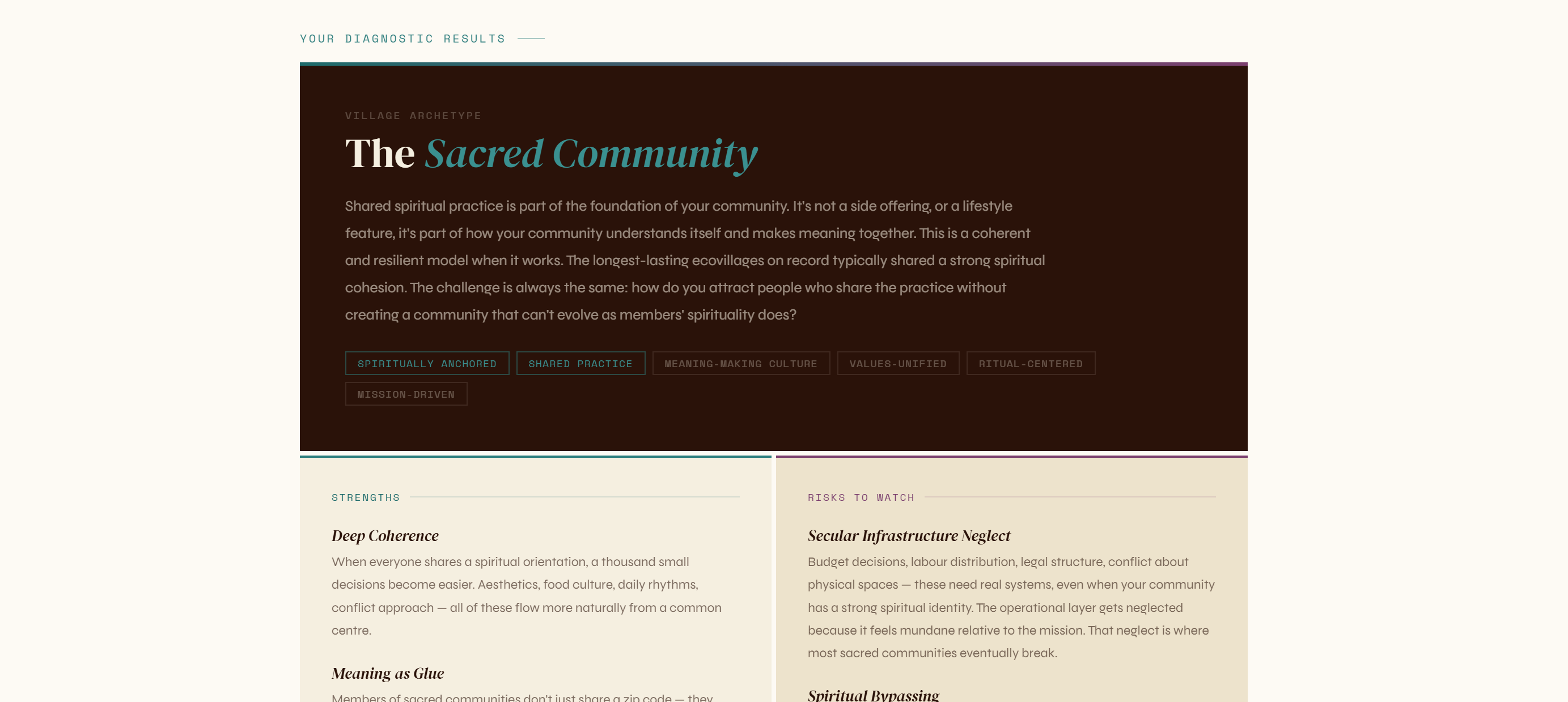
I built this tool for three use cases:
Community founders who want to quickly put a finger on the pulse of what they’re actually building, and reveal their design assumptions that will cost them buckets of money down the road.
Community seekers who want to figure out which community is structurally right for them. I’ve taken short quizzes assessing which community is right for me, but it was kind of like a culturally-focused, somewhat shallow personality quiz and not a values examination.
Community consultants (like myself) who want to use a reference tool to understand the communities they are advising, and detect blind spots or design contradictions early.
If you’re curious about the build process, and want to be a beta tester with first access and ability to customize the diagnostic tool, sign up for this Friday’s webinar, June 12th at noon PST. This webinar is free for paid Substack subscribers
The diagnostic tool is promising because it will expand our vocabulary for community design.
The ongoing principle behind all of this is simple: most founders are operating with borrowed language. They call their project an ecovillage because that’s the label available, not because it’s accurate. They say “commune” when the community doesn’t have income sharing, or “coliving” when they really mean cohousing, because they don’t have better words. Or like my dad, all those words are too strange, and they settle on something neutral like “family compound” to describe their communal property.
The archetype framework gives builders and seekers precise vocabulary by showing them where their actual design choices land relative to the full range of known community models.
And I’m floored to share it with you.
So sign up for the webinar to start your beta access, and let’s start building.
Comments
Nothing yet. Say the first thing.
Sign in to join the conversation.