
Today: Earth Day 2026.
Me: feeling the waves of time, memory, story, eldership and the essential ceremony which I have been exploring in depth this last year - the ceremony of storytelling. Across time and space. Across sacred territories and imposed borders. Across the lifeline of beingness - human and more-than-human, gods, ancestors, elders.
Through this portal I feel the fluidity of what story is - and how it can be told. Is it my telling? Is it a plant’s? Is it an animal’s? Is it a patch of earth’s? Are those perspectives even different or just part of a constant river flowing from the consciousness of all being - waiting to break free to sing?
Each molecule has its own personality but when we dive deep into the laguna of ceremony I am realizing we can hear the sonic waves of each fragment. We just have to find the portalways to listen. We have to reimagine language beyond words, so that we can hear.
I continue to dive, deeper and deeper, finding my story body transforming to swim deeper than my physical body ever could.
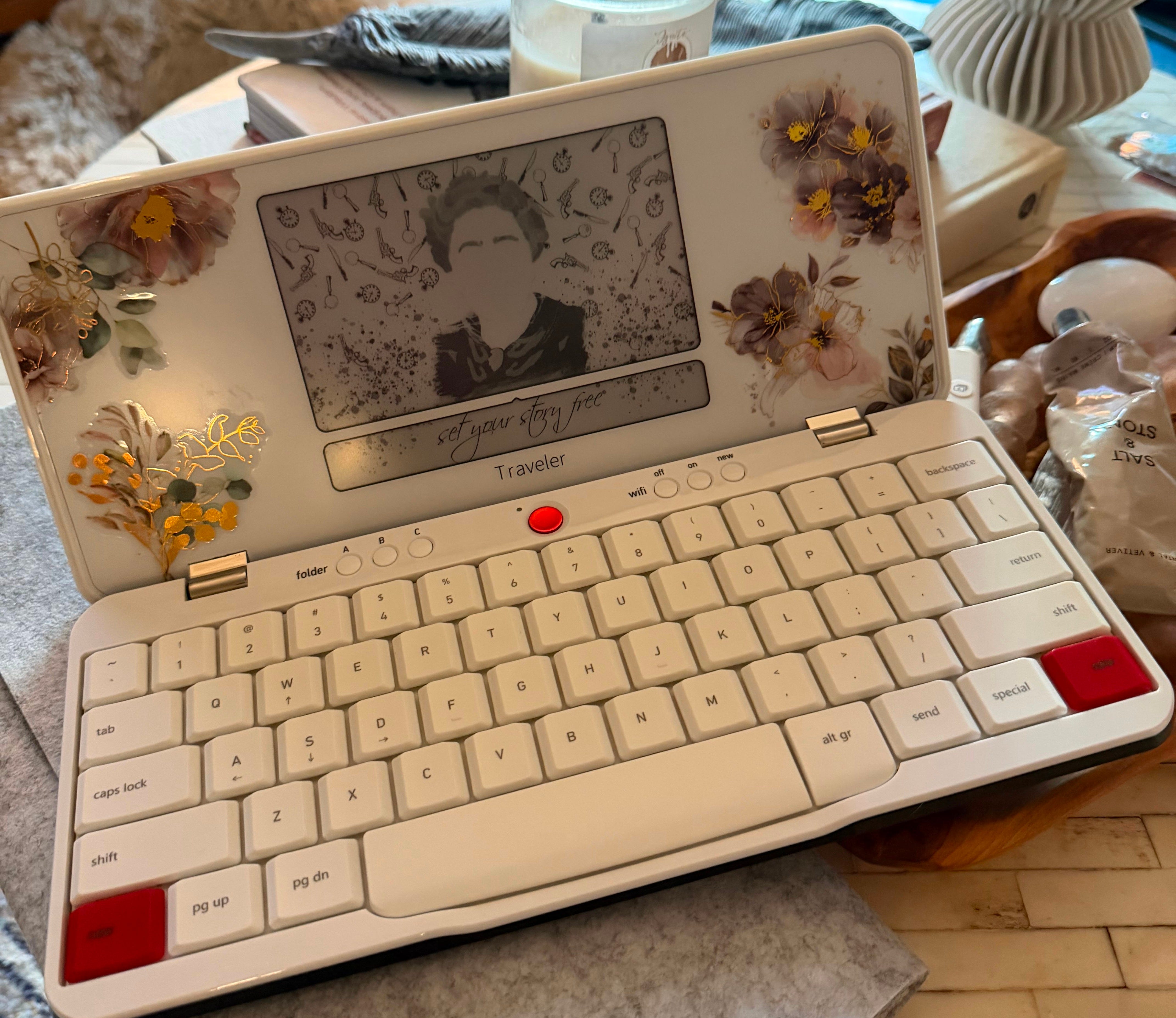
I am preparing for a summer in motion. I am creating my packing list in google docs where I like to plan and plot all things in my life:
backpack,
suitcase,
notebooks and pens,
audio recorder,
freewrite traveler (a literary investment made during a recent warehouse sale for distraction free travel writing and another tax deduction for future work-related expenses)
foldable walking stick/as-needed cane
I am planning a summer semester through the M.F.A. program at my school, after taking a narrative writing class through the same department this past semester. Realizing that to create the “ceremonial storying” research methodology I believe is an essential component of my form of Indigenous research I need to be as adept at my narratives and model for re-storying from the Andean world(s) as I need to be rigorous in my other forms of academic research. This is a stretching of a new literary muscle. Not like the creative nonfiction I have written for decades - it flows from a new spring. Not like academic writing as it is currently constructed - although in conversation with it and deeply researched in its own way.
I will also be carrying the ceremonial storying of Mama Coca/Rebel Hoja and our work together as we bring our collaborative practices and conversations to communities from Turtle Island (North America) to Abya Yala (Latin America) and Europe. I will share more about this journey as we flow into different spaces and through it all I will be storying, weaving practice and narratives as I go. This will include writing more of my “fragmentos del ande” with Mama Coca and beyond as well as expanding my practice of building a sound archive of eco-sounds from sacred territories along the way.
Additionally, I have just confirmed that I will be spending two weeks to begin my Abya Yalan part of my travels at an Artist Residency in the Sierra Nevadas of Colombia - somewhere with powerful magic and ancestral wisdom which I have been feeling increasingly called towards in the last few years. It is part of a beautiful local project intersecting arts, ecologies/eco-care and ancestral wisdoms. I can’t imagine a more ideal way to begin my time in the Andean territories of Colombia, Chile (first time), and Bolivia (where I was last 20 years ago).
I find in this new way of writing - ceremonial storying - comes first through a transmission of some kind - sound, scent, something experiential and relational. It’s a kind of ecolocation practice - where the sensory linguistic ripples in my direction outside of my own volition but through a kind of more sensitized listening. It is said that trained humans can become attuned to the practice of ecolocation - it is the closest to what this feels like. A retraining of my capacity to hear in a different way. One that it is hard to fully give language to when describing.
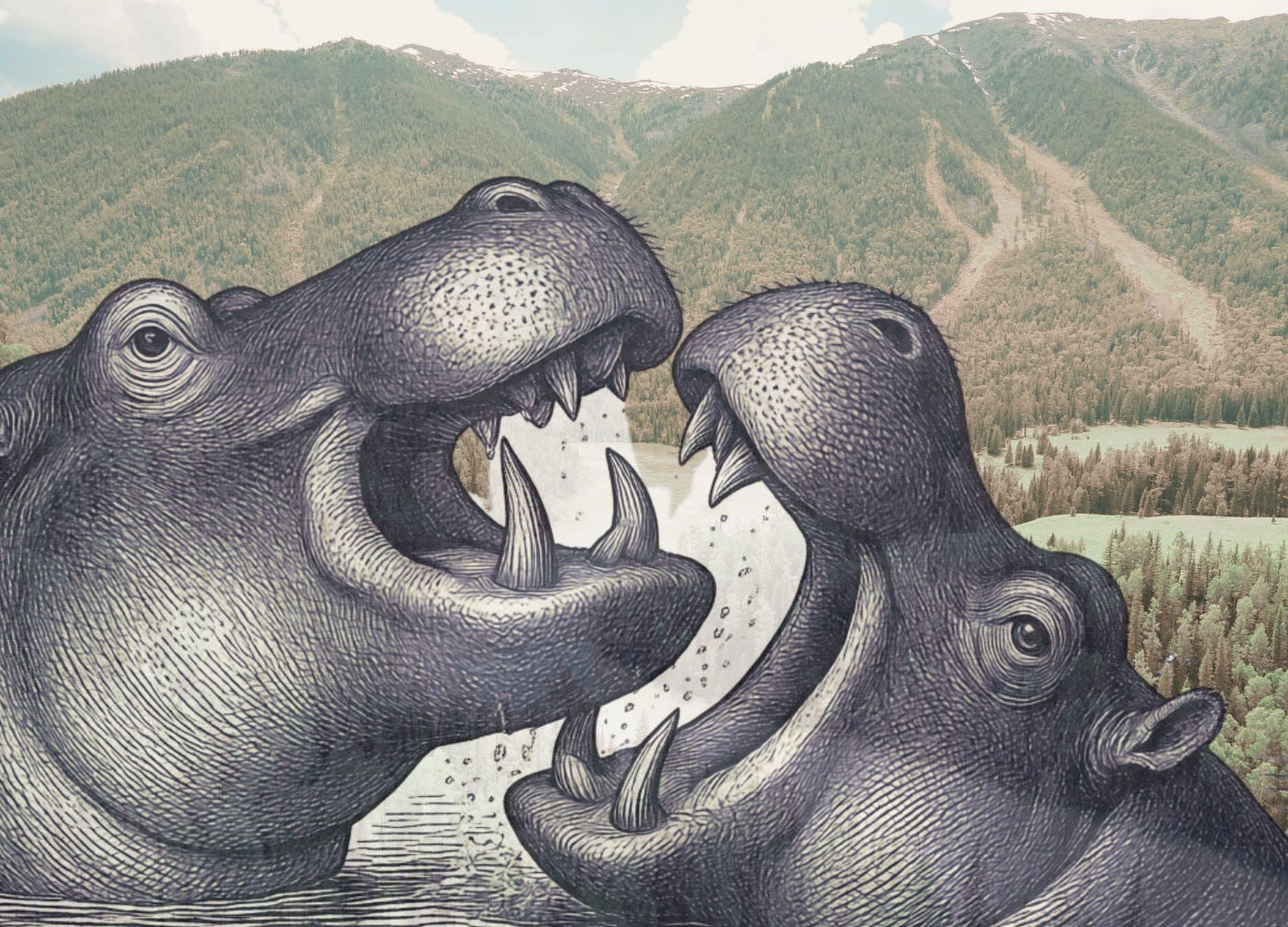
It is appropriate, perhaps, as I find this linguistics of ecolocation listening, that I would be attuned right now to the sound of the hippopotamus, whose ancestors were (what I would call) cousin to the ancestors of our contemporary whales. They were great water beings, wading in deep waters long before human memory. This great ancestor of the hippo going back about 52 million years.
I have been filled with increasing rage over an unfolding crisis in Colombia. One that has been shaping for the length of my own life (give or take a year).
Many may not know, but in 1981 Pablo Escobar bought 4 hippos from a Texan breeding farm and brought them to his mansion compound partway between Medellin and Bogotá.
Once he was killed in 1993, the compound went into disrepair, and these hippos escaped into the surrounding territories, finding their way to the Magdalena River - the core vein of water flow through Colombia.
Their population has grown, due to not having any natural predators to diminish their expansion, and the water ecologies and water kin have struggled to survive this influx of new and unexpected life.
Escobar’s rippling sin, throughout time and place, coming to a crescendo today.
There is no easy or perfect answer, and there are many conflicting opinions.
But soon 80 of the existing hippos will be euthanized, and intentions for sterilization and other mediating efforts are in progress for the remaining population.
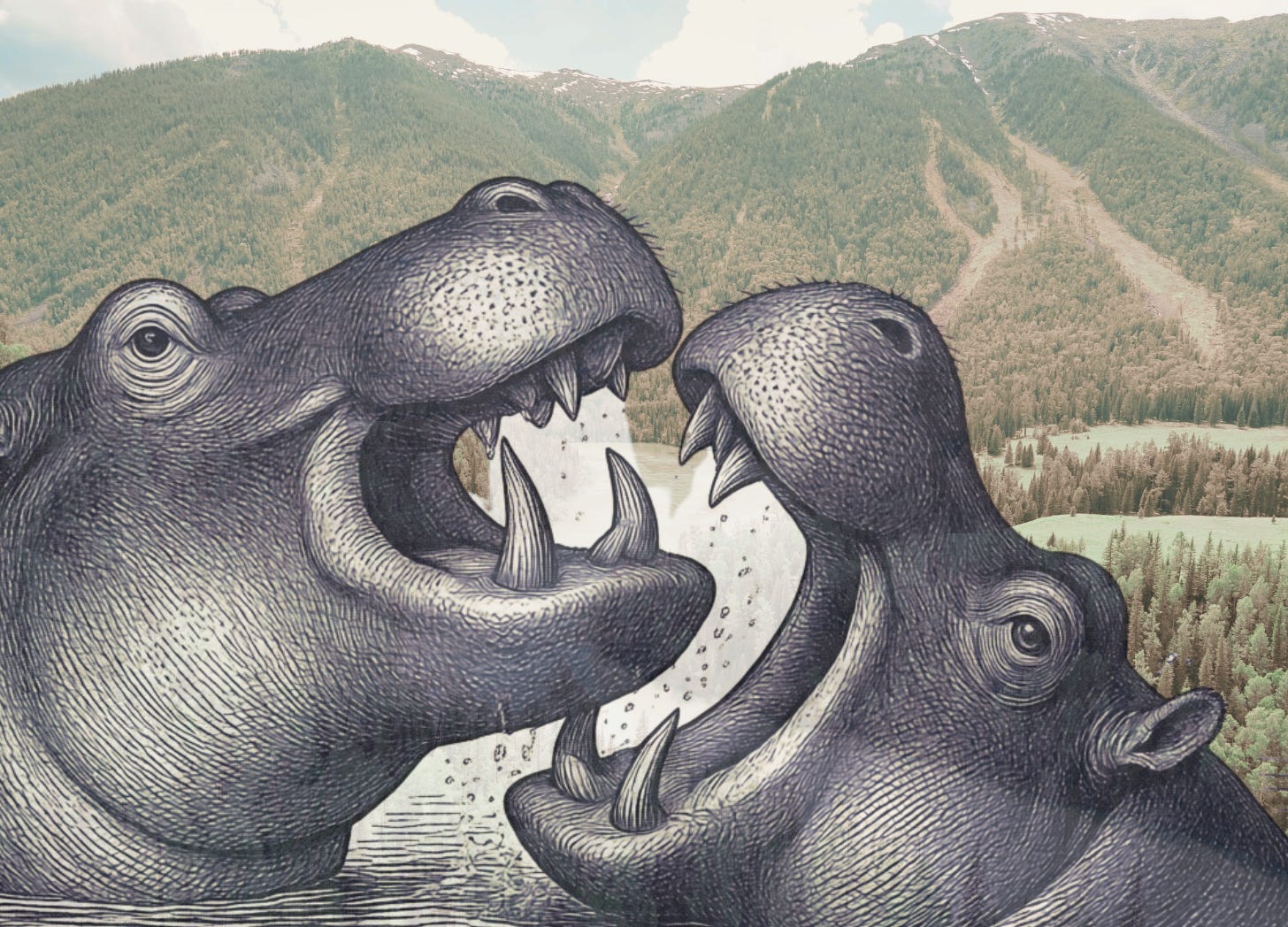
I have been having big feelings about this, and so this piece - hippos of colombia: aftermaths - is a beginning expression of all of them (or at least the ones I can find words for so far).
Text within this block will maintain its original spacing when published
Rage. Rage. Rage.
Words don’t come first, only screams that well in my belly and vomit off my tongue like sonic tears.
I am too angry to cry.
Escobar’s aftermath still bleeds all over the tierra.
His violence, a retribution from the grave. Violence, still.
1981. A year after I went north.
Four hippos moved south - from Texas to Colombia.
Whims of a mad “king.”
Four hippos. Out of place. Out of time.
Like generations of forced migrants.
African artiodactyl.
Ancestral cousins to whales.
Always seeking waters, the rhythm of home.
Gunshots in 1993, opened the gates,
beyond the graveyard palace of the mad “king.”
Free! Free! Free!
Water! Water! Water
Home! Home! Home!
Cool rhythms of the Magdalena.
A new river in a new land.
Home! Home! Home!
First, there were four.
Then 16.
Then 40.
Then 100.
Then more than 200.
Magdalena calling.
River calling.
Home! Home! Home!
Now the river bellies distend from the weight.
These great ancestors.
Gods and Goddesses of becoming.
Descendant cousins of whales.
Not enough room. Overcrowded.
Balance is shifting.
Ayni,
reciprocity,
balance tilted.
Water! Water! Water!
Home! Home! Home!
Into the belly of the river their ceremony calls.
Their song huffs from their powerful jaws.
Water! Water! Water!
Home! Home! Home!
Now, they are the most hippos outside of Africa.
Home? Home? Home?
Soon, 80 will die.
Water! Water! Water!
Home? Home? Home?
Ancient ones. Elders.
Cousins to whales.
Home? Home? Home?
I hear their calling.
Echoes in my mind.
Ghosts from the future.
I fall asleep to them.
They wake me up at 3 A.M.
Their stories, a whale song in my soul.
Beating in the rhythm of my own migrant heart.
I remember their story.
I remember mine.
Rage. Rage. Rage.
Words don’t come first, only screams that well in my belly and vomit off my tongue like sonic tears.
I am too angry to cry.
Aftermaths.
Aftermaths.
Aftermaths.
Comments
Nothing yet. Say the first thing.
Sign in to join the conversation.