
They had fallen in love at Lowell High School, in senior drama class. Beth remembered particularly the scene in the annual school play that year, 1963, Romeo and Juliet, when Friar Laurence offers his thoughts on how fine the romance between the two is, yet how dangerous it may be.
“For this alliance may so happy prove,/To turn your households’ rancour to pure love.”
Those lines had made Beth almost weep. The hopefulness in them. But so had the following line from the friar a while later: “These violent delights have violent ends.”
“But she’s so young!”
“Actually younger than you are, Beth,” the English/Drama teacher Mr. Curtis said.
“She is?”
“She’s just a girl. Romeo’s a boy. It’s one of the facts that makes the play so difficult. I mean, the meanness between the two families. The jealousy between them and what it causes these two kids to do.”
While Beth was playing Juliet, Shay had a smaller part as Balthazar, Romeo’s servant. He also helped change sets between scenes and move things around. There was something to his actual part, Balthazar’s witnessing of so much sorrow. And Shay did have three memorable lines:
“Then she is well, and nothing can be ill:/Her body sleeps in Capel’s monument,/And her immortal part with angels lives.”
Once, in rehearsal, he had noticed that Beth, sitting in her jeans and a sweater on the floor at the side of the room to watch, was watching him after he had uttered these lines to Romeo. She had put fingers to her eyes, to wipe them of tears. She knew that Balthazar did not know that Juliet was still alive, and that this news from him would drive Romeo and Juliet both to their suicides.
Beth enjoyed talking with Shay. A kind of attractive listlessness came with his own speech, as though he were in the act of dismissing himself. But even then, even as an eighteen-year-old, she knew this was not true of Shay Flood. They had been in the same English class with Mr. Curtis the year before, and she had noticed how Shay was the only boy who seemed able to answer Mr. Curtis’s questions about what they were reading.
“How many of you know about these Oakies that Steinbeck’s writing about?”
“What do you think of Uriah Heep?”
“Who likes Jane Austen?”
The other boys in the class, most of them, sat slouched at their desks in embarrassed resentfulness while the girls waved their hands in the air. Shay held his up as well. Noticing this, Beth had planned a way to walk with him, especially after the class in which he had answered Mr. Curtis’s question, “Why do you like Romeo and Juliet?”
“The ways they find to stay together. Especially when each of them thinks the other is still alive.” Shay’s silent look to the side had offered what seemed to Beth like worry. Sorrow, even…. The boys in the class were uninterested in his answer, although Mr. Curtis, brushing dandruff from his jacket’s right shoulder and then straightening his tie, nodded with approval. “Well….” He looked the class over. “Let’s talk about that, what Shay just said.”
Shay and Beth had become friends after this, and Shay had asked Beth to attend the senior prom with him, their first actual date. Not much had come of it. He gave her cheek a kiss at her front door before she went back in. He had gotten a job as a camp counselor in Maine for that summer and would enter NYU in the fall, while Beth would start at Berkeley.
They did like each other, and at the Christmas break, back in San Francisco that first year of college, Shay called Beth and asked her if she would take a walk with him. He had been thinking about her, despite the brevity of the time they had had together. Shay had understood how difficult the part of Juliet must be, Juliet’s naiveté and charm in the same moments that the onrushing doom is coming. He remembered especially the moment when Beth had paused, looking down and waiting as Juliet considered what she was about to say, what maybe she was too frightened to say. “My only love sprung from my only hate!“ Shay had admired the sophistication with which Beth had given the line. Looking down with a hint of sorrow, she had taken in a breath before putting a long, worried pause between the words “love” and “sprung.” “My only love…sprung from my only hate!“ The fury between the Capulets and the Montagues had been an unquestioned part of Juliet’s life until the moment she had first seen Romeo. Shay agreed with the prince’s last lines in the play: “For never was a story of more woe/Than this of Juliet and her Romeo.”
That day they explored parts of Golden Gate Park. Both Beth and Shay had been born and raised in San Francisco and, so, knew the park well. Shay, at NYU, had spent considerable time in Central Park, and felt that the San Francisco park well held its own against the New York City one. He was amused that the biggest difference between the two seemed to be where they were located. San Francisco is a wonder, he knew, celebrating it in conversations with his NYU friends, few of whom had ever been in that city. He especially enjoyed telling them of the unique way-out-west pioneering wonders San Francisco celebrates as well as its sophisticated, somehow European manner. And the park ended abruptly at the Pacific Ocean, which of course has its own thorough authority.
But Central Park is in New York City and, for Shay, there was really no comparison. New York opened him in ways he had not expected and would never abandon. Simply walking through Washington Square on a bright Sunday Spring afternoon, every foot of it crowded with people speaking every imaginable language, jolted him alive. He loved Washington Square. He cherished New York, all of its chaos, all of its talk, all of its noisy, rough insistence.
But for Shay, San Francisco was where Beth could be found. They had enjoyed each other just for those two short weeks of the Christmas break. And by the time that break was over, Shay had discovered in himself a version of Romeo’s woe. He would miss her, and he knew it. He told her so, and this was the reason for their first real kiss. And their second.
They wrote to each other. A lot about school…what they were reading, what they were discovering. Their romance was a successfully hidden impulse, not spoken of or written about much in the letters between each other but, in Beth’s mind especially, something she enjoyed. This Shay was a good guy. He did things that few other guys did…like, ask her questions about herself. Talk about what they were reading. Her emotions, what she felt, what she wished for, what she thought she was finding about herself at Berkeley. She told him how the fellows at Berkeley were nice enough, even a few she had met at fraternity beer busts on Friday afternoons. She attended just three or four in her first year there but found in many of “the brothers” the self-involved clueless self-importance that, she was to discover in later years, was common among many of the men she would come to know.
Both Beth and Shay could hardly wait for the coming summer, when they would see each other again in San Francisco.
Back in town, he called her. He had explained to his father how much he enjoyed NYU and how the students there were not like most of the ones he knew from San Francisco. There was a sophistication among them that had at first intimidated Shay until he had taken on a form of that sophistication for himself. Shay had learned fast and his father expressed actual respect for how that first year in New York had changed him for the better. “You’re an adult, Shay,” his father had said, clapping him on the back. “Proud of you.”
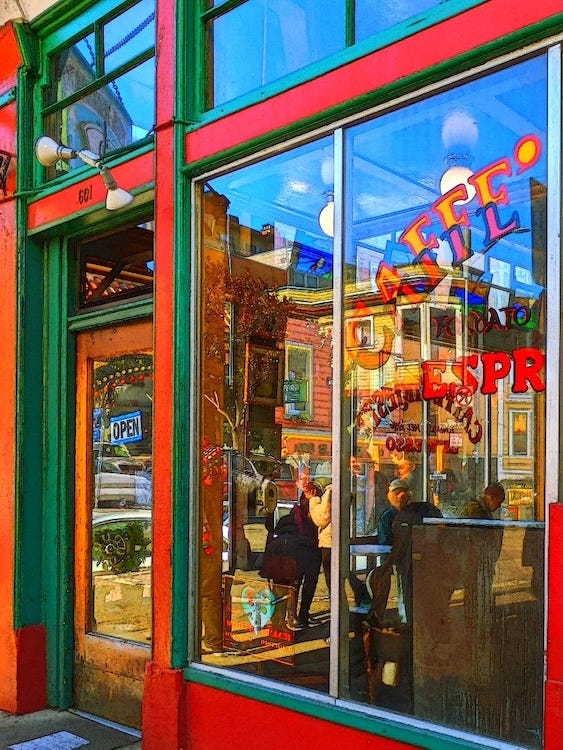
Shay and Beth agreed to meet at The Caffe Trieste, an Italian place on the corner of Grant and Vallejo Streets that had gotten a little fame a decade ago. It had been a locally notorious beatnik hangout, and even now some of the men customers, slouching toward middle age, still wore sullen black, appearing always darkly engaged in intellectual mysteriousness. They had greying beards. They appeared mournful, even as they read books or doodled with their own manuscripts, which some of them did for seeming hours while nursing a single cappuccino. Beth saw a few berets here and there, a nod, she knew, to Paris, a capitol she had visited with her parents as a twelve-year-old. She recalled how the Frenchmen who wore berets had all been working for a living…behind counters in cafes, driving trucks, refurbishing vegetable stalls in open-air street markets, moving furniture. In The Trieste, the berets seemed to be thought of as a mark of poetic insistence, as though it was not available to the average San Francisco schmuck. The beret added self-regard and knowing sophistication to their mutterings about this new Vietnam thing, wherever that place was. The beret was also a self-congratulatory companion to the beatniks’ scribblings and their now-and-then disavowal, contained in actual bothered mutterings, of everyone else in the cafe.
As young college students, Beth and Shay stood out in The Trieste. They were studied by a few of the regulars with disapproving silence before turning back to their Allen Ginsburg book, their Lawrence Ferlinghetti book, their Gregory Corso book, or their own slashed at, much revised, angering and sworn-at manuscripts. Shay himself enjoyed the place. It added to his youthful sophistication because it mirrored a few of the places he had gone to in Greenwich Village. But he and Beth were so young and so obviously college students that they were ignored at The Trieste. New York or not, Berkeley or not, they were just college kids.
Until the afternoon they made love.
—
Shay’s mother had flown to Los Angeles to meet her husband, who was away for the week on business, for a weekend just by themselves. Beth’s parents were in Carmel at a wedding, and Shay and Beth had met each other for another afternoon walk, this time along the broad sidewalk above Ocean Beach. The tide was out and Beth explained to Shay how the tides so fascinated her, the way they shifted with such silent inexorability. “Even the ocean just comes and goes,” she said as, hand in hand, they walked down the sidewalk. “All of it invisible.”
“Gravity,” Shay said.
“Sure. But there’s got to be more than just gravity. The water comes in, caresses the beach, and goes back out…so silently. It touches the beach…so gracefully.” She sighed. “Don’t you think the tide just might want to come and go?”
Shay had not once in his life considered such an idea.
“For a kiss?” she said, smiling. But as she continued looking out to sea, he watched her and realized how much she cared for what she was seeing. Shay had read enough in the novels he liked about emotions like longing and wishfulness, so that even at nineteen, he valued what such feelings were. Few of his high school friends had ever talked with him of such things, although he sensed that the girls did so talk, at least with each other. Guys didn’t at all. But just now, as she looked out into the distance, Shay realized how much he cared for Beth. They were just nineteen. But he smiled as he recalled how Romeo and Juliet had been even younger than that, and if they could fall in love, why couldn’t he and Beth? He suspected he already had.
He took her hand and, as she continued looking…maybe even beyond this ocean…Shay realized he did love her. His sentiment. His wish to embrace her here and now on Ocean Beach. Beth glanced at their joined fingers. So…he did embrace her, and the two fell into a long kiss. A brief, finessed impulse seemed to take Beth, and she put her arms around Shay’s neck and held to him a long moment.
“Shay,” she whispered. “Please.”
They lay together in his bed a few hours later. Both had been so excited, neither being very sure of what to do, how to proceed. But they had proceeded, and Shay knew that what was happening was to remain very secret, something just their own. He was scared, and felt that Beth maybe was, too, although she lay in his arms as though she simply knew what had happened between them and had wished for it. She had given him soft, loving instruction in how to touch her, such good instruction that, with his fingers and her own, she had lost herself in a way Shay had not expected and, at least for a few moments, had not understood. Beth explained what had happened, how it was that she herself was able to do such a thing for herself, only without this new moment in which they had finally, truly found each other. Despite the initial pain that that had caused her, Beth had held to him closely.
“My mother told me that would happen.” Lying still, a bit exhausted, she had caressed Shay’s forehead with two fingers of her right hand, studying the caress and then his eyes. “Don’t worry, Shay. It was fun.”
—
The romance continued, although they were unable to do again what they had now done just once. Holding hands, kissing, sharing stories, laughter, and affection were enough for the next several weeks. They cared for each other.
He got a phone call from Beth, though, one morning, that right away had a tone of possible menace and worry. “Will you meet me this afternoon?”
“Of course,” he said. “Where?”
Beth named a lookout on The Lands End Trail. It was a favorite of theirs, from which they could see the Golden Gate Bridge to the west, the Point Bonita Lighthouse across the way, and the rough Pacific waters below the trail. He had sensed concern in her voice and had asked her about it.
“I’ll tell you when we see each other.”
Shay fretted for the few hours between the phone conversation and their meeting. He wondered if, for some reason, Beth was about to break up with him, that she was feeling constricted. When they met, she hugged him, even as he could see she was in deep worry about something, about this very meeting maybe.
“Shay, I….” Beth lowered her head as she stepped away from his embrace. He saw that she was falling into tears. He took her hand and waited. They were going to break up. Yes, Beth wanted to. The silence was interrupted here and there by an intake of breath by Beth. She put a hand to her mouth. “I missed my period.”
Shay remained silent and continued holding her other hand. He did not need more information. He knew all he needed to know, and for just a moment he considered leaving the responsibility for it in Beth’s hands alone. She was pregnant, so the responsibility was hers. His thoughts swirled with this, knowing really that he was moving in a hurried line toward cowardice. He was himself just afraid. The couple stood in silence, Beth’s hand still in his for a long moment, until Beth looked up at Shay. “Are you going to say anything?”
She was terrified. Her hair was disheveled, as though she had been running her fingers through it back and forth, even with rough self-punishment. Her lips appeared swollen, and Shay knew…could see how much she was blaming herself. He immediately felt like a fool, a kid who plain doesn’t know what he’s doing. He had known what he was doing but had been so excited and so wishing for Beth that he hadn’t really thought about what could happen.
Dumb stupidity.
Beth’s worry was as clear to Shay as it was to Beth and, as his previous idea of leaving the thing in her hands evaporated, he moved a step toward her and took her into his arms. “Come on,” he said.
They walked on the trail toward the bridge, talking.
“Beth, do your parents know?”
“Of course not.”
“And it’s because of me.”
“Of course!”
“And you’re sure.”
“Shay!”
As they walked, Beth looked down at the fractious sea. The trail is many feet up the cliff bordering the bay’s entrance. On a day like this, when the overcast is thick grey and even sullen seeming, the sea below has a kind of dull violence. Bright sunlight and clear air make it appear festive. Instead, on a day weighed down by cloud cover, the ocean attacks the cliffs and pulls away from them, to attack once again and again, as though there is simple inexorability in its wishes. There is strength in them. There is intention. But they roar as though their movement has little clarity in it, little real interest in what is being asked of it by the tide or the weather. Beth was terrified.
She sat up that night in bed, the book she was reading opened, pages down, next to her. She was crying. Shay had held her in a long embrace. He had told her he loved her, and she now thought about the complications that her own body was giving her. She didn’t much enjoy the blood that came from her every month, even as she knew that it was an indication of the possible complication, joy, distress, and love that she could experience someday. But this…now…. How was she going to tell her parents? Her father might not be so angry with her. Her father…Beth cared for him deeply. He’d be upset, for sure. But he would want to talk with her. Who Beth worried about was her mother who, sometimes disapproving of Beth in general and not nearly as joyful and fun as Beth knew herself to be…. Her mother would be furious.
Beth knew about the problems that girls can have with their mothers because a number of her friends had those problems. Sometimes, of course, it was the girls who could be snide toward their mothers. But other times it seemed the other way around. Some moms expected their daughters to simply toe Mom’s line, no matter what it was. Beth had one friend, Meg, whose mother seemed to think there was but one way for a proper girl to be, which was “proper”. Beth and Meg both understood the definition of that word. But Meg’s mother seemed to think of it the way people had thought of it a long, long time ago. Her idea of “proper” was way stodgy and she often badgered her daughter Meg for being “too showy”. Beth knew that Meg was in no way a show-off or promiscuous. She was smart and a lot of fun. Meg told Beth that her mother was just old fashioned, especially here in San Francisco in the 1960s where there was so much going on that someone like her mom could never hope to understand. So, whenever Beth would go over to Meg’s house for a visit, she could expect Meg’s mother to be somehow miffed by the visit, in ways Beth could never figure out. Meg herself would shrug and be nice to Beth…. She always was.
Beth knew well…now…that she would never say anything to Meg’s mother about what was happening inside her. She wouldn’t even tell Meg herself, until…well….
But Beth had to tell her parents, and she did not know how to do that. Her tears came from her anger with herself, how foolish she had been not to be more careful. She put her hand on the book, to take it back up. But then she pushed it away. Beth knew that she was not unique in making love with her boyfriend. In Berkeley, she suspected more girls did so than not. But this…. A baby! She closed the book, turned off the light, turned over on to her side, her head resting on her folded arm, and wept.
They argued. Each blamed the other, even when Shay blamed Shay and Beth blamed Beth. Neither could put aside the guilt. Shay did say to Beth that he should have been more careful, and Beth told him it was all his fault. He said that that wasn’t true, and she apologized for saying what she had said, and so did he. They made up…and soon returned to arguing.
“How can I go back to school?” Beth asked him. “Walking around with a baby in me.” She wept. “You don’t understand anything!”
“Beth, I—”
“You’re not carrying some little kid around in you. How could you understand?”
I—”
“It’s your fault.”
“But—”
“Yours!”
Shay walked her home. It was his fault. He knew it. Beth knew it. His!
“Even though I should’ve…should….” Approaching her house, she moaned and let out a long, self-condemning sigh.
“Yeah, you should’ve.”
“Shay!”
Shay looked to the side, embarrassed and furious with himself. “I’m sorry, Beth. I—”
“Shay!”
That night, Shay, lying in bed, knew he would have to marry Beth. The sheets and blankets were insubstantial protection against this worry, no longer the warm providers of simple sleep. He looked around his room, which was only partially lit by the table lamp by his bed. He had gotten into bed a few hours before, and sleep had been no option. Shay’s responsibilities whirled about him like noise-ridden retribution. They were only nineteen…but so be it. Abortion? Not allowed. 1963? Here in California? President Kennedy? As far as Shay knew, not anywhere! Catholics, his parents wouldn’t allow it. Nobody would.
Beth and Shay both had had plans, Beth herself wanting to teach English and Shay, in New York City, smitten with the idea of acting. But now, with this, he saw the two of them stuck with darling little Jimmy or sweet tiny Cindy in Beth’s arms, suckling her and laughing at Shay.
He didn’t know how he would explain it to his divorced parents. His father, so recently congratulatory of Shay’s New York manner, would be upset with him and this foolishness. His mother, who now lived with a man whom Shay liked but did not know very well, would surely be angry with him. Shay’s whole future was now obstructed and confusing before him, and he felt like an idiot even thinking about that when Beth was the one carrying their little baby. He was just the carrier of the wetness that had joined hers in a moment of blind swimming, wetness that would result in a complete human being held by teenage parents. Shay swallowed, looked to the side, and offered a snide, profane swear word aimed at himself. He swallowed again, looking toward the lamp. He wondered if any of its light would ever reach him. Would there be light for him and Beth? Would light ever be possible again?
They met twice in the next week. There was little exchange. The conversation avoided the facts. None of the conversation was happy, none an exchange of pleasantry. Worry invaded everything between them.
—
They met nonetheless again, after another week. Shay had tried to prepare himself for the guilt that now besieged him. They had to make a decision, he knew. They had to do something.
“I woke up this morning, Shay.”
“So did I.” He actually smiled, surprised by Beth’s mention of so plain a moment. “I usually do.”
“Me, too.” Beth looked to the side and then stopped, took his right hand into her left and brought to her lips. “I was bleeding.” She kissed his hand.
Shay remained quiet. The word…”bleeding”…one that he had always equated with wounds or accidents with knives, with unintended, quick pain.
“I’m okay,” Beth said.
“You…. You mean—”
“Amenorrhoea, my mom calls it.”
“What’s that?”
“When you miss your period. When it…when it comes late.”
“Late.”
“She laughed when I told her. She said it had happened once or twice to her, too.” Beth smiled, swallowing as though some rough, unlikeable bother was being removed from her throat. “And she asked me if you and I had…did we—”
“She did?”
“Yes.” Beth did smile, although the smile itself appeared with what seemed like a touch of personal amazement.
“And what did you—?”
“I said, ‘Yes.’”
“Oh.” Shay looked to the side. ”Jesus.”
“I did.”
“And what did she say?”
“At first, nothing.” Beth offered a sideways nod. “At first.”
“But then what?”
“For a long time, nothing. And then she asked me, was I using protection?.”
“She did?”
“And I said yes.”
“You did?”
“Yes, and that’s true, isn’t it? When we do it again, what we did that time.”
“We will?” Shay scratched his head. “Again?” He felt like a desirous bumpkin.
“Yes.”
Copyright ©2026 Terence Clarke. All rights reserved.
“Terence Clarke: Recovering The Arts” columns are free of charge. Subscribe to them here. Or, if you wish, you can help us financially with a paid subscription at $5.00 per month or $50.00 per year. That, too, can be done here. It’s your call.
We will not share information about your subscription with anyone.
Comments
Nothing yet. Say the first thing.
Sign in to join the conversation.