
Although she had been born and raised in San Francisco, Beth Cronin felt that, really, she was as Irish as Paddy’s pig.
She had been a rock ‘n roller in the 1990s, enjoying her drugs and her boyfriends, and had married one of them, a wannabe musician named Digger Cronin, with whom she then had had two children. Both kids had been remarkably successful in school because of Beth’s own regard for herself and her ability for nurture. Digger, having reverted to his real name John and eventually becoming a distinguished attorney, had had a delusional affair with Beth’s friend Natalia and had run away with her to a remarkably unhappy second marriage.
After Natalia had rid herself of John, she had asked Beth for forgiveness, and Beth had actually thanked her.
By then she was thirty-five, on her own, and had decided that in fact she was an Irish girl. She looked upon her own two children as though they were the very cream of County Galway, from where her great-grandfather Neill Agnew had come, as well as his wife, a distant cousin of Neill’s named Emily Fortune. They had arrived in San Francisco long ago and had had one son, who had founded a tugboat company. Beth’s beloved grandfather.
Beth decided one day to go to Ireland.
“What are you doin’ here then?” the cabbie at the Shannon airport asked her.
“Finding myself.”
He offered a pause that went on for at least a half mile before looking over his left shoulder toward Beth. “You’ll forgive me, Miss. But I been here all me life, lookin’ for the same thing, like.”
“How’s it gone?”
“So far….” He addressed the steering wheel. “Okay.”
“You think so?”
“Well, if you don’t mind condemning yourself now and then, I’d have to say yes.”
“Condemnation!”
“Ah, no.” His gaze through the windscreen remained steady. He was a careful driver, something Beth appreciated as he, she, and the taxi made the sixty-mile journey up the M18 to Galway. “The fact of it is I haven’t spent a lot of time doin’ that to myself.”
“How so?”
“There’s so much else. If you were to live out here long enough, you’d get it.”
“How so?”
“We condemn the weather, right enough. We shout at the rain. We let it know loudly when it’s soakin’ us.” He nodded. “Those kinds of things. But rakin’ ourselves over the coals?”
“The rain? How—”
“It falls on us, Miss. That’s all. Nothin’ like that’s ever happened to you?”
“Well…my marriage.”
A long pause ensued, interrupted by one glance and a soft smile from the driver.
“May I ask your name?” Beth said.
“Lannie Doyle. And yours?””
“And you were born out here?”
“On the very day of me emergence.”
Beth laughed. “So I guessed.”
He drove on for a moment. “What was your name?”
“Beth.”
“And you have a family name, I suppose.”
“Cronin.”
Lannie ran a hand through his hair, shaking his head. “They came from Munster, eh?”
“Who?”
“Those other Cronins. The ones who preceded ya.”
Beth remained silent.
“That’s not such a famous name in Galway. You’ll see. It’s as Munster as you can get.”
“I…I do know that, Lannie. But it doesn’t matter.”
“And do you think you’re Irish?”
“I do.”
“I figured that. I think there are far more people on that continent o’ yours who claim they’re Irish than there’ve ever been on this island.”
Beth laughed. “Why do you ask?”
“Sure you’re not the first such Yank I’ve met who’s ever actually claimed such a thing. Bein’ actual Irish, I mean.” He laughed. “Comes as a surprise because, you know, you all sound so American…” Lannie looked over his shoulder at Beth. A large grin tumbled from his face. “…with that funny accent o’ yours.”
The following day, Beth stood on the front porch of Flannery’s Hotel on Old Dublin Road. Rain surged from the entirety of the grey, fumbling sky. She was an unusually fine-looking woman, evinced by the occasional glances, one after the other, that Lannie had offered his rear-view mirror. Beth had decided in San Francisco that she would wear nothing green in Ireland, feeling that such a preference identifies anyone walking around in that garb as an American tourist. So, she reverted to her preferences for the many colors in her garden. She spent an hour or so every day out there, some tool or another in hand, savoring her effort to allow light to break through, to feed the garden’s wish to flourish. And it did, so much so that she was now congratulated by all her Russian Hill neighbors for being such a pro. The orange, breeze-softened flames of “Beth’s poppies”, as they were known, the superb yellow laughter of “Beth’s daisies,” of course the ever-deepening reds—from soft and dark to profound, to white and blue —of her many roses, along with the hues of her formidable carnations…and no lawn.
Lawn bored Beth.
She hoped she added something to her garden beyond just her hands and the plunge of them into the dirt or her great love of pruning. She hoped she herself shared her garden’s actual beauty. Not just frivolous looks. But that which comes to someone who understands what she is viewing…and doing…and providing.
The fellow at Flannery’s front desk had offered her a fine umbrella, an apology for the weather, a nice smile, a compliment for “your well-advised rain gear, Miss,” and a folded note. “He came in with it just this morning.”
“Who?”
“Lannie.”
Beth fingered the note, surveying it a moment without opening it. When she looked up at the hotel clerk, he offered a commiserative smile. “A fine one, that fella.”
The note was short.
Dear Beth, I enjoyed our conversation yesterday and hope you’ll let me drive you around Galway today. No fare…none of that. I’m upstanding. I am in no way harmful. I guarantee a pleasant journey. Lannie. PS: I’ll be along at 10 AM and hope to find you.
Folding the note, she recalled having asked Lannie during their drive to Galway what his own life was like.
“Well, a Roman Catholic. Baptized and all that. Altar boy at Our Lady Assumed into Heaven and Saint Nicholas. St. Joseph’s Patrician for secondary school. University of Galway. Bachelor of Arts in English.”
“Fully educated, then.”
“Sure, Beth, like a lot of us in Galway.”
“But, Lannie… . Uh, Lannie….”
“I know what’s comin’.”
“What?”
“’Why are you drivin’ a cab, Lannie?’”
“Yes. That is the question,” Beth said.
“Because of my education. If you want a profession that’ll take everything out of you in return for no money at all, write novels.”
“You write novels?”
“I do, and not ashamed to admit it.”
“I wouldn’t be either.”
Lannie glanced at her. “You write, Beth?’
“I don’t. But I read.”
“Well, then, let’s…. Let’s talk about that. Who do you like?”
“James Joyce,” Beth said. “Sometimes.”
A very long silence ensued. Beth felt she was being disbelieved, that Lannie would say she was just bragging or trying to put one over on him. Finally, he gathered himself, as though a lengthy, much-considered response had settled upon its own outcome. “Can’t understand a word he says.” Lannie took in a sad-seeming breath, a kind of admission of a lost wish. “Although there is his Dubliners, of course.”
“That’s the one I mean. Loved it.”
“Yeh. Good, isn’t it?” Lannie’s funk seemed nonetheless to continue. “’Araby,’ eh? And there’s ‘The Dead.’” He pondered the road ahead of him. “You know, he wrote ‘the snow was general all over Ireland.’ So plain-spoken that phrase, and so true to what he wanted the story to say.” The road sped beneath them, disappearing as they surged up it. “I’ve thought a lot about Joyce. I think it was the drink that got to him. And maybe he lost his marbles, which the drink will also do to ya.”
“You mean—”
“Most of Ulysses, except Molly at the end, of course. All of Finnegans Wake.” Lannie waved a hand before his forehead, shaking it. “From the old song, you know.“ Lannie ventured into a thin tenor delivery. ’To help him on with his work each day/Had a drop o’ the cray-chure every morn’.” Lannie sighed, shaking his head. “Although otherwise I didn’t get a feckin’ word of Finnegans Wake.” He took hold of the steering wheel with both hands. “Excuse me, Beth. That kind of coarse language. I…I don’t usually—”
“Don’t worry, Lannie. About that book, I agree.”
Beth saw a broad grin in the rearview mirror. “Attagirl.” Lannie put a bit more speed into the car.
“But, Lannie. What about you?”
“Me!”
“Yes. Who do you like?”
“I’ve had it out with myself about that for many years.”
“About what?”
“My favorite writer.”
“Irish, I’ll bet,” Beth said.
Lannie shook his head back and forth, as though in slow self-examination. His thoughtfulness turned from an examination of the road ahead to some sort of contemplation of a difficult mystery, a long-examined dispute between understandings…. “Jane Austen.”
“You’re kidding.”
“And why would I kid about someone like her?”
Beth had meant her reaction to be one that asked for a commiserative smile. But Lannie seemed offended. “Protestant, wasn’t she?” he said. “A Brit if there ever was one. Sendin’ her cousins off to conquer the colored races. Read her books, Beth. It’s all there.” Looking toward Lannie, Beth saw the remains of his tightened lips. “But I’ll wager you have read her books, eh?” She noted the appearance of a smile and Lannie’s right hand reaching for his head, to push his hair about. Wonder. Even graciousness. The hand, she noted, was lovely. “Sure no one writes as well as she does.”
“I just thought you’d be ready to give me a lesson on who I should read now,” Beth said. “On who the real Irish writers are now.”
“I see. I get it.”
“Is that insulting?”
“No, no, Beth. Please. I don’t—” The taxi progressed a quarter mile further before Lannie ventured a further reply. “You think I’ve got that right…about Jane Austen?”’
“I do.”
“As God is in heaven…of course, even as we….” He leaned forward to look up the road.
Beth waited for the rest.
“Even as we can’t be too sure about God even bein’ up there.”
On the following day as she stood on the hotel’s porch, Lannie arrived with a toot of the horn at exactly 10 AM. He was driving a red Mini Cooper.
“1981,” he said as Beth, laughing and looking about her, seated herself next to him. “I’m proud of it.”
Beth looked into the rear seat, admiring its new-seeming red leather. “You should be. It’s in beautiful condition. And you say it’s forty years old?”
“I do.”
“A little older than me.”
“Ah, but you’re better lookin’.”
Beth sat quietly a moment. This last remark of Lannie’s seemed so cavalier, so insincere, that she wondered whether she had better get out of the Mini before they got under way.
“Excuse me. Uh….” Lannie’s mouth tightened, his lips seeming to negate what had just passed from them. Because she now was sitting next to him, Beth noted with some pleasure that he was a sweet looking man, not just some rough Mick cabbie. “That was forward.” His lips formed the words with considerable finesse.
She took her hand from the door handle and sat back.
“I’m just excited, Beth. I didn’t mean to be so…so…nervy.”
Beth nodded her head to the side…a furtive smile. “I forgive you, Lannie.”
Having thus settled themselves, they took off.
It took some minutes to clear the outskirts of Galway City, and the road they followed was eventually two-laned, narrow, and bordered on both sides by fields of such deep vernal pleasantry that Beth realized she had never in her life seen such green.
“We’re famous for it, of course,” Lannie said.
That Ireland is green is a cliché of notable accuracy. Beth could barely speak as she watched it pass by, as she looked into the distance at the hills covered by it, the nuances of it…dark, fine, piecemeal, of profound emotion, lovely here and gone…the fields of sheep grazing from it, and the many trees in full leaf or needle, the walled fields everywhere. Lannie explained to her how there had been only trees out here a long time ago, but that the Brits had come along and cut them all down. “Their industrialization, see….” Beth had noticed how little industrialization there is in Ireland and mentioned it to Lannie. He responded with a brief lecture on the north of Ireland—“If you want a sorry treat, go up to Belfast.”— the Brits, the great factories and shipbuilding of the last few centuries up there, the need for firewood to make that coal and fuel those factories. “Down here, trees were everywhere.”
“And they obliterated them?”
“Sure didn’t they? And these fields, almost all of them owned by the English and cleared of those trees also so that they could raise their sheep and plant their crops and keep the rest of us in rags.”
“Lannie.”
“Bare toes, dirt floors, huts, and downpours.”
Beth looked out the car window at the countryside, one of the most beautiful she had ever seen. Surely there was nothing like this anywhere in California…or anywhere.
“You wouldn’t think wholesale destruction would be so charming, would you?”
“Oh….”
“But it’s because of us Micks that it still is.” Lannie himself looked out the windscreen, clear pleasantry streaming from him. “And there’s the truth.”
Beth remained silent, surveying the view and feeling the loveliness of it as the Mini passed through, mile after mile.
“Have you published anything, Lannie?”
“I have.”
“Tell me about it…or them….”
“Them. But the most recent is my favorite.”
“What’s it about?”
“The Civil War.”
Beth brought a hand to her chin. “Not ours….”
“No! Ours!” Lannie himself fell into a dark self-examination, sighing as he surveyed the road before them. ”Yours was the real deal, wasn’t it? While Ireland’s was just bollocks.” He grumbled. “We were all I.R.A. in 1920, all the Doyles on my side.”
“And?”
“Well, we lost…and we lost one Doyle.”
“No.”
He shook his head, sighing once more. “Yeh. My great-great-grandfather Bob Doyle.”
Beth sat back and examined her hands, which were folded on her lap. The countryside remained beyond lovely while her thoughts darkened with commiserative sadness.
“The Four Courts, in Dublin. June, 1922. He was killed in an artillery barrage.”
“By?”
“The national army, who else? The Irish army! Michael Collins’s crew, just a couple months before they got Collins himself.”
“Yes, I’ve read about him.”
“So have I, Beth. So have I. Chapter and verse. And I hate admittin’ to the fact that he was a great man.”
“You think so?”
“Of course! We all should have been on each other’s side.” Lannie turned toward Beth and she recognized in him a passage of sorrow. “All of us. Bob Doyle. Mick Collins. Me.”
“But you…. You weren’t even born. You couldn’t—”
“No. But there is memory, you know. And history. And those I do have.”
They drove on without conversation for fifteen minutes. Beth was worried that too much information had sprung from Lannie, information that made more conversation uncomfortable for him. She wanted to break through but wasn’t sure how to do so without incurring even more troublesome memories for him. She had known him now for less than one day, yet found him attractive, simply because of the way that, despite this current silence, he otherwise seemed capable of fine talk, of humorous talk, and maybe even of intimate talk…although Beth was hesitant about any intimacy that could come along. Way too soon, she thought. Grow up, Beth!
For the next five days, Lannie escorted Beth around parts of Counties Galway and Clare. “I’m takin’ a little holiday, Beth.” He took her to the cliffs of Moher, which astonished Beth. “A lot of people think they’re a cliché, these cliffs. Every Yank wants to see ‘em and walk along ‘em.” They were observing the cliffs from a wide spot in the road. For Beth, they were the essence of pre-history, fantastic obstructions to the sea itself, beautiful monsters.
“But if that’s what they are, I’ll take that cliché,” Lannie said.
They spent a morning on The Sky Road, aptly named with a sprawl of huge white clouds overhead.
It was raining the next day, so Lannie took Beth to Kylemore Abbey. It reminded her a little of Walt Disney, but she enjoyed it anyway.
In Galway City, he took her to Garavan’s for a pint, and then for another to The Crane.
Beth’s personal favorite of all these visits was that to the island of Inishbofin and its fine views of the Galway coast. From here, the sea was everywhere, its gigantic urgings almost frightening to Beth. “Inishbofin. It means ‘White Cow Island,’” Lannie explained. “Couldn’t tell ya why.”
And on the final day, Lannie suggested what he said was his favorite place of all. “We’re going into County Clare again this morning,” he said as Beth got into the Mini. “What do you know about it?”
“Not much, although friends of mine have told me about The Burren.”
“That’s right. That’s where we’re goin’.”
“We are?”
“Everything in Clare is worth seein’, Beth, but you’ll not have seen anything like what we’re about to.” Lannie’s demeanor was now back to its former liveliness. His voice continued the humorous certainty it had demonstrated the moment he had driven her from the Shannon Airport. “What do you know about the monks?”
“The monks?”
“Yeh. You know, those men out here in the west protecting the manuscripts and such from The Huns. You know, The Middle Ages.” He shook his head, as though with wit-filled despondence. “Or simply prayin’ out here, on their knees in the cold rain, shiverin’ and worried about whether they’d been betrayed at the very edge of God’s own earth.”
Beth looked out to her right, where The Atlantic Ocean was once again making its presence felt. The weather by now was turning fine, so that The Atlantic was blue beneath swirling white clouds, surging about itself like a heavy-breathing, celestial, endless monster.
“They thought the land stopped right here in County Clare and that no one is his right mind would make any effort to find out what was out there off the coast. Because, Beth, you know….” Lannie pointed to the ocean, gesturing across it. “Out there, it was sin itself, as far as they knew.” He nodded. “Fish? The Deep? Nah, it was none o’ that. It was pure unknown fate.”
Beth took in a breath. Even now, knowing what The Atlantic truly is, she swallowed, imagining the fear those monks must have felt.
“Chaos,” Lannie said.
“Why were they out here, the monks?”
“Because they needed the grace that God would give them simply for bein’ here, protecting Him, so to speak. So that they could ascend to heaven.”
“From here? The Burren?”
“That’s right. You know, from what Oliver Cromwell called it…. It was a famous phrase o’ his, like…‘a savage land, yielding neither enough to drown a man, nor tree to hang him, nor soil enough to bury.’” Lannie waved a hand before his face, laughing. “Good phrase, eh?”
“Terrific!”
“But a bad man.” He turned his head toward Beth. “Don’t say anything to anyone in Galway City about your appreciation of Oliver Cromwell. Or of his predecessor Thomas.” He grinned, a moment of forced hilarity. “They’ll take your head.”
Beth laughed.
“No, of course they won’t, Beth. But if they could sneak up on ya, you’d think they’d like to.”
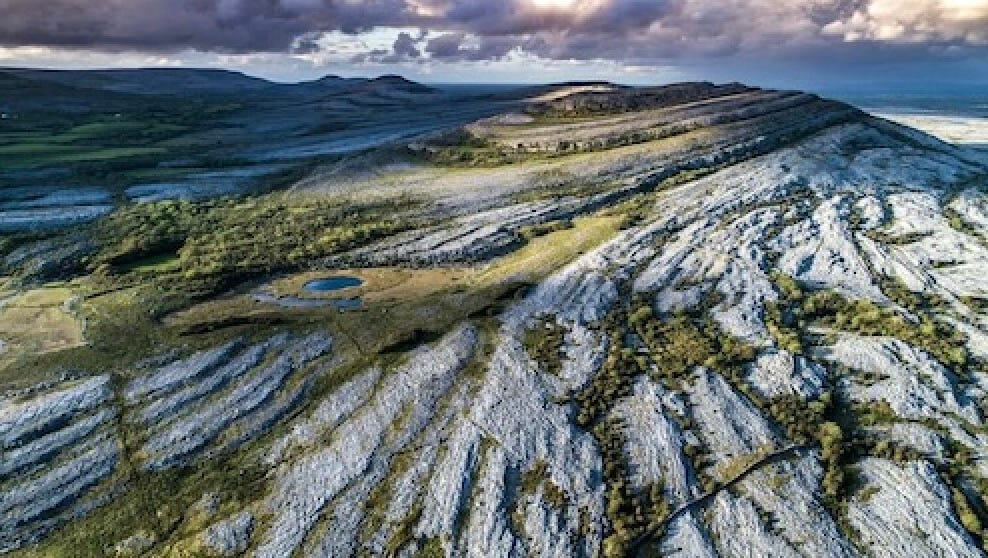
Parking by the side of the road, the two found a rough, narrow pathway leading toward some hills, up which Lannie led Beth. The path wandered through what seemed an endless, rubbly field of limestone rocks of every shape and size, miles of them, as plain-spoken a passage as could be imagined…except for the flowers. Millions of them growing from between the stones, offering, Beth thought, soft laughter as they wavered, laughing, in the occasional winds that blew over them. She noticed how Lannie walked. He was dressed better today than he had been yesterday, even wearing a single-button dark blue sport coat over a white shirt and black slacks. His walking shoes were far more rough…un-shined, high-topped, scuffed, even battered. Amused, Beth was nonetheless grateful that he had advised her at the hotel to bring along some walking shoes of her own, “’Cause I’m takin’ you to the end of the planet.” Just now he also was carrying a small backpack. “Sandwiches. Tea. You won’t find a café out here, Beth.”
“I guess not!” she said, her eyes celebrating the flowers.
After twenty minutes or so, they entered a wood and soon arrived in a small cul-de-sac, shaded by trees, on one side of which was a rough, fallen granite wall covered with bright green scum and leafiness. Light fell through the trees across Beth and Lannie as though it were seeking its own enjoyment. A small stream appeared from some rocks, tumbling down them, clear water reflecting the wavering sunlight. Lannie pointed out how these wall stones had clearly been hewn in order to fit together. A few hundred of them, some still placed together as the ruins of a hut.
“Mac Duagh’s Bed,” Lannie said.
“Who was it?”
“Colman Mac Duagh. He’s a saint. Lived out here for many years, praying, searching for his soul.”
“Did he find it?”
Lannie studied the structure. “You’d have to ask him.”
“When was he here?”
“Seventh century.” Lannie nodded toward the structure that was still standing. “There were many of ’em out here, Beth. Many. All of ‘em searchin’.”
She remained silent, trying to contemplate what such an existence must have been like. The weather alone would have convinced you that you’d been condemned to this place to rot, rather than allowed to set up here in order to contemplate the face of God.
“Were they all saved?”
“Ask them.” Lannie gestured toward the falling stream. “But that’s the finest water in all of Ireland right there.” He removed the backpack and took a plastic glass from it. “Try it.”
Beth knelt and marveled as, even here, even into this small cup, the water seemed to reflect light itself from its own clarity. She brought the cup to her mouth. The water, so cold, was entirely pure.
“You see?” Lannie said.
Beth leaned forward to take up more.
“I’ve often thought…” Lannie knelt down with his own cup and reached out to fill it. His shoulder brushed Beth’s. “…that Mac Duagh might have concluded he’d found his heaven right here. You can’t beat water like this, can you?”
She did not move. She had enjoyed the light touch of his sport coat’s sleeve.
“But I wouldn’t live out here for all the tea in China.” Lannie laughed, sipping from his cup. “At least not in the seventh century.” Beth fell into silence, sipping from her cup once more. “No heat. No TV. No internet,” Lannie said.
The two remained quiet.
Beth sighed. “I’m not much of a Catholic, Lannie. But would you mind if I said a little prayer to Father Mac Duagh?”
“You won’t mind if I don’t join you?”
“Of course not.”
“That sort of thing is beyond me.”
“How so?”
“Ever since my mother had me and they put her into one of the laundries.”
“You mean, the Magdalene Sisters?”
“Yeah, those hoors. You know about them?”
“Oh, Lannie…. Your mother—”
“Out of wedlock, that’s right.”
“Your father?”
Lannie lowered his head. “You’ve got me there. I was adopted.”
“And those parents?”
“As loving as they could be. Fine Catholics, even as they welcomed my real mother. They’d let her come visit me. Caught the fury of the priests for it, but did it anyway”
“And how do you feel now?”
“Loved, Beth. Loved by all three of ‘em. All three still alive.”
He looked down. His high forehead, so Irish, so filled, Beth thought, with thoughts and fine humor, with all his history and fine blather, his Civil War, with kindness, his contemplative eyes, his hands on the wheel of his Mini, his rough, even bitter contemplations.
“Beth, I have a question.” Lannie stood up and took a few steps away. He replaced his cup in the bag and put his hands in his pockets. Beth, as before, was amused by his seeming shyness. “Somethin’ I’ve been meaning to ask you.” He pushed a few stones aside with the toe of his left boot. “Especially this morning.”
There was a silence, interrupted only by the soft burble of the water.
“Would you consider stayin’ with me a while?”
“In Galway?”
“Where else?”
“Well…. Lannie!”
His eyes fell to despondency, as though Beth’s effort to answer Lannie had been so worrisome that the only thing he could come up with now was a silent sigh. Beth moved to refuse him. But as she watched Lannie’s eyes, she fell into more truthful self-searching and a consideration of what she really wished to say.
“Can you imagine it?” His eyes sought hers…and found them. “Beth and Lannie!”
She thought about it again…what she really wished to say.
“Will you, Beth?”
Copyright © 2026 Terence Clarke. All rights reserved.
Note: No Plagiarism Software, also known as Artificial Intelligence, was used in the composition of this story.
“Terence Clarke: Recovering The Arts” columns are free of charge. Subscribe to them here. Or, if you wish, you can help us financially with a paid subscription at $5.00 per month or $50.00 per year. That, too, can be done here. It’s your call.
We will not share information about your subscription with anyone.
Comments
Nothing yet. Say the first thing.
Sign in to join the conversation.