
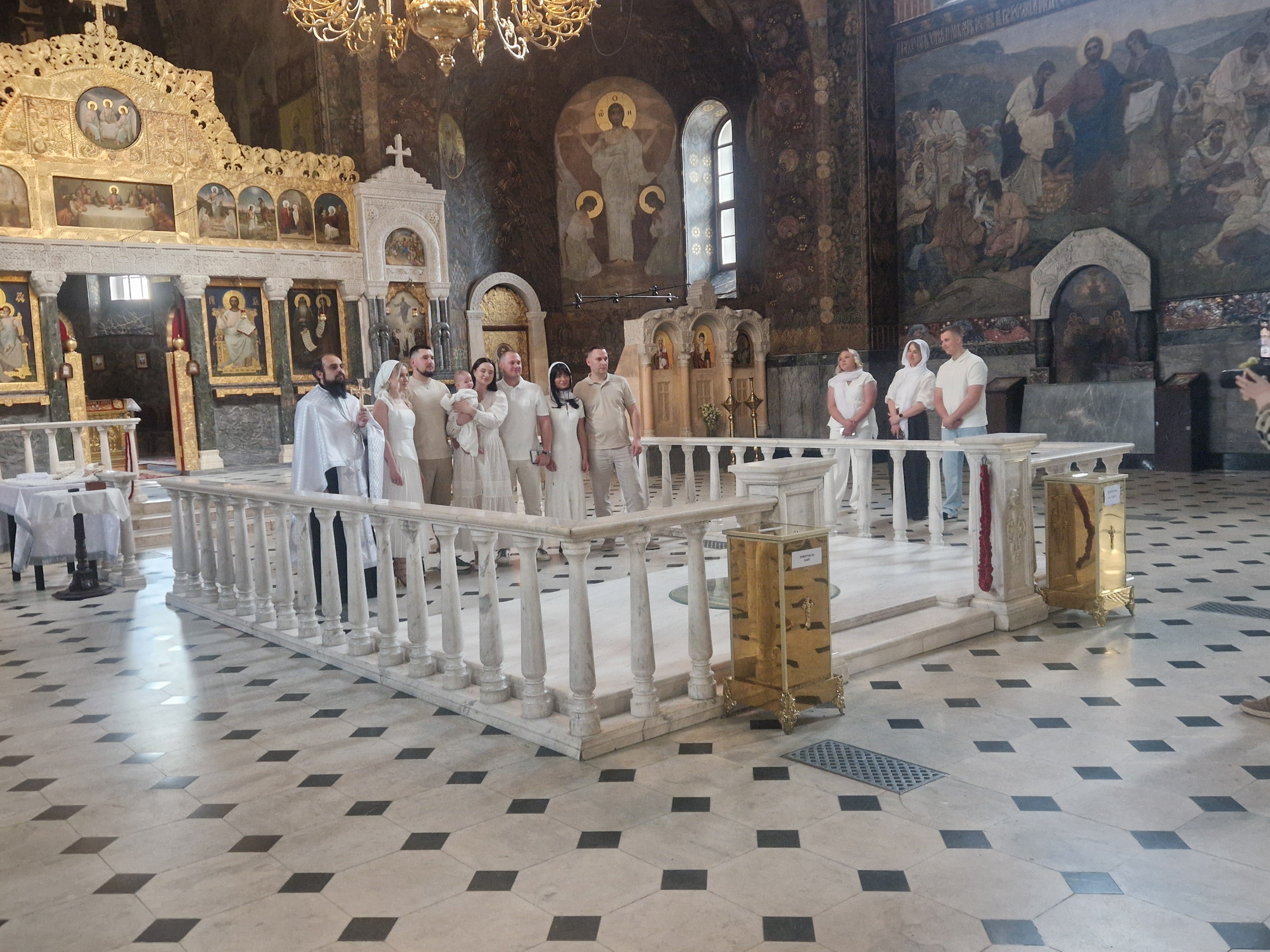
A baptismal ceremony at the Cathedral of the Dormition, Kyiv-Pechersk Lavra monastery, Kyiv, Ukraine, May 10, 2025. Photo: Nicolas Tenzer
Last week’s protests calling for General Syrsky’s dismissal and the reinstatement of Mykhailo Fedorov as defense minister came as little surprise. Not only were they a continuation of the previous year’s protests following the government’s attempt to curtail the investigative powers and independence of anti-corruption bodies—President Zelenskyy had abandoned that reform the very next day—but they also reflected a desire to break with old practices that Ukraine’s “new society” condemns: overly hierarchical command structures, bureaucracy at every level, rigid organizational structures, and, of course, collusion, backroom deals, and corruption.
What people like Fedorov or Robert Brovdi, alias Magyar, the commander of the drone unit, and many others—including Iryna Terekh and Denys Shtilerman, CEO and co-founder of the defense company Fire Point—embody is not only innovation, flexibility, efficiency, and ingenuity—all qualities that will enable Ukraine to defeat Russia—but also Ukrainian society’s revenge on the former elites. It is also, implicitly but no less fundamentally, the major factor distinguishing Kyiv from Moscow.
However, this should not be seen merely as a reenactment of the old “Ancients versus Moderns” debate. Even the current war cannot be entirely reduced to this, even though it is the Ukrainians’ admirable ability to innovate continuously and rapidly—both technically and in strategic and tactical terms—that has enabled them first to resist, and today to score victories—not only by striking deep into Russian territory, but also, on a political level, by demonstrating to the world Ukraine’s transformation into the leading military force in Europe, and certainly beyond.
Moreover, this debate is already a long-standing one in Ukraine, as elsewhere: I was able to observe it firsthand within the Ukrainian administration during several missions in the early 2010s, when many senior officials lamented the entrenched old habits of the senior executives appointed by Yanukovych and the Party of Regions—and these outdated practices enabled large-scale corruption and kept the country within the former Soviet sphere of influence. Maidan was first and foremost a revolution for freedom and dignity, but also a revolution for this kind of modernity.
The Nation in Arms
True change stems from the convergence of this aspiration for modernity—linked to freedom, the rule of law, and democracy—with the concrete reality of a nation in arms. There can be no question now of repeating old practices, because what is at stake is life and death for hundreds of thousands of Ukrainians on the battlefield—victory or defeat—and ultimately the ability of the Ukrainian nation and people to survive in a struggle against absolute evil. In this context, the demand for truth and transparency is, in a sense, even more urgent.
Nothing can be left in the shadows. Corruption was a misdemeanor; it has become a crime.
There have long been reports of the shortages faced by soldiers on the front lines—not only of shells and ammunition, but also of vehicles, drones, and defensive capabilities. Bureaucratic delays were costing lives. The failure to modernize procedures resulted in the deaths of men and women. Often—and Ukrainians are certainly brilliant at this as well—it was only through resourcefulness that vehicles could be delivered; drones were civilian models repurposed for military use before being “officially” integrated into units.
On another front, General Zaluzhny—and later, especially General Syrksy—were
Comments
Nothing yet. Say the first thing.
Sign in to join the conversation.