
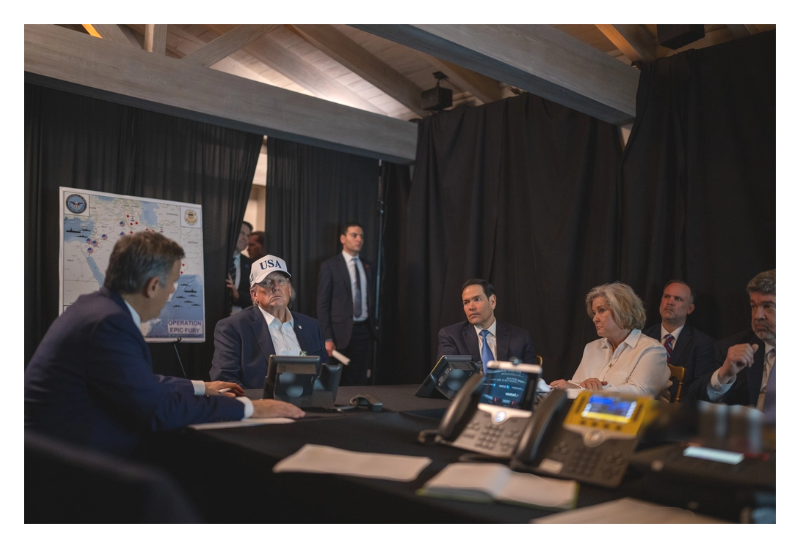
President Donald J. Trump oversees Operation Epic Fury at Mar-a-Lago, Palm Beach, FL, Feb. 28, 2026. (White House photo by Daniel Torok)
No matter how hard one looks, it is virtually impossible to find a serious expert commentary welcoming the draft agreement—of which, admittedly, only the broad outlines are known—reached between Washington and Tehran. It is, quite rightly, portrayed as a surrender, an abandonment, a capitulation, a gift to the Iranian police state, a catastrophe, a farce, and so on. In a way, the seeds of this were already sown in the decision to go to war with Iran and, even more so, as I pointed out exactly three weeks after the war began, in the conditions under which it was waged, the lack of serious anticipation of Tehran’s reactions, the conduct of operations, and—in a certain sense, even more so—the manner in which they were halted, as well as the management, in terms of communication and posture, of the long period between the declaration of the end of heavy strikes and the announcement of the agreement. All these phases will long serve as case studies and material for strategy textbooks on what absolutely must not be done. They will demonstrate the consequences of power without strategy, without thought, and without intelligence.
Everyone agrees that Iran will find itself, if the agreement is ultimately concluded, in a situation that is eventually far more favorable than before the outbreak of the war. Admittedly, a number of its leaders were killed, but they were immediately replaced because Tehran had anticipated such a scenario. Part of its ballistic capabilities were damaged, but far less than U.S. and Israeli leaders had claimed at the start of the war—and, above all, not enough to prevent it from posing a threat or causing harm. The domestic economic situation is catastrophic—hence the Revolutionary Guards’ hope for a lifting of sanctions—but a totalitarian regime’s capacity for resilience is always greater than that of democracies. The global economic shock caused by the blockade of the Strait of Hormuz and the disruption of energy supplies from several Gulf countries represented a considerable cost for a benefit that is hard to identify.
Above all, not only will Iran retain its military arsenal, its ability to support its proxies, and its totalitarian stranglehold on a civil society that has been murdered, crushed, and stifled, but it will have come to understand the levers of power at its disposal—levers that will in no way be challenged; quite the contrary. If sanctions are
Comments
Nothing yet. Say the first thing.
Sign in to join the conversation.