
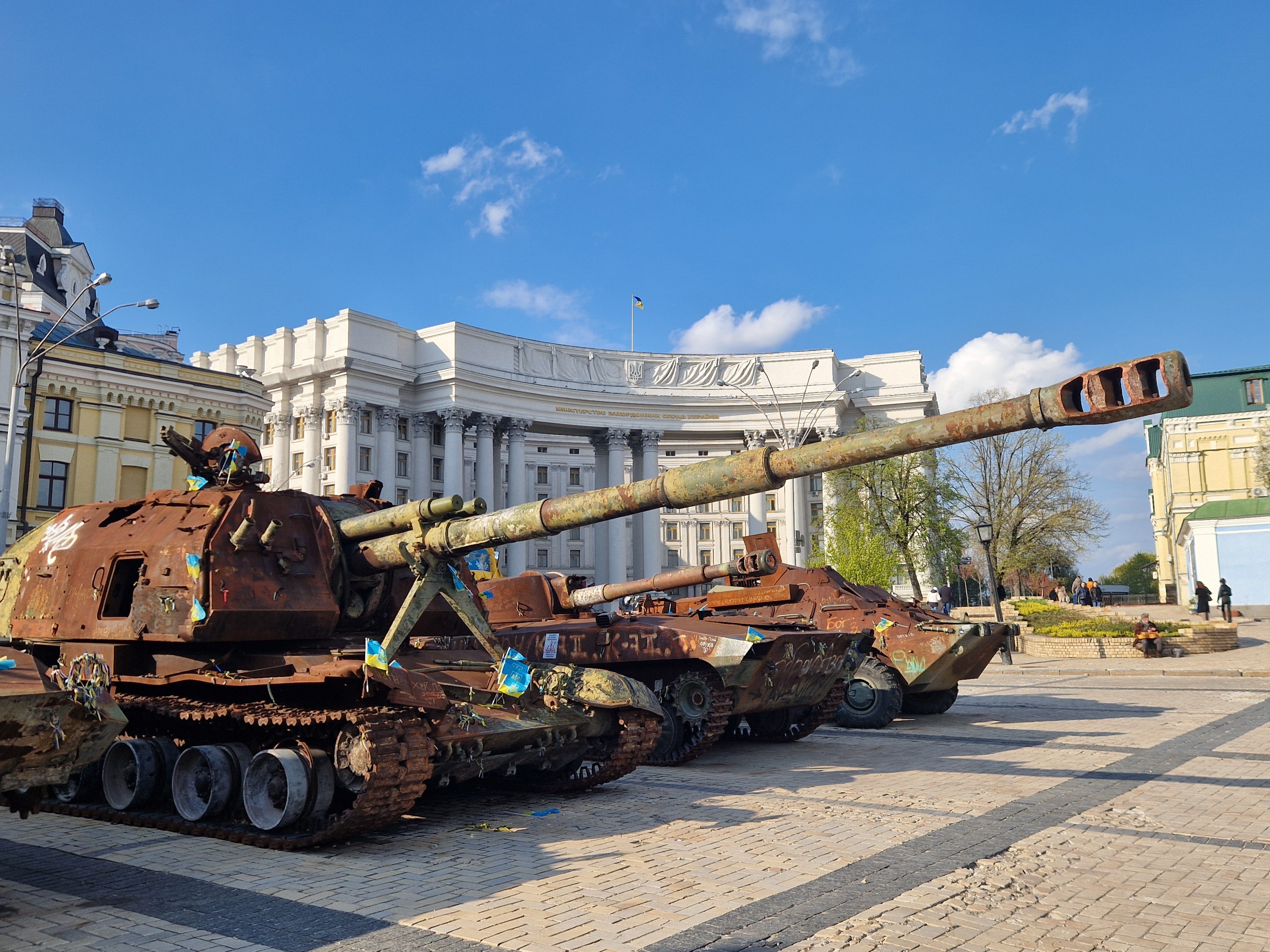
Russian tanks captured by the Ukrainian Armed Forces on Michael’s (Mykhailivska) Square, in front of the entrance to St. Michael’s Golden-Domed Monastery and the Ministry of Foreign Affairs. Kyiv, Ukraine, April 25, 2026. Photo: Nicolas Tenzer
The evidence has become so glaringly obvious that even the most cautious analysts now admit it: Russia is facing major setbacks. Already, six months after the start of full-scale war, I had mentioned this, to widespread skepticism: Moscow can no longer win the war.
Nevertheless, I remained measured at the time: I did not, however, predict a Ukrainian victory. Such a victory would actually have been possible as early as the end of 2022 if the Allies had committed all their resources to the battle. They refused to do so due to fears that have been explained time and again, even though they are fundamentally inexplicable. This refusal will remain an indelible stain in the history books. The trickle of Western weapons, themselves subject to restrictions regarding their nature and range, prevented Ukraine from launching a decisive offensive. The counteroffensive of summer 2023, for this reason, was a failure. I could clearly see Ukraine making progress toward “strategic autonomy”—as had been announced to me in July 2023—but I never imagined that by 2026 it would have advanced to such an extent that it might well be in a position to defeat Russia on the battlefield.
Today, as we know, Ukraine has begun to make progress again on the battlefield, albeit still too slowly. Above all, it inflicts considerable damage on Russian refineries almost daily, shutting down a large number of them to the point of causing fuel shortages. It also successfully targets oil depots, airfields, and Russian warships, as well as other enemy logistics facilities—reaching further and further and striking harder and harder. It does so, let us recall, entirely legally, under Article 51 of the United Nations Charter, which authorizes the country under attack—and indeed all those coming to its aid—to strike at the aggressor’s military bases and anything that contributes to the Russian war effort. Ukraine has become a global leader in combat drone technology to the point that its expertise is sought after by many countries, not just those in the Gulf targeted by Iranian drones. It is beginning to manufacture—albeit in limited numbers so far—long-range missiles, the very ones the Allies have refused to provide or have not yet produced. Europe’s security now rests on Ukraine.
Admittedly, Kyiv is not yet in a position to recapture all the territories occupied by Russia. But this possibility is becoming increasingly real, even if no one can say with certainty today when it will happen. It should, moreover, begin with Crimea, as a former Ukrainian foreign minister suggested to me as early as the end of 2022.
Land routes are beginning to become impassable for Russian forces. For now, the Kerch Bridge has not yet been destroyed, but there is no reason to believe that this will not become a reality in the coming months. The recapture of the other territories will likely not be achieved through a ground offensive—which would be difficult and, above all, very costly in human lives—but by cutting off the Russian forces stationed there from their rear base, from which they receive their supplies of weapons, ammunition, and food, particularly once the Ukrainians have enough medium-range missiles to do so.
It must certainly be noted that Russia still has resources, particularly in terms of missile production, as President Zelenskyy recently pointed out. These are used to attack Ukrainian towns and villages, schools, hospitals, train stations, children’s playgrounds, and residential buildings, always with the same intent: to kill and destroy, to annihilate life itself. The Kremlin is benefiting from the suspension of U.S. aid, as the White House is directly responsible for civilian deaths in numerous Russian strikes. This underscores the urgency—repeatedly emphasized over the past several years—of European assistance in missile defense and the implementation of the Sky Shield project, which has been stubbornly refused for unacceptable reasons. But these Russian war crimes and crimes against humanity, aimed at genocide, will not prevent Moscow’s defeat. They merely conceal its internal collapse—military, economic, financial, and intellectual.
The time has come for the fatal blow
Many agree, now as in the past, that the worst thing would be to offer Russia a way out—in other words, a solution that would allow Putin, even if only partially, to save face. Even those who argue that now is the time—because Moscow is backing down and facing the economic problems we all know about—to talk with Putin would, if asked, agree with this. Yet what they risk achieving, while denying it, would amount to the same thing.
The least suspect among them, Finnish President Alexander Stubb, seems—no doubt as part of a broader vision of multiple détente initiatives—to be playing along with this game. Just recently, in an interview with the Swiss newspaper the Neue Zürcher Zeitung, while emphasizing, with specific figures to back it up, the Russian debacle, he argued that it was necessary to talk with Putin, while questioning the appropriate format and making a biting aside about the Americans’ attitude. Stubb’s position is clear in substance, but his strategy is far less so. He knows perfectly well, as do other European heads of state and government, that Putin wants to pursue the war to the bitter end, even if it means destroying the Russian economy and sacrificing another million or two soldiers, and that his propaganda apparatus would exploit any discussion. He would see it as a sign of Western weakness.
Admittedly, in his remarkable open letter to Putin, in which he lays out the entire situation, President Zelenskyy included an ambiguous sentence: “The front line today is the line from which diplomacy must begin.” This should undoubtedly be read primarily as a communication tactic aimed first and foremost at the West to demonstrate, once again, that he is not the one blocking the talks to which the West appears committed. He had certainly anticipated that Putin—whose fear of the Ukrainian president has been evident from day one—would reject any proposal for a meeting and maintain his war aims, however unrealistic they may be. No doubt he intends to demonstrate, as he does regularly, that it is impossible to negotiate with the Kremlin criminal. Fundamentally, and rightly so, he has no intention of ceding any territory. I am not certain that he holds the “allies” in high regard—those whom he believes are leading him to utter such words.
Precisely, one wonders about the strategy that might lie behind these attempts at discussions with the Kremlin—assuming, as I doubt, that there is one.
Is the aim to turn Ukraine’s anticipated victory into what would effectively be a defeat? To impose peace on Putin now—assuming, moreover, that this is even possible—even under the least favorable conditions for Russia since the start of full-scale war, on the one hand, would bear no resemblance to a “just and lasting peace,” to use the conventional terminology, which presupposes a Russian defeat; on the other hand, it would amount to depriving Kyiv of its anticipated victory. To imagine any kind of agreement—albeit a very provisional one—in which Ukraine would cede part of its territory would be to betray Ukraine and create a lasting threat to all of Europe. Russian propaganda narratives could, moreover, easily spin this semi-defeat into a real victory.
Is the aim to push the Russian dictator to concede defeat by making him glimpse the even more disastrous consequences should he continue his war of no return? This might seem more sensible on paper, but it would be an illusion. Putin is not driven by a form of rationality analogous to that of the leaders of democracies. His rationality, which is instrumental, is entirely directed toward the annihilation of the Ukrainian people and of Ukraine as a nation. To think he might yield, unless completely defeated in reality, is wishful thinking: Putin will continue the war to the bitter end. He is not in a mental state to compromise—in a way, fortunately for us, because he could have done so some time ago, with a more developed tactical sense, by exploiting the beliefs of certain European leaders to devise a ruse, capitalizing on their willingness to accept concessions, only to resume the war tomorrow with greater resources. In fact, that is precisely what any form of ceasefire or peace agreement with Russia would lead to.
Is the aim, then, to try to influence Russia’s trajectory by attempting to guard against a so-called doomsday scenario in which the country would descend into chaos following its total defeat? While one certainly cannot suggest that this is the thinking of most current European leaders, it is also a fact that it has motivated certain Western leaders, notably Joe Biden. Even as scenarios of Russia’s breakup—assuming even that this is something to fear—are highly questionable, some foreign policy analysts are still inclined to give credence to the myth of stability, as if the reality of today’s Russia were not the greatest evil. We cannot therefore rule out that some, driven by a strange terror of what they unfortunately describe as a “vacuum,” secretly prefer to keep Russia as it is, albeit weakened. It will certainly be permanently crippled after a real defeat, provided it is managed over time, but it would only be so momentarily if concessions and a compromise were sought.
I have often written that there can be no discussions, let alone negotiations, with Putin’s Russia. Shortly before the London meeting between President Zelenskyy and the French, German, and British heads of state and government on June 7, 2026, former Ukrainian Foreign Minister Dmytro Kuleba wrote these words: “The final London Declaration [June 1941] was not about ending a war. It was about uniting those willing to win it and shape the peace that followed. One can only hope today’s meeting is guided by the same logic.”
Thinking about the aftermath
The key issue, therefore, is not peace, but the victory of Ukraine and the free world. It is not about ending the war, but about preventing Russia from invading Ukraine again, committing mass crimes, and attacking its neighbors, either directly or indirectly. There can be no “just and lasting peace” with Russia as it currently stands.
Comments
Nothing yet. Say the first thing.
Sign in to join the conversation.