
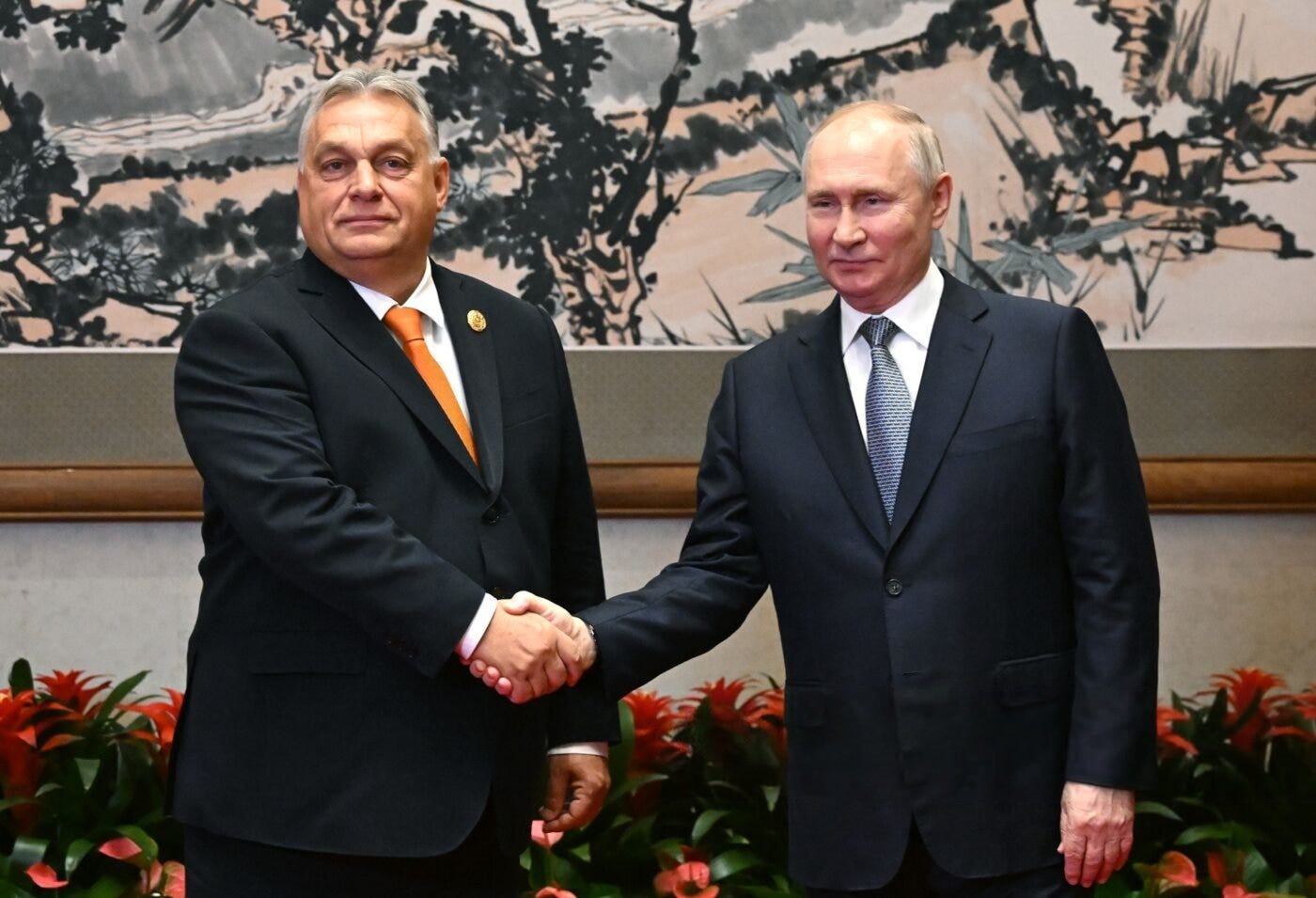
Viktor Orbán meets Vladimir Putin, 2023. Author: Grigory Sysoev. Source: https://riamediabank.ru/media/8537557.html?query=Орбан&page=2&context=search&cs=VRUF3CGWi79PCwzAZAHGoQ. RIA Novosti archive, image #8537557 / RIA Novosti / CC-BY-SA 3.0
Orbán’s defeat in the April 12, 2026, parliamentary elections—which paved the way for Péter Magyar’s landslide victory—was rightly hailed as a victory for Europe. Beyond the Hungarian government’s increasingly visible collusion with Putin’s Russia and corruption on an industrial scale—the two often go hand in hand—Hungary was the source of numerous dysfunctions within the European Union’s institutions, even beyond its blocking of the €90 billion loan to Ukraine. One may certainly have reservations about the future policies of the Magyar government, which remains conservative, but there is no doubt that it will allow for more peaceful relations with the rest of Europe. He has already shown signs, albeit incomplete ones, of distancing himself from Moscow and has been perfectly clear on Ukraine’s sovereignty. We certainly should not expect him to provide financial and military support to that country comparable to that of most EU nations, especially since he must rebuild an economy destroyed during the Orbán years—and particularly its tax system—but the de-Russification of Hungary should proceed.
De-Orbánization and de-Putinization go hand in hand. We hope that exemplary trials for traitors will take place, even if the task will be as difficult as it is long.
While the European Union has thus had a major thorn removed from its side, difficulties remain and could intensify over the coming months and years. Admittedly, Orbán, due to his long tenure in power, had strengthened Russia’s grip on a segment of the Hungarian ruling class in a manner unique within the EU. The revelations regarding the sharing of secret discussions from the European Council by Foreign Minister Péter Szijjártó with his Russian counterpart were merely the tip of the iceberg. Hungary, along with Serbia, served as a sort of hub in Europe for the distribution of Chinese goods and influence.
Other countries have shown similar complicity, primarily Robert Fico’s Slovakia and Andrej Babiš’s Czech Republic. However, Bratislava does not carry the same weight as Budapest, and in Prague, President Petr Pavel remains a counterweight, albeit a fragile one. The recent shift in tone by Fico, though still incomplete, and even, to a lesser degree, by Babiš, does not reveal a doctrinal conversion on the part of either, especially since it seems doubtful to me that they have any doctrine other than one dictated by circumstances, but rather the result of a new sense that the Putin regime is about to fall. That did not, however, prevent Fico from traveling to Moscow on May 8 and 9, 2026, though he did not attend the lame-duck military parade. His remarks about a possible dialogue with Moscow—which are pure nonsense—reveal a conversion that is, to say the least, incomplete. Perhaps, however, these are merely the last flickers of a bygone era. The announcement of Ukraine’s impending victory likely explains this new though fragile pragmatism more than Orbán’s defeat. Depending on other events—including a spread of far-right votes across Europe—this early sign of these countries returning to an attitude more in line with European principles may come to nothing.
The victory on April 19 of the coalition led by Rumen Radev in the parliamentary elections is likely to further accentuate Sofia’s pro-Russian shift, even if it is expected to be, at least initially, less pronounced than what we have seen in Hungary.
Other countries also remain weak links, even as they continue to support Ukraine and vote for increased sanctions against Russia at European Council meetings. Austria remains, to say the least, timid in its aid to Kyiv, and its main bank, Raiffeisen, continues to conduct lucrative business in Russia.
Belgium has blocked the transfer of frozen Russian assets held in Euroclear to Ukraine, and its Prime Minister, Bart De Wever, has even advocated for a form of normalization of relations with Moscow. Cyprus and Malta remain entry points for Russian oligarchs, with their “golden passport” schemes that fuel corruption. These countries could distance themselves even further from their support for Ukraine if larger countries were to shift, even partially, into Russia’s orbit.
Outside the European Union, but in a country that is key to Europe’s defense, the local elections in the United Kingdom on May 7, 2026, have brought the island closer to the worst possible European model: one of political fragmentation where, despite a majority of the public regretting Brexit, the most anti-European party has emerged victorious. The far-right Reform UK, which is also characterized by pro-Kremlin leanings, ultimately jeopardizes the rapprochement with the EU initiated by Prime Minister Keir Starmer.
In reality, there are two ways to torpedo the European project. The first is undoubtedly to align completely with Russia, as Orbán’s Hungary has done. The second is to undermine European institutions and the rule of law from within by challenging the fundamental principles and rules of the European Union, as Poland also did when it was governed by PiS. We should also add a third, which seems to me even more threatening today: being too cautious in supporting Ukraine and in the war against Russia.
We are still far from having saved Europe.
2027: A Dangerous Year
While Europe may face internal threats from smaller nations—such as Hungary—it would, by definition, be far more vulnerable to larger nations. Three specific scenarios could arise in 2027.
The first scenario, though not necessarily the most alarming, could result from electoral gains by the Lega, one of the parties in the current government. Whatever one may think of Giorgia Meloni, she has managed to marginalize the rabidly pro-Russian Salvini and to champion a traditionally Euro-Atlantic policy—even if Trump’s whims have led her to distance herself somewhat from the United States—and, above all, a European one. While she does not plan to send Italian troops to Ukraine, her support for Kyiv has never truly wavered. This was far from a foregone conclusion, given the Farnesina’s former accommodating policy toward Moscow and the ties—not entirely severed—between a number of major Italian companies and Russia. Credit must be given to Italy for standing firm and maneuvering skillfully on the political front. It has, in fact, acted in the same manner toward Beijing by withdrawing Rome’s participation in China’s One Belt One Road initiative as soon as Meloni came to power. Italy remains, however, fertile ground for Russian propaganda, which finds fairly powerful outlets in certain media outlets. Southern Europe is even further from Ukraine than Western Europe, which is already too far away. Italy’s situation therefore remains relatively fragile. The discrediting of the League is, however, a positive sign, and the Five Star Movement has all but disappeared. Giorgia Meloni does not, however, appear to face direct competition from any figure capable of challenging her leadership.
The situation is much more uncertain in Poland, where the coalition led by Donald Tusk remains fragile, as demonstrated by the victory of the PiS-backed candidate in the 2025 presidential election, who continues to challenge the government. Another PiS victory in the 2027 parliamentary elections would pose three major risks to the European Union. The first concerns the rule of law: the restoration of this principle, driven by the Tusk government, could be radically called into question, turning Poland—a country on the front lines of European security—into a nation at odds with the rest of Europe. Given the current security risks, any division within Europe constitutes a net gain for its enemies. The second risk is that of a dissociation from the movement—initiated since the start of the Trump presidency—to assert greater European strategic autonomy, based on a decoupling from the United States, at least in terms of arms procurement and security guarantees. The third risk may seem more indirect, but it is real: it is the risk of weakening in the face of Moscow’s hegemonic and destructive ambitions. In reality, this risk already existed during the previous PiS era: certainly, there was a very broad consensus in Poland recognizing the danger posed by Russia, and Warsaw has always provided unwavering support to Ukraine, despite sometimes ambiguous rhetoric during the PiS campaign for the 2023 parliamentary elections. But the Polish government’s exploitation of historical disputes between the two countries and, even more so, its rhetoric on so-called traditional “values”—which largely mimicked that of the Kremlin—provided a kind of ideological endorsement for Russia. PiS leaders also had no qualms about supporting other representatives of the European far right who were clearly aligned with Moscow. Poland would therefore likely continue to arm itself at a rapid pace, but its defense might be less integrated with that of Europe due to significant disagreements on other issues. The trend—already discernible, incidentally—of Poland acting unilaterally and limiting its involvement in Ukraine’s defense—as seen in its refusal to join the Coalition of the Willing, regardless of the limitations of that initiative, as previously described—would only intensify if PiS won the November 2027 parliamentary elections.
The case of France is certainly the most worrying. A victory—which remains entirely possible—by one of the two potential far-right candidates in the April 2027 presidential election, which could then lead to a similar outcome in early parliamentary elections, would be a potentially fatal blow to Europe. Of course, this would first mean that France would have a pro-Russian president who would immediately cease all support for Ukraine, but it would also mean that the European Union’s sole nuclear power would adopt a hostile stance toward Europe. All the progress—admittedly imperfect and measured—made toward European strategic autonomy, particularly in the realm of defense, would be called into question. The French head of state would be as isolated in Europe as Trump is within the Alliance, but without the backing of a powerful country capable of commanding even a semblance of respect. Anyone is perfectly entitled to criticize the positions defended by France in Europe, but no one can deny that it plays a decisive role in European dynamics, if not its very survival. If a country the size of France were to cross over to the other side, the entire European edifice would be irreparably cracked, perhaps to the point of collapse. One can also imagine the disastrous consequences of a permanent member of the United Nations Security Council and one of the major military powers on the European continent—one of the few today, if not the only one, capable of projecting power abroad—falling into Russia’s sphere of influence. The fact that France is currently the main target of Russian propaganda demonstrates the decisive nature of the French stakes for Moscow. On every level, a victory for the far right would be an unexpected gift to Russia.
But the risk to France, while it would be at its peak with a far-right victory, is by no means limited to this scenario. First, the trajectory of French debt, which amounts to an annual debt burden of 65 billion euros, significantly constrains fiscal maneuvering room at a time when a massive effort must be made toward rearmament. While the military budget is currently off-limits, concerns remain about its medium-term prospects. This situation alarms some of our partners, notably Germany, particularly when it comes to long-term joint military projects—even if, in Berlin, the temptation to go it alone sometimes outweighs considerations of European solidarity. Furthermore, regardless of who is ultimately elected as head of state, the fragmentation of the National Assembly does not bode well for the ability to make difficult and necessarily unpopular decisions regarding reform. Finally, while Emmanuel Macron, after having harbored the hope—illusory from the start—of some form of agreement with Moscow, has adopted a much more confrontational stance since 2023, what will become of his successor, even if he does not come from the ranks of the far right? While some candidates are clearly committed to Ukraine’s side, others—without being suspected of allegiance to Moscow—have never, through their statements, demonstrated the priority they accord to Ukraine.
Faced with these major risks, it is urgent that current European leaders significantly step up their support for Ukraine in the coming year. This support must not merely be an accelerated continuation of current military aid programs for Ukraine, but must also lead to new breakthroughs, whether in terms of sanctions, the protection of Ukrainian airspace (the Sky Shield initiative), or the supply of unrestricted long-range weapons.
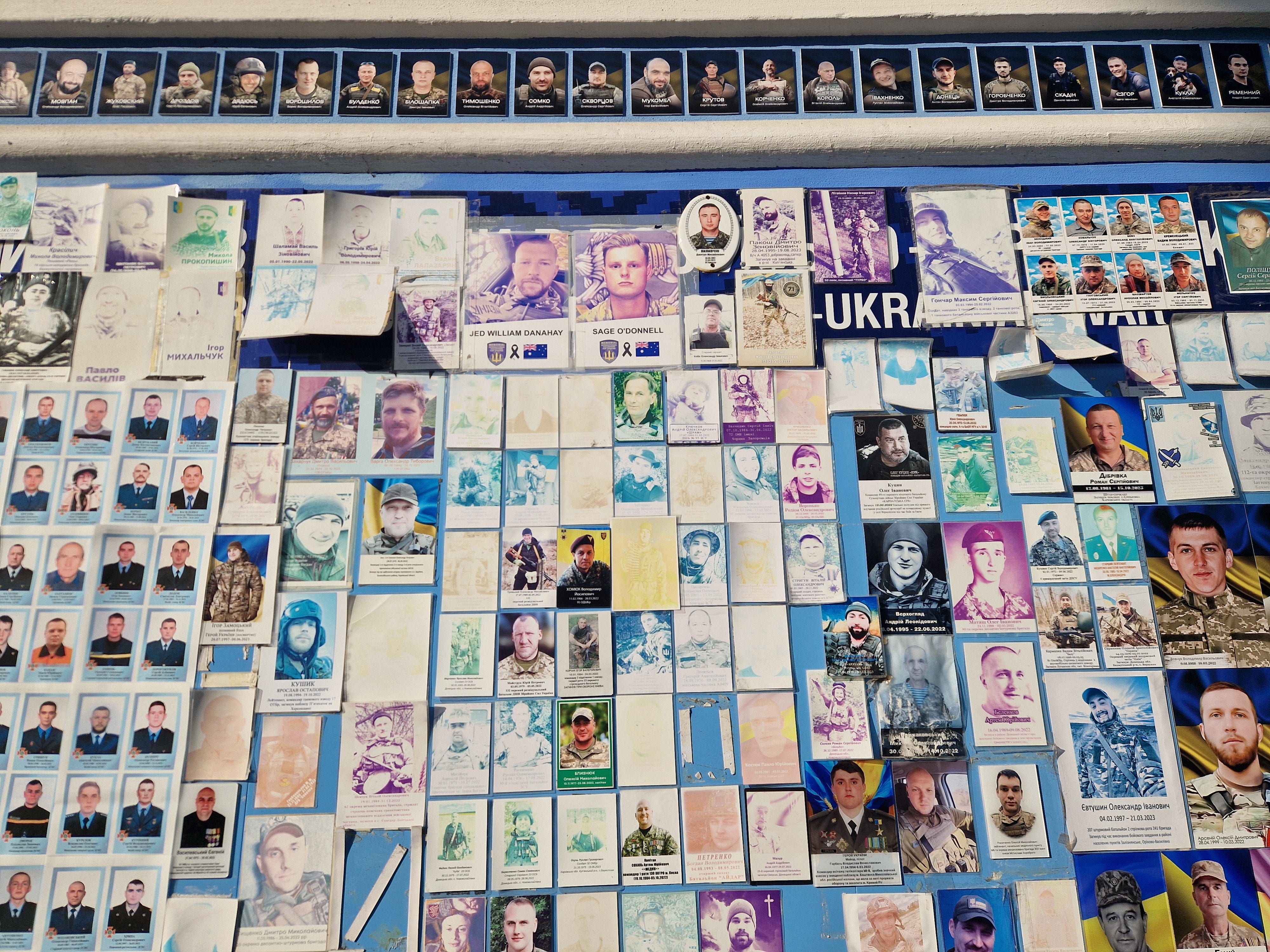
The Wall of the Fallen, adjacent to St. Michael’s Golden-Domed Monastery, Kyiv, Ukraine, April 25, 2026. Photo: Nicolas Tenzer
The ideological war is the key
Winning the war against Russia outright is undoubtedly Europe’s top priority. Once that victory is secured, Europeans will need to demonstrate sufficient strategic
Comments
Nothing yet. Say the first thing.
Sign in to join the conversation.