
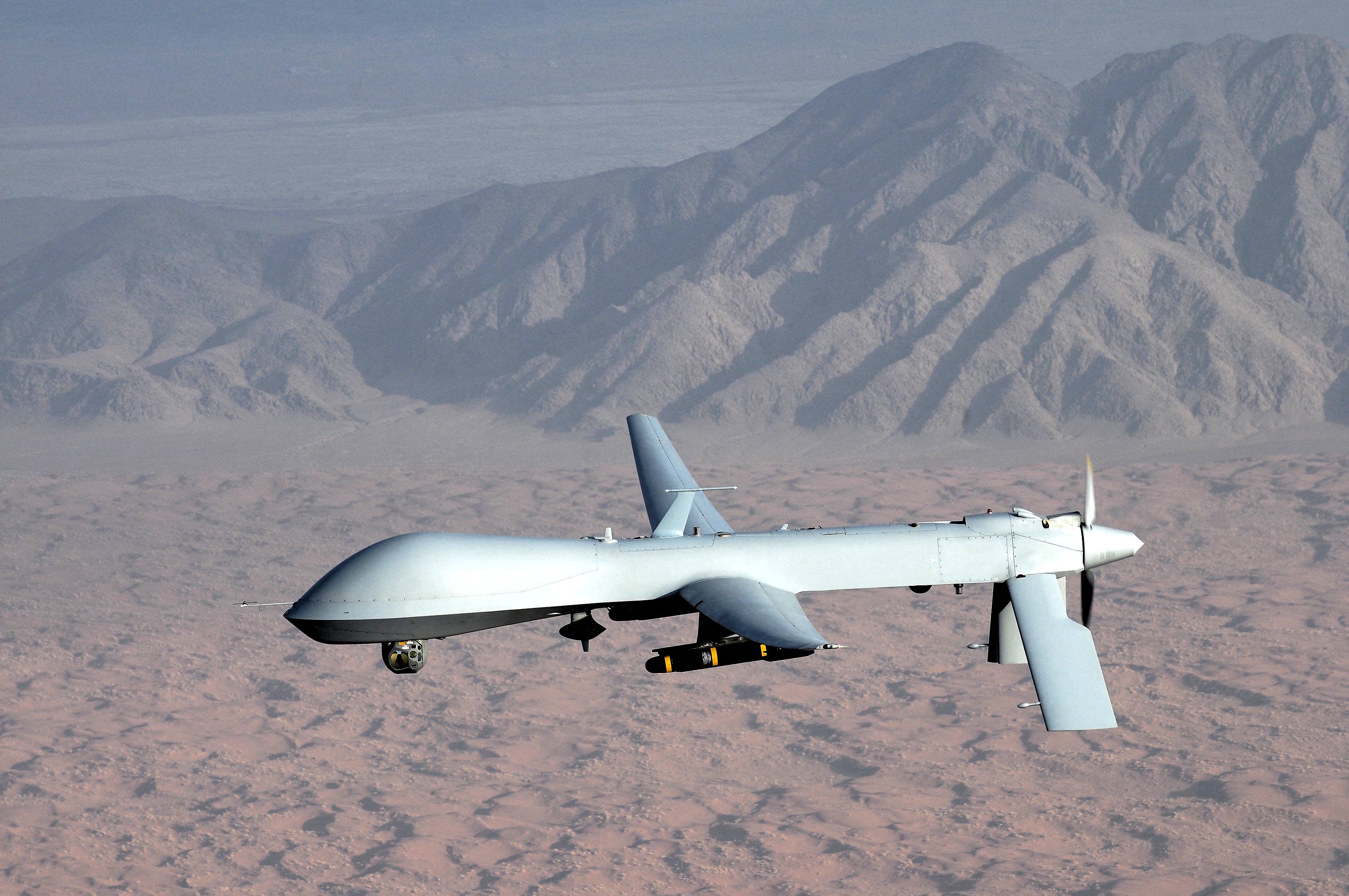
US Air Force MQ-1 Predator unmanned aerial vehicle. U.S. Air Force photo by Lt. Col. Leslie Pratt. (16 December 2008). Source: http://www.af.mil/shared/media/photodb/photos/081131-F-7734Q-001.jpg via http://www.af.mil/News/Photos.aspx?igphoto=2001601881. Public Domain
This essay is the last in our series of six dedicated to the interrelations between artificial intelligence and international relations related issues.
They were written with Constantin Vaillant Tenzer, a researcher in mathematics applied to cognitive neuroscience and machine learning at ENS Ulm (Paris Sciences et Lettres University). For more than four years, he has been working on improving AI algorithm training methods in collaboration with French and American companies.
In the field of international relations and security, artificial intelligence is exponentially multiplying certain threats from states or groups seeking to destroy democracies. However, it would be wrong to conclude that this constitutes a conceptual or strategic revolution. International affairs remain unchanged as such, and the movements are those set in motion by actors who set themselves often radical goals of destruction. However, the tools offered by AI enable them to go even further in the cognitive and intellectual weakening of democratic societies and their leaders. The current state of democratic societies, weakened by the decline in the teaching of the humanities and the liberal arts, provides fertile ground for alienation—in the classical sense of the term Entfremdung—caused by AI. As one leading expert has noted, military decision-making processes aided by AI can also suffer from a lack of critical thinking.
Admittedly, when it comes to the art of war and the daily activities of diplomats and international relations analysts, AI offers new tools—including data monitoring and analysis, machine translation, and surveillance of influence operations—that are all the more important for them to adopt given that hostile powers are doing so as well. However, the “revolution” in the work of the military, negotiators, and experts does not mean a revolution per se.
We will therefore only briefly review how AI is changing working methods, bearing in mind that our enemies are doing the same, and focus on four more fundamental aspects—without revisiting the issue of sovereign AI, which has already been addressed but is indeed an essential response: the question of shifts in power relations, new threats—or more accurately, the modification and increase of old ones—in their military dimension and malign influence, and what some call “AI governance,” which is certainly necessary but undoubtedly largely illusory.
AI in the service of knowledge about the world
One of the major contributions of AI to diplomacy and security is the spectacular improvement in monitoring and intelligence.
“Research assistant” tools make it possible to continuously scan articles, reports, social networks, and official documents, and extract relevant summaries for decision-makers or diplomats. They make it possible to decode incoherent and contradictory messages, identify recurring propaganda narratives repeated ad nauseam by websites allied with revisionist powers, and thus provide an optimized response. For example, systematic tracking of the “arguments” deployed by Russian propaganda agents on social media makes it possible to analyze their rhetorical tactics and the recurrence of the same distorted facts or lies and the same lines of attack. It allows us to point out how they are repeated—voluntarily and sometimes involuntarily—by a range of people, sometimes even leaders, who see no malice in them, and thus to respond.
However, this work can only bear fruit if it is directed by analysts who are themselves experienced in analyzing the rhetoric of enemy states or groups. While it is easy for non-specialists to detect blatant lies—such as those regarding the so-called “Kyiv Nazis”—, the analysis of the amplification of the risk of “nuclear escalation,” a point driven by Kremlin propaganda that has penetrated the minds of leaders with no particular sympathy for Moscow, requires both knowledge of the rhetorical devices used by Russian propagandists and the ability to provide counterarguments. But AI
Comments
Nothing yet. Say the first thing.
Sign in to join the conversation.