
September, the birthing place of autumn. This month is the river mouth. The hedgerows surge, great estuaries of abundance. A tide of magentas and chestnuts overflow its banks. Berries, roots, fragrant hummus.
Autumn: the beginning of a slow decline into winter and the obituary to an almost forgotten, yet forever longed for, summer—
Most beloved Season (June-August)
Summer was the season of sweetness and passed away on August the 31st after a brief yet epic seance. She followed in Spring’s footsteps, yet passed after a regrettably brief season, cut short by Autumn’s cold and impatient command.

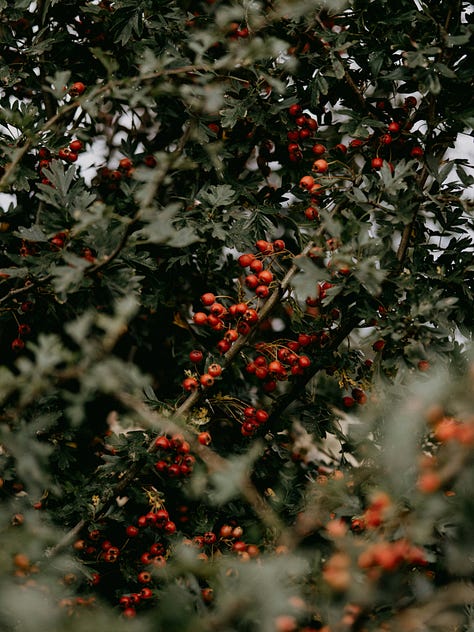

September is, in this hemisphere, the beginning of autumn. As back-to-school busyness runs rampant, things are slowing down in nature.
This subtle slowing down— of leaf growth and quickly approaching hibernation period— is an invitation in itself.
An invitation to be radically countercultural.
Slow down.
Social media, news articles, and YouTube videos will all plead with you saying, “this is the time to knuckle down, to get serious”. They shove hustle at you as if resisting going full “monk mode” will result in a life of poverty and lack.
Hustling harder will not lead to a full and enriched life. It will lead to a life of high stress levels, eroding relationships, and an identity built on output.
Nature gently nudges us in another direction. Look to the trees. Is their identity based around how tall they grow or how large their leaves span? Or the birds. Is their identity formed around the heights they reach or the prey they catch? Or the wild and beautiful grasses. Do they identify themselves by how quickly water rushes through their xylem or how efficiently they metabolise nitrogen?
If identity’s value positively correlated with output and productivity, this principle would be seen in nature. Darwin’s law may offer the counter point of “the bigger the better”, and yet, everything created has adapted and evolved to rest.
Why do trees lose their leaves?
Deciduous trees lose their leaves to spend less energy through winter, protect themselves against harsh conditions, and conserve moisture. Instead of focusing its energy in leaf and fruit growth, a deciduous tree will lose its leaves so it has more energy to direct to self-preservation and root growth.
And you?
As autumn approaches, what would it look like for you to reject the cultural demand to retain or increase output, instead focusing on a natural slowing down? Reassigning energy from external output to activities that enhance self-preservation and figurative root growth.
That’s radical.
This is the etymology of the word “radical” according to Merriam Webster’s dictionary definition:
“Radical comes from a Latin word meaning "root," and in its earliest uses it referred to roots of various kinds, first literal and then figurative. Because roots are the deepest part of a plant, radical came to describe things understood as fundamental or essential. In phrases like "radical reform" and "radical change," radical implies a shift in the most fundamental or essential part of something; such uses led to the word radical taking on meanings relating to extreme views, policies, etc.”
A radical return to nature’s cycles of rest is a return to the fundamental, the essential. Rest is fundamental to the human body and mind. This is your slow down prescription. Go rest.
Truly, we live with mysteries too marvelous
to be understood.How grass can be nourishing in the
mouths of the lambs.
How rivers and stones are forever
in allegiance with gravity
while we ourselves dream of rising.
How two hands touch and the bonds will
never be broken.
How people come, from delight or the
scars of damage,
to the comfort of a poem.Let me keep my distance, always, from those
who think they have the answers.Let me keep company always with those who say
“Look!” and laugh in astonishment,
and bow their heads.by Mary Oliver
This poem speaks through deep time, echoing the mysteries of this world. In this poem Oliver seems to be gently probing the receiver of this poem to let go of their longing to “have the answers”, instead resting in the mystery of life with humility. What a challenge. To look to these profound mysteries— even within the simplicity of grass “in the mouths of lambs”.
We live in the constant tension of “delight” and “scars of damage”. How do we hold both and somehow live in astonishment and humility? Perhaps by seeking company with those who allow themselves to be surprised by beauty and life and mystery all at once.
Perhaps the company we seek is the very grass, lambs, rivers, stones, and poems themselves.
This autumn, may we rest in “the comfort of a poem”.



Here is your September challenge. As much as you can… walk. Walk to the shop. Walk to work. Walk to the library. Walk to the gym.
Walk on the weekends. Walk to relax. Walk when you feel irritable. Walk when the world feels dark. Walk for the joy of it.
Walk to observe. Walk to watch. Walk to pay attention. Walk to notice. Walk to keep present.
Walk as a counter cultural, and radical, act of rest. Walk because the world moves slower that way. Walk because your feet get tired and you need to sit down. Walk because it’s raining and you will get wet. Walk because you might be late this way, but at least you will be present for the turning of the leaves and the returning of the dark evenings. All senses switched on to the spiralling chimney smoke and dying bird song and conker littered tarmac.
Walk to stay wild. To stay present.
A september ritual.
Prepare your house for the coming autumn. Switch out your summer duvet for a winter one. Add a blanket to both your bed and sofa. Gather some autumn memorabilia from outside:
Conkers, chestnuts, drying grasses, winged seeds (samara), Hawthorne.
Fill your house with said memorabilia!
Romanticise the darkening evenings. Start eating meals in candle light. Commit to a book or TV show that is exclusively for the evenings. Take baths, embrace skincare, go to bed early.
Switch out your fresher summer recipes for warmer autumnal ones. Embrace spices and warm flavours. Collect apple windfalls and blackberries. Fill your kitchen with warmth and life.
Try the recipe below to kick off your autumnal kitchen.
1 chopped onion
1 tsp cinnamon
1 tsp chilli powder
1 tsp paprika
1/2 tsp mixed green herbs
1 peeled and chopped butternut
1 cup yellow lentils
1 stock cube + water
Salt + pepper
Combine your chopped onion and spices in a saucepan with a drizzle of olive oil. Stir until browned.
Add your chopped butternut and stir for 3 minutes.
Pour in the lentils and stock (with enough water to cover both the butternut and lentils). Season with salt and pepper and cook on a low to medium heat until the butternut is completely soft.
Blend until smooth. Serve with sourdough bread and roasted pumpkin seeds. Enjoy!
No posts
Comments
Nothing yet. Say the first thing.
Sign in to join the conversation.