
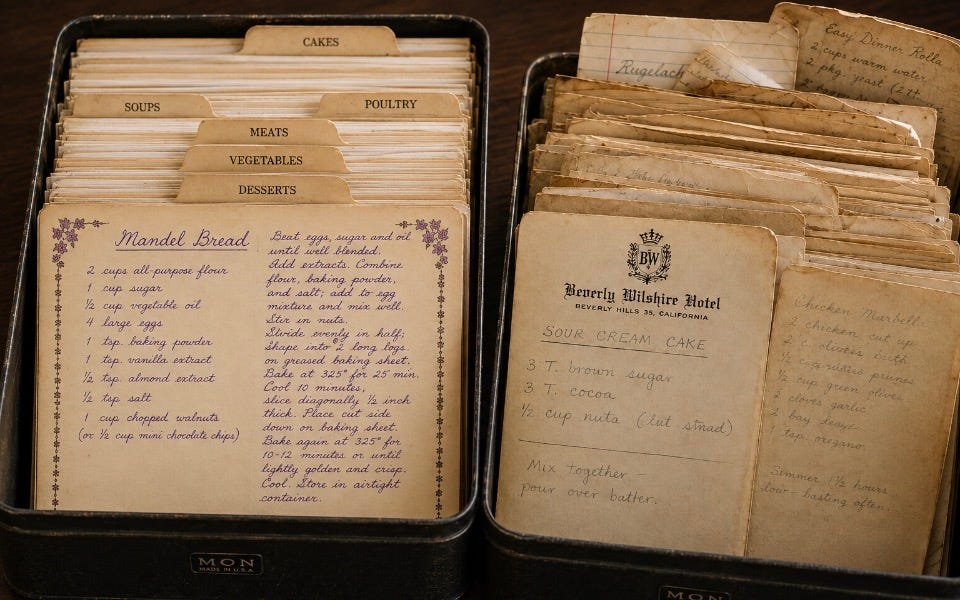
This week, I finally opened two small tin recipe boxes that had been sitting on a shelf in my kitchen for years.
I’d dust around them.
Move them.
Put them back.
I’d been rearranging my avoidance.
The boxes were identical.
Same size.
Same tin.
Same little index-card tabs.
One box contained recipes that looked as though they’d been painstakingly curated by the Library of Congress.
The other looked like the lone survivor of a kitchen fire.
My Buby’s box was immaculate.
Meticulous dividers.
Printed tabs.
Recipes copied in elegant royal-purple cursive.
In her world, penmanship wasn’t a skill.
It was how decent people recognized one another.
Not blue ink.
Not black.
Purple.
When the company stopped making her favorite ink, she responded the way most people would respond to news of an approaching asteroid.
She bought enough bottles to survive the ink apocalypse.
My mother’s box, on the other hand, looked like it had lived fully and fought for its life.
Butter stains.
Coffee rings.
Flour.
Grease.
Fingerprints.
Evidence.
A recipe wasn’t finished until it had survived something.
Most of her recipes were written in pencil.
Crossed out.
Rewritten.
Argued with.
Recipes were merely suggestions.
Then there were the recipes themselves.
Calling them recipes is generous.
They were historical documents from a brief period in American cooking when there appeared to have been a coordinated national effort to remove nature from the food supply.
Fruit wasn’t served.
It was entombed.
Usually in Jell-O.
There was a time in American history when people looked at perfectly good food and thought,
“This would be so much better if it jiggled.”
Jell-O wasn’t dessert.
It was a biosphere.
Entire food groups evolved there.
Nothing escaped.
Not peaches.
Not pineapple.
Not cherries.
If it fit into a mold, someone molded it.
Cream-of-something soup appeared in places it had absolutely no business being.
There was enough canned fruit to survive a Cold War.
Enough shredded coconut to reroof a tiki hut.
A few of those ingredients have quietly disappeared from grocery shelves.
Even the FDA had its limits.
Then I noticed the instructions.
Not measurements.
Instructions.
A heap.
A scant.
A dollop.
A swish.
Jewish women of a certain generation must have signed a blood oath never to acknowledge the existence of standard units of measurement.
Then, halfway through a recipe my grandmother had written for my mother:
DON’T FORGET TO LIGHT THE OVEN!
First of all…
Why are we screaming?
Second…
My mother had been producing extraordinary meals for years.
Did my grandmother honestly believe her daughter remained one distraction away from serving cake batter as a beverage?
The deeper I dug, the less I felt like I was reading recipes.
I was reading personalities.
I found one of my mother’s sour cream cake recipes written on stationery from the legendary Beverly Wilshire Hotel.
Which, frankly, is the most accurate psychological profile of my mother ever assembled.
She believed glamour and gravy belonged at the same table.
Her first formal dinner featured pheasant under glass.
Someone forgot to open the fireplace flue.
Black smoke rolled into the dining room.
My father calmly moved everyone onto the patio.
Dinner continued.
Nothing was getting between my mother and her guests. Not smoke. Not weather. Not common sense.
Whether she was feeding two people or two hundred, if there was a brisket to be made, she was making it herself.
When my mother got married, she registered for a china pattern my grandmother considered spectacularly ugly.
Years later, my mother opened a cabinet in my grandmother’s home and found a complete second set of her own wedding china.
“Why do you have my china?” my mother asked.
Without missing a beat, my grandmother replied,
“It was ugly then.
It’s ugly now.
But when I die, you’ll have seating for twenty-four.”
That’s love in a Jewish family.
Not approval.
Infrastructure.
Tucked between my grandmother’s recipe cards were letters from women I’d never met, scattered across the country.
Every one began the same way.
News about a husband.
A child.
A vacation.
A worry.
Only then came the recipe.
Recipes were the original attachment.
Women of that generation rarely said,
“I’m thinking about you.”
They said,
“I’ve enclosed my strudel recipe.”
It meant exactly the same thing.
After my Buby died, we cleaned out her freezer.
Inside were enough homemade challahs and mandel breads to feed us for what felt like years.
My grandmother believed death was no excuse for running out of baked goods.
Death, in her opinion, was unfortunate.
Hunger was unacceptable.
Looking back, it may have been one of the last completely lucid things she ever did.
Not the baking.
The planning.
The instinct to keep feeding the people she loved, even after she wouldn’t be there to watch them eat.
The more time I spent with those boxes, the less I felt like I was reading recipes.
I was reading two women.
My Buby cooked from memory.
My mother cooked from possibility.
One preserved tradition.
The other wasn’t afraid to stretch it.
I slid the little tin boxes back onto the shelf.
They looked exactly the same.
I didn’t.
No posts
Comments
Nothing yet. Say the first thing.
Sign in to join the conversation.