
My doctor slid his chair closer.
“How did you do it?”
I had lost fifteen pounds.
After a certain age, losing fifteen pounds is like trying to evict a tenant who knows the legal system better than you do.
I’m still very much on the journey, so let’s not engrave anything on a trophy just yet. But something was definitely changing.
So when my doctor asked what I’d done differently, I gave him the most honest answer I had. It also happened to sound completely ridiculous.
“I started listening to my stomach.”
The second the words left my mouth, I thought there was a reasonable chance he might refer me for psychiatric evaluation.
Instead, he didn’t laugh.
“Tell me more.”
What followed was a conversation about intuitive eating. Or at least my version of it.
For years I thought hunger was hunger.
Apparently it is not.
I’ve become convinced there are at least three different voices weighing in every time I eat.
My face.
My chest.
And my stomach.
The face is a complete opportunist.
The face wants warm bread, roasted garlic, perfectly crisp French fries, and anything involving melted cheese.
Frankly, I respect the face. The face has excellent taste.
If the face were running the operation, I would be delighted and considerably larger.
The second voice is my chest.
The chest is convinced food has magical properties.
Stress? Food.
Celebration? Food.
Disappointment? Food.
Anxiety? Definitely food.
The chest feels an emotion and immediately wants to do something about it.
Numb it.
Soften it.
Tamp it down.
Or bury it beneath an everything bagel and a schmear.
Then there is the stomach.
The stomach is annoyingly reasonable.
The stomach doesn’t care that somebody brought donuts. The stomach doesn’t care that there is birthday cake in the freezer. The stomach doesn’t care that the bread basket has arrived.
The stomach is the designated driver. It spends most of its time trying to stop the face and the chest from making decisions they will regret tomorrow.
The surprising part wasn’t learning that these three voices existed.
The surprising part was realizing how often I was listening to the wrong one.
And once I saw it with food, I started seeing it everywhere else.
Especially lately.
At some point, I noticed people were serving things up:
Fear.
Rage.
Frustration.
Disappointment.
The emotional casserole.
None of that was new.
What was new was noticing how quickly I assumed it belonged on my plate.
I had been treating a buffet like a plated meal.
And many of us grew up in a time when cleaning our plates was practically a moral imperative.
Which may explain a lot.
Because somewhere along the way, I confused receiving something with being responsible for it.
That’s when it hit me.
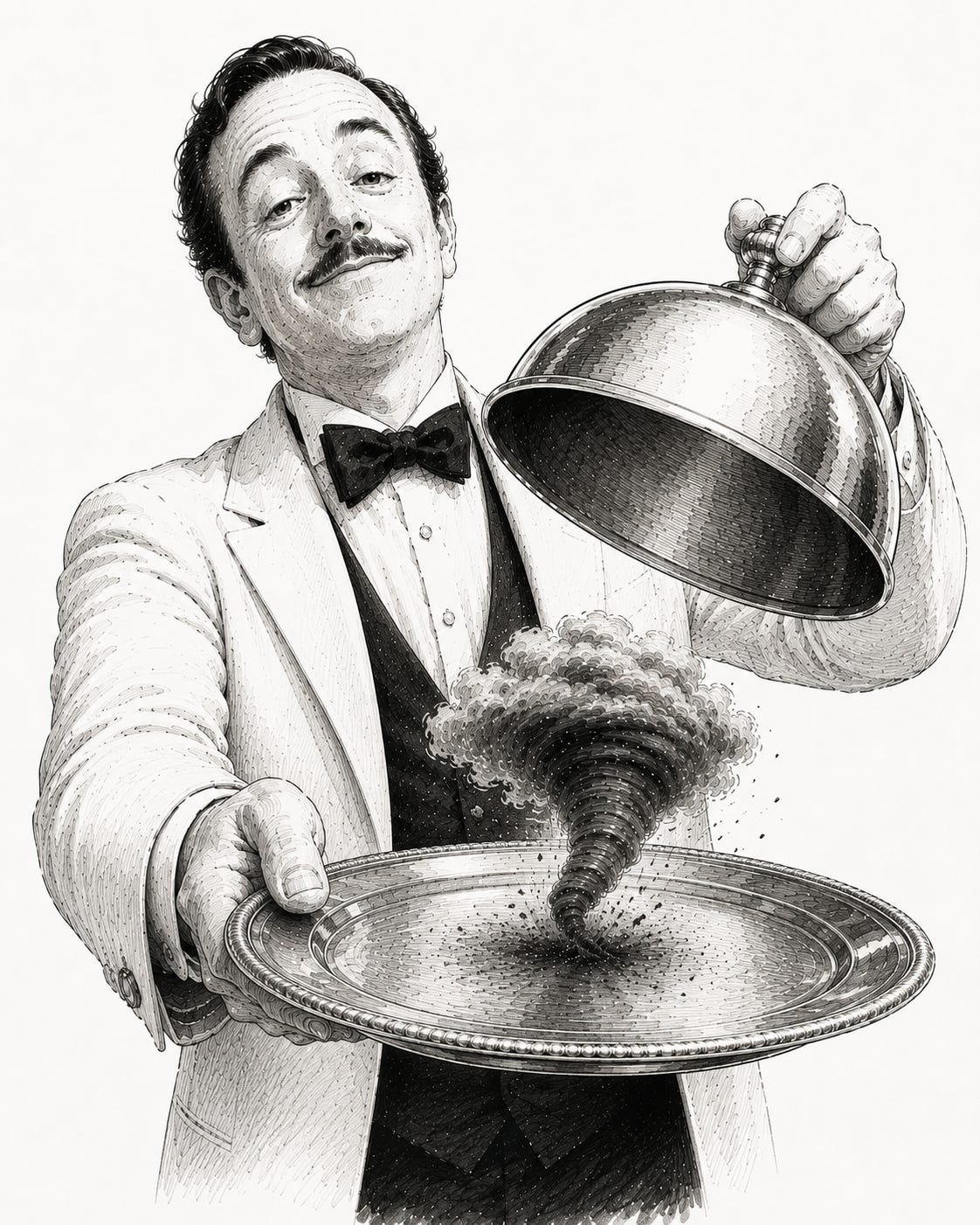
Other people’s emotions are not a plated meal.
They’re a buffet.
A buffet is optional.
You can walk past things. You can admire them without taking them. You can sample something. You can decide you’ve had enough.
Dear God, who put the anchovies next to the pudding?
And perhaps most importantly, you do not have to consume something simply because someone put it in front of you.
A plated meal assumes the decision has already been made.
A buffet reminds you that it hasn’t.
Not everything that enters my awareness belongs inside me.
The most important thing I consume isn’t food.
It’s everything else.
No posts
Comments
Nothing yet. Say the first thing.
Sign in to join the conversation.