
My feed is telling me that Helen Andrews has written something on gender.
Being aware of Mrs Andrews’ work on generational change and her years in Australia working for the CIS, I braced myself for the worst. Australians will know what I mean when I say that her persona and content is prime Sky After Dark*.
The article is not wholly terrible but it is mostly wrong and the ways it is wrong do actually lead to some important conversations about organizational cultures.
What is Andrews position? In short, men and women are different. Men are more competitive and direct. Women are more conciliatory and indirect. Women are taking over institutions and “feminizing” them and this is bad. This is now a common observation on the Right and such castrated vajazzled feminized institutions are called “The Longhouse”.
I will not argue this based on quantitative data but rather what I have seen with my own lyin’ eyes. Your own personal mileage may vary.
Let me begin by stating my position. I am a man**. I have worked in some very female dominated professions (librarianship, learning & development, marketing). I have also worked in some male dominated professions (sales, IT). I am not exceptionally macho. I am equally awkward with men and women. This is all based on my observations.
So where do I agree with Andrews? Well, I agree that collectively men and women exhibit different behaviours in aggregate. The stereotypes are at least partially true. Men like sports*** and do not like talking about their emotions. Women like shoes*** and do like talking about their emotions.
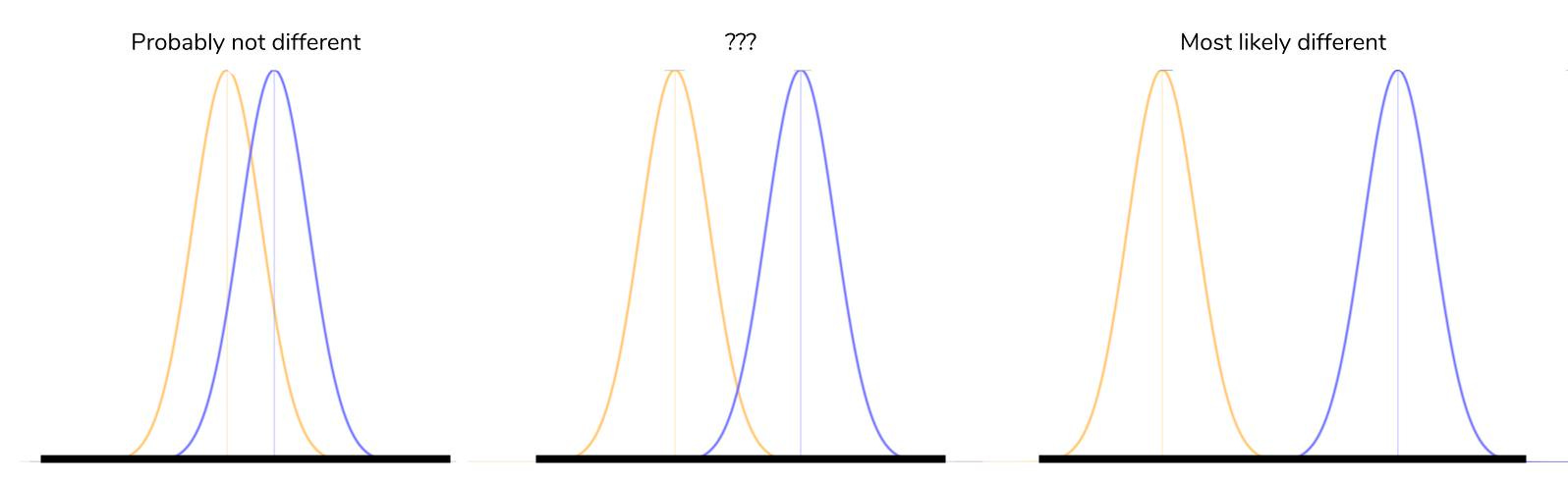
The question is how true are the stereotypes. To get mathematical**** for a moment, assuming that dudeness and chickness for any characteristic are normally distributed, we might ask:
How are apart are the means of the two distributions? The three examples show three different pairs of distributions. From right to left in the example below, no degree of overlap (men are women are completely different), low degree of overlap (men and women are mostly different), one with a high degree of overlap (i.e. many men and women often behave the same way). Or to put it another way:
Right: Men are from Mars, Women are from Venus.
Middle: Men are London, Women are from Paris.
Left: Men are from Littlehampton, Women are from Angmerging.
What are the standard deviations of these distributions? In the example below Y has a greater standard deviation than X. Or to put it another way, are all men the same and all women the same or are they all freaky and different?
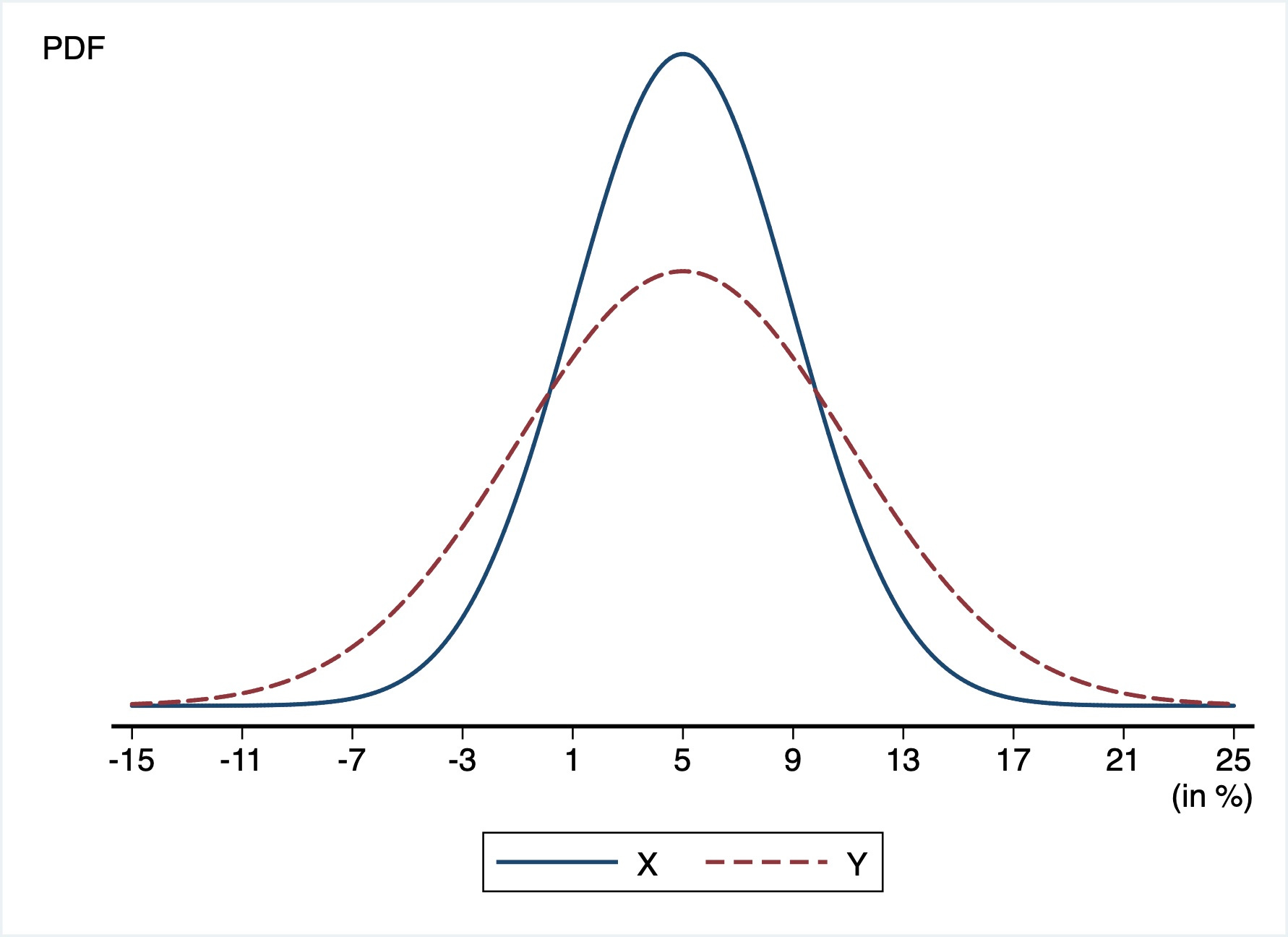
Andrews puts in a caveat that: “A random woman might be taller than a random man, but a group of ten random women is very unlikely to have an average height greater than that of a group of ten men. The larger the group of people, the more likely it is to conform to statistical averages.” but she quickly abandons that to imply that the standard deviations are small, and the means are very far apart. Women are the same as each other and completely different to men.
This has not been my experience and it is getting less my experience as time progresses.
I have worked for a wide variety of women and men who have differed greatly in their competitiveness, empathy, intelligence, bluntness, and deviousness. I have worked with nurturing men and alpha bitches.
What Andrews’ article does not talk about are other factors that influence people's behaviour. Some of these are personal - age, class, ethnicity being obvious ones that come to mind. Our organizations are run by the old and by the middle and upper class. They shape (but ultimately do not control) cultures. And ethnic background has a big impact on behaviour. Comparing an Israeli woman to Japanese man on a scale of bluntness is going to get you very non-Andrewsian results.
Above all, people are shaped by the professional cultures that they find themselves in. Yes, changing the personal backgrounds of those who enter a profession will change it - people don’t leave their baggage in the lockers. But it is more likely that those professions will attract certain types of people and incentivize them to become ever more what those professions value and are valued for. Lawyers are chosen for their ability to argue. Librarians by our desire to organize and serve.
However for all groups and institutions, there is a trade-off. On the one hand, there are certain behaviours (and knowledge and attitudes) that are selected for and reinforced. But if those groups become too homogeneous they risk becoming toxic and brittle.
Male-dominated spaces risk becoming locker rooms. 20 years ago, a bunch of us sat in a meeting with a couple of very senior tech execs. They were laughing about a third exec who ran a group called AIS-D and was flamboyantly gay. “AIDS!” they yelled at each other. “He’s got AIDS!”. It wasn’t so much the juvenileness of the joke that got me. It was the carelessness that someone else might find it offensive. They laughed at their own jokes but never anyone else’s. That kind of behaviour is no longer publicly acceptable (who gives a shit what people say in private) and that is not a bad thing. We need to put the jocks in their place.
Likewise female-dominated spaces risk becoming dens of drama and intrigue where the slightest actions are over-examined for their impact. “Does her coughing when I talk mean she hates me?” “No, she has a cold”. Or insults adopt the passive-aggressive camouflage of feedback. We need to keep the mean girls in their place.
Our organizations have become more diverse and that has made them more resilient and robust (although this may be about to change). The greater the breadth of skills and experiences you have, the greater the chance of you have of handling curve balls when they arrive. Which they always do. However this diversity means that assumptions of behaviour and values no longer hold but must renegotiated. The change brought by this renegotiation of “how we do things around here” is uncomfortable. And it is this discomfort that prompts many of the conservative concerns about “feminization”.
So I say to my conservative brothers and sisters and those that lieth betixt: “Se vogliamo che tutto rimanga come è, bisogna che tutto cambi”. There is no going back to the Locker Room of the past. Well, not until some has washed those jock straps.
Finally, I want to discuss this comment by Andrews: “a male CEO must operate within the limits set by his human resources VP”. I see a lot of comments about the power of HR on Substack and from the Right that fundamentally misunderstand the role that HR plays in most organizations. Most HR professionals I know do not exercise veto power over their CEO. They will typically advise on employment law matters and act as loyal corporate functionaries. Depending on the organization, that might mean they are enabling employees to do good work or they may be hatchet people. They also make handy scapegoats. Senior executives typically make policy and then get to blame HR if it goes wrong. CEOs are mostly responsible for stuff that happens in organizations - good, bad, and crazy. This is not say that HR professionals have no power or are blameless for mistakes. But such executive disavowals can be very convenient and are convincing to those unversed in organizational politics.
What do you think?
*When the sun goes down, the Murdoch-owned Sky New Australia totally loses its shit and goes full frothing MAGA like some kind of unnatural vampire or werewolf that not even piss-poor ratings can kill.
**Yes I am, yes I am , yes I am.
***I do not particularly like sports or shoes so it is with some alarm that I note that I developed an obsession with sports shoes. On a recent trip to Italy, I was more excited by visiting the Sun68 shop than the Uffizi. Although I don’t think my sneaker obsession qualifies me as non-binary or even bicurious yet.
****If getting mathematical doesn’t lose the ladies then making this comment surely will. I must resist the FEMINIZATION of this Substack AT ALL COSTS. And to the Mathematics PhD who dumped me all those years ago, I am not bitter and this article is why I deserved that PhD more than you with your Vector Spaces and your Lie Algebras. IT WASN’T JUST THE ALGEBRAS THAT WERE A LIE, FIONA!!! *Ahem*
No posts
Comments
Nothing yet. Say the first thing.
Sign in to join the conversation.