
Stacey and I met on a panel about BookTok and publishing, but I’d been following her for months before that. A dedicated thinker and a student of the human condition, Stacey’s tastes and mine aligned when it came to books about finding oneself, desire, and the mysteries surrounding being a person today.
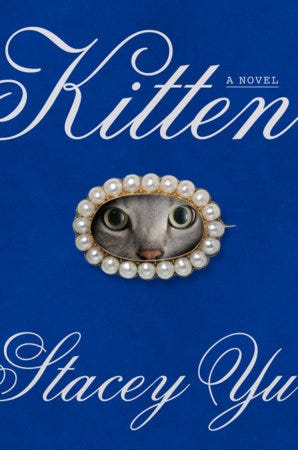
Kitten, Stacey’s debut novel, is out today, and it is gorgeous work about power, agency, longing, and obsession. I was absolutely gripped by the first sentence. It details the story of Katie, a young woman who resists the pull of adulthood by subsuming herself into her older boyfriend’s world, eventually becoming enamored with his cat, Silver. This is a book about being in your twenties, about sizing up your life and the people in it, and establishing oneself as a person worthy of consideration and care. I loved it, and wanted to ask Stacey about the writing process and themes that sung throughout the book.
Thank you so much for doing this! I’m so excited to chat Kitten, and can’t wait to see you during your tour. Firstly, I know you recently posted about loving the writing process for this book, which shocked me a little. How many drafts did you go through writing this book? I’m asking because I had insight into your process and was so in awe of how meticulous you are with word choice and sentence structure.
SY: I wouldn’t say I loved the writing process, though I do miss it - or, I miss the relationship I had with the book at the time while writing it. It was a very difficult, often painful time, but it was a special time, too. You only write your first novel once. I would discover so many things about the book with each draft, and each revelation felt a bit like a miracle, like I was discovering what writing really was.
I was on my seventh draft when I queried the novel and found my agent. We did two more revisions together before we sold it, after which I did another two rounds of developmental revisions with my editors, and a couple more rounds of sentence edits. So maybe officially eleven or twelve drafts, though I’ve read the book front to back, with an eye for small tweaks, many more times than that. For my final draft, I retyped it from scratch. Unfortunately this was extremely useful. It took ages, but it helped ensure every sentence and word was earned. (Though now, I can’t bear to read the book; I catch at least one thing I’d change or delete on every page.)

This book feels so tangible and of the real, material world: the way you evoked fabric and food, sumptuous descriptions of fur. Why did you choose to root your book in the material vs. the intangible?
SY: I love an Internet novel, on occasion. I can be impressed by cool, detached books about ideas and banter and phenomena. But the books that capture my heart are often vibrant with sensorial, material, and physical detail. I think of Alan Hollinghurst’s private twilit Notting Hill gardens, where you can see the bubbles rising up the champagne flutes. Or Sophie’s swollen foot in Deborah Levy’s Hot Milk. Or the clamor and dirt of Ferrante’s Naples. I love things, I love noticing new things about things, the way they sit within a space, make sound, elicit feeling. I guess I wrote to my own reading taste.
Kitten is, in many ways, a book about desire: desire for the past, desire for an old version of your mother, desire to embody a cat. Physicality is instrumental to desire. When you really want something, you know it in full detail.
It’s also a book about class - specifically the dysphoric feeling of moving between classes. And you can’t really write a book about upper crust spaces without writing about what makes such spaces desirable and disorienting, which has as much to do with the unsaid as it does with physical signifiers.
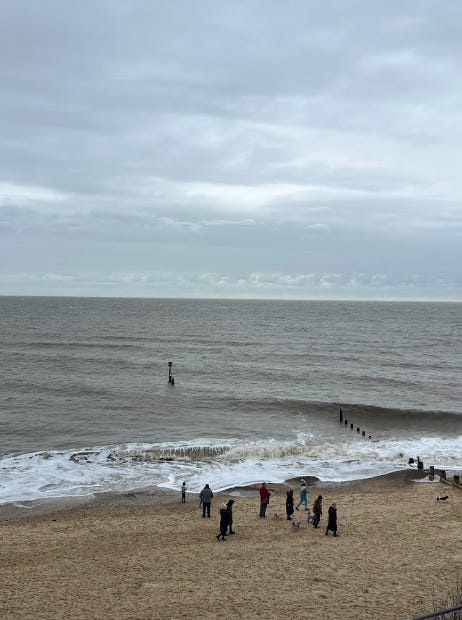
I also wanted to bring up the way you summoned a sense of place. Half of the book takes place in a town you described so beautifully, I felt like I had walked the streets myself. How did you choose to set the book here? What was it about the setting of the cold sea in winter that drew you to this setting?
SY: Kitten takes place in a fictional New England beachside town. I can’t believe I’m admitting this publicly, but I actually based it off a beachside town in the UK. It’s Old England! Original England! When I went to the English seaside for the first time, I was struck by its moodiness and the way it felt slightly out of time, a bit past its heyday. I’m from California, so I’ve always associated the ocean with sun, vigor, and health. The Atlantic ocean is dark and gray and Byronic and glum, totally different from the Pacific.
Also, beach towns on any day are such contained, specific places with their own private mythologies. But in the off-season, they can feel especially closed off. You can’t help but feel like a visitor. It was a great way to intensify the anxieties and sense of displacement my protagonist Katie was already struggling with.
This book fits alongside a few books this year that explore the Mother Wound1. What is it about this moment in culture that’s making people want to explore this relationship?
SY: I think the mother wound is eternal and ancient as anything, and because of that there are infinite ways to tell its story. The way the mother wound is explored is revealing of where we are culturally.
When I think of popular, defining stories about mothers in our contemporary moment, I think of Jeanette McCurdy’s I’m Glad My Mom Died and all the exposés on influencer mothers like Ruby Franke. I also think of intergenerational stories like Michelle Zauner’s Crying in H-Mart and Ocean Vuong’s On Earth We’re Briefly Gorgeous. These stories are unmistakably contemporary, reflecting both culture (celebrity and influencer families) and geopolitics (immigration and interracial relationships in the backdrop of war). So for me, it’s not so much that we’re newly interested in stories about mothers, but that these stories probe the mother wound, as you put it, in ever new and ever relevant ways.
When I wrote Kitten, I wanted to craft a mother-daughter relationship that was grounded in age-old anxieties (codependence, jealousy) while integrating the specifics of regional differences and class and race anxieties today. Katie’s mother immigrated from China when she was a little girl, and while Katie was raised in America, she inherits, to some degree, her mother’s sense of out-of-placeness; their relationships to misbelonging both unite and polarize them.
Finally, to me, this book is about a specific kind of grief. I think grief is underexplored as a subject outside of the standard types, and I wanted to get your thoughts on what it means for Katie to long for an adulthood she hasn’t had yet or for a childhood she didn’t much enjoy.
SY: I’m really glad you said this! Grief is such a big part of this book. Most broadly, it’s about grieving the end of childhood, which, for my main character, is the end of her mother’s love - at least, a love that she understood. I think registering a difference in how we are loved is one of the most painful emotions we go through as children (and adults), but it’s also inevitable. People change. We grow up. We forge new relationships with our family and the world. I think sometimes that love might change or warp so much, we’re unable to recover from it. But other times, and most of the time, we must learn to change with it.
bell hooks captured this grief in the first page of All About Love, which I will quote below to save you from what would be a far less elegant ramble from me:
“I was my father’s first daughter. At the moment of my birth, I was looked upon with loving kindness, cherished and made to feel wanted on this earth and in my home. To this day I cannot remember when that feeling of being loved left me. I just know that one day I was no longer precious…Grief and sadness overwhelmed me.”
As a fun final question, what’s your favorite episode of Girls?
SY: Great question. The finale of Season 2, “Together.” Possibly the least fun episode of Girls, but the one that means the most to me.
Thank you, Josh!!!
Thank you all for reading! Kitten is out today. You can get it here (Bookshop link here) or wherever books are sold. Stacey will be on tour, find a date near you here!
Additionally, here’s my blurb of the book I sent to Stacey when I read it in January:
A vivid portrait of obsession and longing, KITTEN is a tour de force. A study of a young woman coming to terms with the heft of her life, Yu adeptly and vividly draws the reader into a story of longing and the unnamable grief of being lost at the very beginning of your twenties. KITTEN is haunting and beautiful, and deeply relatable for anyone who’s ever cried after talking to their mom, or cried at the thought of being lost, being seen, or being found.
Kin, Pool House, Flashlight, Just Watch Me, Lake Effect, 200 Monas, Famous Men, Skin Contact.
No posts
Comments
Nothing yet. Say the first thing.
Sign in to join the conversation.