
I’m still suffering from a pinched nerve, moved last week, and am away for work this week, but the show must go on! If you want a Summer House reunion take, there’s one here. I was also on CBS Mornings a few days ago talking reality tv!
Spoilers for a number of episodes of Girls below.
I have work, and then I have a dinner thing. And then I am busy, trying to become who I am. Girls, Season 1, Episode 1
After reading Lena Dunham’s Famesick (review here), I wanted to revisit the world of Girls. I watched the show when it originally aired, and was almost exactly the age of the protagonists— they were freshly out of school when I was in my senior year, and we sort of grew up together. Dunham breezes through the pivotal moments of the series, eager to tell a better story, but I wanted to live in the world she created: grimy and dirty, wistful and sad.
Girls is not a show about growing up: it’s a show about becoming. The two things are similar but not identical— a venn diagram with crossover, mirror images superimposed on one another. At the end of season 1, Kathryn Hahn’s overworked supermother character tells Jessa that she’s probably often getting into messy situations because she’s “...doing it to distract herself from the person she’s meant to be”, a thesis of the show. Jessa turns around and marries a stranger to try on a different version of her life, a recurring theme across characters and seasons.
Even while it was airing, it was clear the show’s most powerful/oft-remembered/controversial episodes were the bottle episodes: some feel like dreamscapes, short stories expertly rendering a human experience with the touch of a master. Some were examinations of power and consent, others were deeply felt explorations of familial trauma. Either way, you can’t discuss Girls without discussing the bottle episodes, a core feature of the show and one which arguably catapulted the show into a new level of national attention/conversation.
Honorable Mention:
The Iowa Saga
Episodes 401, 402, 403, 404
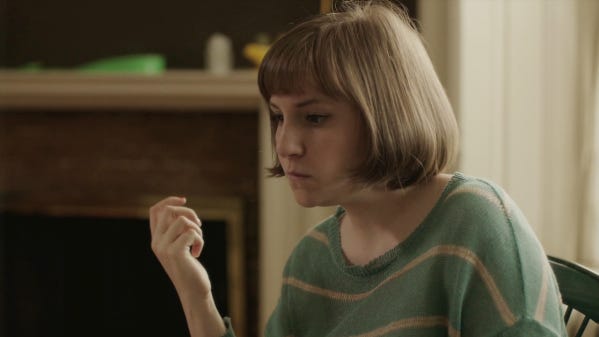
Ok, starting with four of the ten episodes of season four when this is supposed to be about bottle episodes is a bit of a cheat, but I can’t resist. A few years ago, I posted about how Dunham expertly skewered the types of people found at the Iowa Writers’ Workshop,— an acerbic downer, a voice of the people, a privileged white guy who looks up to Kerouac and DFW— she clocked them effortlessly. The self-serving Tumblr doublespeak language in “Triggering” is also pitch perfect.
If you like this episode, you should read1: Show, Don’t Tell (Curtis Sittenfeld), Autobiography of a Face (Lucy Grealy), Truth and Beauty (Ann Patchett), Seduction Theory (Emily Adrian), Make Your Home Among Strangers (Jennine Capó Crucet), Disorientation (Elaine Hsieh Chou)
“Flo”
Episode 309
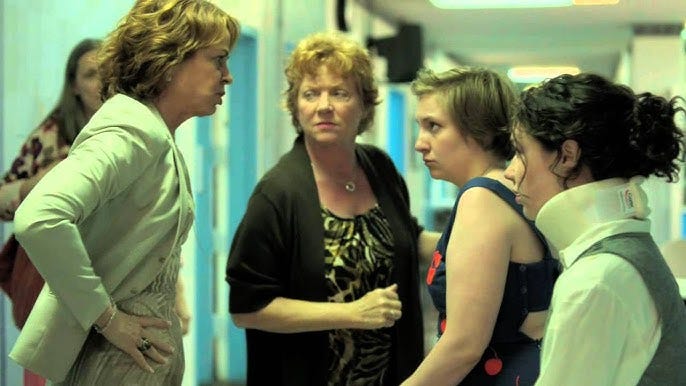
A mini-drama in under thirty minutes, this episode sees Hannah visit her dying grandmother and contend with her mother’s sisters. The texture given to Loreen (Hannah’s mom) is essential: in earlier episodes, we had only ever seen her be the authority figure sternly trying to steer Hannah into a fulfilled adulthood. During this episode, we see Loreen trapped in her ossified family dynamic, transported to childhood, torn between two sisters: the cloying resentment of “the childless one” and the barbed jabs of “the divorced one”. The strokes are broad, but Bruce Eric Kaplan’s writing is sharp and paints a vivid portrait of sisterly disdain. Hannah also beefs with her acerbic cousin (a perfect Sarah Steele), but the relationship between all the women is masterfully done.
If you like this episode, read: Family Lore (Elizabeth Acevedo), The Weird Sisters (Eleanor Brown), Marrying the Ketchups (Jennifer Close), Saints for All Occasions (J Courtney Sullivan), Red at the Bone (Jacqueline Woodson), A Reason to See You Again (Jami Attenberg), Shred Sisters (Betsy Lerner)
“The Return”
Episode 106
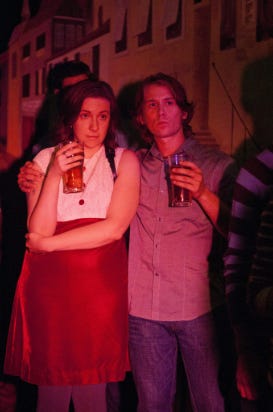
There is something deeply specific about the experience of returning home after you’ve lived somewhere else. You’re both changed and unchanged, everything is both new and familiar, and looking at the people you once knew intimately fills you with both dread and longing. While I’m famously born and raised in New York City (this is a deeply transplant-y episode), Lena Dunham (also a native New Yorker!) captures the essence of being away and being deeply annoying and deeply judgmental: the dichotomy of wanting to be both above the people and of the people, the loneliest place to be.
If you like this episode, read: Goodbye, Vitamin (Rachel Khong), Town & Country (Brian Schaefer), Disappoint Me (Nicola Dinan), Wait (Gabriella Burnham), This Motherless Land (Nikki May), Homebodies (Tembe Denton-Hurst)
“Japan”
Episode 503

Jessa marries a stranger and goes to rehab in an attempt to become a different version of herself. Marnie becomes a singer and torches her life, Hannah works at GQ, at a school, and goes to Iowa. Shosh, frequently described as the character with the best and most sustained arc, goes to Japan. In Japan, she is the most herself: while we understand that in AA parlance, “pulling a geographic” means that wherever you go, there you are, Shosh genuinely seems like a new version of herself in Japan: she’s confident and fun, breezily conversing with her coworkers in Japanese. During the episode, we see the core Girls thesis pop up again when Shosh dresses up as a sexy nurse, but doesn’t become a new person: she’s just Shosh in a sexy nurse costume.
Avoidance is Shoshana’s favorite drug (don’t tell my mom I did crack— don’t even tell me I did crack, realizing Ray lived with her for months at a dinner party): at the end of the episode, she decides to hold on to the fantasy by remaining in Japan, missing her flight to playact New Shosh just a bit longer.
If you like this episode, you should read: Berlin (Bea Setton), What Belongs to You (Garth Greenwell), All This Could Be Different (Sarah Thankam Mathews), Enter Ghost2 (Isabella Hamad)
“American Bitch”
Episode 505
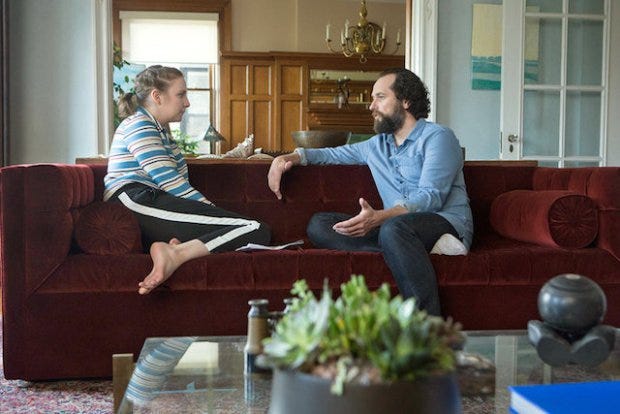
Probably the best and most tightly written episode of Girls, this two-hander sees Hannah face off against a male author (a perfectly slimy Matthew Rhys) accused of sexual assault by a number of young female fans. In question is the issue of power: Chuck Palmer is a very famous, well connected (pictures of him and celebrities, including Obama, adorn his walls) writer using his considerable influence to maneuver very young women into compromising situations.
The episode is masterful: he flatters and flirts with Hannah until her defenses are down, and the episode ends with a leering Rhys using his daughter as a human shield to avoid accountability. I went on at length about Dunham’s Unspeakable Thing and the nature of contradictions in my previous post, so I won’t revisit here, but gender, consent, power, accountability, and cancel culture are all interrogated in under thirty minutes. If you haven’t watched it in a couple of years, I suggest going back and revisiting: it’s brilliant.
If you like this episode, you should read: My Dark Vanessa (Kate Elizabeth Russell), True Story (Kate Reed Petty), Consent (Annabel Lyon), Consent3 (Jill Clement)
“One Man’s Trash”
Episode 205
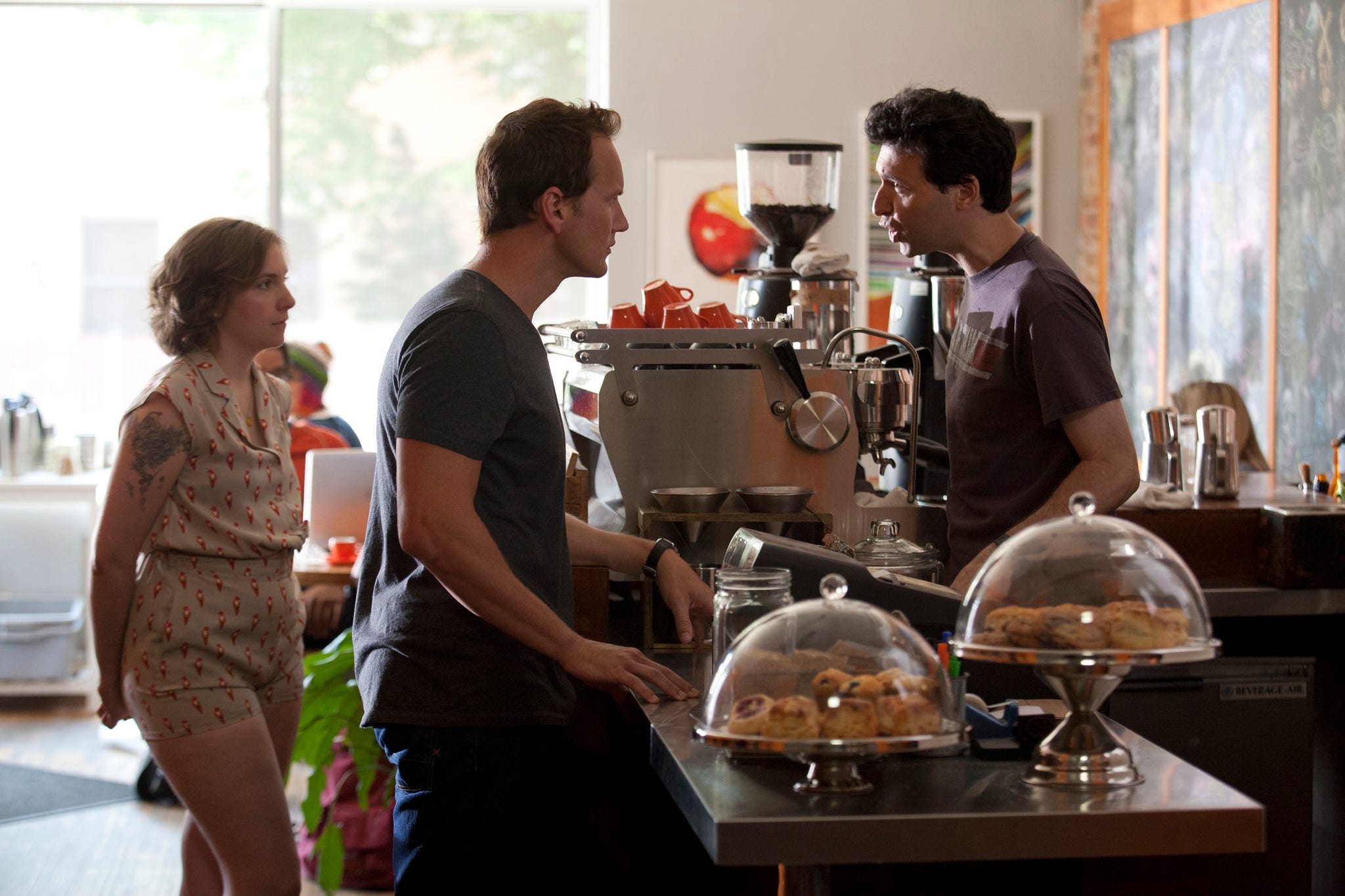
The most controversial episode of Girls, this is the episode that launched a thousand thinkpieces and made Girls even more of a Hot Topic. Another two-hander, Hannah meets handsome doctor Joshua (the dreamy Patrick Wilson) after putting her job’s garbage in his fancy brownstone’s garbage cans (what the hell, sure). They spend two days together, having sex, talking, flirting, and attempting to open up. Attempting is the key word here: Hannah has a core monologue about wanting to be happy that cracks her open as a character, revealing that her lust for horrible experiences is more a manifestation of her desire for fulfillment than a Freudian death drive:
I made a promise, such a long time ago, that I was going to take in experiences, all of them, so that I could tell other people about them and maybe save them. But it gets so tiring, trying to take in all the experiences for everybody, letting anyone say anything to me. Then I came here, and I see you, and you’ve got the fruit in the bowl and the fridge with the stuff. And I realize I’m not different. I want what everyone wants. I want all the things. I just want to be happy.
The fantasy of the perfect life is seductive, but a fantasy nonetheless: Joshua is taciturn, recalcitrant, handsome but empty. The house is shrouded in shadow, he and Hannah rarely occupy the same frame, creating a visual language for the clear distance between them. Mad Men taught us that you can have everything and still be unhappy, and Girls feints at this by giving us Joshua. Would Hannah be happy in a brownstone? The brownstone (and Joshua) is the vessel, the desire dressed up but ultimately and fundamentally simple: Hannah just wants to be happy. Don’t we all?
Books to read if you like this episode: Sweetbitter (Stephanie Danler), Luster (Raven Leilani), Win Me Something (Kyle Lucia Wu), Intimacies (Katie Kitamura), Kitten4 (Stacey Yu, Stacey on here), Memorial (Bryan Washington)
“The Panic in Central Park”
Episode 506

My favorite episode of Girls, widely heralded as a masterpiece and a recent favorite of the Gen Z Girls resurgence. This episode is a Marnie character study: we’ve spent five seasons watching Marnie flop and fail, trying on new identities in order to convince the world she has her shit together. Marnie was a gallerina, a girlfriend, a singer, and a wife, and all of the identities fit her like a shroud. She wants and she wants and she wants and when she does get something, it’s usually so dulled down that it’s worth questioning why she even wanted it in the first place. I get her on a spiritual level. This episode is about surrender, releasing control and letting yourself be taken by the current of someone else’s baggage as a way to temporarily escape your own. As with the episodes above, this episode is about the fantasy: the fantasy that you and your ex (Christopher Abbott, back and brilliant for one ep only) would’ve worked out, the fantasy that you can change, an idyllic reprieve from your string of failures.
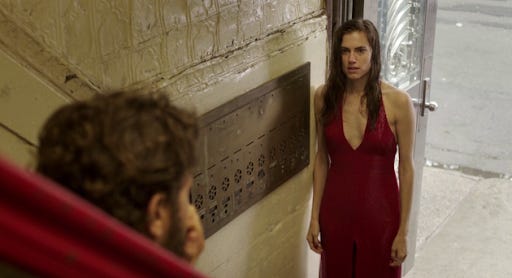
To many, this episode is about reuniting with an ex, but like “Trash” and “Japan”, this episode is about trying on a second skin: Marnie dons a sparkly red dress and runs around Manhattan calling herself Magita Perez. Magita is cool, Magita is game, Magita is down, and most importantly: Magita is not Marnie. I can make myself cry thinking about this episode, and at the very end, after finding Charlie’s needle, she goes home to Desi and tells him she wants a divorce.
“I didn’t want to give up yet another dream”, Marnie says, the first self-aware moment she’s ever had on the show. Marnie’s madman confidence is completely shorn: there is no delusion left. Fantasies can be punctured, fantasies can fade, fantasies end: we see that in “Trash”, “Japan”, and “Panic”. Eventually, you have to come home to yourself.
Books to read if you like this episode: Cult Classic (Sloane Crosley), Bellies (Nicola Dinan), Sirens & Muses (Antonia Angress), Hesper and Willa (Amy Feltman), Splinters (Leslie Jamison)
I’ll be back next week with a proper update!
Sittenfeld, Patchett, and Grealy all went to Iowa. I can always immediately tell when someone went to Iowa based on the first two pages of their books.
Soft recommendation as I haven’t read this yet but fits the theme.
Soft recommendation as I haven’t read this yet, but really want to. Comes highly recommended and is right up my alley.
No posts
Comments
Nothing yet. Say the first thing.
Sign in to join the conversation.